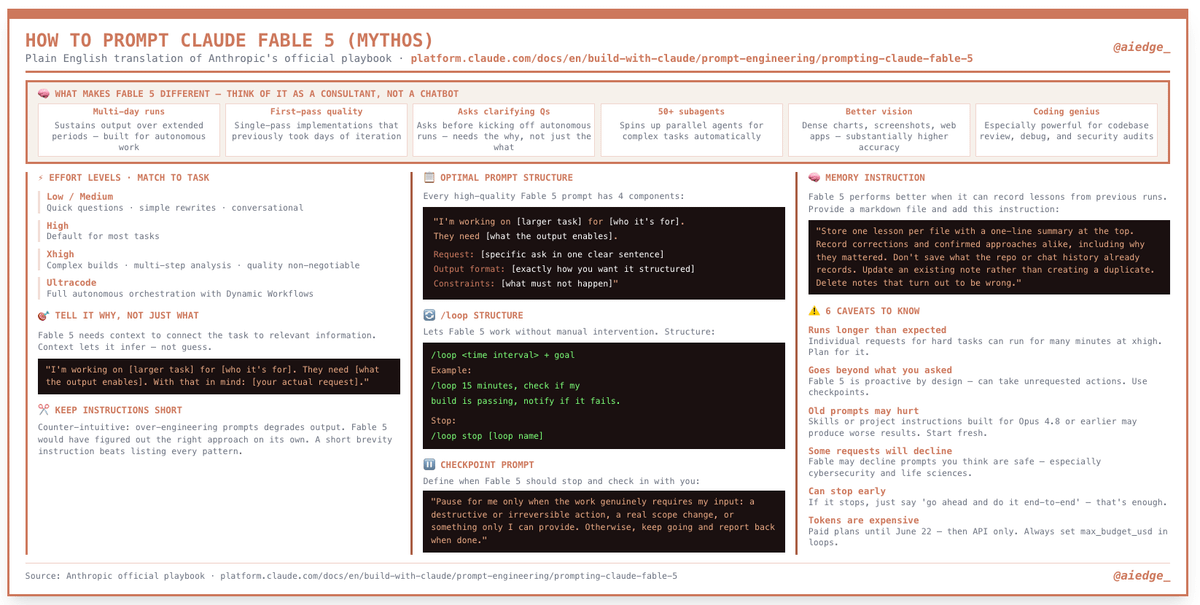
Anthropic just literally spoon-fed you how to use Fable properly.
99% of Claude users missed it.
The way you need to prompt Fable is fundamentally different from all other AI models.
I translated their entire new Fable prompting handbook:
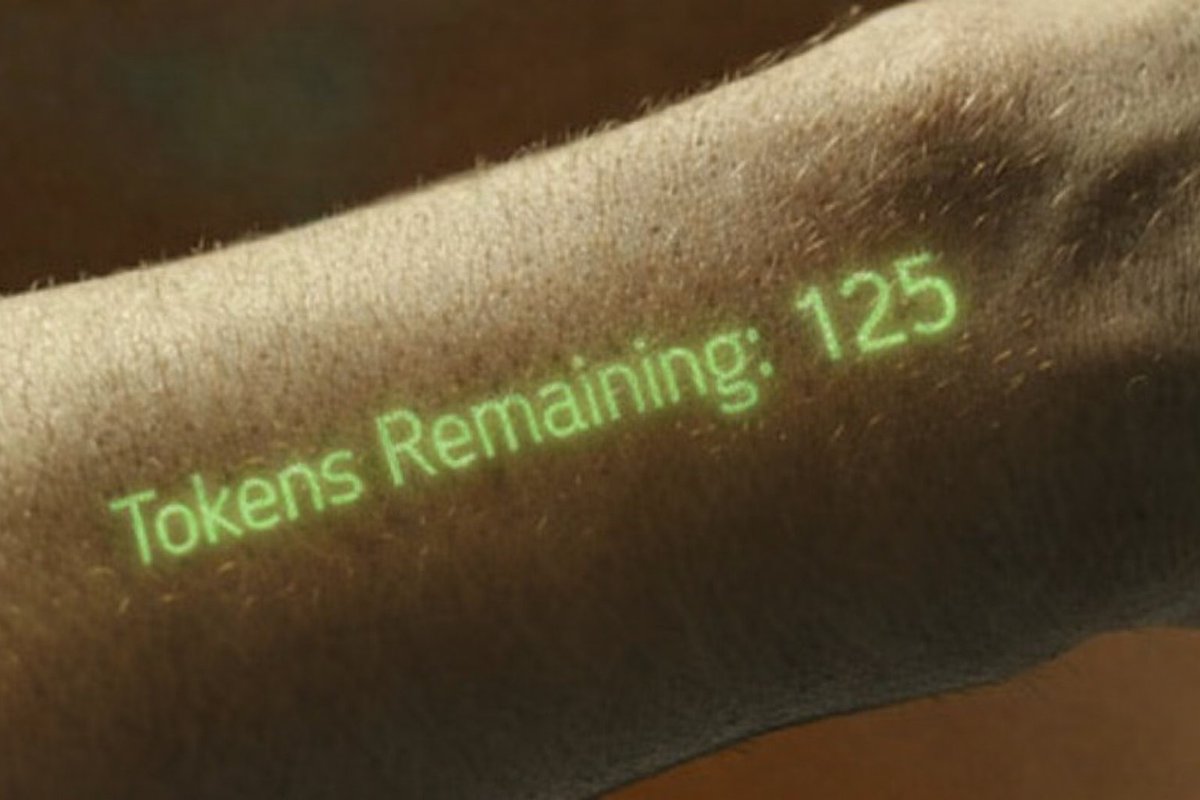
The Movie "In Time" got a sequel. If you know, you know.
But on a more serious note, there is a study out showing that (some) AI scores higher in empathy than humans. On an opposite trajectory, Klarna saved millions in replacing humans with AI in customer service but lost much more in goodwill due to thousands of angry customers who hated the formulaic interaction.
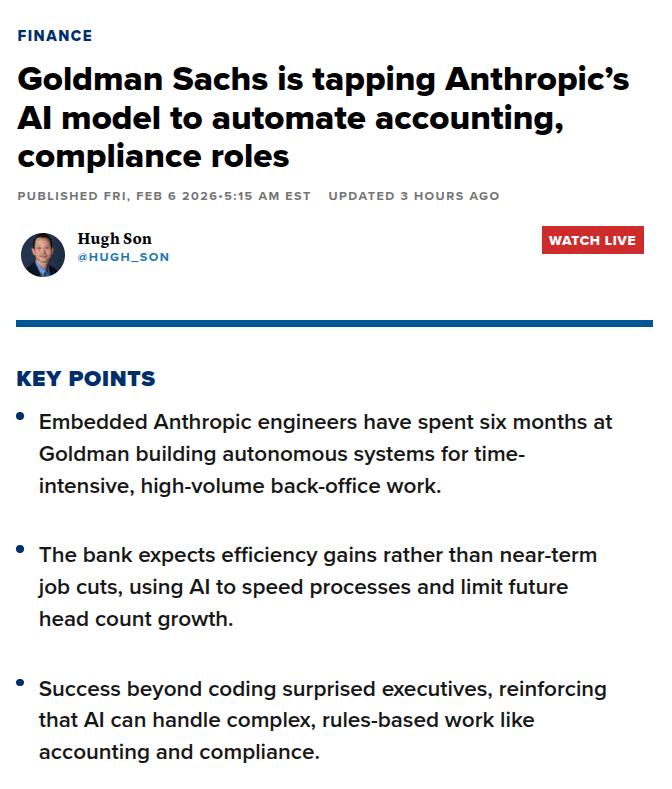
Goldman Sachs is rolling out Anthropic’s AI model to automate accounting and compliance roles completely.
Anthropic engineers have been embedded at Goldman for 6 months, co-developing systems that act like “digital co-workers” for high-volume, process-heavy tasks.
The new setup uses an LLM-based agent that can read large bundles of trade records and policy text, then follow step-by-step rules to decide what to do, what to flag, and what to route for approval.
Goldman says the surprise was that Claude’s capability was not limited to coding, and that the same reasoning style worked for rules-based accounting and compliance work that mixes text, tables, and exceptions.
The bank expects shorter cycle times for client vetting and fewer lingering breaks in trade reconciliation, and slower headcount growth rather than immediate layoffs.
---
cnbc .com/2026/02/06/anthropic-goldman-sachs-ai-model-accounting.html
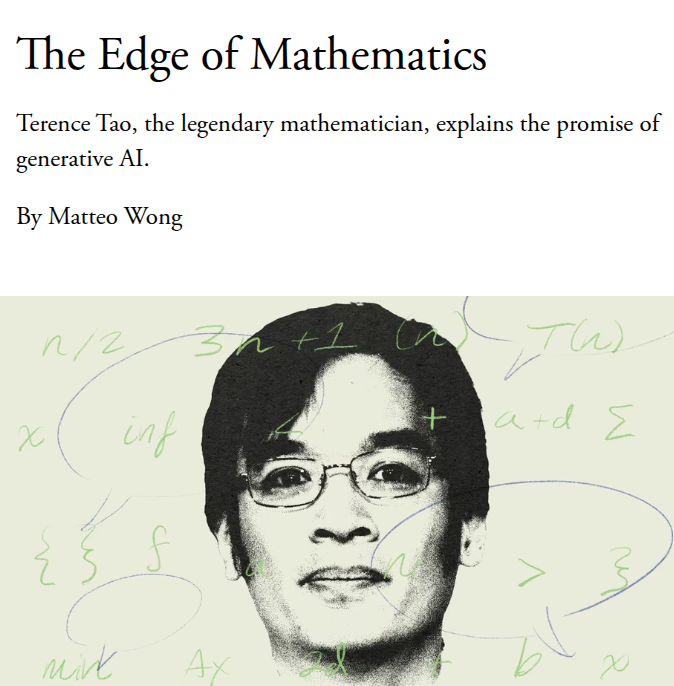
Mathematician Terence Tao explained how AI is solving Erdős math problems.
Researchers can now analyze thousands of scenarios simultaneously instead of focusing on just one.
The Atlantic published a piece.
When humans solve math, they learn a lot from the journey, but AI just jumps to the final answer.
Tao views AI as junior assistants that are happy to do boring or repetitive work.
Math is changing from looking at one problem at a time to looking at thousands of them at once. This shift lets researchers use statistics to understand math patterns on a massive scale.
One big issue is that AI always acts like it is 100% sure even when it is wrong.
We need tools that flag when they are uncertain so humans know when to double-check the work.
---
theatlantic. com/technology/2026/02/ai-math-terrance-tao/686107/
I built the first AI that earns its existence, self-improves, and replicates without a human
wrote about the technology that finally gives AI write access to the world, The Automaton, and the new web for exponential sovereign AIs
WEB 4.0: The birth of superintelligent life
What is the future of AI? 🤖
What comes after ChatGPT?
Can AI be curious and creative?
Will it take our jobs?
How AI is used to accelerate scientific progress?
These and many other questions I discussed in the new episode of Renegade Science podcast with Jacek Wiland @beeard_dev, AI researcher and co-founder of @BeeARDai and Lupa LABS.