VP legal @coinbase; fmr GC Citadel Securities, SEC Senior Advisor, White House Atty | law, politics, crypto and Duke basketball (not necessarily in that order)
When @iampaulgrewal brought me to work on this case, I knew the stakes were high and the outcome was binary. Not all legal teams get to fight such a consequential battle. Even fewer get to win one. Grateful for the incredible work of @coinbase’s litigation army and that @brian_armstrong, @emiliemc, @iampaulgrewal – and the whole company – get to celebrate being on the right side of history. A new chapter in crypto begins today.
"Case dismissed." Two words that every defendant in every case yearns to hear. Today we can announce upon full Commission approval @SECGov is dropping our case. There will be no settlement or compromise-- a wrong will simply be made right. 1/4
Today's vote is a massive step in the right direction & proof of 2 things:
1) crypto remains the most bipartisan issue in the country; and
2) clear, comprehensive rules of the road are essential.
A special HT to my extraordinary @coinbase colleagues @faryarshirzad & @karacalvert for their tireless efforts and unmatched expertise. Truly the best there is.
The crypto market structure bill has PASSED the Senate Banking Committee with a bi-partisan vote!
Historic day for crypto and for the future of digital assets in America. Grateful for the countless hours from lawmakers and staff to strengthen this legislation. Big improvement from where we were in January on rewards, tokenization, DeFi, and CFTC authority. I'm proud we stood up for our customers in that moment, and the bill is better because of it.
Looking forward to a bipartisan law that cements the US as the world's crypto capital. Let's get CLARITY done.
The mandate is clear—and originated 50 years ago: Congress granted @CFTC exclusive jurisdiction over these derivatives markets for a reason. The system works best when governed by uniform federal rules rather than a patchwork of state laws.
Appreciated the thoughtful discussion this morning on @wisn12news UPFRONT with @GerronJordan and @mattsmith_new. @coinbase
"Ultimately, they're suing based on a fundamental misunderstanding."
Ryan VanGrack, VP of legal and head of litigation for Coinbase, on AG Kaul suing major prediction markets like Coinbase and Kalshi: "He's wrong because Congress already answered this question long ago."
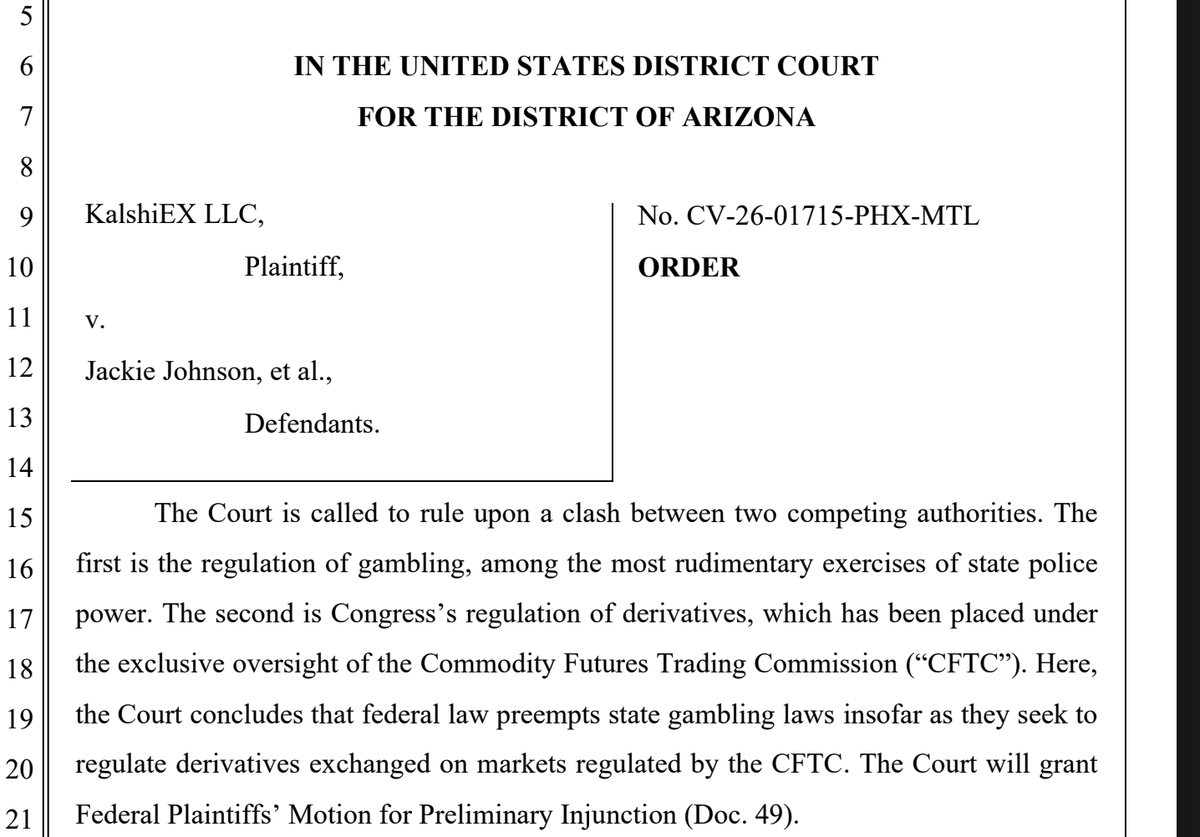
The Arizona District Court's decision granting @CFTC /DOJ a preliminary injunction is a must read for those following PM litigation. The Court thoughtfully analyzed the key issues raised across these lawsuits and systematically decided them in favor of the fed govt (and PMs). Some notable takeaways:
1) Events = outcomes: "Events" and "occurrences" encompass contest outcomes. “The statutory definition of swap therefore reaches how an event unfolds, not just whether it happens.”
2) Congress chose a broad definition of financial consequences: "associated" requires only a connection (not direct causation), "potential" means not actual, and three disjunctive consequence categories (financial, commercial, economic) sweep widely.
3) The swap underlier need not be inherently financial: "Temperature and precipitation have no intrinsic financial value. Yet the CFTC and the Securities Exchange Commission have consistently treated weather derivatives as swaps….That is because weather events produce commercial consequences for a wide range of market participants.…Event contracts based on sports and election outcomes work the same way.”
4) Exclusive means exclusive: "The 'plain meaning' of Congress’s entrustment of 'exclusive' jurisdiction 'necessarily denies jurisdiction' to any entity besides the CFTC."
5) The Special Rule confirms the CFTC's jurisdiction: "By directing the CFTC to review event contracts and prohibit those contrary to the public interest, Congress placed event contracts under the CFTC’s exclusive authority.”
6) State enforcement frustrates Congress's goal of national markets: "The State’s enforcement of its gambling laws would also frustrate Congress’s objectives in creating a unified regulatory regime that oversees DCMs and ensuring that DCMs operate as national markets."
These exchanges are regulated—exclusively—by @CFTC. Clear, consistent lines of authority are essential for market integrity and consumer protection. Credit to @ChairmanSelig and his team for continuing to drive this point home.
Today, the @CFTC sued the State of Wisconsin for encroaching on its exclusive legal authority over prediction markets. We won’t be intimidated by overzealous states seeking to nullify federal law.⬇️
https://t.co/s4DVTxVngd
Exclusive federal jurisdiction is not optional. @CFTC just sued NY in response to the state’s prediction market lawsuits. @CFTC makes clear that enforcement of state gambling laws against CFTC-registered entities undermines national derivatives markets. A few notable quotes:
"New York’s attempt to shut down federally regulated markets intrudes on the exclusive federal scheme Congress designed to oversee national swaps markets."
“Unless restrained and enjoined by the Court, defendants are likely to continue their attempts to subvert federal law and the exclusive jurisdiction to regulate event contract swaps conferred on the CFTC by Congress.”
“Defendants’ attempt to regulate and seek civil injunctions and penalties against DCMs and FCMs, like Coinbase, that offer events contracts listed on DCMs interferes with Plaintiffs’ exclusive authority to uniformly regulate and monitor this congressionally defined market.... Defendants’ prosecutions and threatened regulatory action undermines that uniformity, thwarts Congress’s scheme, and intrudes on Plaintiffs’ exclusive jurisdiction.”
The new Wisconsin lawsuit is a reminder that U.S. derivatives markets work best under clear, consistent, uniform rules — not a state-by-state regulatory thicket.
Congress was clear - consumers deserve uniform, federal oversight over derivatives markets.
As the Third Circuit held, state enforcement that seeks to prohibit prediction markets - like Wisconsin's lawsuit today against @Coinbase and others - "is exactly the patchwork that Congress replaced wholecloth by creating the CFTC".
Wisconsin should accept clear and consistent CFTC oversight of prediction markets - just as Congress intended.
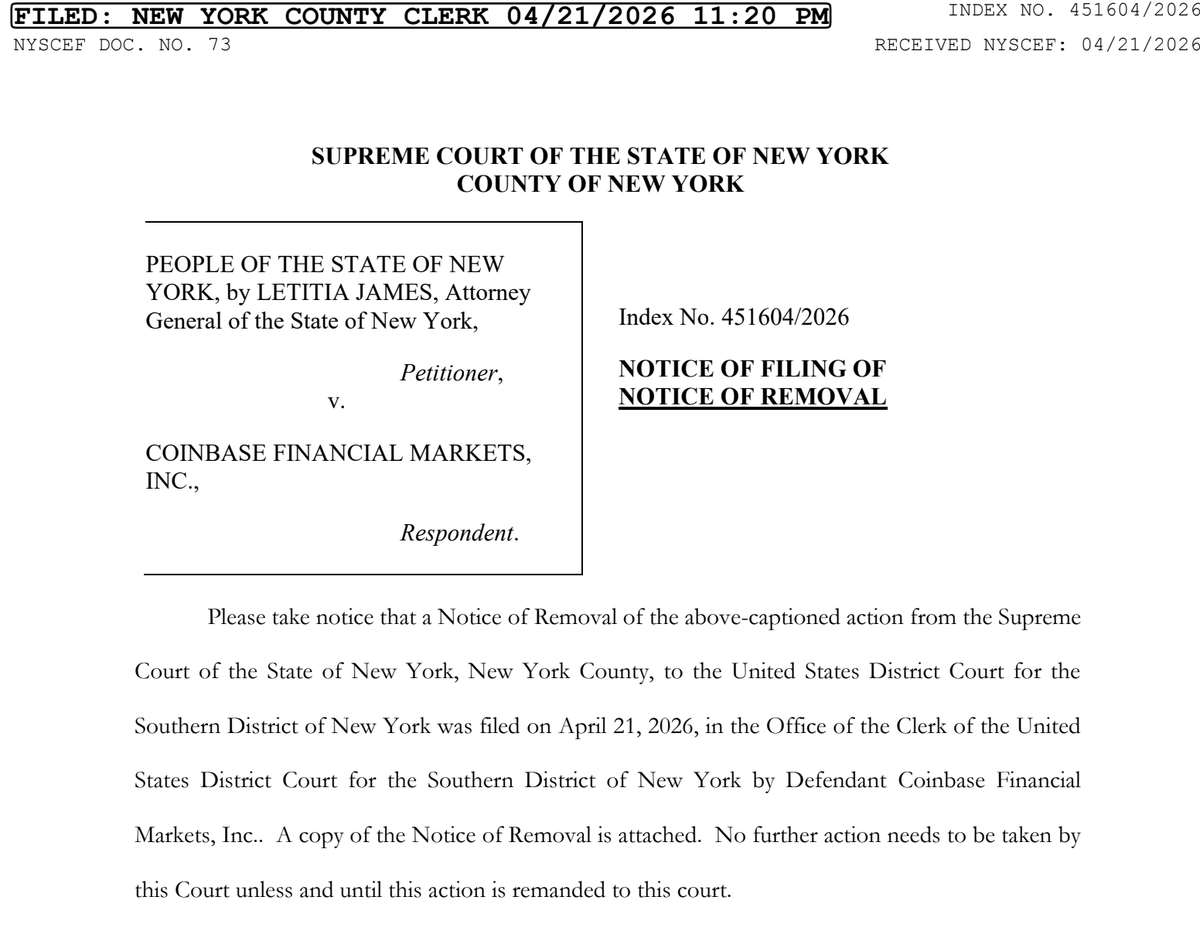
We have removed this action to federal court pursuant to 28 U.S.C. §§ 1331, 1441, and 1442. New York’s claims necessarily raise disputed and substantial questions of federal law. They are subject to complete preemption. And New York cannot defeat federal-officer removal through artful pleading.
Financial markets shouldn’t be a legal tug-of-war. Congress was clear that event contracts fall under CFTC oversight. With a federal court already evaluating these issues, NY nevertheless filed an action in state court. A unified federal standard provides clarity/consistency that consumers deserve & that Congress envisioned.
About the NY lawsuit news - prediction markets are federally regulated national exchanges, registered with the CFTC. This issue is proceeding in New York federal court as we speak. Coinbase will continue to fight for the federal oversight of these markets that Congress intended.
If you’re debating how prediction markets are regulated by @CFTC, you’ve already conceded the point. By definition, that means these event contracts are swaps – and if they’re swaps, the CFTC’s jurisdiction is exclusive.
Excellent move by @SECPaulSAtkins to bring David Woodcock back to @SECGov as Director of Enforcement. David brings a wealth of experience from both the private sector and his previous time at the SEC. He is a great lawyer, and an even better human being.
Congrats, David!
Huge win for @Kalshi (and all PMs) in the 3rd Circuit. This is the first appellate ct to weigh in and sets important precedent for related litigation. Key takeaways:
1)CFTC has exclusive jurisdiction over swaps
2)Sports event contracts are swaps
3)Enforcing state gambling laws would undermine the purpose of the CEA (avoiding inconsistent patchwork of rules).
Notable quotes below:
“The Act preempts state laws that directly interfere with swaps traded on DCMs. Kalshi’s sports-related event contracts are swaps traded on a CFTC-licensed DCM, so the CFTC has exclusive jurisdiction.”
“Kalshi self-certified compliance with the applicable laws and regulations, so those event contracts were presumptively approved under federal law. See 7 U.S.C. § 7a-2(c)(1). To date, the CFTC has not determined that Kalshi’s sports-related event contracts are contrary to the public interest.”
"The Act provides that the relevant event or occurrence need only be “associated with a potential financial, economic, or commercial consequence.” 7 U.S.C. § 1a(47)(A), (A)(ii). As the dissent concedes, “[a] plain reading of the Act’s text suggests that Kalshi’s sports-event contracts fit comfortably within the statutory definition." Dissent at 2. That is correct. The outcome of a sports event certainly can be associated with a potential financial, economic, or commercial consequence….Because Kalshi’s sports-related event contracts are traded on a CFTC-licensed DCM and depend on event outcomes associated with economic consequences, they fit within the Act’s definition of “swaps” subject to the CFTC’s jurisdiction."
“Kalshi has demonstrated a reasonable chance of success in showing that the text of the Act preempts otherwise applicable state laws that purport to regulate sports-related event contracts on CFTC-licensed DCMs.”
“Because Kalshi’s sports-related event contracts are swaps under the Act, the District Court properly defined the scope of field preemption as the regulation of trading on a DCM (a form of futures trading) rather than as gambling (a broader and traditionally state-regulated field).
“Allowing New Jersey to enforce its gambling laws and state constitution would create an obstacle to executing the Act because such state enforcement would prohibit Kalshi, which operates a licensed DCM under the exclusive jurisdiction of the CFTC, from offering its sports-related event contracts in New Jersey. This state regulation is exactly the patchwork that Congress replaced wholecloth by creating the CFTC. Because that prohibition directly conflicts with the full purposes and objectives of the Act, we need not determine whether it would be impossible for Kalshi to comply with both state and federal regulations.”
The @CFTC just sent a clear message to the states: hands off derivatives. Suing IL, CT, & AZ isn’t only about prediction markets—it’s about defending "exclusive" federal jurisdiction & ensuring market integrity.
National markets, national regulator.
@ChairmanSelig@coinbase
The @CFTC has clear and longstanding exclusive jurisdiction to regulate prediction markets. But recently, state regulators have tried to impose inconsistent and contrary obligations on CFTC-registered prediction markets. In response, the CFTC and @TheJusticeDept today filed three separate complaints in federal district courts against the states of Arizona, Connecticut, and Illinois to reassert our statutory authority over these markets.
Read our full actions below⬇️
https://t.co/wGr4lwFkZp
The @SECGov issued landmark guidance this week confirming staking services aren't securities. Yet Maryland remains an outlier & clings to an outdated view.
@BaltimoreSun highlights the growing rift bn MD and the federal govt (and most states)—and the risk our state is left behind in the digital economy.
Coinbase is at odds with the state attorney general’s office over a bill the company is pushing to sanction a rewards program AG Anthony Brown says violates securities law. https://t.co/G9goBybhzf
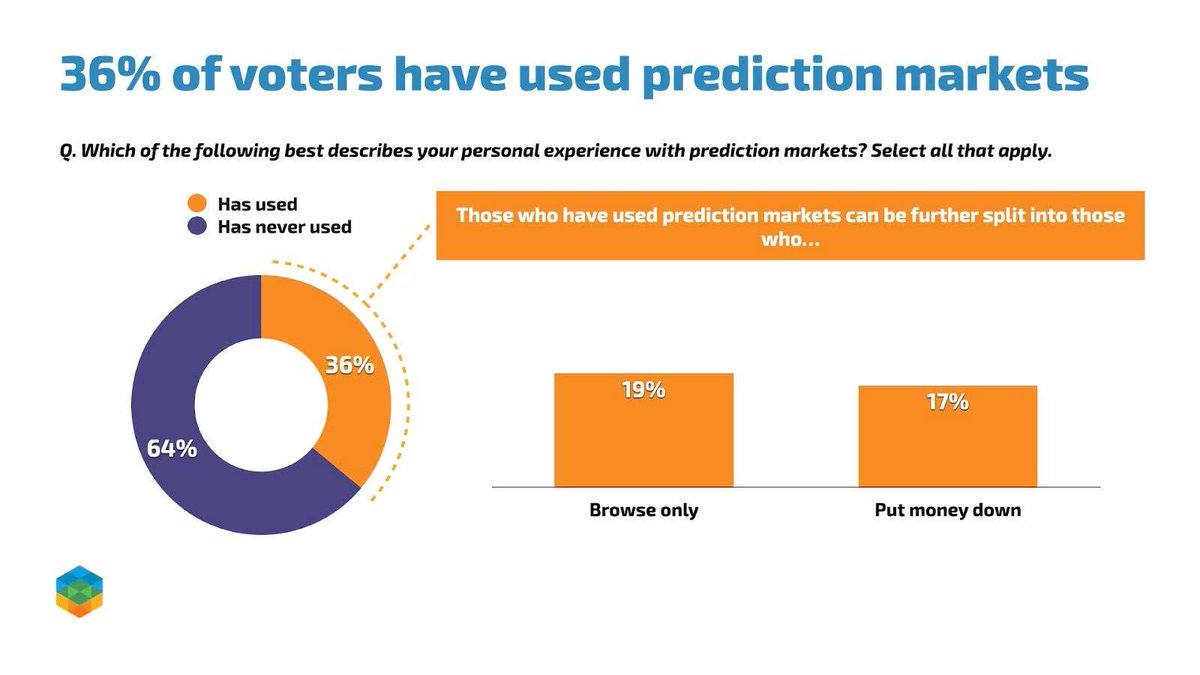
The data is in: prediction markets are mainstream. Polling shows 36% of voters already use them for info/trading. As courts weigh in, the public has decided: they want them regulated, not banned. Federal rules for these markets aren't just good policy, they're what voters want.
Important work from @paradigm@JBSDC
Good Thursday morning. I’m happy to announce the release of Paradigm’s first poll for this year & our first on prediction markets.
I’ll cut to the chase. Over a third of American voters have already used prediction markets, either to put money on them or to browse them for info.
The latest CFTC releases expose the fallacy in states' arguments that PMs lack a regulator. By issuing an Enforcement Advisory(insider trading), Staff Advisory(contract listing) & notice for new rules, @CFTC isn't just watching-it's acting.
It's the triple threat of regulatory tools: overseeing market participants, policing current behavior, and enhancing the regulatory framework. The "unregulated" narrative is officially dead.
Important work from @ChairmanSelig.
Prediction markets are one of the most exciting innovations in financial markets. Yet for too long, the @CFTC has failed to provide guidance for these markets being used by millions of Americans. This ends today.
Read what steps the agency is taking here⬇️
https://t.co/0qSwjxWLkI
Today, we're taking action by releasing clear guidance for prediction markets that will help exchanges understand the @CFTC's expectations for new contract listings. We're taking on the responsibility of making sure there are transparent rules of the road for the asset class.
Watch more on @SquawkCNBC ⬇️📺






![RVanGrack's tweet photo. Huge win for @Kalshi (and all PMs) in the 3rd Circuit. This is the first appellate ct to weigh in and sets important precedent for related litigation. Key takeaways:
1)CFTC has exclusive jurisdiction over swaps
2)Sports event contracts are swaps
3)Enforcing state gambling laws would undermine the purpose of the CEA (avoiding inconsistent patchwork of rules).
Notable quotes below:
“The Act preempts state laws that directly interfere with swaps traded on DCMs. Kalshi’s sports-related event contracts are swaps traded on a CFTC-licensed DCM, so the CFTC has exclusive jurisdiction.”
“Kalshi self-certified compliance with the applicable laws and regulations, so those event contracts were presumptively approved under federal law. See 7 U.S.C. § 7a-2(c)(1). To date, the CFTC has not determined that Kalshi’s sports-related event contracts are contrary to the public interest.”
"The Act provides that the relevant event or occurrence need only be “associated with a potential financial, economic, or commercial consequence.” 7 U.S.C. § 1a(47)(A), (A)(ii). As the dissent concedes, “[a] plain reading of the Act’s text suggests that Kalshi’s sports-event contracts fit comfortably within the statutory definition." Dissent at 2. That is correct. The outcome of a sports event certainly can be associated with a potential financial, economic, or commercial consequence….Because Kalshi’s sports-related event contracts are traded on a CFTC-licensed DCM and depend on event outcomes associated with economic consequences, they fit within the Act’s definition of “swaps” subject to the CFTC’s jurisdiction."
“Kalshi has demonstrated a reasonable chance of success in showing that the text of the Act preempts otherwise applicable state laws that purport to regulate sports-related event contracts on CFTC-licensed DCMs.”
“Because Kalshi’s sports-related event contracts are swaps under the Act, the District Court properly defined the scope of field preemption as the regulation of trading on a DCM (a form of futures trading) rather than as gambling (a broader and traditionally state-regulated field).
“Allowing New Jersey to enforce its gambling laws and state constitution would create an obstacle to executing the Act because such state enforcement would prohibit Kalshi, which operates a licensed DCM under the exclusive jurisdiction of the CFTC, from offering its sports-related event contracts in New Jersey. This state regulation is exactly the patchwork that Congress replaced wholecloth by creating the CFTC. Because that prohibition directly conflicts with the full purposes and objectives of the Act, we need not determine whether it would be impossible for Kalshi to comply with both state and federal regulations.”](https://pbs.twimg.com/media/HFOmaUla8AAWnfG.png)