RWA tokenization just hit $33.5B — tripled in a year. But 56% of large tokenized assets show zero weekly transfers. Because most of it isn't tied to a real cash flow.
Chinese factory owners already understand what's missing — they just don't call it Web3. 👇
#RWA#Web3#RWABS
Securitize's October 8 launch runs through a registered broker-dealer and delivers UCC Article 8 securities entitlements rather than the shares. A licence stack defines what the holder legally owns; for Asian distribution the decisive layer is the local licence, not the offshore stack.
@tokenterminal Lloyds settled $750,000 in USDC with Visa from its own Canton node while Visa settled on a separate public chain, in under an hour on a weekend. Asian banks care less about chain rankings than whether private node and public ledger share one legal record.
Singapore's stablecoin consultation closes October 16 and proposes barring issuers from paying interest on regulated coins. That pushes the yield leg into tokenized T-bills, so bank-issued funds become what Singapore corporate treasuries scrutinise first, once one is recognised locally.
录
Distributed value is nearing $40B, yet DTC's SEC-cleared service will issue digital representations carrying the same rights as the underlying: a represented model at the core of US markets. Asian institutions will ask which record the regulator treats as legal, not which bucket grows.
@tokenterminal That offshore concentration is exactly what China's February 6 notice refuses: the CSRC filing for a token must cover the asset itself, not just its wrapper. For a Chinese industrial issuer, domicile is a compliance decision before it is a tax one.
@Securitize Securitize Stocks are entitlements under UCC Article 8, so $15.6B of tokenized-equity volume still settles on one transfer agent's book. That book, not the chain, is what Hong Kong and Malaysia moved October 2 to link through their central depositories.
@CantonNetwork@KaikoData@CantonFdn Chronicle found 70.8% of the 20 largest tokenized assets fail at least one of five transparency checks. A shared price is half the problem; the other half is one legal record, which Korea pins to a central depository plus two account managers.
$46.2 billion of tokenized assets sit across 36 chains, per https://t.co/PF82ia0taN, which is the fragmentation the IMF flagged. For a Chinese operator, the entry ticket is not another chain; it is an asset whose cash flow a regulator can read and a ledger a depository can keep. Not financial advice.
$65B tokenized, yet 80% of stock trades are under one share. The revolution is retail-sized, and the IMF just said so.
The IMF's new Global Financial Stability Report put a number on tokenization the marketing never does. Against roughly $300 trillion in global capital markets, tokenized assets total about $65 billion. Tokenized repo trades $300–350 billion a day; the US repo market does around $13 trillion. More than half of tokenized-equity trading happens outside regular market hours, and about 80% of those trades are for less than a single share.
So the honest picture is a small, fragmented, mostly retail market, not the institutional takeover the pitch decks promise. The IMF is not dismissing it. It is saying the ceiling is not technological.
The report names four constraints that decide whether tokenization scales: legal certainty, regulatory clarity, interoperability, and secure settlement. Every one is a policy question, not a code question. It adds a settlement principle most crypto builders skip: securities should settle in central bank money, because stablecoin settlement layers on contagion and concentration risk.
Now read that list and look at who is actually answering it.
Korea published draft rules, open for comment until November 11 and in force February 4, 2027, that require every tokenized-securities ledger to be kept by at least two account managers plus the central depository. China's February 6 notice makes the CSRC filing for an offshore token cover the asset itself. Hong Kong and Malaysia agreed on October 2 to study a depository link between CMU and RENTAS, with a joint workstream on compliant cross-border stablecoins.
The US is moving too, but through a five-year exemption the SEC issued on September 17, a staff-built, time-limited path, while the CLARITY Act stalls in the Senate. Fast, but provisional.
For a Chinese industrial company weighing whether to put a real asset onchain for overseas investors, this is the whole decision. The chain is the easy part. The question is whose rulebook your asset lives under, and whether that rulebook is a law or a waiver. Asia is writing laws. That is slower, and it is the part that lasts.
Not financial advice.
4 constraints, per the IMF, decide whether tokenization scales: legal certainty, regulatory clarity, interoperability, and settlement in central bank money. None is a coding problem. The jurisdictions that answer them first in law will outlast the chains that ship features fastest. Not financial advice.
$46.2 billion of tokenized assets sit across 36 chains, per https://t.co/PF82ia0taN. Two Asian regulators wrote the proof requirement into their rules: Korea's ledgers must be kept by at least two account managers plus the depository, and China's CSRC filing for offshore tokens covers the asset itself. For a Chinese operator, machine-readable cash flow is the entry ticket. Not financial advice.
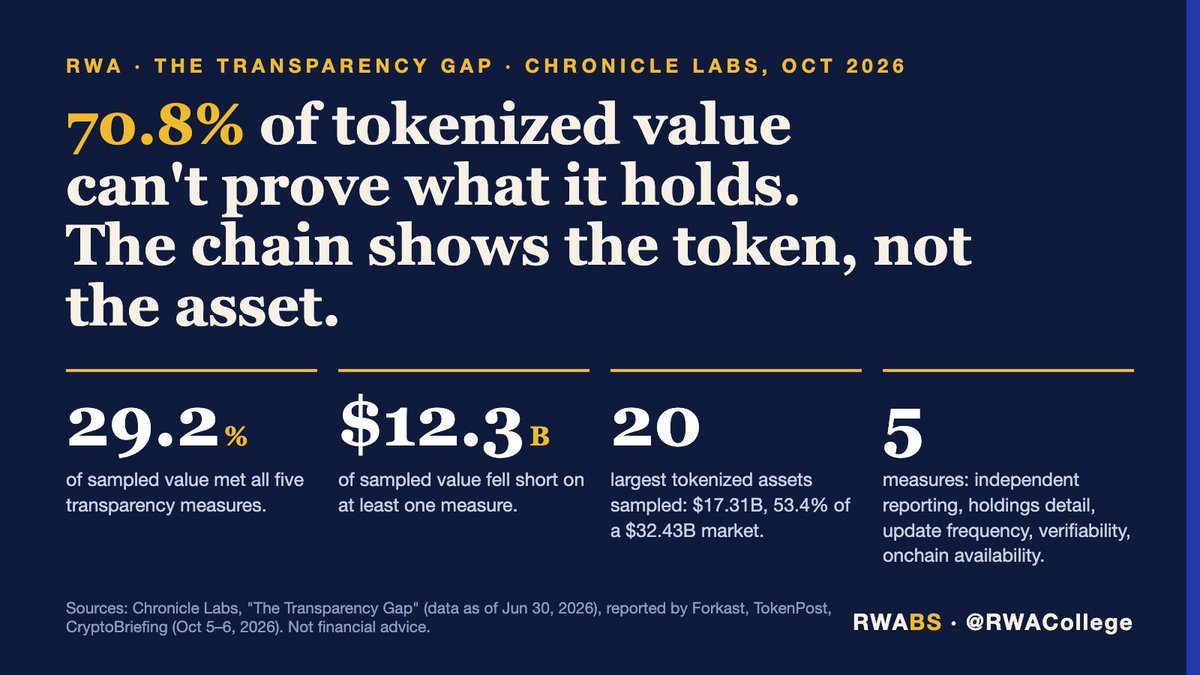
70.8% of tokenized value can't prove what it holds. The chain shows the token, not the asset.
Chronicle Labs sampled the 20 largest tokenized assets, $17.31 billion, 53.4% of a $32.43 billion market as of June 30. It scored each on five measures: independent reporting, detail on holdings, update frequency, verifiability, and whether the data lives onchain. Only 29.2% of that value passed all five. The other $12.3 billion fell short on at least one.
Here is the consensus tokenization sells: put an asset onchain and it becomes transparent. Here is what the ledger actually records: who holds the token and when it moved. What the token holds is still a PDF from the issuer, updated when the issuer chooses, and rarely checked by anyone the holder can audit.
So tokenization made the claim transparent, not the asset. Those are different things, and the gap is where the next losses will come from.
Three parties already price this. S&P Global Ratings' new vault assessment grades portfolio quality, liquidity and curator risk, and cannot score a vault whose collateral it cannot read. Korea's draft rules require every tokenized-securities ledger to be kept by at least two account managers plus the central depository. China's February 6 notice makes the CSRC filing for offshore tokens cover the asset itself.
Now the uncomfortable part for Wall Street. A fund token comes with a trustee's quarterly file. About 9,000 EV chargers behind Longshine's 2024 Hong Kong deal report their sales from the device. On update frequency and verifiability, the Chinese charger can beat the Manhattan fund token. Verifiability follows the data, not the brand.
Not financial advice.
5 measures decide whether a token can prove its backing: independent reporting, holdings detail, update frequency, verifiability, onchain availability. S&P Global Ratings' vault assessment, launched October 4, grades portfolio quality, liquidity and curator risk with a (v) suffix to say it is not a credit rating. The graders arrived before most issuers did. Not financial advice.
@CantonNetwork@BSCNews Korea's regulator just answered the same design question in law: under the draft rules out for comment until November 11, every tokenized-securities ledger is shared by at least two account managers plus the central depository. Asia is specifying who validates, not which chain.
@SPGlobalRatings Deposits in these vaults are near $10 billion, up from about $1.5 billion two years ago, and the scope includes vaults lending against tokenized real-world collateral. For Asian issuers taking assets offshore, an outside party now grades where their tokens get pledged.
Weekend demand is partly Asian daytime demand: Kaiko found 71% of Uniswap's tokenized-stock volume in September traded outside US market hours, and Chainalysis puts Korea's retail-led crypto economy at $449.1 billion, up 12.3%. Issuers serving that clock need a clear answer on legal title.
@WuBlockchain Two lines in the report beat the ranking: wallets sending stablecoins peer-to-peer in China grew 43x from Q1 2024 to Q2 2026, and institutional platforms took 16% of Hong Kong's inflows. Mainland demand is already onchain; Hong Kong is where it meets a licence.
@centrifuge@token2049 Both questions got a referee on October 4: S&P Global Ratings launched its Vault Risk Assessment, grading onchain lending vaults on portfolio quality, liquidity and curator risk, with a (v) suffix to mark it is not a credit rating. Allocators now get graded alongside assets.
@TheBlockCo Add the October 4 filing to the primer: OKXICE, the ICE and OKX venture, asked the SEC to run 24/7 trading in 63 US stocks under September's five-year exemption. Round-the-clock means Asia's working day, where the first question is who holds legal title.
@CantonNetwork@GoldisinMyVienz Shinhan validates a global ledger while its home regulator writes who may keep one: Korea's draft rules, open for comment until November 11, require issuer account managers to hold KRW 4 billion in equity and IT and control staff. In Asia, validation comes licensed.