The Hollow Men
American capitalism is rotting from the head down. We have replaced the "Owner-Operator"—the risk-taker-with a new, parasitic class of corporate bureaucrat: The Risk-Free Insider.
By "Insider," I am not referring to a specific title. I am referring to the entire administrative state that has captured the modern corporation. This includes the Directors who exist solely to collect fees, the Executives who exist solely to collect bonuses, and the Managers who exist solely to hire consultants.
These are the hollow men of the boardroom. They are masters of PowerPoint. They wear the right suits. They say the right buzzwords about "governance" and "ESG." But they are mercenaries fighting a war with someone else’s ammunition.
In a functioning economy, authority is tied to liability. If you make a bad decision, you lose your own money. That fear of loss is the only thing that keeps a business honest. It forces you to cut waste, obsess over the customer, and stay late to fix what is broken.
Today, we have severed that link.
We have rigged the game so that heads, the Insider wins; tails, the shareholder loses.
If the stock goes up, the Insider collects a massive performance bonus. If the stock crashes due to their own incompetence, they are fired with a "Golden Parachute" worth tens of millions. They are gambling with the house’s money, and they never leave the table poorer than they arrived.
This looting starts in the boardroom.
We have normalized a "Country Club" culture where directors are selected based on social profiling rather than their ability to build a business. The modern board member is often a professional tourist—paid an average of $350,000 a year.
Let’s be brutally honest about what that number represents. The average director is paid nearly five times the GDP per capita of the United States. They earn more for attending four quarterly lunches than the vast majority of Americans earn in five years of hard labor.
And for what?
Most of these directors are "over-boarded," sitting on three or four boards simultaneously. They treat directorships as a gig economy for the elite. They fly in, rubber-stamp a compensation package they didn't read, and fly out. They collect checks from companies they do not understand, do not use, and certainly do not love.
They are not there to ask hard questions. They are there to be collegial. They are there to protect the other Insiders.
And what happens when these boards hire executives who also have no personal capital at risk?
We get the Delegation Economy.
When a Risk-Free Insider faces a crisis—bloated expenses, a broken supply chain, or a stale product—they do not roll up their sleeves. They hire a consultant. They pay a strategy firm millions of shareholder dollars to produce a 100-page deck telling them what they already know.
This is not management. It is intellectual money laundering.
They use shareholder capital to buy an insurance policy for their own careers. If the plan fails, they can blame the consultants. They delegate the work because they are terrified of the responsibility. They would rather preside over a slow, comfortable decline than risk a bold mistake.
While American Insiders are busy optimizing their severance packages, our global competitors are optimizing their products. They are not slowed down by bureaucracy. They are not waiting for a slide deck. They are outworking us.
If we continue to fill our C-suites with administrators instead of operators, we will lose our edge. We will see iconic American franchises hollowed out by fees, managed for the benefit of the Insiders, while the true owners—the shareholders—are left holding the bag.
The time for polite governance is over.
If we want to save the American economy from mediocrity, we must demand a return to the "Owner’s Mentality." We need leaders who treat shareholder capital with the same reverence they treat their own savings. The era of the Risk-Free Insider must end.
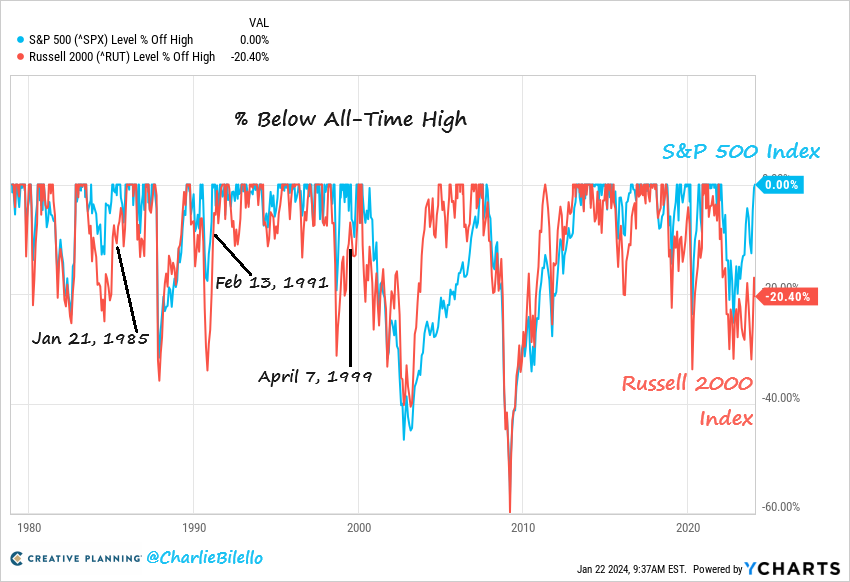
S&P 500 is at an all-time high with the Russell 2000 in a 20% drawdown. In the past has this divergence been bullish or bearish for equity markets? The answer will surprise you...
Video Discussion: https://t.co/wRurtB6YsT
The SEC narrowly passes new rules that Wall Street and Hester Pierce fought against.
"..The Securities and Exchange Commission will now require dozens of firms, including high-speed traders and hedge funds, to face new capital requirements, register their activities and report more information on their transactions. The changes resulted from the SEC’s 3-2 vote to broaden its definition of what it considers to be a securities “dealer.”
It couldn’t immediately be determined how far-reaching the final rules would be after nearly two years of battling between the regulator and the trading and investment industries. Some final tweaks reduced the reach of the proposed plans, potentially easing the worst fears that traders would pull back from important markets such as Treasurys. Industry groups and watchers said they were still studying the final rule on 6 February.."
SEC increases oversight for hedge funds, high-speed traders https://t.co/eTsBmEhQuE via @FinancialNews@HAMShortkiller@WilliamPFarran1@faulkingtruth@BasileEsq $MMTLP $FNGR $GTII $NWBO $ENZC
The S&P 500 closed at an all-time high last Friday while the Russell 2000 Small Cap Index was still in a 20.4% drawdown. That's the largest Russell 2000 drawdown we've ever seen with the S&P 500 at an all-time high.
What happened following the 3 previous largest Russell 2000 drawdowns when the S&P 500 was at a record high? Both indices would rally higher over the next year with the R2k outperforming and joining the S&P 500 at an all-time high...
1) April 7, 1999 (-19.2% R2k Drawdown): S&P 500 gained 14.3% over the next year and R2k gained 36.5%.
2) February 13, 1991 (-13.5% R2k Drawdown): S&P 500 gained 12.1% over the next year and R2k gained 35.5%.
3) January 21, 1985 (-13.3% R2k Drawdown): S&P 500 gained 17.4% over the next year and R2k gained 18.2%.
Just in: The Senate just passed a massive $886 Billion dollar defense bill
Do Politicians own stocks that directly benefit from this? Of course they do
Many own stakes in defense companies like General Dynamics $GD, Lockheed Martin $LMT, & more
Here's who they are and how much they own:
Rep. Scott Martin (R)
- Owns $100K of Lockheed Martin $LMT bought back on 11/12/22.
- Lockheed has signed numerous multi million dollar military jet contracts with the Pentagon in the last few years
- Stock is up 7% since
Rep. Nancy Pelosi (D)
- Owns $1.3M of Crowdstrike $CRWD bought back in 2020
- Crowdstrike is the industry leader in cybersecurity defense
- Stock is up 100%+ since she bought
Sen. Tommy Tuberville (R)
- Owns millions in Cleveland Cliffs $CLF call options bought over the last few years
- Cleveland Cliffs is one of the largest steel exporters
- Was a top pick by J.P. Morgan in 2022 due to the Ukraine/Russian War
- Stock is up 53% in the past year
Rep. Kevin Hern (R)
- Owns a number of defense related stocks including $600K in Raytheon $RTX, $350K in Lockheed $LMT, & $100K in Chevron $CVX
- All bought back in 2021
- $RTX is flat since 2021, but $LMT is +22%
Rep. Markwayne Mullin (R)
- 3 months ago bought $150K worth of Blackrock $BLK, Raytheon $RTX, & Boeing $BA
- Blackrock just signed an agreement with Zelinsky to rebuild Ukraine post war
- Stock is up 18% since
Rep. Carol Miller (R)
- Owns $100K of Blackrock $BLK & General Dynamics $GD
- General Dynamics is rated one of the best war stocks to own by multiple reports
- Stock is up 32% since
These are just examples of the largest positions but there are much, much more smaller positions out there
Politicians should not be allowed to own war stocks. It's wrong. It's unethical. And the incentives are so off.