Medicaid fraud (and all forms of govt fraud) impose a systemic cost on everyone in our society. We all pay a price for this … independent of politics.
The @MiddeskHQ team is leveraging their business identity infra to break down this fraud from the open source HHS data. Details below:
Yesterday we posted what @MiddeskHQ found when we cross-referenced the @DOGE_HHS dataset against our business identity infrastructure.
300K+ views later, people are asking: what does this fraud actually look like up close? 🧵
If you're a journalist, researcher, or data analyst looking at this data we'd love to help.
DM me or reach out at [email protected]
Fraud hides in identity. Let's find it.
This is just a conservative pass of blacklisted providers, revoked licenses, and the businesses directly connected to them.
There's much more to dig into: anomalies in average claim sizes, geographic clustering, further validation of individual provider legitimacy.
It gets worse.
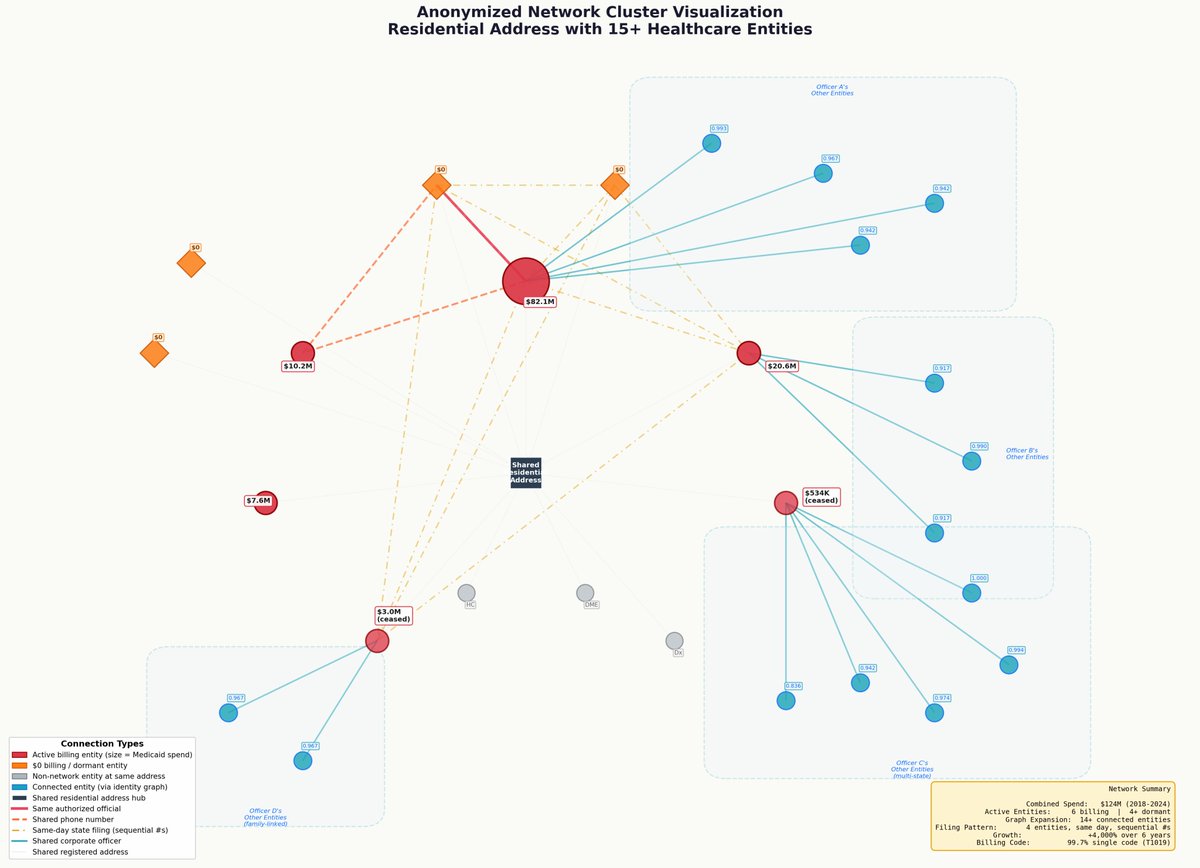
Using our graph, we traced from the 1,489 highest-risk providers to 1,329 additional connected providers who share exact operating addresses and/or officers.
Total payouts to this network: $1.7B.
Shell entities are used to funnel money to excluded providers.
$563M in payouts went to 1,175 providers blacklisted from federal healthcare programs for criminal activity or misconduct.
They shouldn't be receiving a single dollar. They received half a billion.
$155M was paid to providers with suspended, inactive, or revoked licenses.
From 2018–2024, $1.09T in Medicaid payments went to ~1.6M providers.
The biggest category was personal care services (in-home visits) at $122B. The fastest growing was behavioral health/substance abuse claims, up 450%+ over 5 years.
HHS just open-sourced the largest Medicaid dataset in history. About $1T in claims data, free for anyone to analyze via @DOGE_HHS. Everyone's looking at what was billed. At @MiddeskHQ, we're looking at who's behind the billing.
Here's what we found 🧵
Like everyone else, I’ve been spending the weekend reading all about this alleged Minnesota fraud and wanted to use the tools that we have at @MiddeskHQ to see what we could learn.
Verifying a business is a challenge but not an unsolved problem. There is a difference between a business that is real on paper (i.e. they have registered with the Secretary of State) and one that has legitimate business operations.
This evaluation is contextual, so you wouldn’t automatically decide that a business that has only formed last week and doesn't have a credible office location is illegitimate. When we started Middesk, we didn’t really have a business for at least 6 months and were running the company out of my apartment.
But there are signals that we can look at to build a more complete picture of a company, even if they are just getting their business off the ground.
I pulled 2,000 child care and home health care companies formed in Minnesota with a registered operating address in Minneapolis. To build the list, I focused on companies that mentioned child care or home care in their entity name to expand the scope beyond what we might have found if we only looked at industry specific licenses.
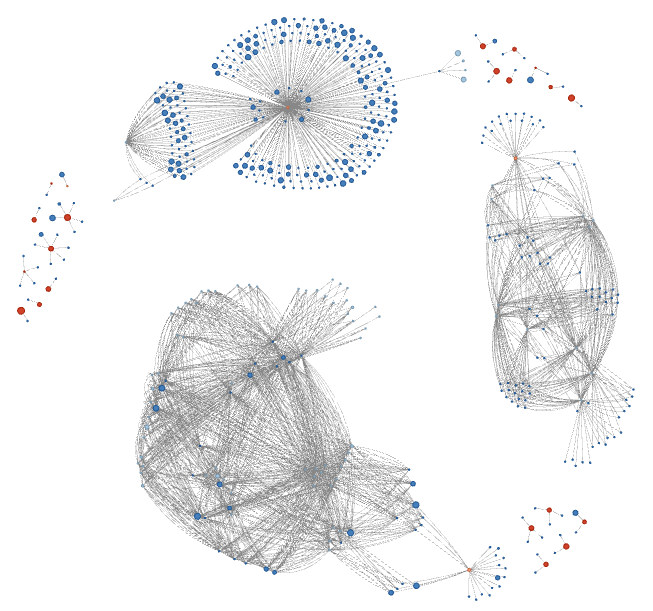
I placed the businesses on a graph to show the relationships, which looked like this:
Then I looked at clusters of businesses that were using the same or similar addresses as their operating location.
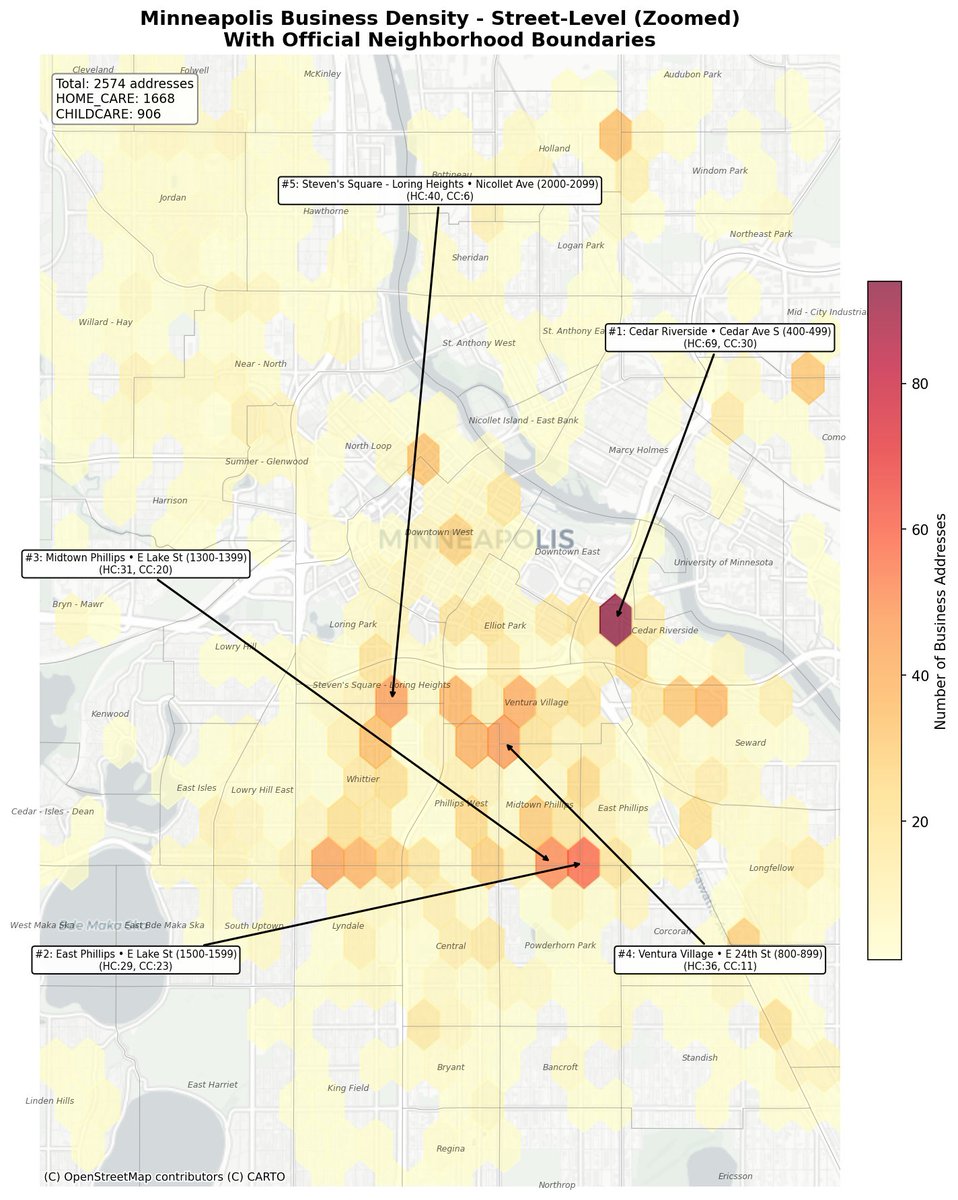
You can see the heatmap of address density below, but consider that a single block in MN has more than 100 companies from the sample of businesses that we used for this dive.
We can also see some of the businesses visited in the @nickshirleyy video within that block, along with other high density blocks.
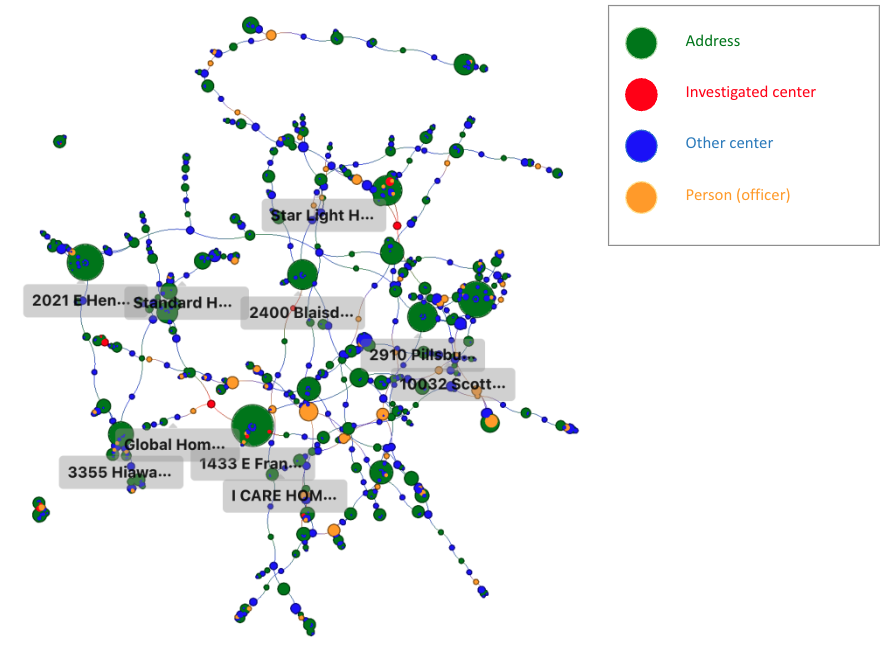
Next, I looked at the connections between companies, since businesses are easy to shut down and re-open on paper. Connections were based on shared addresses, individuals, and ownership structures.
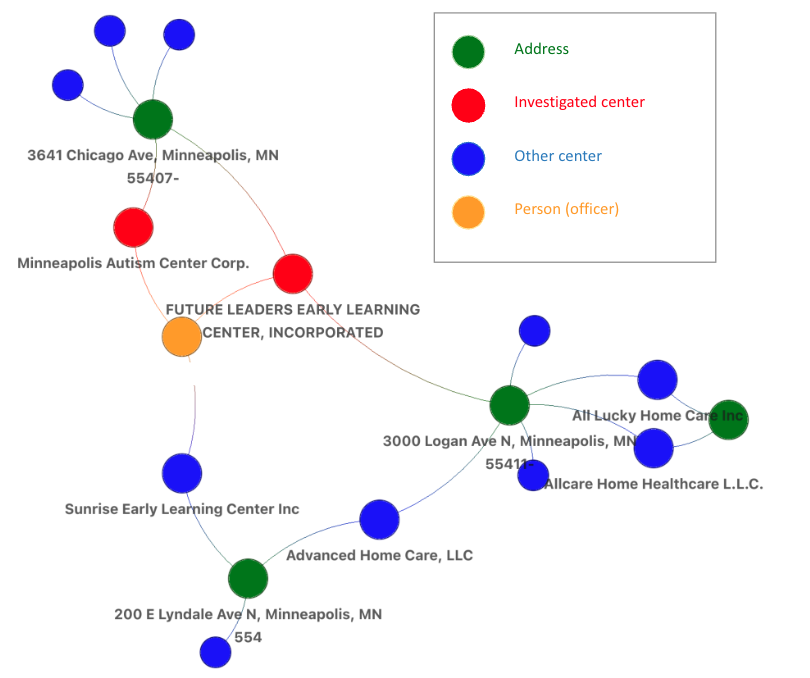
For example consider this cluster of related businesses:
12 companies connected through 3 shared addresses and a shared officer. 2 of the companies in this cluster are visited in the video. These businesses are the red ones.
And TBC, it doesn't mean that all businesses in the cluster are fraudulent, just an example of higher risk.
To go a bit further, I looked at the online web presence of the entities in the cluster above and found that of the 12 companies, all have no credible online web presence (Google Places page, recent reviews, online/available website, etc.).
When you consider that the average age of these 12 businesses is 8 years, this increases the risk of the cluster further. You would expect businesses formed in the last 8 years to have some meaningful online presence.
Next step would be expanding beyond Minneapolis and layering in funding data like grants, PPP loans, etc. But the clustering patterns alone tell you a lot.
Join an elite group of technologists to transform the federal government through modern software development. Go to https://t.co/Jv6v8D7k3i to apply today
Something great
The world of neoclouds is full of fluff and endless comparisons of apples to oranges, and that's all in an environment of extremely expensive infrastructure.
https://t.co/nJl0DxdJOw
We spent the past few months analyzing the key factors that truly define the cost of AI model training, and showing how high-quality infrastructure can streamline development and maximize return on investment.
We’ve been fortunate to partner with @alexandr_wang and the @Scale_AI team since the days when they were working out of @daniel_levine’s basement. Thanks for bringing us along for the ride, and here’s to what’s next. 🚀
Read more about Scale, Meta, and our continued partnership here: https://t.co/VrnVf6ueBj
I am incredibly proud and thrilled to share that @circle is now a public company listed on the New York Stock Exchange under $CRCL!
12 years ago we set out to build a company that could help remake the global economic system by re-imagining and re-building it from the ground up natively on the internet.
Our mission – to raise global economic prosperity through the frictionless exchange of value – has animated our work ever since.
When we founded the company, I told every employee and every investor that this was a multi-decade opportunity, and that I sought to build a deeply lasting internet technology platform. Now, just over a decade in, we are just starting to realize our early vision.
Our transformation into being a public company is a significant and powerful milestone – the world is ready to start upgrading and moving to the internet financial system. From inception, we have been deeply focused on being trusted, transparent, compliant, ethical and well governed. Holding ourselves to the high standards of the NYSE and SEC rules and regulations further deepens those attributes.
To every single person, project and firm who’s been part of this journey, thank you. I am humbled and deeply grateful. This is not only a moment for each of us personally, I believe it's a significant moment in the future development of our global economic system as it inexorably synthesizes with the internet.
Congratulations to the SHP Boys Lacrosse team, your 2025 @cifccs Champions!
The Gators defeated SI 8-7 to claim the programs first CCS title since 2021!