RYT is blockchain built for populations, not traders.
Where compliance and accessibility aren't enemies. Where infrastructure serves economies instead of extracting from them.
Opportunity Infrastructure for billions is what we're building.
Corruption is a middleware problem. Someone in the middle skimming from health systems, government services, citizen access. Blockchain doesn't just move value faster, it removes the opportunity to intercept it.
That's the argument for sovereign infrastructure in markets where trust in institutions has been broken by the people running them.
@Nasdaq
The next wave isn't crypto-funded startups with multi-billion dollar valuations. It's sovereign-funded infrastructure with multi-billion dollar budgets.
Nation states deploying blockchain for critical systems.
Different buyer, different capital, different scale entirely.
That's the market RYT is building for.
@Nasdaq
Tempo and Plasma are payments companies that happen to be chains. RYT is sovereign infrastructure that happens to be a chain. Different expression of the same idea.
For most of crypto's history, the model was: build a generalist L1 first and go looking for use cases. The chain led. Customers came eventually, or didn't show up.
That order is reversing. Tempo and Plasma needed a chain to run a payments product. RYT needs a chain to run sovereign infrastructure for governments and capital markets. The chain is downstream of the customer.
The buyer's requirements drive the design. The chain has to support validator control at the subnet level, data residency by jurisdiction, programmable compliance natively and deterministic settlement. The chain gets shaped around what the buyer needs to ship.
Customer first, chain second. That's why this category is forming: the generalist L1 model produced plenty of chains and very few real customers. The opinionated model starts from a buyer and works backwards into the protocol.
A sovereign subnet keeps that control with the issuer.
Validator set, finality rules, network-layer privacy and access controls all configurable to the rail's actual requirements. The contract logic is the same on Ethereum or a subnet. The infrastructure beneath it isn't."
Issuing a sovereign stablecoin on a public mainnet means outsourcing the dependencies.
If the underlying chain has an outage, censors, governance disputes and hard-forks, the national payment rail goes with it.
That's a dependency a central bank shouldn't have to accept.
Head of Stablecoin Product Strategy Joshua Moss at Visa makes the right call on stablecoin payouts for creators.
USDC suits that use case. But sovereign use cases need different rails. Government disbursements and central bank payment systems need sovereign assets and rails, issued by the state, deterministic and architecturally gas-free.
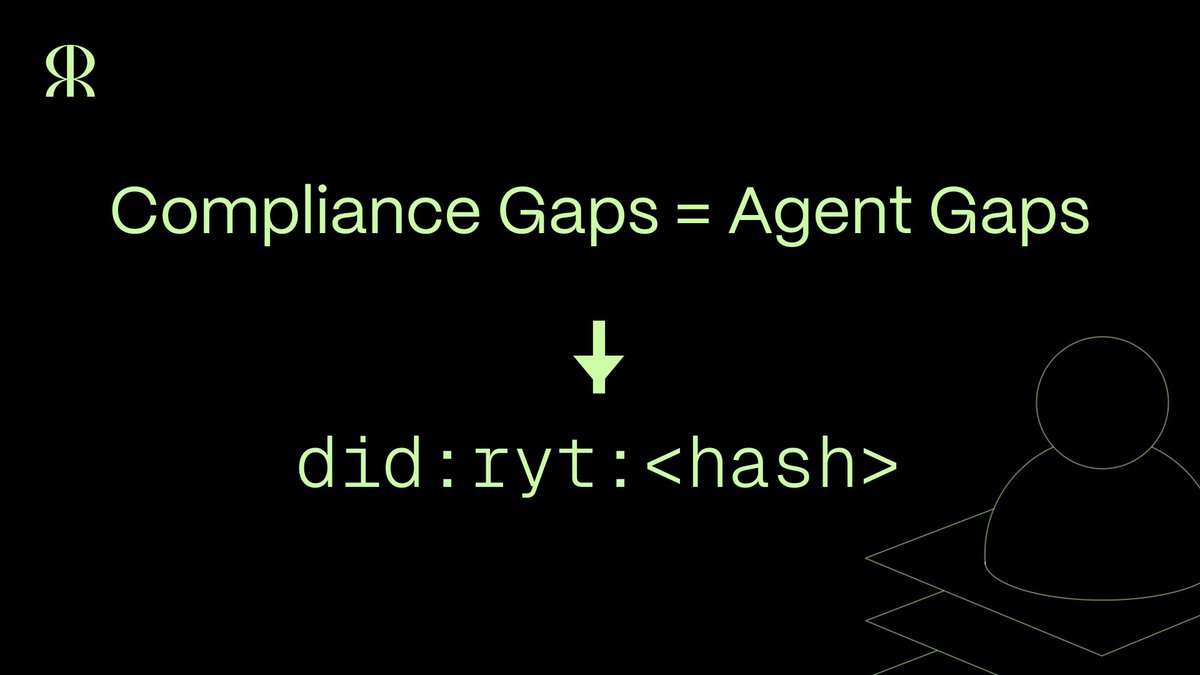
The gap in true compliance and credible agentic controls are the same.
Both need identity at the protocol layer, not bolted on via apps.
Smart contracts need to read creds like token balances. With network-wide revocation available everywhere, at once.
Only on RYT.
With architecturally gas-free settlement underneath, the subnet doesn't pay continuous coordination fees back to the main chain either. The math for a 10-year sovereign contract works because the cost line stays predictable. That's the architecture we're building for.
Sovereign subnets are how we approach giving governments their own controlled environment without forcing them to operate a chain.
Architecturally they're partitioned views on shared infrastructure, not independent networks. The distinction matters for cost and for portability.
That's different from spinning up an entirely separate chain. Independent networks have to design their own consensus protocol, bootstrap a token economy to secure it and run the full operational stack. A subnet inherits the protocol from RYT and runs its own validators under its own rules. Most governments don't want to be chain operators. They want a controlled environment without that overhead.
Has "tokenized" become just a marketing word?
Both dino bones on Solana and tokenized Treasuries on Ethereum are just wrapper structures. An SPV or fund holds the underlying, and the token is a claim on that entity. Tokenized deposits on Canton are bank-issued with bank obligations attached. Securitize ISTs represent actual shares of stock onchain.
All these products have completely different risk profiles and regulatory schemes. The "tokenized" label doesn't really tell you what you've actually bought.
Bridge co-founder @zcabrams nails the dynamic.
Stablecoins were legal before regulatory clarity.
The capability was always there.
Regulatory clarity just rebalanced the ROI math by dropping perceived risk.
The same pattern is queued one layer up. Sovereign capital markets and central bank rails are where comfort arrives next.
Builders shipping through the ambiguity will be ready when the ROI math shifts there.
RYT's subnets treat privacy as a primitive instead of a layer.
A central bank gets a network with its own privacy and access rules, sharing the mainnet for settlement and finality. The workload Drex couldn't run, architected for sovereignty and success from the start.
Drex is Brazil's CBDC project. In August 2025, after two pilot phases, Banco Central confirmed Drex would launch on centralized architecture, not the blockchain platform it had piloted, citing privacy and costs.
Buried in that decision was a critical insight: Privacy as a bolt-on doesn't work at production scale.
Crypto folks see "government deal" and picture a small pilot, grant or RFP win.
Real sovereign infrastructure means longterm commitments on systems that move trillions of dollars and that millions of citizens depend on. Hard-won, highly scrutinized deals, on-par with a bid to rebuild a national power grid.
But the upside is the buyers aren't asking about your whitepaper in Discord 🙃
These agentic security primitives, on top of a low latency, high speed and architecturally gas-free network positions RYT as the optimal platform for agentic commerce.
ERC-8004 launched in January with backing from MetaMask, the Ethereum Foundation, Google and Coinbase. The pitch is agent identity for the AI era. Wallets, agents and services that can verify each other onchain.
Security for agentic operations is core to the protocol. Revocation is immediate and comprehensive. Subnets can limit access to credentialed agents only as a chain-native rule, not a separate contract integration. The kill switch is network-wide, not per-app.