"We are such stuff as dreams are made on, and our little life is rounded with a sleep.." by 01010011. Moving blocks since 2013 | ₿ $BTC | $ETH #AI#RWA#DEFI 🧩
$YOM @YOM_Official TGE is coming on 5-june
the part i'm watching is simple: cloud gaming got big fast, but the cost of running it still looks too heavy for mass usage. AWS at ~$2/hour and YOM is at YOM at ~$0.05/hour... let's do the math 👇
quick read 🧵
→ what YOM is
→ the cloud gaming gap
→ the cost gap
→ $YOM launch setup
→ june-5 TGE date
▫️what YOM is
YOM is building a decentralized cloud gaming network on Avalanche.
the simple idea is this:
instead of relying only on big cloud infra, YOM lets games stream through a distributed network of hardware.
player taps play → YOM routes the session → the game streams to the device → the session settles through the network (aka cloud gaming)
so the bet is pretty clear.
make cloud gaming cheaper, easier to access, & less dependent on the usual AWS-type infra.
⚠️ here's a more general thread i wrote a while ago about it:
https://t.co/uxY2DRAtqx
▫️the cloud gaming gap
the cloud gaming market is around $121B & nearly doubled in the past year.
but the funny part is that a large part of gamers still sit on hardware that cannot run the games they want.
apparently, 47% of gamers are on hardware that cannot run cloud gaming properly:
so there is this weird mismatch:
• demand is growing
• the market is already huge
• hardware still blocks a lot of users
• cloud infra is still expensive
that is where YOM is trying to position itself.
not by selling another game, more like by becoming the infra layer behind streaming games.
▫️the cost gap
the number that stands out most is the cost comparison.
AWS is listed at around $2.00/hour.
YOM is listed at around $0.05/hour.
that is a 95% reduction
and imo this is the part traders will look at first, because the cloud gaming market is already big, while $YOM launches at a much smaller valuation.
▫️$YOM launch setup
$YOM TGE is on june-5.
network: Avalanche C-Chain / custom L1.
launch price: $0.10.
FDV: $75M.
initial market cap: around $12.4M-$13M.
token supply: 750M.
the token is also described as strictly deflationary through a 5% session settlement burn 🤔
traction:
• 1M+ quest participants
• 263K testnet DAU
• 40+ studio partners
• 400+ games from previous YOM context
backers include Avalanche Foundation, Outlier Ventures, Borderless Capital, & CV VC.
there is also a 6-9 month cliff for the team + investors, w/ zero insider selling at TGE ✌️
▫️ june-5
i think we should do some math here:
~$121B cloud gaming market, 95% lower listed hourly cost, $75M FDV, around $13M initial market cap.
and TGE on june-5.
direct link: https://t.co/AuFYm78x62
Australia has roughly 439 million hectares of agricultural land, with broadacre farming forming the vast majority estimated to cost around $2 trillion. @Nvidia is worth $5.5 trillion. Probably nothing.
@Crypto_Chase In the past 6 years many like yourself tried to find a POV so MSTR looks as bad as possible but the numbers speak clear and simple:
@Strategy (formerly MicroStrategy, ticker: MSTR) currently holds 843,706 BTC.
But at the same time I get the frustration, not easy hold.
$KAIO @KAIO_xyz 's post-TGE roadmap is:
first get products live, then make those products useful across DeFi & CeFi
→ 3-6 months
→ KASH
→ distribution
→ 12-month composability
→ $KAIO roadmap
⚠️ if you missed my general thread about KAIO it's here:
https://t.co/MbUIUt6IeN
⚠️ if you missed my thread about KAIO's products, here's that one:
https://t.co/LESXRsWymN
▫️3-6 months
$KAIO's roadmap splits pretty cleanly into execution first, then composability later.
the next 3-6 months are about getting more products live & pushing them into more distribution channels.
the main item is the planned Mubadala Capital tokenised fund.
that matters because it would bring a sovereign-wealth-linked fund structure onchain, aimed at qualified institutional & accredited investors.
▫️KASH
KAIO is also targeting Q2 2026 for KASH, its first retail-facing product.
the product is described as US-dollar money-market exposure, w/ onchain settlement & a $100 minimum.
so the point is clear:
• institutional-style yield product
• smaller entry size
• onchain access
• retail-facing UX
still, this depends on launch execution, access rules, & where users can actually use it.
▫️distribution
KAIO also mentions ongoing talks w/ centralised exchanges, apps, & payment platforms.
the goal is to put KAIO products inside places where users already hold balances.
that part is important because tokenised funds don't scale only through the fund itself.
they need distribution.
▫️12-month composability
the 12-month roadmap moves into DeFi & CeFi integrations.
KAIO wants its tokenised funds to work as collateral, margin, & structured product inputs.
the more specific detail is that KAIO wants the tokenised asset itself used as collateral, instead of a wrapped version.
▫️$KAIO roadmap
so the roadmap is not only "more funds onchain."
it is:
• launch more fund products
• make the first retail product live
• expand distribution
• make tokenised funds usable inside DeFi & CeFi
that is the roadmap to watch now.
BlackRock showing up on @kaio_xyz $KAIO product page made me stop scrolling
because this is where RWA gets more serious:
not another tokenized asset idea, but regulated funds that need issuance, transfers, settlement, servicing, & investor checks to work onchain.
here's what you need to know about this project:
→ why KAIO
→ the mechanism
→ what the compliance layer changes
→ what products are already live
→ where the chain part becomes useful
→ $KAIO
→ what actually matters
▫️why KAIO
i kept seeing RWA projects talk about tokenized funds like the hard part is putting the asset onchain.
but i don't know if you knew, but the messy part is what happens after the fund becomes a token
who can buy it? or who can hold it? or who can transfer it?
essentially, which rules follow it across wallets, platforms & chains?
that is where KAIO became more interesting to look at.
from what i read, the product is less about making funds look web3-native & more about keeping regulated fund logic alive after the asset moves onchain.
so the main thing i wanted to understand was simple:
does KAIO make tokenized funds more usable, or does it mostly recreate old fund access w/ a chain wrapper around it?
▫️the mechanism
KAIO is a protocol for issuing & managing institutional financial assets onchain.
it is deployed on eth mainnet, & it uses sc for investment execution, settlement, asset servicing, & fund lifecycle workflows.
in plain english, the fund can move through a chain system, while the admin parts stay attached to it.
the flow looks something like this:
i) issuer brings a fund into KAIO
ii) smart contracts handle issuance, transfers, settlement, & servicing
iii) compliance checks sit inside the transaction flow
iv) distributors & wealth platforms connect through APIs or the KAIO Gateway
v) investors get access to tokenized fund positions that can move across supported networks
they raised $19M in total from backers like @tether@further@laserdigital_@BHDigitalAssets@LyrikVentures@Karatage_@ShorooqPartners
▫️what the compliance layer changes
the important part is the modular (that can be adjusted) compliance engine
that means KAIO checks rules around each transaction instead of treating the fund token like a free-moving asset.
for example:
i) is this investor allowed to hold this product
ii) does this jurisdiction allow this transfer
iii) does the transaction match investor-level requirements
iv) can this position move to another wallet or network
v) does the fund still meet legal & investor protection rules
that is less exciting than "onchain yield", but it is probably the part institutions care about most.
a fund manager does not want a tokenized product that breaks the rules after the first transfer.
▫️what products are already live
the product page made the idea more concrete for me.
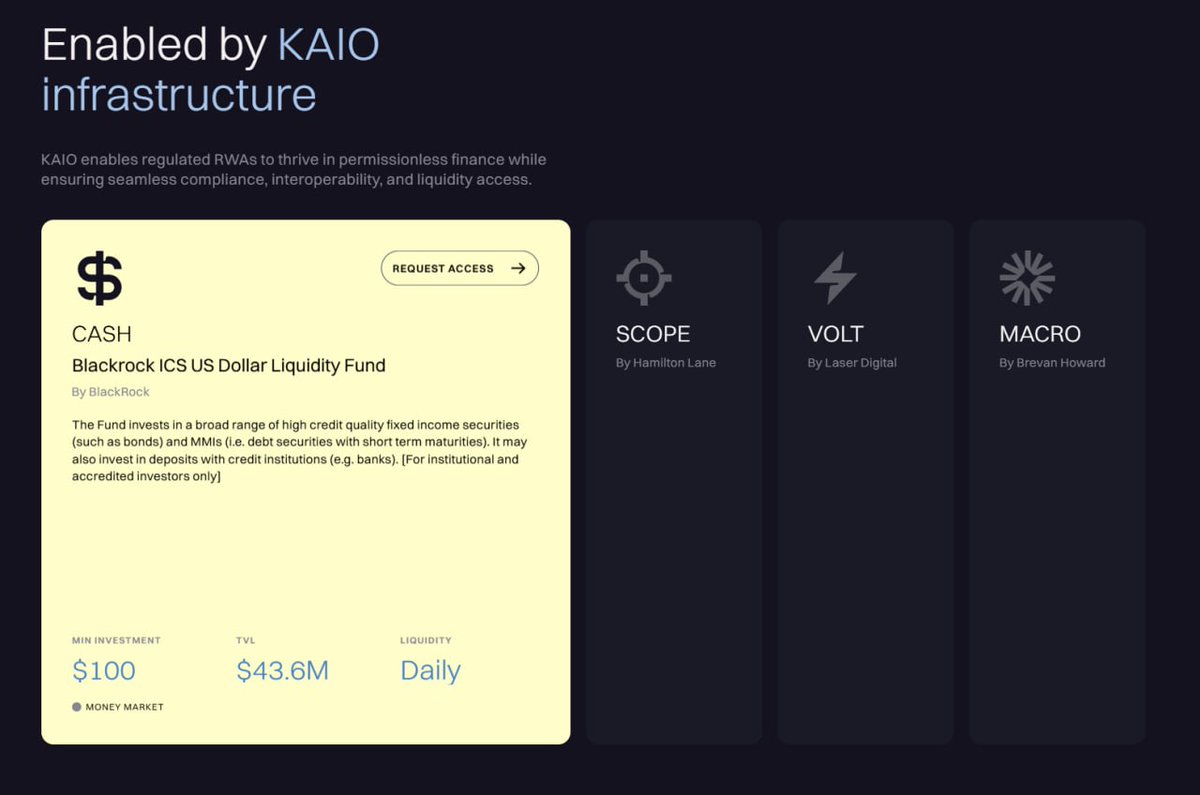
KAIO already shows tokenized funds from BlackRock, Laser Digital, Hamilton Lane, & Brevan Howard.
these are:
I) CASH - BlackRock ICS US Dollar Liquidity Fund
w/ $100 minimum, $68.47M AUM, & daily liquidity
II) CARRY - Laser Digital Carry Fund
w/ $10,000 minimum, $13.01M AUM, & monthly liquidity
III) SCOPE - Hamilton Lane Senior Credit Opportunities Fund
w/ $10,000 minimum, $11.22M AUM, & monthly liquidity
IV) MACRO - Brevan Howard Master Fund
w/ $10,000 minimum, $11.44M AUM, & monthly liquidity
KAIO is handling more than one clean RWA category
money market, private credit, crypto basis, & hedge fund products all have different mechanics.
so the infra needs to support more than token creation.
it needs lifecycle management.
▫️where the chain part becomes useful
KAIO talks a lot about composability.
tokenized assets can move across networks like Solana, Avalanche, Polygon, Sui, TON, & more.
also in DeFi protocols, liquidity pools, settlement layers, collateral management, cash flow processes, & risk management.
▫️$KAIO
$KAIO has also been listed recently on @uniswap@mexc & it's planned to go live as well on @coinbase@kucoin@bitget@gate
token utilities include:
i) access to KAIO products as investors
ii) access/coordination for fund managers to bring assets onchain
iii) governance
iv) stakin
v) possible future yield or incentive rewards from the Community & Liquidity pool
vi) protocol fee
▫️what actually matters
the catch is ACCESS…
these products are for onboarded accredited investors & institutional investors.
so this is not retail opening an app & buying anything they want.
the more accurate read is that KAIO is building rails for regulated assets to behave more like onchain assets.
they can be issued, transferred, settled, moved across chains, & used inside financial workflows.
but the compliance layer stays in the path.
that is probably the real RWA direction imo.