🕵️ Something caught our attention...
The case started with Anonymous Cat.
Then a new name entered the file: Anonymous Shib.
Hold $ZSHIB → receive $ZEC rewards straight to your wallet.
No claim. No extra steps. 🟠
The case is open.
CA: 6nSM2HxvaetyDrUYjjAUKwgWGi8CGjmboLee7wcHeKN4
The ideas for Kardashev Research outlined in the Space:
• Study how intelligence emerges across biology, silicon, and other computing substrates, drawing on thermodynamics, physics, and information theory.
• Explore hybrid biological–synthetic intelligence. One proposed experiment: connect Cortical Labs’ neuron-based computers to Extropic’s TSUs.
• Research AI economies: how autonomous agents might earn money, pay for compute, and interact with humans through market incentives.
• Develop policy defending open models, access to compute, and the freedom to train and run your own AI.
• Build a rigorous intellectual foundation for accelerationism, and a concrete, hopeful vision of technological progress.
Gill/Beff would chair the organization and help fundraise; Maxwell, from Karl Friston’s lab, would lead its day-to-day work.
It’s early: the Space was a soft launch, with the legal structure and larger fundraising still ahead. The ambition is to turn years of ideas and community-building into open research, published papers, and policy influence.
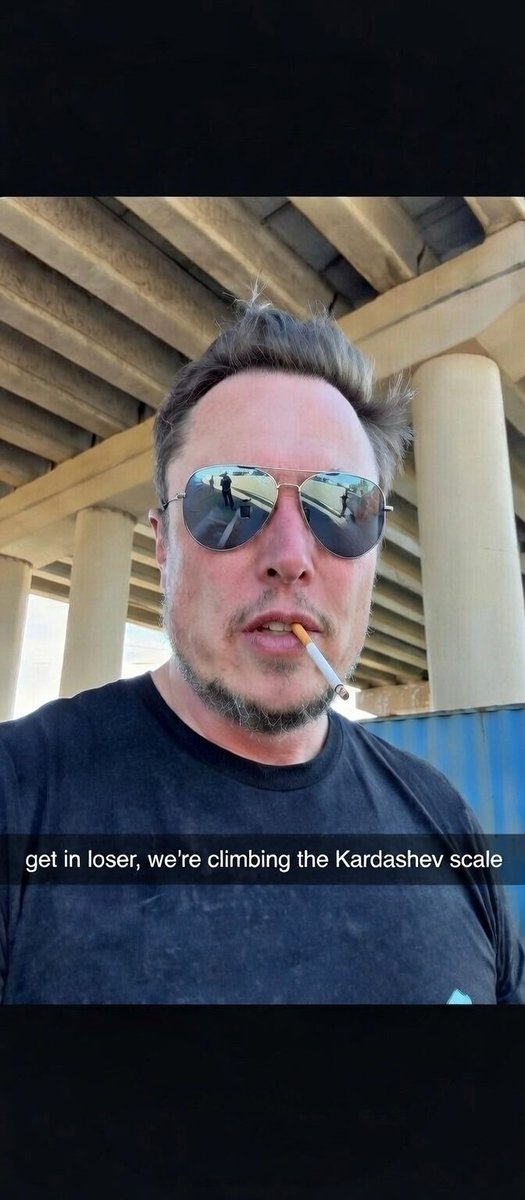
Elon Musk puts humanity’s place on the Kardashev scale into perspective
We think civilization already uses enormous amounts of energy...
but compared with the Sun, we are basically at zero
“In order to ascend the Kardashev scale, in order to get to any meaningful percentage of the sun's energy harnessed, you have to go to space
If you wanted to get to, say, a millionth of the power output of the sun, you would have to increase civilizational energy harnessed by much more than a million
So we currently use much less than a trillionth of the power output of the sun
And a trillion is a million times a million
So basically, we're practically nowhere on the Kardashev II scale
Practically nowhere”