I build software, automation and AI systems that solve real operational problems.
My background is in systems engineering, but I’m increasingly focused on the bigger picture: how software, workflows, data and AI can make operations simpler, faster and more reliable.
Here I’ll share:
- what I’m building
- practical automation ideas
- software and system design
- useful AI applications
- lessons from solving real technical and operational problems
Building AUTOMETA → https://t.co/YPOm6Cce5k
AI pilots rarely fail because the model cannot read the document.
They fail because production is a pile of missing fields, two records that disagree, and an exception someone still handles by phone.
A pilot proves the model can do the task.
Production is the station around it: one input, one permitted action, a reason to stop, and a record of what it did.
Automate the station, not the job title.
I am the British whistleblower who reported evidence concerning Howard Lutnick, his links to Jeffrey Epstein, and Cantor Fitzgerald and BGC to the FBI in 2020–21.
Listen to the BBC File on 4 documentary about my whistleblower story:
https://t.co/rLRDnZA4Dv
BBC News:
https://t.co/DdNNOosnKL
I later shared evidence with the House Oversight Committee, which subsequently questioned Lutnick behind closed doors.
My disclosures also contributed to regulatory action in the US and UK, including a £96m HMRC tax assessment relating to BGC’s partnership scheme. I believe the true tax exposure is substantially higher.
I also reported to the FBI and financial regulators matters involving Cantor Fitzgerald’s Relief Fund and BGC/Cantor’s annual 9/11 Charity Day.
The personal consequences of whistleblowing, and the retaliation I say followed, have been devastating for my family and me.
Mother Jones previously reported that documents I uncovered revealed a years-long business tie between Howard Lutnick, Cantor Fitzgerald and Jeffrey Epstein through AdFin, including a 2018 exchange in which Lutnick and Epstein discussed the company directly:
https://t.co/aRdn302v4i
https://t.co/aRdn302v4i
Follow me here on X and on LinkedIn. I intend to share more of the evidence and the story behind what happened.
AI pilots rarely fail because the model can't do the task.
They fail because production has missing documents, conflicting records, and exceptions handled by phone call.
Automate the station, not the job title.
https://t.co/WhZMOyStsV
A real distribution channel, a workflow you understand better than the user can explain, data or access nobody else has, and the operational grit to make it reliable after the first week.
OpenAI’s own launch post, 11 December 2015, lists the co-chairs as Sam Altman and Elon Musk. Greg Brockman was CTO. Ilya Sutskever was research director. The founding researchers were already named. Altman announced it the same day Musk did.
Elon Musk: “I am the reason OpenAI exists.”
“I put in some number on the order of $50 million.”
“At the time, Google had three quarters of the world’s AI talent.”
“I was constantly urging Larry Page to be careful about the danger of AI.”
“The final straw was Larry calling me a speciest for being pro-human consciousness instead of machine consciousness.”
“I came up with the name OpenAI.”
“The intent was open source, nonprofit. The opposite of Google, which was closed source, for profit.”
All before Sam Altman came along.
@vikktorrrre Early money, a co-chair seat, a real safety argument, then an exit. “All before Sam Altman came along” is the part that does not survive the press release.
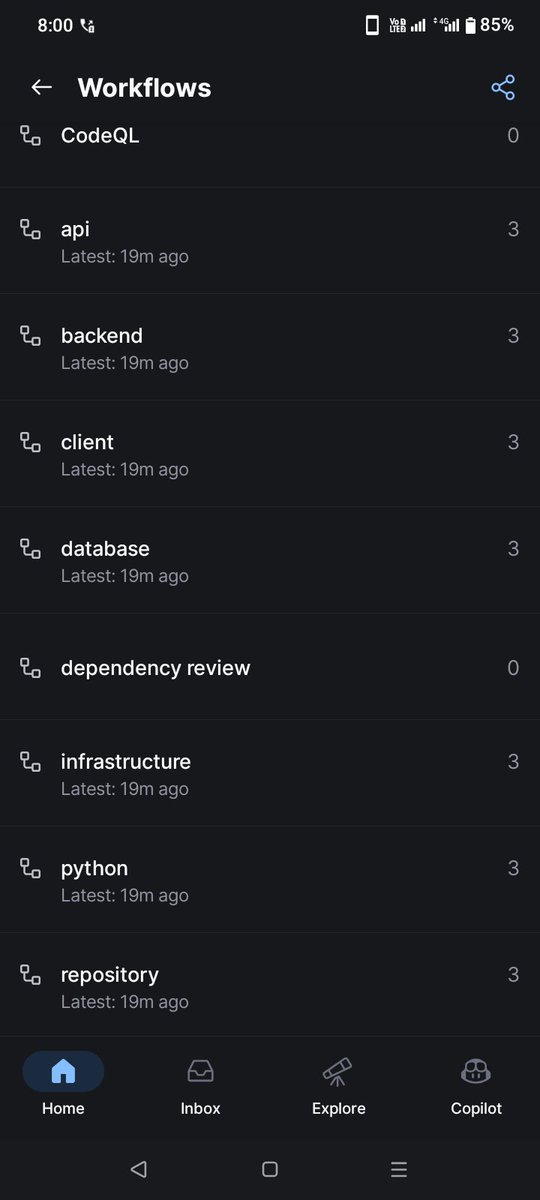
This is the boring part of software that matters later.
Separate CI for API, backend, client, database, infrastructure, and Python; so the project can grow.
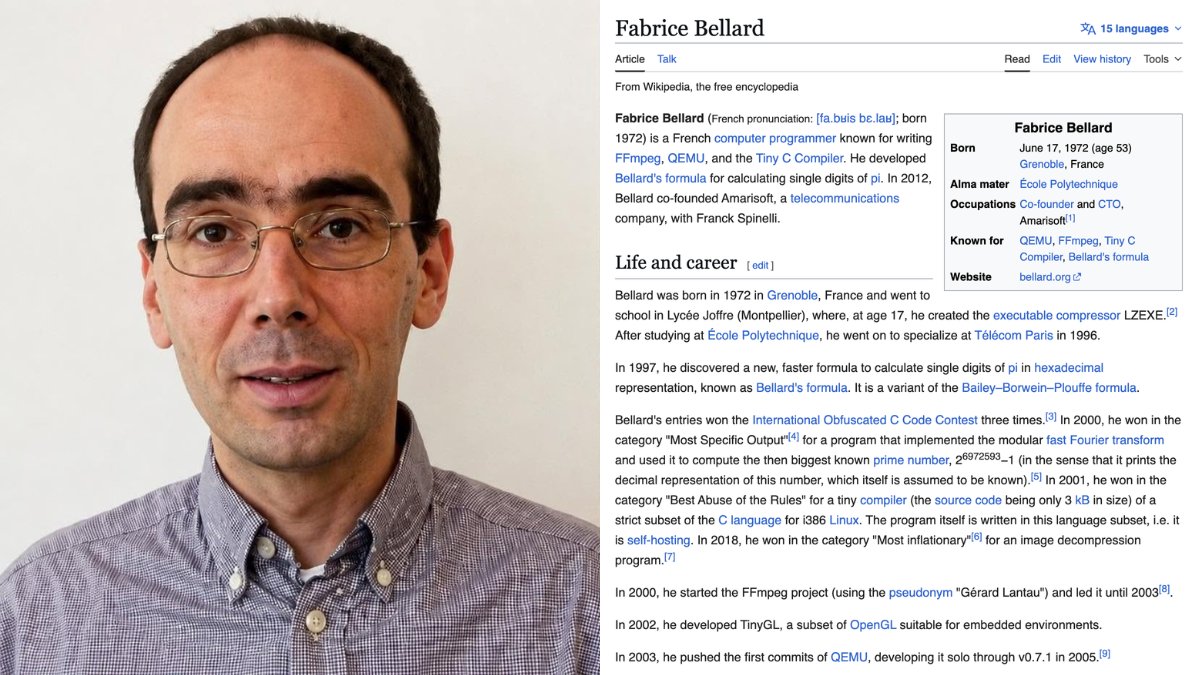
A French engineer who lives quietly in Paris has spent 30 years writing software that the entire internet now runs on without knowing his name.
He wrote the code that streams every YouTube video, every Netflix show, every TikTok clip. He wrote the code that runs the virtual servers underneath AWS, Google Cloud, and Microsoft Azure. He calculated more digits of pi than anyone in history. He has no Twitter. He has no marketing. He just keeps shipping.
His name is Fabrice Bellard.
Here is the story, because almost nobody outside the systems programming world knows what one man has built.
Fabrice was born in 1972 in Grenoble, France. He studied at École Polytechnique, the top French engineering school. He never went to Silicon Valley. He never built a startup empire. He just wrote code.
In 2000 he started a project called FFmpeg, an open-source multimedia framework for encoding, decoding, and streaming video. He was 28. The project did one thing nobody else had done well. It handled every video and audio format that existed, in one library, on every operating system. He led it himself for years.
Today FFmpeg is the invisible engine of the internet. YouTube uses it. Netflix uses it. VLC uses it. Chrome and Firefox use parts of it. Every Android phone, every iPhone, every smart TV, every video editing tool you have ever touched runs FFmpeg somewhere underneath. If you have watched a video on a screen in the last 20 years, Fabrice's code processed it.
He was not done.
In 2003 he started QEMU, a machine emulator and virtualizer. He wrote it solo until version 0.7.1 in 2005. QEMU lets you run any operating system on any other operating system. It became the foundation of modern virtualization. KVM, the Linux kernel hypervisor, runs on top of QEMU. Every major cloud provider, AWS, Google Cloud, Microsoft Azure, IBM Cloud, runs virtual machines on infrastructure built around it. The Quick Emulator is the most cited piece of cloud infrastructure code on Earth.
He kept going.
In 2001 he won the International Obfuscated C Code Contest with a small C compiler that grew into TCC, the Tiny C Compiler. TCC can compile and boot a Linux kernel from source in under 15 seconds. In 2004 he calculated the most digits of pi ever computed at the time, using a personal desktop computer and an algorithm he derived himself called Bellard's formula. In 2011 he wrote a complete PC emulator in pure JavaScript that runs Linux in your browser, a project called JSLinux that engineers still cannot believe is real.
In 2019 he released QuickJS, a small but complete JavaScript engine that fits where V8 cannot. In 2021 he released NNCP, a neural network based lossless data compressor that immediately took the lead on the Large Text Compression Benchmark.
Then he turned his attention to large language models. He built TextSynth Server, a web server with a REST API for running LLMs locally. He released ts_zip and ts_sms, compression utilities that use language models to compress text and short messages at ratios traditional algorithms cannot reach. He released TSAC, a very low bitrate audio compression system. In December 2025 he released Micro QuickJS, a new JavaScript engine for microcontrollers, separate from QuickJS, designed for environments with almost no memory.
Fabrice co-founded a telecom company called Amarisoft in 2012, where he serves as CTO. Amarisoft builds 4G and 5G base station software used by carriers and labs around the world. He has been running it for over a decade while continuing to ship personal projects from his own home page at bellard dot org
He has no Twitter. He has no Instagram. He gives almost no interviews. His personal website is a flat list of projects with no styling, no fonts, no marketing copy. Just titles and links.
A quiet French engineer who never moved to Silicon Valley wrote the code that quietly runs the internet.
He is still shipping.
Anthropic pays $750,000+ a year for engineers who can build LLM architectures from scratch. Stanford taught the entire thing in 1 hour lecture & released it for free.
Bookmark & watch this today before someone takes it down.
Met a guy who got a $750,000 offer from Anthropic
I asked him how he broke into AI so fast
He sent me the exact video that got him in. Andrej Karpathy's 3.5 hour deep dive into LLMs
You won't find anything better about how LLMs work than this video
I watched it last night
Halfway through, I realized I have been using AI completely wrong for years
Bookmark this and read the article below.
How should Result<T> treat Success(null) when T is a reference type?
The plan requires an explicit, tested null-success policy.
The source material does not decide whether Success(null) is valid.
The minimal API (Match, TryGetValue, TryGetError, …) is left as a design choice, not a mandate.
Vote:
A) Ban it; Success must always carry a non-null T
B) Allow it; null is a valid success value
C) Allow only when T is T? / annotated nullable
D) Leave it unspecified and document the risk
What’s your call, and why?
#dotnet #APIDesign
Peter Thiel built PayPal alongside Elon Musk
Then he walked into Stanford and used Mark Zuckerberg, Larry Page, Bill Gates, Elon Musk, and even Einstein to explain one of the most controversial ideas in business:
“Competition is for losers”
And the deeper you go into the lecture, the more uncomfortable the argument becomes
Thiel starts with a distinction almost nobody makes: creating enormous value and capturing enormous value are two completely different things
Airlines transformed civilization and generate enormous revenue, yet historically struggled to keep much of the value they created. Google, by comparison, operated in a much smaller market but captured an extraordinary share of the economics
That leads to Thiel’s central claim:
There are basically two kinds of businesses, monopolies and businesses competing their profits away
The strange part is that both sides lie about it
A monopoly wants regulators to believe it operates in a huge competitive market. A terrible competitive business wants investors to believe it occupies some tiny unique niche
Thiel uses Google as the example. Define it as “search” and its dominance looks enormous. Define it as advertising, technology, cloud, phones, cars and software, and suddenly it looks like one player among hundreds
How you define the market can completely change the story
So how do you actually build something dominant?
Thiel says you usually start absurdly small
Amazon began with books. eBay gained traction in tiny enthusiast markets. PayPal focused on roughly 20,000 power sellers on eBay. Facebook started with around 10,000 Harvard students and reached roughly 60% penetration there in about 10 days
The mistake is starting with: “This is a trillion-dollar market”
To Thiel, that often means you’re entering an ocean filled with competitors
Own a tiny market first. Then expand outward
But dominating today isn’t enough
The truly valuable company has to remain dominant tomorrow
That’s where Thiel brings in Mark Zuckerberg, Larry Page and Bill Gates. The next Zuckerberg won’t build another Facebook. The next Larry Page won’t build another search engine. The next Bill Gates won’t build another operating system
Copying what made them successful misses the entire lesson
They became valuable because they built something sufficiently different that competition became much less relevant
Thiel looks for several things: proprietary technology that can be dramatically better than alternatives, network effects, economies of scale and brand
And then comes another contrarian idea:
Forget the first-mover advantage
Think about the last-mover advantage
Microsoft became enormously valuable because it dominated operating systems for decades. Google because search endured. Facebook’s value depended on whether it could remain the dominant social network
Thiel says most of a technology company’s value often lies many years into the future, which means investors obsess too much over current growth and not enough over one question:
Will this company still matter 10 or 20 years from now?
Then the lecture gets even more interesting
Thiel argues that some of humanity’s greatest innovations created unbelievable value while their creators captured almost none of it
Einstein transformed physics
The Wright brothers helped create aviation
Railroads transformed economies
Yet revolutionary innovation does not automatically create extraordinary fortunes
Meanwhile, software founders can sometimes capture billions because the economics of their industries, scale, marginal costs, network effects, allow them to retain a much larger percentage of what they create
He then points to Elon Musk, Tesla and SpaceX
Thiel’s explanation isn’t simply that Musk invented one magical technology. He highlights the ability to integrate many pieces of the business together, manufacturing, distribution, suppliers, engineering, in ways competitors struggled to replicate
Creating value mattered
Structuring the business so you could actually keep that value mattered too
But the last few minutes may be the most important part of the entire lecture
Thiel stops talking about companies
He starts talking about you
Humans copy each other
If everyone wants the same prestigious university, the same Wall Street job, the same startup idea or the same career, we interpret the competition itself as proof that the prize must be valuable
Thiel argues the opposite can be true
The fact that thousands of intelligent people desperately want something may be evidence that you should look somewhere else
He knows the trap personally. He followed the prestigious path through Stanford and Stanford Law into a top New York law firm, a place where, as he describes it, people desperately wanted to get in from the outside and desperately wanted to leave once they were inside
He left after seven months and three days
Someone at the firm told him it was reassuring to see him leave because he hadn’t realized “it was possible to escape from Alcatraz”
The door had been open the entire time. That is ultimately what “competition is for losers” means
Competition can make you better at beating the person standing next to you
But it can also make you so obsessed with winning someone else’s game that you stop asking whether the game is worth playing
Peter Thiel ends the lecture with one line that summarizes the entire philosophy:
Don’t rush through the tiny door everyone else is fighting to enter
Look around the corner
There may be a vast gate nobody is taking
Watch the full lecture below ↓
A Stanford professor took two average stocks, rebalanced them daily, and turned $100,000 into $7 million without predicting a single price.
Bookmark & watch today, no matter what.
I think one of the the practical approaches could be to automate the station, not the job title. For example a bakery doesn’t need a robot baker. It needs a robot that loads trays, bags loaves, and wipes the floor after close. A machine shop doesn’t need a robot machinist. It needs a cobot that opens the door, swaps the part, and hits cycle start.
That’s how abundance actually arrives for small firms, one reliable dull physical loop at a time, cheap enough that the owner can buy it without a committee.
Sam Altman, CEO de OpenAI:
“Cada noche tengo unos cuantos miles de agentes funcionando con GPT-6 Astra.”
En 53 minutos enseña algo que hace unos años parecía imposible: todo lo que una sola persona puede llegar a construir hoy con IA
Y deja una idea muy potente sobre la mesa: quizá las próximas grandes empresas no necesiten grandes equipos, sino una persona con las herramientas adecuadas y cientos o miles de agentes trabajando a su lado
Sinceramente, estos 53 minutos pueden valer más que muchos cursos de 500 € sobre cómo construir con IA