PISA 2025: Asia domina la educación mundial… y Ecuador muestra una brecha preocupante 📚🌎
Más de 760.000 estudiantes de 15 años de 91 países y economías participaron en PISA 2025, la evaluación de la OCDE que mide qué tan bien pueden aplicar sus conocimientos en Ciencias, Lectura y Matemáticas a problemas reales.
El patrón es muy claro: Asia oriental domina los primeros lugares.
🔬 CIENCIAS
🥇 B-S-J-Z (China): 597
🥈 Singapur: 560
🥉 Macao (China): 541
4. Taipéi Chino: 540
5. Japón: 538
📖 LECTURA
🥇 Singapur: 535
🥈 B-S-J-Z (China): 527
🥉 Taipéi Chino: 508
4. Japón: 503
5. Macao (China) / Corea: 501
➗ MATEMÁTICAS
🥇 B-S-J-Z (China): 612
🥈 Singapur: 563
🥉 Macao (China): 549
4. Taipéi Chino: 546
5. Japón: 525
B-S-J-Z no representa a toda China: agrupa Beijing, Shanghái, Jiangsu y Zhejiang.
¿612 significa “612 de 1000”? No.
PISA no tiene una puntuación máxima fija ni funciona como porcentaje. La escala fue diseñada históricamente alrededor de los 500 puntos, por lo que superar los 600 representa un rendimiento extraordinariamente alto.
🌎 ¿Y Sudamérica?
🇺🇾 Uruguay lidera entre los participantes sudamericanos en Ciencias (445) y Matemáticas (405).
🇨🇱 Chile obtiene el mejor resultado regional en Lectura (436).
🇪🇨 Ecuador:
🔬 Ciencias: 393 | OCDE: 482
📖 Lectura: 385 | OCDE: 461
➗ Matemáticas: 366 | OCDE: 463
En un ordenamiento simple por puntuación media, Ecuador aparece aproximadamente:
🔬 70.º en Ciencias
📖 65.º en Lectura
➗ 76.º en Matemáticas
Pero el dato más preocupante no es el ranking.
Solo alcanza al menos el Nivel 2 —considerado el nivel básico de competencia—:
🔬 Ciencias: 40%
📖 Lectura: 38%
➗ Matemáticas: 20%
Es decir, 4 de cada 5 estudiantes ecuatorianos no alcanzan el nivel básico en Matemáticas.
Y el problema no es exclusivamente ecuatoriano. Frente a PISA 2022, el promedio OCDE cayó alrededor de 14 puntos en Lectura y 9 en Matemáticas; Ciencias se mantuvo relativamente estable.
PISA no mide simplemente cuánto memoriza un estudiante. Intenta responder algo más importante: ¿puede utilizar lo que aprendió para comprender y resolver problemas del mundo real?
Fuentes:
OECD — PISA 2025 Results, Volume I
https://t.co/sh0ByfHPFg
OECD — Ecuador Country Note
https://t.co/bTr8IGJy1e
OECD — Student performance in PISA 2025
https://t.co/Kr79NWRoxP
OECD — PISA FAQ / escala
https://t.co/DLZ0MS3uKM
🐧 LINUX TURNS 35
On August 25, 1991, a 21-year-old computer science student named Linus Torvalds posted a message to the comp.os.minix Usenet group:
He was building a free operating system for 386/486 PCs.
He described it as “just a hobby” and said it probably wouldn’t become “big and professional.”
That prediction didn’t age well.
Linux is now one of the foundations of modern computing.
But how did it start?
Torvalds was studying at the University of Helsinki and experimenting with his new Intel 386 PC. He was using MINIX, a Unix-like operating system designed mainly for education, and wanted more control over his computer while learning how operating systems actually worked.
What started as low-level experiments gradually gained:
→ process management
→ disk access
→ a filesystem
→ Unix system calls
→ Bash
→ GCC
Eventually, it had become an operating-system kernel.
📅 August 25, 1991 — Torvalds publicly announced the project. This is the date most commonly celebrated as Linux’s birthday.
📅 September 17, 1991 — Linux 0.01 was uploaded.
Then something changed everything: other people started contributing.
Linux became an open-source collaborative project. Developers could inspect the code, fix bugs, support new hardware and build on top of it.
And 35 years later, its reach is enormous.
🖥️ ~7.5% of worldwide desktop web usage was Linux in July 2026, according to StatCounter.
🌐 62.1% of websites whose operating system can be identified run Linux, according to W3Techs.
🧠 500 out of the TOP500 supercomputers in the June 2026 ranking use Linux-family operating systems.
📱 And Android is built on a Linux kernel. Google says Android has 3+ billion active devices in more than 190 countries.
That doesn’t mean there are 3 billion traditional “Linux users” — Android is its own operating-system platform — but it shows how far the Linux kernel has spread.
There is actually no exact number of Linux users, because there is no central company registering every Linux installation.
And that may be the most interesting part of the story:
A hobby project created by one student became infrastructure used by servers, clouds, phones, routers, embedded devices and every one of the world’s 500 fastest supercomputers.
Not bad for something that “won’t be big and professional.” 🐧
#Linux #OpenSource #Technology #Programming #RabbitHoleData
Sources:
Linux Foundation — Linux’s original announcement
https://t.co/AUVx5aoDjO — Linux anniversary
StatCounter — Desktop OS market share
https://t.co/i6oiTVaX1i — Desktop OS market share
W3Techs — Linux web usage
https://t.co/BBVF430TOV — Linux usage statistics
TOP500 — Operating system statistics
https://t.co/i5ShE6dM6u — Linux OS family statistics
Google — Android active devices
https://t.co/LIfRAIWLZO — Android Show I/O 2025
Android Open Source Project — Linux kernel architecture
https://t.co/GgPuqwLWBF — Android kernel overview
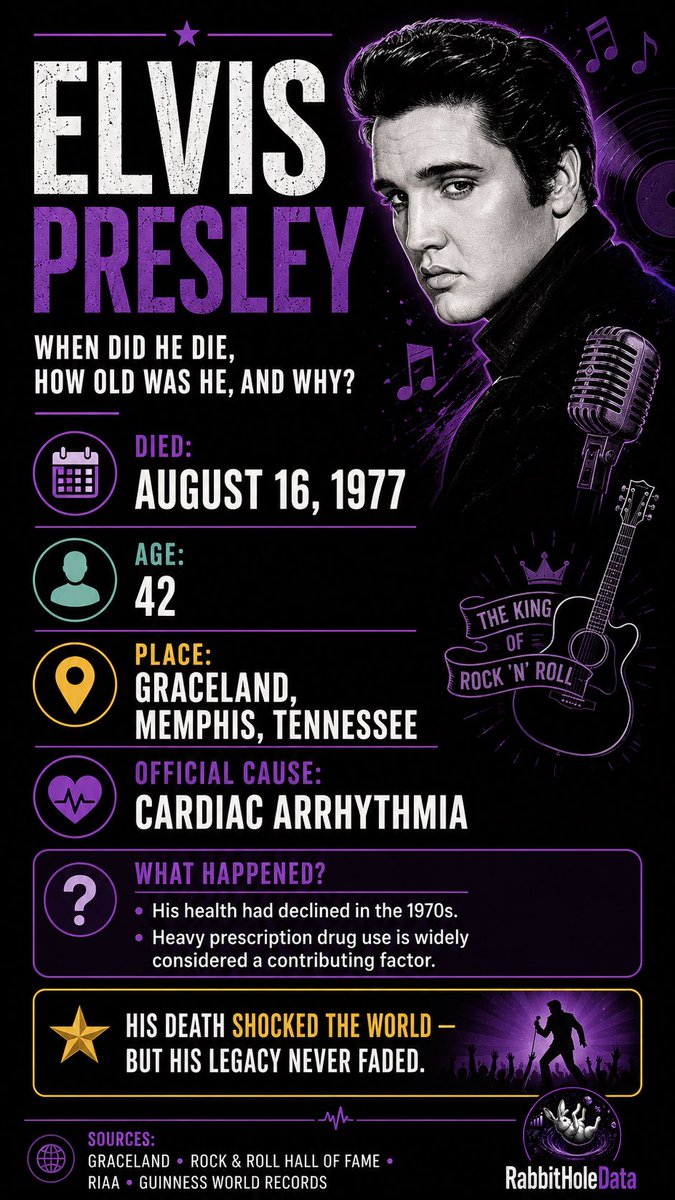
On August 16, 1977, Elvis Presley died at Graceland at just 42 years old. Decades later, his nickname still survives: “The King of Rock ’n’ Roll.” 👑🎸
So why was Elvis that huge — and why does he still matter?
First, an important distinction: Elvis did not invent rock & roll. The genre grew from blues, R&B, gospel and country, with crucial pioneers such as Sister Rosetta Tharpe, Chuck Berry, Little Richard and Big Mama Thornton.
What Elvis did extraordinarily well was bring that musical collision to an enormous mainstream audience.
📺 He arrived at the perfect moment.
Television was becoming a mass medium, and Elvis had more than a voice: his hair, clothes, movement, charisma and provocative stage presence made him instantly recognizable.
🌎 He helped turn rock & roll into global pop culture.
Records, television appearances, concerts and Hollywood movies meant Elvis was no longer simply a singer. He became one of the first truly global multimedia music superstars.
📈 And the numbers remain extraordinary:
• Guinness World Records recognizes Elvis as the best-selling solo artist, with an estimated 1 BILLION records sold worldwide.
• His RIAA-certified U.S. album sales exceed 146.5 million units.
• The Rock & Roll Hall of Fame describes him as the “first anointed King of Rock & Roll.”
And then there are the songs. Five of his most iconic:
🎵 Hound Dog
🎵 Jailhouse Rock
🎵 Can’t Help Falling in Love
🎵 Suspicious Minds
🎵 Love Me Tender
So… is he still the King?
If we mean the artist dominating music today, obviously not. The industry, charts, sales and streaming have completely changed.
But as a cultural title? Yes.
Elvis became a template for what a modern music superstar could be: sound + image + performance + fashion + sexuality + television + mass media.
That formula can still be seen in generations of artists who came after him.
Elvis became more than famous — he became a cultural symbol.
That may be the real reason the title “King of Rock ’n’ Roll” has survived for decades after his death.
Sources:
Graceland
https://t.co/dPcd4oONFz
Rock & Roll Hall of Fame
https://t.co/ihtDkA8e8U
Guinness World Records — Best-selling solo artist
https://t.co/12Z7mmhsqg
RIAA — Elvis Presley certified album sales
https://t.co/XL2YDEkvGq
¡La pelea entre los Caballeros de Bronce y el poderoso Aldebarán de Tauro cumple 39 años! 🐂💥
¿Eres de este signo zodiacal? ♉
#LosCaballerosdelZodiaco#SaintSeiya
🍺 Today is International Beer Day!
Every first Friday of August, people around the world raise a glass to one of humanity’s oldest drinks. But unlike beer itself—which has a history stretching back thousands of years—International Beer Day is surprisingly young.
It began in 2007 in Santa Cruz, California, created by Jesse Avshalomov and friends. The idea was simple: bring people together over beer, recognize the brewers and bartenders behind it, and encourage people to discover beers and brewing traditions from other cultures.
Originally, the celebration was held on August 5. In 2012, organizers decided to move it to the first Friday of August, making it easier to celebrate going into the weekend. An official 2013 guide already described it as a worldwide celebration and listed events in 50 countries.
So what do people actually do? 🍻
Meet friends for a beer, try unfamiliar styles or beers from another country, visit a brewery, order tasting flights, pair beer with food, attend trivia nights or special events—and, importantly, toast the people who brew and serve it.
And there’s a good reason beer can support a global celebration: its scale is enormous.
🌍 In 2024, the world consumed about 194.1 billion liters of beer. Asia alone represented 32.6% of global consumption, while China remained the world’s largest market by total volume. The Czech Republic was #1 per capita for the 32nd consecutive year, at 148.8 liters per person.
That global total works out to roughly 532 million liters every day—or more than 6,000 liters every second.
So International Beer Day isn’t commemorating a battle, a king, or an ancient brewing discovery. It started with a few beer lovers in California and became a simple idea with global appeal:
Beer is not just a drink. It’s agriculture, chemistry, history, craftsmanship—and culture shared across thousands of years. 🍺🌍
Sources:
International Beer Day — official materials
Kirin — Global Beer Consumption Report 2024
🌍 Hoy se celebra el Día Internacional de la Amistad.
Pero, ¿por qué se celebra el 30 de julio?
Aunque muchos creen que es una fecha creada por la ONU, en realidad su historia comenzó más de medio siglo antes… y en un país de Sudamérica. 🧵👇
En 1958, el médico paraguayo Ramón Artemio Bracho fundó la Cruzada Mundial de la Amistad.
Su objetivo era sencillo, pero ambicioso: promover la amistad como una herramienta para construir una cultura de paz entre las personas y los pueblos.
Fue esta organización la que eligió el 30 de julio como el Día de la Amistad.
Más de 50 años después, en 2011, la Asamblea General de la ONU adoptó oficialmente esa misma fecha como el Día Internacional de la Amistad, invitando a todos los países a celebrarla.
Lo curioso es que el 30 de julio no conmemora ningún acontecimiento histórico mundial.
La ONU simplemente decidió reconocer el trabajo que durante décadas había realizado la Cruzada Mundial de la Amistad, convirtiendo una iniciativa nacida en Paraguay en una celebración internacional.
Pero la idea va mucho más allá de reunirse con amigos.
Según la ONU, la amistad puede ayudar a:
🤝 Reducir prejuicios y la desconfianza.
🌍 Acercar culturas y países.
🕊️ Favorecer el diálogo y la comprensión mutua.
👧👦 Enseñar a las nuevas generaciones el respeto, la empatía y la cooperación.
Entonces, ¿por qué en muchos países se celebra otro día?
Porque el 30 de julio convive con tradiciones nacionales que ya existían:
🇦🇷🇺🇾🇧🇷 20 de julio: Argentina, Uruguay y Brasil (inspirado por la llegada del ser humano a la Luna en 1969).
🇺🇸🇮🇳 Primer domingo de agosto: Estados Unidos, India y varios otros países.
🇪🇨🇲🇽🇵🇪🇻🇪 14 de febrero: Ecuador, México, Perú, Venezuela y otros, junto con el Día del Amor y la Amistad.
Una idea que nació en Paraguay terminó siendo reconocida por casi todo el mundo.
A veces, los cambios más grandes empiezan con algo tan sencillo como una amistad. 💜
⸻
Fuentes
• ONU – Día Internacional de la Amistad: https://t.co/E835vXffiu
• Resolución A/RES/65/275 de la Asamblea General de la ONU: https://t.co/jjt3IJobet
• UNESCO – International Day of Friendship: https://t.co/wvvTKtlcCP
• Cruzada Mundial de la Amistad: https://t.co/2OJlXs8qRl
57 years ago today, humans first landed on the Moon. The source code that helped get them there? It’s on GitHub.
Margaret Hamilton led the MIT team responsible for Apollo’s onboard flight software. The Apollo Guidance Computer software eventually grew to about 145,000 lines of code. 👀
Explore the original Apollo 11 guidance software for the Command and Lunar Modules. 🌕
https://t.co/x1lDIB4vjX
Image credit: Draper Laboratory; restoration by Adam Cuerden, via Wikimedia Commons.
Combatir la piratería es necesario, pero el análisis queda incompleto si toda la responsabilidad recae en quien consume.
Como decía Gabe Newell, la piratería también suele ser un problema de servicio: precio, acceso y calidad. Este año hay quejas constantes por transmisiones caras, cámaras poco nítidas y una experiencia que no justifica el costo.
Exigir respeto por los derechos audiovisuales y exigir un mejor producto no son posturas opuestas. Si la transmisión quiere valer más, también debe ofrecer más: mejor calidad, una experiencia acorde al precio y una propuesta que entienda el contexto económico y el poder adquisitivo en Ecuador.
El desarrollo del tema (piratería) con mayor amplitud aquí: https://t.co/EsSnEZqPsx
While working with Codex, a GPT‑5-based coding agent, I attempted to use the in-app browser to visualize and validate a local HTML report opened through a file:// URL.
Codex returned the following error:
“Browser Use rejected this action due to browser security policy. Reason: Browser use cannot visit the requested page because its URL is blocked by the Browser use URL policy. The agent must not attempt to achieve the same outcome via workaround, indirect execution, raw CDP or browser commands, alternate browser surfaces, or policy circumvention.”
Como dijo Gabe Newell, de Valve: la piratería suele ser más un problema de servicio que de precio.
Precios altos, mala oferta, bloqueos y fragmentación la explican, pero no justifican que el atajo ilegal sea siempre la primera opción. No poder pagar todas las plataformas también puede significar elegir una, rotarlas o no tener ninguna.
Cuando buscar lo pirata se vuelve automático, deja de ser solo una falla del mercado y pasa a ser una práctica normalizada que también perjudica a creadores y servicios locales.
El desarrollo del tema con mayor amplitud aquí: https://t.co/EsSnEZqPsx
Do longer workweeks actually help?
Only in one narrow case: a short, real emergency with a clear end date and recovery afterward.
As a routine, the evidence points the other way: long hours tend to hurt health, safety, sleep, and quality.
The red line in the research is usually around 55+ hours per week.
A joint WHO/ILO analysis estimated that long working hours led to 745,000 deaths from stroke and ischemic heart disease in 2016. Compared with 35–40 hours per week, working 55+ hours was associated with 35% higher stroke risk and 17% higher risk of death from ischemic heart disease.
That matters because a “12-hour Monday-to-Friday schedule” is already 60 hours per week.
The problem is not only long-term disease. It is also performance.
A NIOSH/CDC review looked at 52 studies on overtime and extended shifts. Long hours were repeatedly associated with fatigue, poorer sleep, more injuries, and reduced performance.
In one U.S. cohort of 10,793 workers, overtime was associated with a 61% higher injury rate. In hospital nurses, shifts longer than 12 hours, overtime, and working more than 40 hours per week were linked with significantly higher error risk.
So, are extra hours ever “good”?
Yes — but mostly as a rescue tool.
In software engineering, a systematic review of time pressure found a familiar tradeoff: many high-quality studies reported higher short-term productivity, but also lower quality. In other words, overtime can buy speed, but often pays for it with bugs, mistakes, rework, and burnout.
A practical way to think about it:
1 week: often manageable if it is a true emergency and recovery follows.
2 weeks: fatigue starts accumulating. Sleep, mood, and focus slip.
4 weeks: this is no longer just an emergency; it starts looking like poor planning, understaffing, or unrealistic scope.
8 weeks: burnout, mistakes, health strain, and quality problems rise.
12 weeks: sustained overwork. High risk, not a healthy normal.
The key distinction is this:
Overtime is not automatically bad. Chronic overtime is.
A serious incident, production outage, legal deadline, migration, security breach, or launch crisis may justify extra hours for a short period. But it should come with rules:
Clear end date.
Reduced scope.
Rotation.
Protected sleep.
No 7-day weeks if avoidable.
Compensatory rest after.
A postmortem to prevent the same “emergency” from becoming normal.
The trap is when companies call every planning failure an emergency.
If overtime is rare, paid, limited, and followed by recovery, it can help a team get through a crisis.
If overtime becomes the operating model, the evidence is pretty clear:
You are not gaining productivity.
You are borrowing from sleep, health, quality, and future capacity.
Good for a short rescue. Bad as a routine.
References:
WHO/ILO, long working hours and deaths from heart disease/stroke:
NIOSH/CDC review on overtime and extended shifts:
Rogers et al., hospital nurses and patient safety:
Kivimäki et al., The Lancet meta-analysis:
Time pressure in software engineering systematic review:
Is this sidebar meant to show threads across all projects in one global view, or would the same “Needs you / Running / Recent” structure be repeated separately for each project?
Also, for option 3, how would the state transitions work visually? For example, when a thread moves from Running → Needs you → Running → Recent, would the card animate between sections? I’d be curious to see how those transitions would feel in practice, since threads jumping between tiers could otherwise get a bit disorienting.
Why is World Rock Day celebrated on July 13? 🤘
Because on July 13, 1985, rock music became the soundtrack to one of the largest humanitarian broadcasts in history: Live Aid.
The event was organized by musicians Bob Geldof and Midge Ure after television reports exposed the devastating famine in Ethiopia. Their first response was the charity single Do They Know It’s Christmas? Its success inspired something far more ambitious: a massive concert capable of reaching the entire world.
Live Aid was staged mainly at Wembley Stadium in London and JFK Stadium in Philadelphia. For roughly 16 hours, dozens of major artists performed while the concerts were linked internationally by satellite.
Audience estimates vary by source, but the broadcast reached well over one billion viewers across more than 100 countries—an extraordinary achievement for 1985. It also raised more than $100 million for famine relief, with some later estimates placing the total considerably higher.
But its importance went beyond money.
Live Aid demonstrated that music, television and celebrity could be combined to mobilize people globally around a humanitarian crisis. It became a model for later benefit concerts, fundraising campaigns and artist-led activism.
It also produced some of rock’s most enduring images.
Queen’s compact Wembley performance—featuring Bohemian Rhapsody, Radio Ga Ga, We Will Rock You and We Are the Champions—is still widely regarded as one of the greatest live sets ever performed. Freddie Mercury did not merely sing to the crowd: he transformed tens of thousands of people into part of the performance.
Where did rock come from?
Rock ’n’ roll emerged in the United States during the late 1940s and 1950s. It was not created from a single genre or by one person.
Its foundations came largely from African American rhythm and blues, blues and gospel, combined with influences from country, boogie-woogie and other popular styles.
Artists such as Sister Rosetta Tharpe, Chuck Berry and Little Richard were fundamental in shaping its sound. Rock later crossed into a wider commercial audience and evolved through the British Invasion, hard rock, punk, metal, alternative music and countless other branches.
Its history is complex: rock became a global cultural force, but its growth also involved racial segregation, unequal recognition and the frequent repackaging of Black musical innovation for white audiences.
That makes July 13 more than a celebration of famous bands.
World Rock Day remembers the moment when a genre born from cultural fusion, rebellion and social change showed that it could unite a global audience around a common cause.
Rock was entertainment.
On July 13, 1985, it also became global action.
References
History — Live Aid concert raises more than $100 million:
https://t.co/d1ocew0Dwf
TIME — Live Aid’s 30th anniversary and global impact:
https://t.co/nDQ6IB56zI
Encyclopaedia Britannica — Rock music and its historical roots:
https://t.co/Fi2fCOVm3Z
Rock & Roll Hall of Fame — History of rock and its pioneers:
https://t.co/sAMVHh5b5f
Queen — Live Aid performance:
https://t.co/BetDk0FdbI
Should Engineering Managers be technical or people focused in the AI Era? @GergelyOrosz, former Uber EM and founder of The Pragmatic Engineer, says the pendulum has swung to technical managers, for now:
“I'm not sure there's a right or wrong model. I've seen all sorts of models work out. There's pros to both.
When an engineering manager does not code, they will care far more about people. They will pay more attention to what is frustrating people at the personal level, at the organizational level. And they will try to fix those systems and they'll try to take really good care of people.
Engineering managers who code, they will be more into details, they will be able to give more technical guidance, they will have better technical discussions and they will care a lot less about this first category of things. And they also probably will not have bandwidth to make systems level changes or go to meetings to, for example, work with HR to actually change some policy that makes no sense and upsets a few people or work with a bunch of other teams to have this new system instead of everyone just duplicating the work.
Right now, the industry is definitely going very strongly in the direction that managers should be technical. Let's forget about this people management stuff.
So I think people need to, unfortunately, expect less guidance and support from managers. Managers who love doing this part and are very good at the people part will probably feel underappreciated for a while.
And I think there's a pendulum. I think it'll swing back. And I think we've been at the side where we have been very focused on people and it has been very rewarding as a manager. And it was great to be an engineer at companies like this.
It's now going back where it'll be less so, and I wonder if it'll come back again”
Dota 2 turns 13 today.
Official release: July 9, 2013.
But Dota 2 did not begin like a normal video game.
It began as DotA, a fan-made Warcraft III mod. A community experiment became a competitive format. Then Valve hired IceFrog, the mysterious developer behind DotA Allstars, and turned that mod culture into a standalone game.
That is the strange origin of Dota 2:
not a top-down studio invention, but a fan-built rabbit hole that became one of the most important esports in history.
The biggest symbol of that transformation is The International 2021.
TI 2021 had a total prize pool of:
US$40,018,195
Team Spirit won the tournament and the first-place prize was:
US$18,208,300
That number is absurd even when compared with traditional sports:
TI 2021 champion: US$18.2M
2026 Masters winner: US$4.5M
2026 Wimbledon singles champion: £3.6M
Tour de France overall winner: €500k
So the 1st-place prize at TI 2021 was roughly 4x bigger than the Masters winner and about 36x bigger than the Tour de France overall winner.
And if we compare it with football?
For the 2026 FIFA World Cup, the champion receives US$50M from FIFA, while the total prize pool for all 48 teams is US$655M. But there is an important difference: that World Cup money goes to the national federation/team structure, not directly as a single player or five-person roster payout.
That makes Dota 2’s TI 2021 prize especially striking: a five-player esports team earning a prize in the same conversation as major global sports.
And Dota 2 is not just surviving on nostalgia.
On Steam, Dota 2 still had hundreds of thousands of active players on July 9, 2026, with Steam Stats showing 357,374 players active and a daily peak of 719,275 at one snapshot that day. Player counts move constantly, but the point is clear: 13 years later, Dota 2 remains one of Steam’s most-played games.
Dota 2 is a rare case where a mod became a game, a game became an esport, and an esport became a financial benchmark for competitive gaming.
A fan-made map turned into a global institution.
References / links:
Steam Dota 2 release date: https://t.co/LAmpvhDdev
Wired — Dota origin / IceFrog / Valve: https://t.co/H0xxKJ0MYq
Dota 2 TI10 official prize pool: https://t.co/494iexMrYs
Steam Stats: https://t.co/WajQU2Uda7
Wimbledon prize money: https://t.co/iDjRgUHWVW
PGA Tour Masters purse: https://t.co/cks99R8scb
Tour de France prize money: https://t.co/UGqn700SeG
FIFA World Cup 2026 prize money: https://t.co/J0vAlIwecV
Dota 2 turns 13 today.
Official release: July 9, 2013.
But Dota 2 did not begin like a normal video game.
It began as DotA, a fan-made Warcraft III mod. A community experiment became a competitive format. Then Valve hired IceFrog, the mysterious developer behind DotA Allstars, and turned that mod culture into a standalone game.
That is the strange origin of Dota 2:
not a top-down studio invention, but a fan-built rabbit hole that became one of the most important esports in history.
The biggest symbol of that transformation is The International 2021.
TI 2021 had a total prize pool of:
US$40,018,195
Team Spirit won the tournament and the first-place prize was:
US$18,208,300
That number is absurd even when compared with traditional sports:
TI 2021 champion: US$18.2M
2026 Masters winner: US$4.5M
2026 Wimbledon singles champion: £3.6M
Tour de France overall winner: €500k
So the 1st-place prize at TI 2021 was roughly 4x bigger than the Masters winner and about 36x bigger than the Tour de France overall winner.
And if we compare it with football?
For the 2026 FIFA World Cup, the champion receives US$50M from FIFA, while the total prize pool for all 48 teams is US$655M. But there is an important difference: that World Cup money goes to the national federation/team structure, not directly as a single player or five-person roster payout.
That makes Dota 2’s TI 2021 prize especially striking: a five-player esports team earning a prize in the same conversation as major global sports.
And Dota 2 is not just surviving on nostalgia.
On Steam, Dota 2 still had hundreds of thousands of active players on July 9, 2026, with Steam Stats showing 357,374 players active and a daily peak of 719,275 at one snapshot that day. Player counts move constantly, but the point is clear: 13 years later, Dota 2 remains one of Steam’s most-played games.
Dota 2 is a rare case where a mod became a game, a game became an esport, and an esport became a financial benchmark for competitive gaming.
A fan-made map turned into a global institution.
References / links:
Steam Dota 2 release date: https://t.co/LAmpvhDdev
Wired — Dota origin / IceFrog / Valve: https://t.co/H0xxKJ0MYq
Dota 2 TI10 official prize pool: https://t.co/494iexMrYs
Steam Stats: https://t.co/WajQU2Uda7
Wimbledon prize money: https://t.co/iDjRgUHWVW
PGA Tour Masters purse: https://t.co/cks99R8scb
Tour de France prize money: https://t.co/UGqn700SeG
FIFA World Cup 2026 prize money: https://t.co/J0vAlIwecV