Enthusiastic about Biocatalysis, Evolution and Extremophiles. Loves gradients, microengineering and meditation. @KITKarlsruhe @NiemeyerLab. Views are my own.
Imagine you could visualize the stress of microbes using a rainbow of fluorescent proteins! Our RGB-S reporter, a plasmid that monitors different stress types in real-time is now available through addgene: https://t.co/ddBEXsDoFX
The paper: https://t.co/vvlWR7AUzZ
New article! Read A three-colour stress biosensor reveals multimodal response in single cells and spatiotemporal dynamics of biofilms in npj Biofilms https://t.co/xkKijWSzmP
@EvolvedBiofilm@KITKarlsruhe Thank you for mentioning our work so prominently here 😀 Since there have already been a few enquiries: we are currently in the process of depositing the plasmid with Addgene. I will post here as soon as it is available there.
These microbubbles are further processed to become monodisperse foams that consist almost entirely of enzymes.
These foams work as stable, highly active biocatalysts @RabeKersten@NiemeyerLab@KITKarlsruhe
👉 https://t.co/CTvo1Ljy16
Enzymes and foams? Great idea?
Contrary to what we probably all learned in basic biochemistry class, foamed enzymes can be used to produce extremely stable biocatalytic materials.
Check out the paper
https://t.co/3m2wU18rZa
and the corresponding german press release.
Congratulations to Esther Mittmann who won a well deserved poster prize at #Biotrans2023! Anaerobic flow biocatalysis is not easy, but continuous transformation is the key to establishing new-to-nature reactions for future industrial applications!
#Biotrans2023 has offered us much science and fun 😊 Thanks a lot to the organizers and Julian Hertel, Felix Ott, Esther Mittmann, Astrid Winterhalter, Marius Stöckle for representing IBG-1 !
#biotrans2023 Today we have three more posters for you on thermostable enzymes (Marius, 1222), use of ITC for enzyme modeling (Felix, 1392) and self-immobilizing enzymes (Astrid, 1414). Be sure to check them out 😀🧪🦠👩🔬🤓
Finally on my way to LaRochelle! L
Looking forward to great science and happy to presen our work on a new biocatalytic material on Thursday 😀
While I am traveling, talk to my colleagues Esther and Julian presenting poster 1229 and 1393 today, more posters tomorrow
#biotrans2023
📢GBM Compact: Focus on Proteomics 👉Registration is open at https://t.co/VKpLp7KHkm Register and submit your abstract now! Short talks will be selected from the abstracts! Also, two poster prizes (300 Euro each) will be awarded; Join us in Frankfurt for an exciting conference🤩
Super happy to be part of the YI@GBM board, ensuring that early career scientist, post-doc, group leader etc are also being heard. Great team 👩🔬🧑🔬👨🔬
OPEN POSITION - Join our team @KITKarlsruhe for #deeplearning based #simulation of #xray#tomography to enable training of algorithms for processing time-resolved tomography.
Check out this link to learn more: https://t.co/SYLfvI9wQs
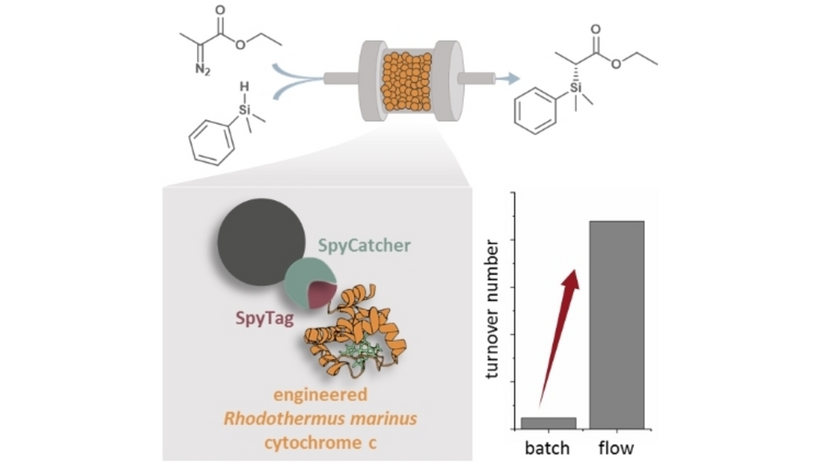
How to increase total turnover numbers of new-to-nature enzyme reactions? Integrate them into flow reactors to enable continuous conversions, check out our paper in @ChemCatChem thanks to the hard work of Sabrina Gallus, Esther Mittmann and Annika Weber 👍
An Immobilised Silicon-Carbon Bond-Forming Enzyme for Anaerobic Flow Biocatalysis by Kersten S. Rabe and co-workers (@NiemeyerLab, @RabeKersten). #OpenAccess thanks to #ProjektDEAL. https://t.co/MlfFTZRCiM
Looking forward to fixing the substrate solubility and drop in stereoselectivity next 🧪🤓
Thanks: German Chemical Industry Association VCI for the support of Kekulé Fellows Sabrina Gallus (former) and Annika J. Weber (current) and @ChemCatChem for the fast publication process!
We moved the new-to-nature biocatalytic production of organosilicones developed in the laboratory of @francesarnold into a continuous reaction setup under anaerobic conditions. Result: TON up six-fold and much higher STY ⬆️⬆️👍
https://t.co/t0ngtu0hw2
Second part: We also learned a lot more about the solubility and stability of the substrates and understood what is important for the continuous synthesis of organosilicones under anaerobic conditions.