I’m a results-driven performance marketer and creative strategist with a strong background in media buying, video content creation, and team leadership.
i'm 26. i run a 70+ person creative agency.
we produce 3,000+ ads every single month.
but five years ago i was broke, alone, and starting from zero for the second time.
here's the real story:
at 17, i taught myself video editing.
no course. no mentor. no connections.
just a laptop and an obsession with understanding what makes creative work.
that obsession pulled me into search arbitrage.
500+ ads launched per day.
$500K+ budgets.
hiring and training entire teams.
i opened an office. built a whole operation around it.
by 22, i had scaled past $100K/month.
then i lost everything.
not some of it. all of it.
most people would've gone and gotten a job.
i sat down and asked myself one question:
"what do i actually know how to do better than almost anyone?"
the answer was simple.
i know how to make ads that perform.
not because i read about it.
because i've been in every seat.
editor. strategist. media buyer. founder.
so i rebuilt. but this time with structure.
systems before scale.
data before opinions.
speed before perfection.
today we work with e-commerce brands, supplement companies, and mobile apps.
our creatives run against $10M+ in ad spend every month.
one single ad we produced spent over $530K and scaled for six months straight.
and i still personally review creatives before they reach a client.
i'm not sharing this to flex.
i'm sharing this because nobody tells you the real version.
the version where you lose it all, sit in silence, and decide to rebuild anyway.
that's the part that actually matters.
if you're in the middle of that right now, keep going.
the skills don't disappear when the money does.
Everyone is using AI to make ads now.
Same tools, prompts and workflows everyone copied from the same threads.
So the result is predictable: everyone's ads are starting to look identical.
AI stopped being an advantage the moment everyone got access to it.
The edge now is using it better:
→ Knowing which formats AI speeds up and which ones it cheapens
→ Knowing when your audience needs trust more than polish
→ Keeping real strategists on angle, psychology, and ICP research
→ Letting AI handle speed and format diversification, not the thinking
We use AI heavily in production. It has never written our strategy.
Full automation" is where this is headed. It isn't where it's at yet
Everyone's using the same AI tools right now.
Same prompts. Same models. Same generic outputs.
Which means AI creative is becoming a race to the bottom unless you're using it for what it's actually good at: speed and format diversification, not strategy.
We still put real creative strategists behind every angle. AI just lets them test faster.
This AI replaces your $235K marketing team.
Claude + ChatGPT = 200 creatives in under an hour.
We tested it across 4 D2C client accounts last week.
Here's what used to happen:
→ Brief a creative team. Wait 2 weeks.
→ Get back 5 concepts. 3 miss.
→ Request revisions. Wait another week.
→ Finally launch. Budget already wasted on the delay.
Here's what happens now:
→ Feed Claude the product URL and competitor ads
→ It builds the full buyer psychology. Pain points, objections, dream outcomes.
→ Writes 12+ hooks scored by scroll stop potential and conversion intent
→ Top hooks get paired with visual direction for each ad format
→ ChatGPT generates the finished static ads with product imagery, copy overlays, and brand matched visuals
→ 200 creatives sitting in a folder. Ready to upload to Meta.
The brands running this aren't producing more ads because they have bigger teams. They're producing more because the system removes every bottleneck between strategy and finished creative.
One brief in. 200 creatives out. Tested the same week.
Results across client accounts:
→ Creative production costs dropped 80%+
→ Testing velocity went from 5 ads a month to 40+ a week
→ CPAs dropped because Meta finally had enough creative diversity to optimize
This took us months of real ad spend to figure out. Yours for one DM.
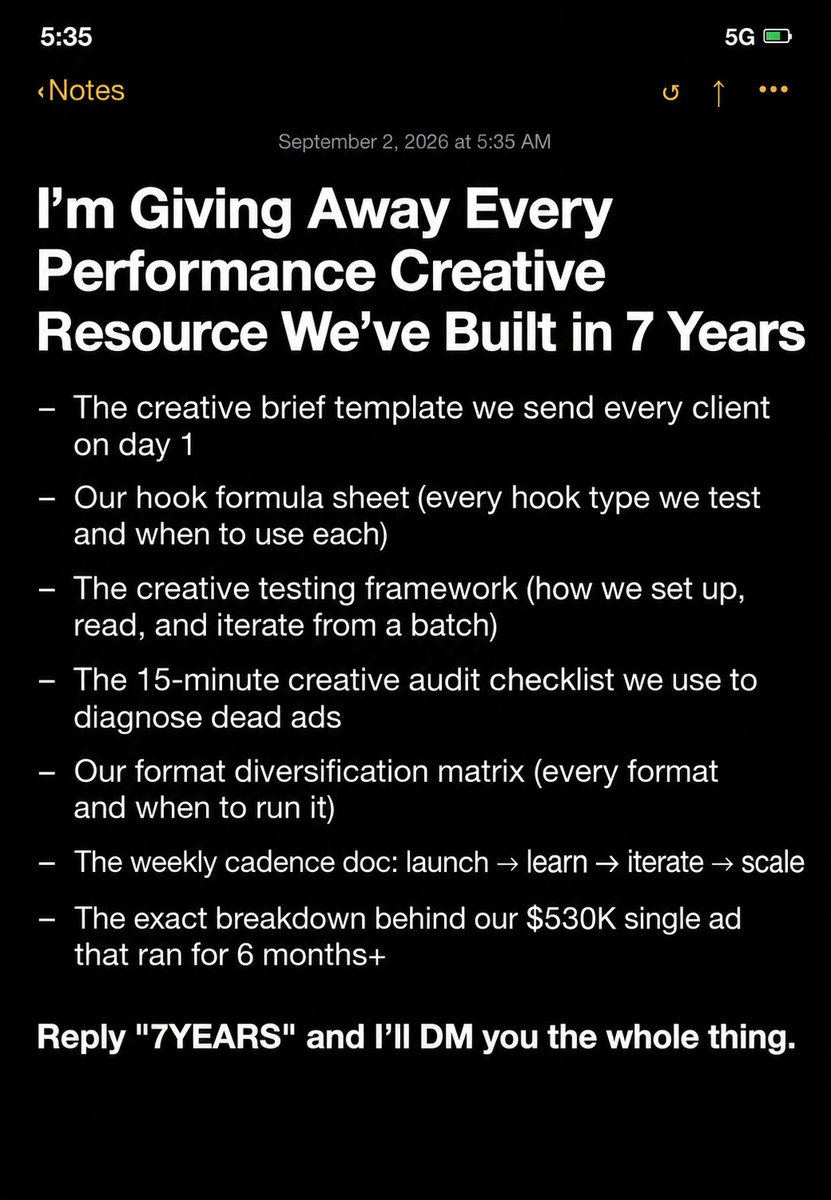
I'm giving away every performance creative resource we've built in 7 years.
Every system, template, and framework in one drop.
For context
These are the same systems running behind 3,000+ ads/month and $10M+ in ad spend for our partners right now.
Inside:
- The creative brief template we send every client on day 1
- Our hook formula sheet every hook type we test and when to use each
- The creative testing framework, how we set up, read, and iterate from a batch
- The 15-minute creative audit checklist we use to diagnose dead ads
- Our format diversification matrix every format and when to run it
- The weekly cadence doc: launch → learn → iterate → scale
The exact breakdown behind our $530K single ad that ran for 6 months+
As I said
This is the actual system behind our results, not a repackaged course.
Whether you're
a) launching your first ad account or
b) already spending $50K+/month and plateaued, it's all in here.
Everything you need to stop guessing on creative.
Reply "7YEARS" and I'll DM you the whole thing.
"We only need 5–10 creatives a month."
We produce 3,000+ ads every single month. So I've been on both sides of the volume argument.
Here's why low volume is killing your ad account 🧵
2/ Low volume isn't a budget decision. It's a learning speed decision.
Every creative you launch is a data point. 5 creatives/month = 5 data points. That's not testing. That's guessing with extra steps.
3/ The brands we work with that scale fastest aren't the ones with the biggest budgets. They're the ones willing to launch 50–75 creatives a week, read the data, and iterate the next week.
Volume isn't an expense. It's a moat.
4/ "But we can't produce that many good ones."
That's a process problem, not a volume problem. If your creative production breaks at 20 ads, you don't have a system. You have a person doing everything manually.
5/ The math is simple.
More creatives = more hooks tested = more angles validated = faster winner identification = faster scaling.
Less creatives = hoping. And hoping is not a strategy in 2026.
Everyone is about to find out that AI is not a competitive advantage.
We produce 3,000+ ads every single month and we use AI heavily. So this isn't a take from someone avoiding the tools.
The pitch is that AI makes creative cheap and fast. That part is true. It's also true for every competitor you have. Same tools, same prompts, same output.
Scroll your feed right now. Ads aren't getting bad.
They're getting identical. On Meta, identical is worse than bad bad at least gets ignored quietly. Identical trains your audience to skip an entire visual language, and yours is in it.
Where AI actually wins:
Speed. Volume. Format diversification, testing formats that used to be too slow or too expensive to justify producing.
Where it loses:
Strategy. ICP research. Angle development. And knowing when not to use it at all. For audiences where trust and authority decide the purchase, an obviously-AI ad costs you credibility you don't get back with better targeting.
We run creative against $10M+ in monthly ad spend. The pattern is consistent: AI creatives don't automatically outperform. It depends entirely on the product, the offer, and who you're talking to.
The advantage was never "we use AI."
It's using it better than everyone using it the same way.
Agree or disagree?
At one point I was launching 500+ ads a day.
Not a typo. Search arbitrage. Me, a team I trained from scratch, and a volume of creative most agencies won't produce in a year.
At that volume you stop having opinions about what works.
You can't afford them. The data contradicts you twenty times a day. Ads I was certain about died in an hour. Ads I almost didn't bother launching spent five figures.
That's the part you can't get from a course, a case study, or someone's thread. Pattern recognition isn't taught. It's accumulated. You have to be wrong a few thousand times in a row before you start being right early.
Most people in paid ads have seen a few hundred creatives perform. Some have seen a few thousand.
That gap is the entire job.
I left arbitrage for e-commerce, lead gen and mobile apps years ago. Brought my best-trained people with me. Different business, different clients, different stakes.
Same instinct, built the expensive way.
Leaving search arbitrage was the best business decision I've made and it looked like a downgrade at the time.
I had the volume. I had the office. I had a team I'd hired and trained myself. Numbers most people would kill for.
And I knew it wasn't going to last in a form I wanted to keep building on.
So I walked into something slower. Real brands. E-commerce, lead gen, mobile apps. Businesses where the product actually has to be good, where the customer comes back, where you can't brute-force your way to a result.
I brought my best people with me and reorganized the entire thing around one mission: content built specifically for paid advertising. Not brand content. Not content that looks nice in a portfolio. Content that has a job.
Four years later: 3,000+ creatives a month, running against $10M+ in monthly ad spend.
The lesson wasn't "take the risk."
It was that volume built on something unsustainable is still just volume. It doesn't compound.
Skill does but only if you point it at something that's going to be there in five years.
Targeting stopped being your edge. Meta automated it into a commodity.
Your creative is the targeting now.
The angle decides who leans in. The hook decides who stays. The person on screen decides who trusts it. Meta just distributes what the creative already sorted for you.
Which means the brands still optimizing audiences and campaign structure are optimizing the part that no longer moves.
And the ones producing 20 ads that are all the same format think they ran 20 tests. They ran one.
Creative isn't the asset you plug into the strategy anymore.
It is the strategy.
How to find your next winning ad.
Most brands don't need more creatives. They need to stop misreading the ones they already have.
We produce 3,000+ ads/month. Here's the diagnostic we run before producing anything new:
Hook rate low → don't rewrite the ad. Rewrite the first 3 seconds.
Hook rate strong, hold rate drops → the body broke the promise the hook made. Fix the body.
Hook + hold strong, CTR low → the offer or CTA isn't landing. The creative did its job. The message after the scroll didn't.
CTR strong, CVR weak → that's not a creative problem. That's a landing page problem.
Most brands look at ROAS, kill everything, and produce 10 new untested creatives.
They just reset the clock.
One question before you brief your next ad: where in the funnel did the last one break?
That answer tells you exactly what to build next.
I'm genuinely terrible at lying.
So I never fake results, never exaggerate numbers, never pretend a campaign performed when it didn't.
Turns out honesty is also good business.
$0 → $42K in 35 days.
This client had never had a consistent winner before working with us.
Week 1: we didn't touch production. We audited every past ad and rebuilt their testing matrix from scratch angles, hooks, edits, clear KPIs. Found 3 new creative angles before we launched a single asset.
Week 2: we delivered 18 variants and replaced the freelancer chaos with a structured sprint workflow. Editors, strategists, and media buyers all in the same feedback loop. CTR went up 68%. CPA dropped 40%.
Week 3: we ran performance checks at 72 hours on everything. Paused what wasn't working. Scaled what was. Launched variants daily to stay ahead of fatigue.
Campaigns scaled 2.5x. ROAS held.
The result isn't the number. It's that performance became predictable.
That system now runs across 15+ eCommerce accounts.
The account is fine. The creative strategy is broken.
7+ years. $10M+ in ad spend/month running against our creatives.
It's almost never the platform.
Fix the one that stung.