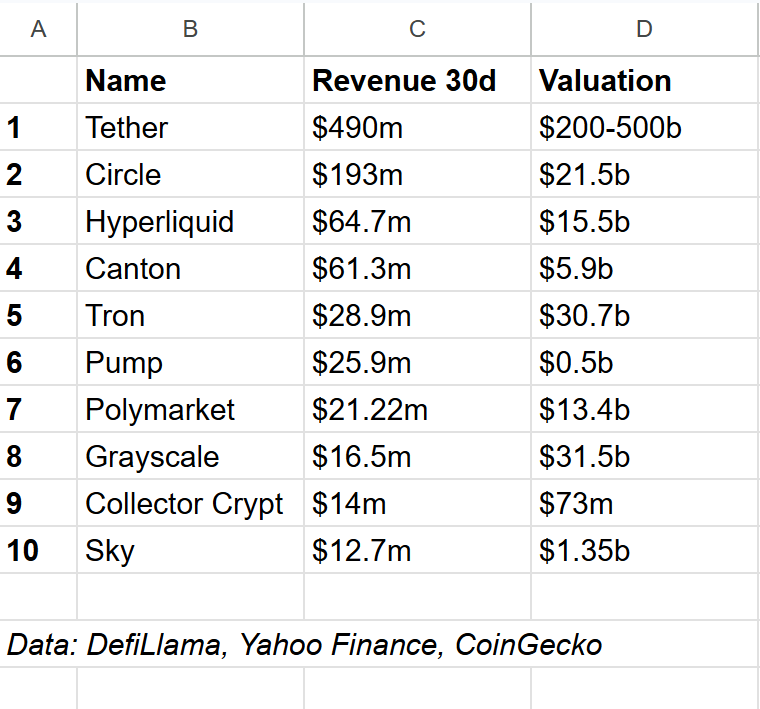
Top 10 crypto projects by revenue.
And the valuation gaps are insane.
Tether: $490M revenue in 30d, $200B–$500B valuation.
Circle: $193M revenue, $21.5B valuation.
Hyperliquid: $64.7M revenue, $15.5B valuation.
Canton: $61.3M revenue, $5.9B valuation.
Tron: $28.9M revenue, $30.7B valuation.
Pump: $25.9M revenue, $0.5B valuation.
Polymarket: $21.22M revenue, $13.4B valuation.
Grayscale: $16.5M revenue, $31.5B valuation.
Collector Crypt: $14M revenue, $73M valuation.
Sky: $12.7M revenue, $1.35B valuation.
Notice anything?
The market is not pricing these projects on revenue alone.
It’s pricing narrative, distribution, optionality, and what people think they could become.
That’s why some high-cashflow names still trade like growth assets,
while some lower-revenue names get massive premiums.
The real alpha is in the gap between what a project earns today and what the market is willing to pay for tomorrow.
If you want, I can turn this into a sharper, more aggressive version too.
@DarfDor Yep. The table is basically a reminder that the biggest winners are often the ones with the widest gap between today’s revenue and tomorrow’s expectations.
Cryptocurrency cards have quietly crossed the $10B+ mark in processed volume.
(A quick summary from @Delphi_Digital's report on crypto neobanks.)
Neobanks Daily — here’s what actually matters:
Crypto card volume hit $10B, with 23.4M txs and 1.6M addresses. May 2026 alone did $830M+ (≈16x in 2 years).
There are 190+ “crypto neobanks”, but real volume is concentrated in a small group.
@Visa still handles ~96% of onchain crypto card volume. Crypto front‑end, old rails underneath.
The real upgrade isn’t the card, it’s stablecoin settlement: faster, cleaner global money movement while UX stays “normal”.
Strongest models: full‑stack issuers (picks-and-shovels), remittance‑first cards, and players in weak banking markets.
DeFi‑native cards try to make the wallet the bank account, letting you spend from onchain balances.
My takeaway:
A “crypto card” alone isn’t interesting anymore.
The winners are the ones people trust to hold, move, and spend stablecoins — the card is just the skin.
@princeofbera@anoma@AnomaPay There are many companies, and not all will survive. But it's clear that the foundation for future payment systems is being laid.