NGC 4038 & NGC 4039 Antennae Galaxies
The Antennae Galaxies are two colliding galaxies in the Corvus (Latin for "crow) constellation, a small constellation in the southern hemisphere.
I love how the colliding of NGC 4038 & NGC 4039 is formed like a heart. The heart shape and the long tails of stars, gas and dust are really fascinating. The two long tails ejected by the galaxies, resemble the antennae of an insect, hence the nickname "Antennae Galaxies".
Data: Telescope Live
Processing: Beatrice Heinze
I did the stacking in Astro Pixel Processor and the processing in PixInsight.
Telescope: Planewave CDK24 (24 Inch/61cm)
Location: El Sauce Observatory, Rio Hurtado valley, Chile => Bortle scale: Class 1
Total Exposure Time: 10 hours 50 minutes
See also the annotated version below in the comment section 👇
Mandel-Wilson 5 - The Fish Hook Nebula
IFN Nebula in Camelopardalis
48h total integration in L-Ha-RGB with SQA 85.
#Astrophotography#CielosESA#Astronomy
The Cygnus Wall — a fragment of the North America Nebula (NGC 7000). Photo taken yesterday, after denoising. The nebula is located approximately 2,590 light-years from Earth (according to Gaia astrometric measurements). In wider views of the North America Nebula, the Cygnus Wall occupies an area corresponding to Central America on a map. The structure consists of layers of hot gas, dust, and newly formed stars, illuminated by bright, young stars — partially obscured by dark dust — that were born within it. #Astrophotography
Cygnus Wall, a fragment of the North America Nebula (NGC 7000), located approximately 2,590 light-years from Earth (based on Gaia astrometric measurements), in an image captured last night using a Seestar S50 telescope. In images covering a wider region of the nebula, the Cygnus Wall is situated in the same area that corresponds to Central America on the map. The Cygnus Wall consists of layers of hot gas, dust, and newly formed stars. It is illuminated by bright, young stars—partially obscured by dark dust—that were formed within it.
#Astrophotography
The Croc's Eye Galaxy (M94) is a face on spiral galaxy with an unusual ring structure and hosts a supermassive black hole. Discovered by Pierre Méchain in 1781. (Per Wikipedia)
Taken 06/02/26
Exp: 4 hours (started 2 hours before moon rise)
#astronomy#astrophotography
The Ring Nebula (M57) captured on the night of May 27th, 2026 — 235 s of live stacking with the Seestar S50 + duo‑band filter. This remarkable object, located about 2300–2500 light‑years away, is one of the most iconic planetary nebulae in our sky. What you see here is the gaseous shell expelled by a dying star once similar to the Sun. #Astrophotography
Vega (α Lyrae) is the brightest star in the constellation Lyra and the fifth brightest star in the night sky, located just 25 light-years from Earth. Here’s a photo from last night. 1240 seconds live stacking with Seestar S50.
The Elephant’s Trunk Nebula (IC 1396A), a cluster of interstellar gas and dust within the larger ionized gas region IC 1396, lies in the constellation Cepheus, about 2,400 light-years from Earth. Data for this image was collected during the night of May 23–24, 2026. #Astrophotography
Clouds over Hudspeth County, Texas.
Hudspeth County is in Far West Texas, just east of El Paso County. These mountains straddle the state line separating Texas and New Mexico and are located a few miles west of Dell City, Texas.
#Panorama#WestTexas#DJImavic4pro
Messier 12, or M12 (NGC 6218), is a globular cluster in the constellation Ophiuchus, sitting about 16000 light‑years from Earth and stretching roughly 75 light‑years across. Here it is in my shot captured on the night of May 14th, 2026. Full image details are listed in the ALT. #Astrophotography
Iris Nebula (NGC 7023) – a reflection nebula in the constellation of Cepheus. Located about 1,400 light-years from Earth, it is illuminated by the bright star SAO 19158, which is surrounded by dense clouds of dust. The star’s blue light reflects off tiny dust particles, giving the nebula its characteristic pale blue glow.
Photo taken last night ✨#Astrophotography
The globular cluster M3 is located in the constellation Canes Venatici (Hunting Dogs). One of the brightest and most magnificent globular clusters in the northern sky, it contains roughly half a million stars and is home to over 270 variable stars — more than any other known globular cluster. This ancient stellar city is about 34,000 light-years away and shines at magnitude +6.2. A true jewel of the spring sky! Photo taken on the night of May 4, 2026. #Astrophotograpy
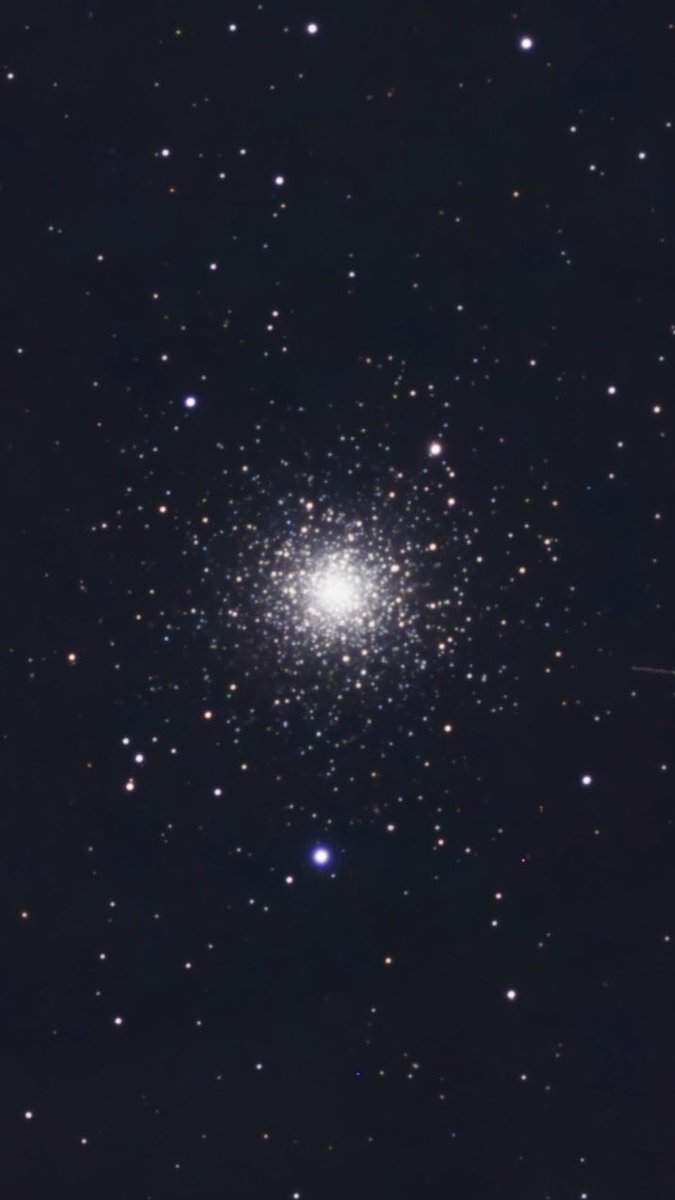
Messier 13 (M13), known as the Great Globular Cluster in Hercules, is one of the most beautiful and brightest globular clusters visible in the northern sky. It consists of several hundred thousand old stars, densely packed within a region about 145 light-years in diameter. Located 22,000–25,000 light-years away from Earth, the cluster is approximately 11.5–11.65 billion years old. It is an easy and highly rewarding target for observation, especially from late spring through the end of summer.
Photo taken on the night of April 29/30, 2026. #Astrophotography
M5 – Globular Cluster in the Constellation Serpens. Astrophotography captured on the night of April 29/30, 2026. This is one of the largest globular clusters in our Galaxy, with a diameter of approximately 164 light-years. M5 lies 24,500 light-years away from Earth and contains over 100,000 stars. Formed more than 10.6 billion years ago, it is one of the oldest globular clusters in the Milky Way. #Astrophotography
Dumbbell Nebula (M27, NGC 6853) — one of the most iconic planetary nebulae in the night sky, tucked away in the constellation Vulpecula. It was formed from a star several times more massive than the Sun, which shed its outer layers after the red giant phase, creating this cosmic “dumbbell.” At its very center shines a white dwarf with a mass of 0.56 ± 0.01 M☉ — the largest known star of its kind. Small, but incredibly powerful.
Photo details in ALT. #Astrophotography