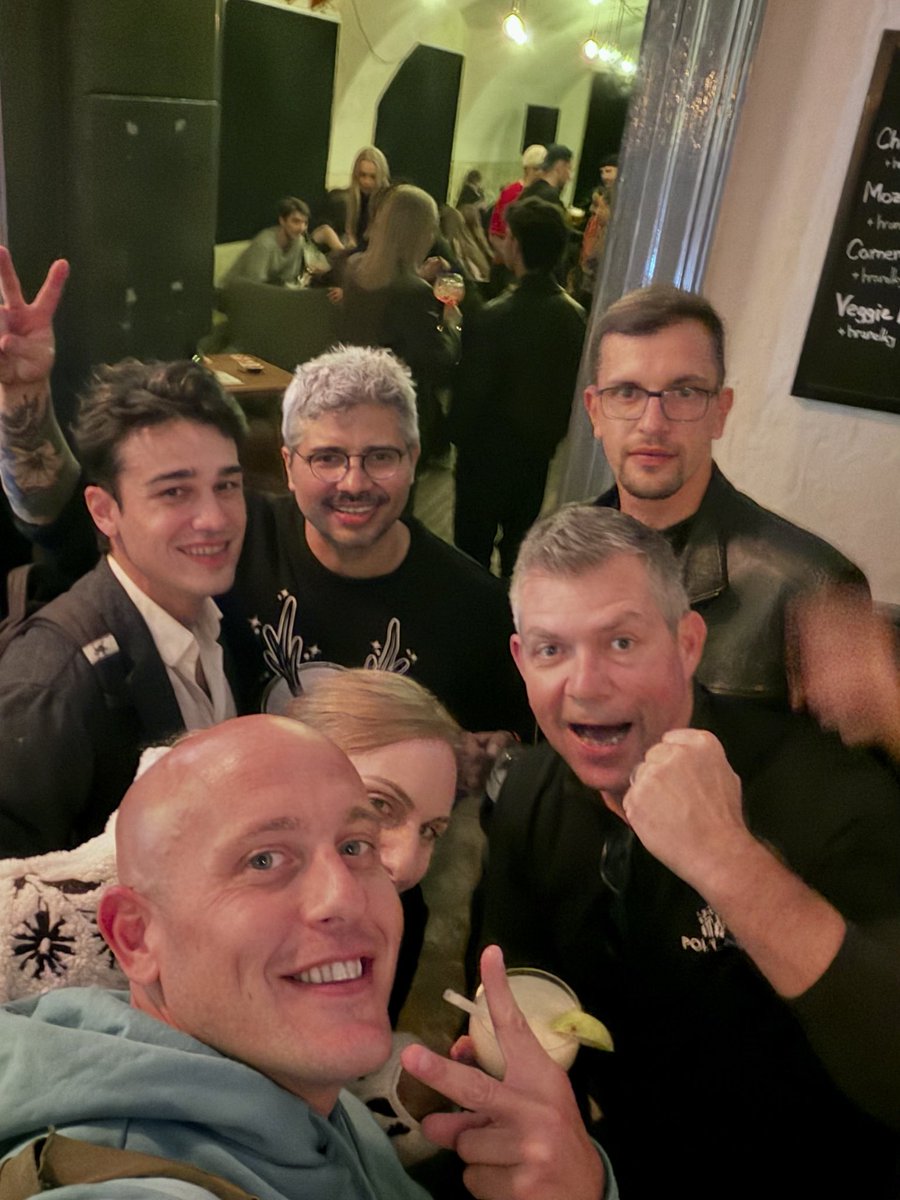
Polis Hubs is open for business. 🏛️
If you're forming a new society, you know the vision is only the start. The real challenge is building and sustaining a thriving community.
That's our work. Inspired by our brain trust at @Polis_Labs, we design field solutions for startup communities: constitutions that hold up, coordination audits that keep them healthy as they grow, and practical roadmaps for founders and investors based on our team's firsthand experiences within the startup society movement.
The company is live. The website is still under construction, so follow along here to see it launch. Working on something right now? Our DMs are open.
"A prospective investor in a network-state-type project once asked me what would prevent a new community from simply buying a chunk of land in the middle of nowhere, where it could just mind its own business and be left alone. I gave two reasons why the invisible approach always backfires.
First, there is no piece of land on the entire big blue Earth that isn't claimed by somebody. The concept of "blank slate" territory is appealing in theory and nonexistent in practice. Inside Network School, the working assumption appeared to be that Forest City is an artificial island*, largely empty, so no Malaysian could feel any attachment to it.
What we found in greater Johor was the reverse. Although nobody in late 2024 knew what Network School was, they definitely had opinions about Forest City. It functioned locally as a monument to how the original Chinese development deal went against Malaysia in general and, if you’ll forgive the term, “majorly screwed us,” in the words of one Johor area business owner. Other Malaysians we spoke with described the island as cursed, and anyone familiar with Malay culture can tell you that word isn't used lightly. Man-made or not, the island represented a huge outlay of both private and public money, and it seemed a blow to their Malaysian national pride that the government would even contemplate selling it off cheaply to foreign investors."
Read more 👇
Excited to join the @Polis_Labs advisory board. Hopefully we will help inform experiments in community building and governance, and provide some answers to challenges parallel societies, charter cities, network states, and special jurisdictions face as they gain momentum
I am excited to announce that @Polis_Labs has formally established its advisory board.
It is now positioning itself as a civtech leader in risk analysis, participatory research, and governance within the parallel society space.
They welcome @mbauwens, founder of the P2P Foundation, Dr. @annbrody7, conducting deep research on decentralized governance and DAOs, and @pcekerevac, a senior fellow at the @AtlasNetwork, developing their freedom, innovation, and technology program.
Happy to welcome them to the team. Could not ask for a more solid group of advisors.
Research from @JoinEdgeCity dropped.
Overall, participant-residents were pleased and stoked.
Concerns emerged regarding communication, and also local displacement issues.
Read the report below. 👇
The recording of the First Sealand Town Hall is now available.
e-Citizens gathered to discuss governance, ideas, and the future of Sealand as part of ongoing civic participation within the community.
🎥 https://t.co/eTl2B9hwMA
E Mare Libertas 🌊
4/4 Four recommendations for organizers in this space, drawn from what participants told us:
— State the governance model honestly
— Pre-establish conflict resolution before it's needed
— Match community infrastructure to social ambition
— Resolve what the experiment is trying to demonstrate
Full study (CC BY 4.0): https://t.co/KmBSxkU7UH
I can't express how proud I am of the @Polis_Labs research team. They are delivering.
Want to understand how individuals living in an experimental pop-up community feel and think about the governance and organization?
There seems to be a decentralization gap that needs to be addressed.
What we learned:
Participants in experimental community projects don't necessarily object to centralized decision-making. But they do mind when the gap between decentralization rhetoric and the centralized operational reality they encounter on the ground is wider than expected.
Managing expectations regarding which decisions will sit with community organizers and which are to be shaped by participant feedback is a key activity that may shape community member willingness to remain or return.
This is a finding the broader ecosystem of popup cities and network-state experiments will likely recognize.
Polis Labs is live.
We're an independent research institute studying how free communities coordinate, why they fail, and what frameworks help them endure.
Updated program, focused thesis.
First research outputs are now public.
https://t.co/N0PiPNX1qI
You can't fight the Machine
But maybe you can rewild it?
I have thoughts on Paul Kingsnorth's Against the Machine and why the parallel societies movement might be the middle way he's missing (link below)
Hey friends! We've got a bundle of updates to share as we close in on the final week of Early Bird ticket prices for Valley of the Commons.
New partners, team members, sponsors and exciting possibilities abound.
Here is the high level overview 🧵
1/7
The team @Polis_Labs is constructing a proper science of voluntary order. This is Synousiology, literally the study of voluntary being-together.
It's research in this arena that tackles why coercion emerges in coordination breakdowns, why voluntary and panarchic orders fail to emerge with regularity, and how parallel societies can adapt their governance and coordination mechanisms to achieve voluntary consensus via relational dynamics and interaction.
This research has some relationship to the Austrian notion of Praxeology, but moves beyond economics and deductive human action to consider emergent, collective, and compositional voluntary order in live human networks.
The future ahead is bright.