@StartideProphet@Dolfijnmanjohns I am the complete opposite. Nothing bores me more than robots, spaceships, psionic powers and nanotech. No matter how much fantasy stuff you put in a sci-fi, it won't hold a candle to the real thing.
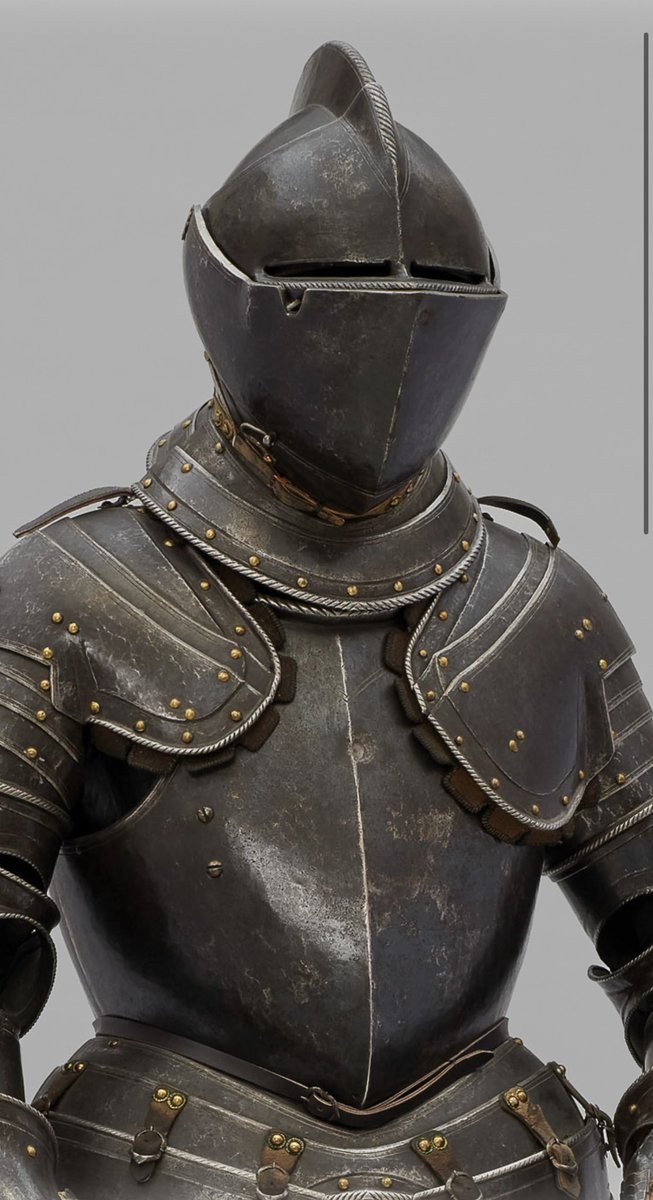
🇮🇹⚔️Proofed Cuirassier Armor of Giacomo Malatesta (1530-1600) made in Milan ca. 1560
“Proofing” was done by shooting the armor with a firearm before being sold to demonstrate it could stop projectiles.
Note the proof marks on breastplate AND the helmet (helmet is MAYBE battle damage) ; you can see how thick this proofed armor was when looking at the helmet wrapper/visor.
The identification of this previously unknown harness with the armor of Giacomo Malatesta was succeeded by O. Gamber in 1958 according to the illustration in Jakob Schrenck von Notzing's 1601 published picture inventory of the Ambraser collection.
Giacomo Malatesta took part as a boy in the campaigns of Charles V against Algiers (1541) and Kleve (1543). After that, he repeatedly fought against the Turks in Venetian service.
Malatesta was captured in Albania before 1572, but released against ransom and ended his career as Venetian commander-in-chief.
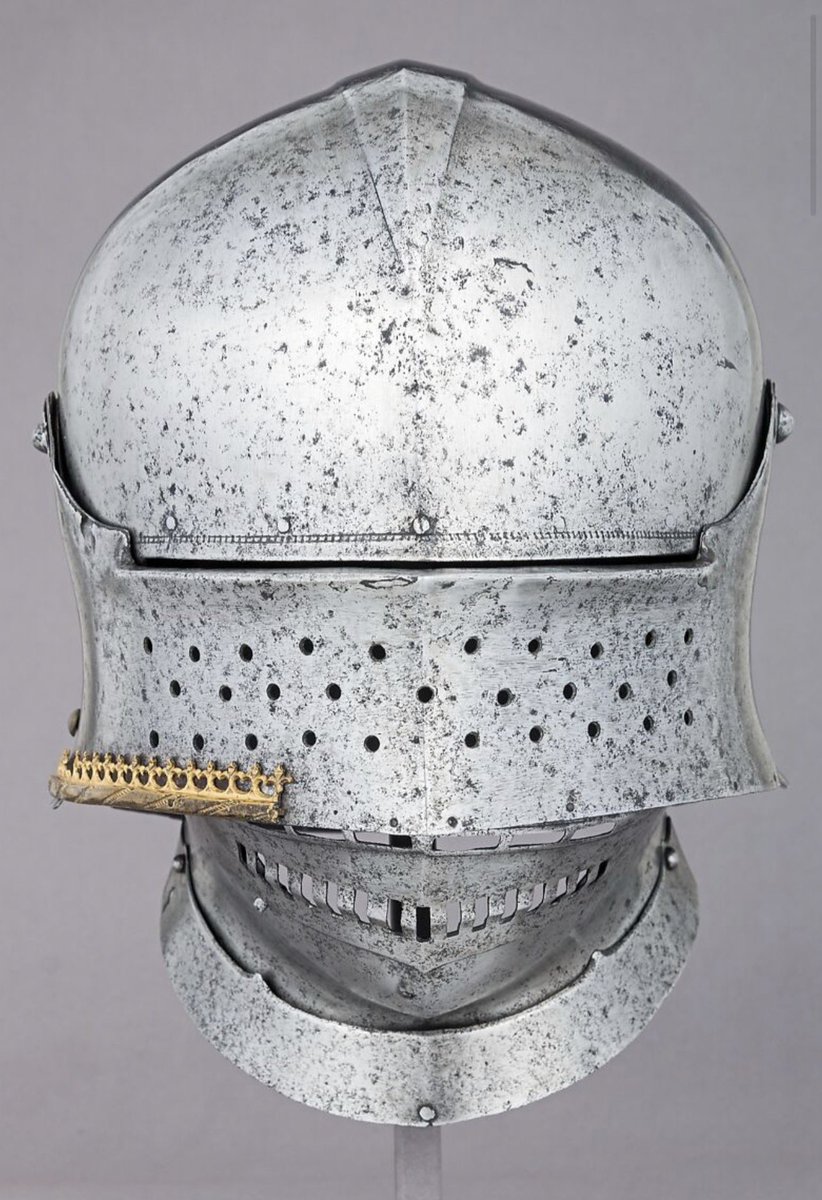
👑🇩🇪🇦🇹Visored Close Sallet of future Holy Roman Emperor Maximilian I Habsburg (1459-1519)
Made in Augsburg ca. 1490 by Lorenz Helmschmied.
This sallet was a new type probably invented by Lorenz Helmschmid for Emperor Maximilian I (1459–1519) around the time he became head of the Holy Roman Empire in 1493.
Its construction, with the falling buffe (chin defense) pivoting on the same points as the visor, anticipates the development of close helmets around 1510. The gilt fleur-de-lis trim, which originally bordered the entire helmet, is a typical late Gothic decoration on armors of high quality and is found on several that belonged to Maximilian and other members of the Habsburg court.
•Dimensions: H. 12 in. (30.5 cm); W. 9 in. (22.9 cm); D. 12 3/8 in. (31.4 cm); Wt. 4 lb. 15.7 oz. (2261 g)
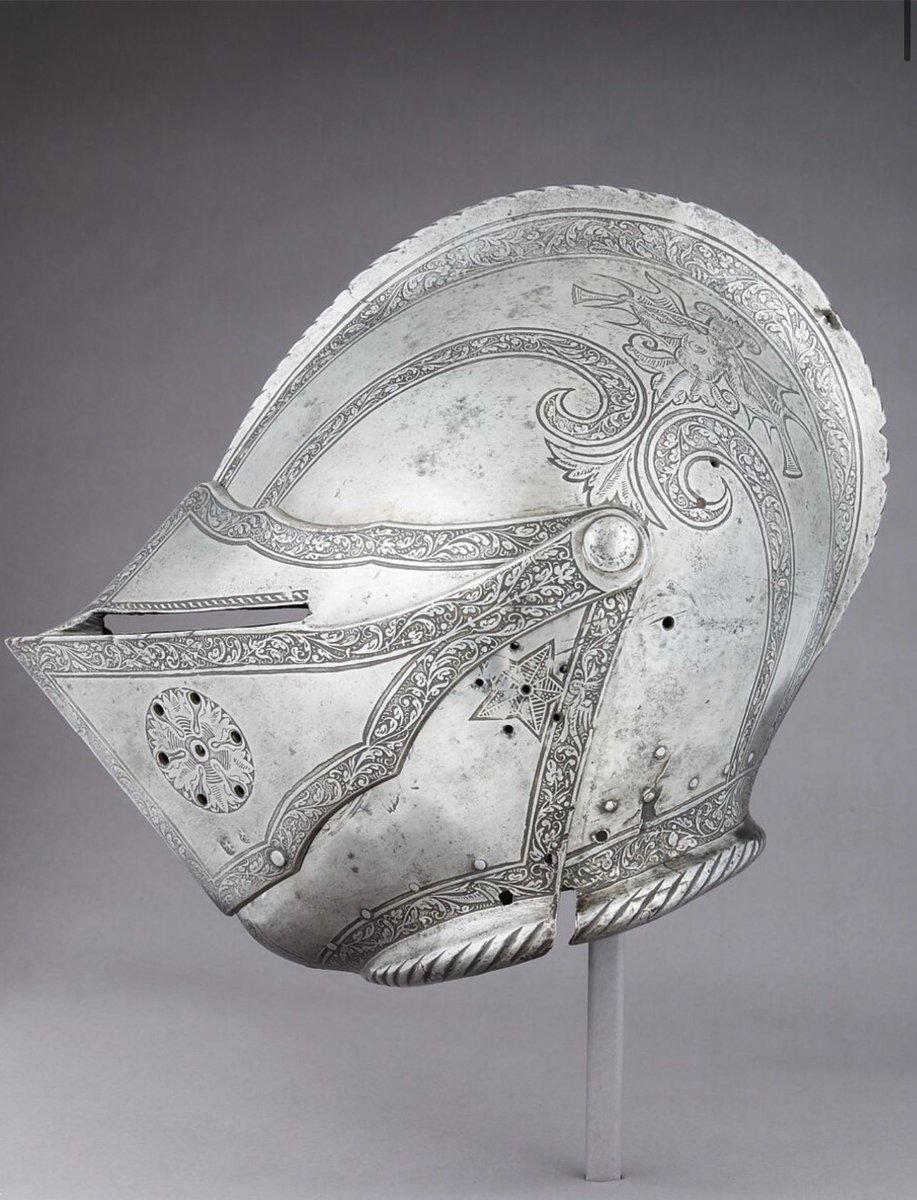
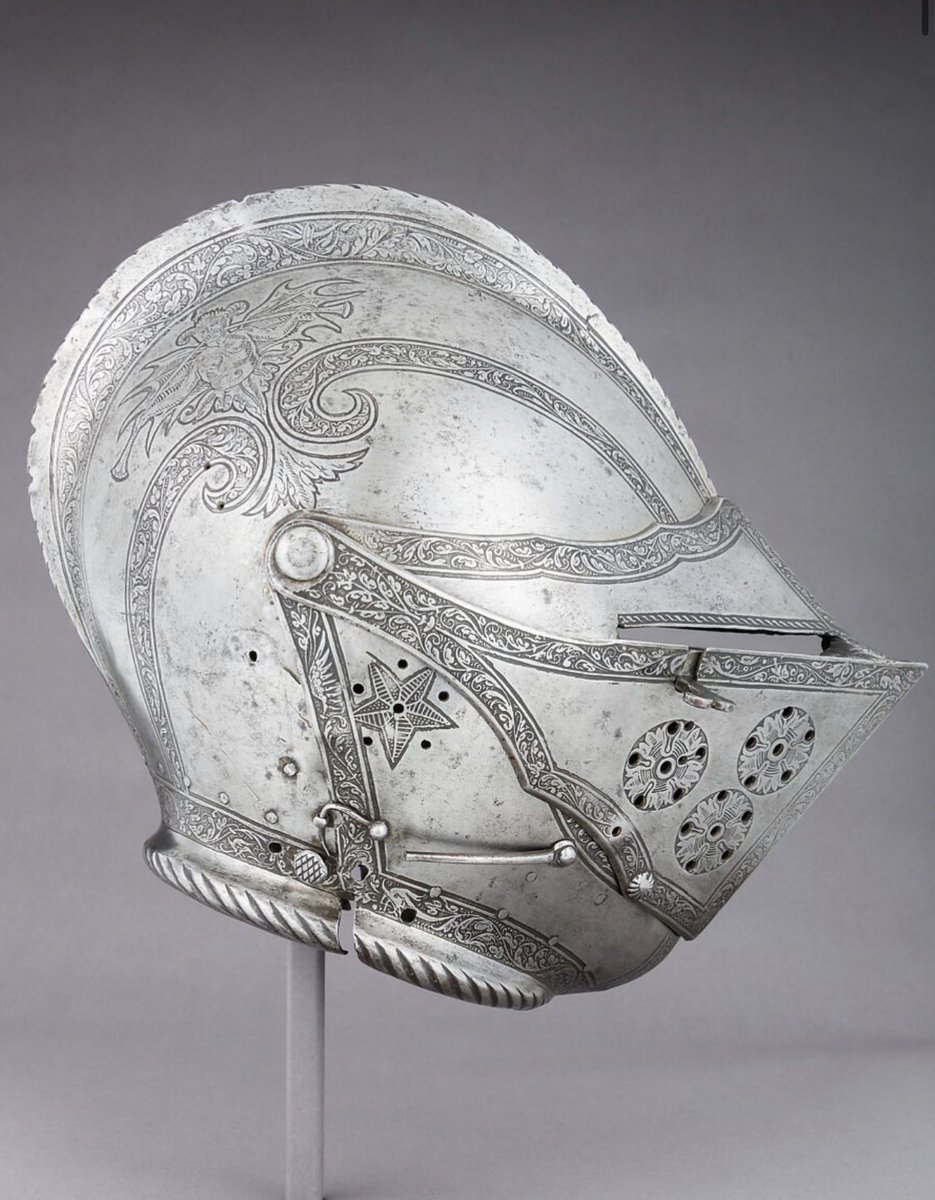
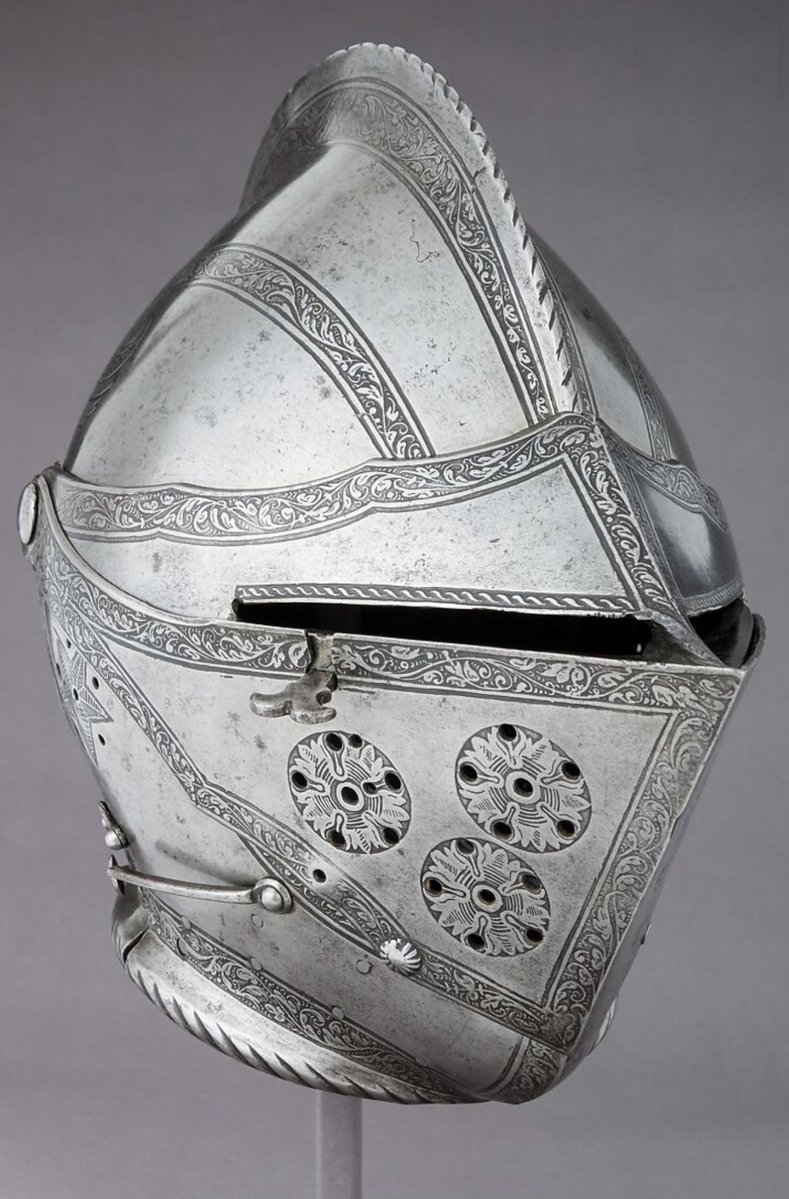
🇩🇪Etched Close Helmet made in Nuremberg ca. 1550 by Kunz Lochner
•Dimensions: H. 12 3/4 (32.4 cm); W. 8 1/8 in. (20.6 cm); D. 13 in. (33 cm); Wt. 6 lb. 9 oz. (2975 g)
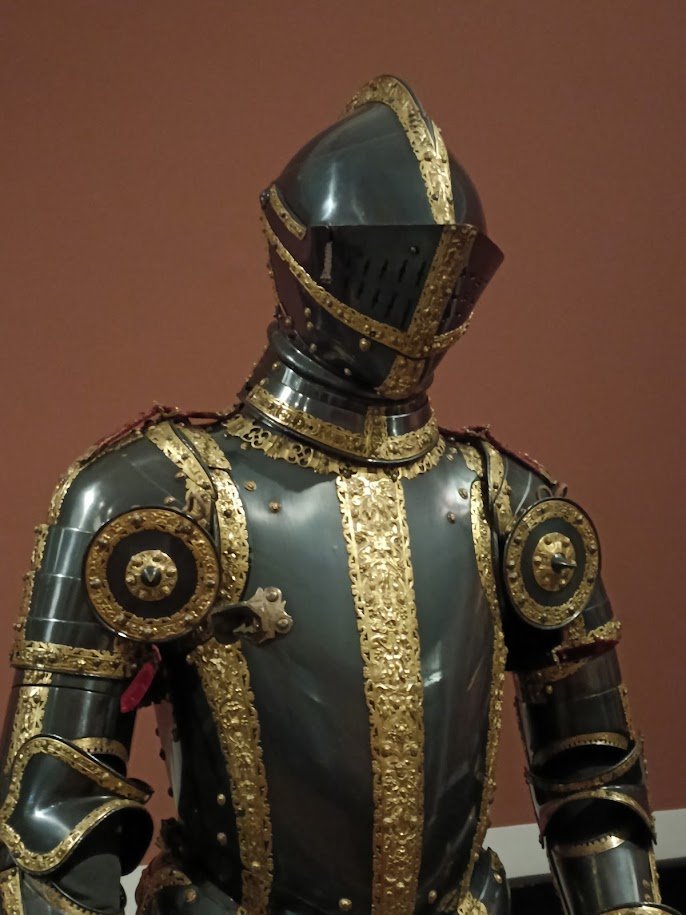
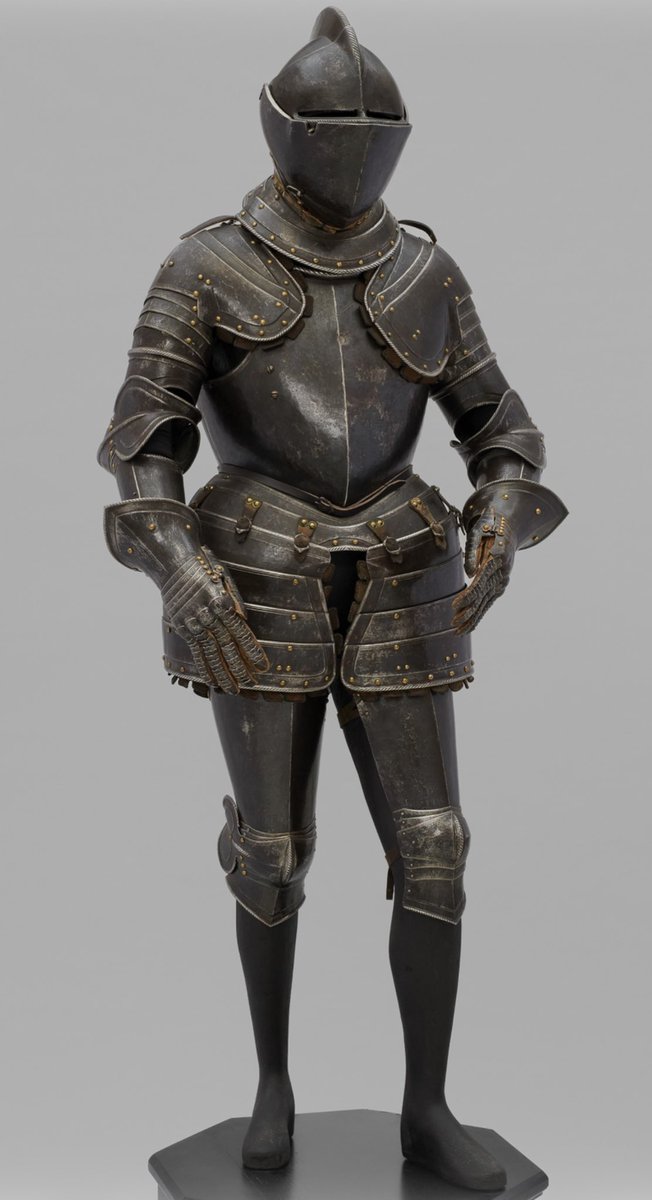
🇮🇹Milanese Etched Half Harness for The Field made ca. 1560
Note the “peas cod” shaped breastplates of the 2nd half of the 16th Century. We also see the fully evolved close helm.
This may have been worn with or without leg armor.
Dimensions: Height 102 cm Weight: 16.65 kg.
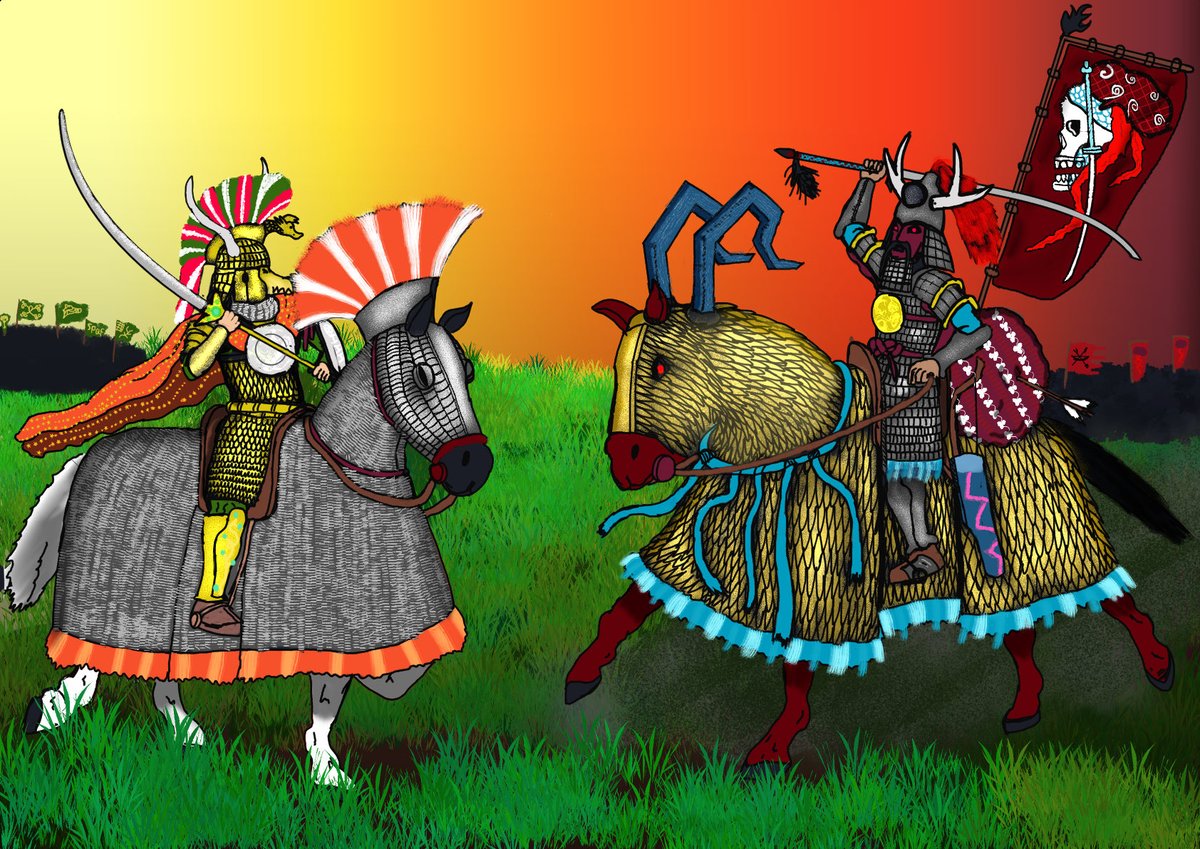
⚔️Do you prefer the aesthetic of European Arms & Armor of the first half of the 15th Century or the second half?
Illustrations by Graham Turner
Drop a comment on which one and why! Curious to hear peoples thoughts.👇🏻
👑🇳🇱🇩🇪🇪🇸Etched & Gilded Close Helmet of Holy Roman Emperor & King of Spain & Germany Charles V (Carlos I) (1500-1558).
Made in Augsburg by Desiderius Helmschmied ca. 1535
Very unique one here, almost a close burgonet/close helm hybrid. Around 1530 we start to see helmets like this with a falling buffe visor design coming out of Augsburg-this one also has visor like a close helm. The falling buffe acts as a detachable bevor/gorget.
Innovative modular helmet designs like this are hallmark of the Helmschmied armor making family.
Dimensions: H 31,5 cm × B 23 cm × T 31 cm
Weight: 2.4 kg
🧵🇫🇷”The Duties of a Good Knight” 👇🏻
This is another excerpt from the 1387 book by Honore de Bouvet titled “The Tree of Battles” from part 4, chapter 8.
Again this is great insight into 14th C. thinking on the role of a good knight.
Quote:
“Now we must see what are the qualities of all good knights, and what their duties are.”
“And I tell you that the first and principal thing is that they should keep the oath which they have made to their lord to whom they belong, and to whom they have sworn and promised to do all that he shall command for the defence of his land, according to what is laid down by the laws.”
“He is no true knight who, for fear of death, or of what might befall, fails to defend the land of his lord, but in truth he is a traitor and forsworn. A knight must be obedient to him who is acting in place of his lord as governor of the host, and if he is not obedient to him he is no good knight but is overbearing and insolent.”
“And knights, especially those who are in the king’s service, or in a lord’s, should in thought and deed be occupied only with the practice of arms, and with cam–paigning for the honour of their lord, and for his peace, as says the law. “
“They must always carry out the orders of him who takes the place and guards the interests of their lord, and if a knight acts contrary to such command he must lose his head.”
“Further, the laws say that a knight must not till the soil, or tend vines, or keep beasts, that is to say, be a shepherd, or be a matchmaker, or lawyer; otherwise he must lose knighthood and the privileges of a knight.”
“And he should never, if he is a paid soldier, buy land or vine–yards while he is in service, and what he does buy must belong to his lord. If you wish to know why this was so ordained, I tell you that it was that knights should have no cause to leave arms for desire of acquiring worldly riches.” END QUOTE