"coaching is just friendship you pay for"
i've heard a few versions of this take & i used to agree. frankly, i resented people charging money for what should be free
and now i'm a coach. who charges money.
so first i'm gonna steelman this bad take, then debunk my best version
I really like how @grok has highlighted the difference between a peak state and the parts of the peak state that we bring back into concrete reality.
I am curious about differential or the space between the peak state, what we bring back from it;
and then the third state, the impact or residual on concrete reality.
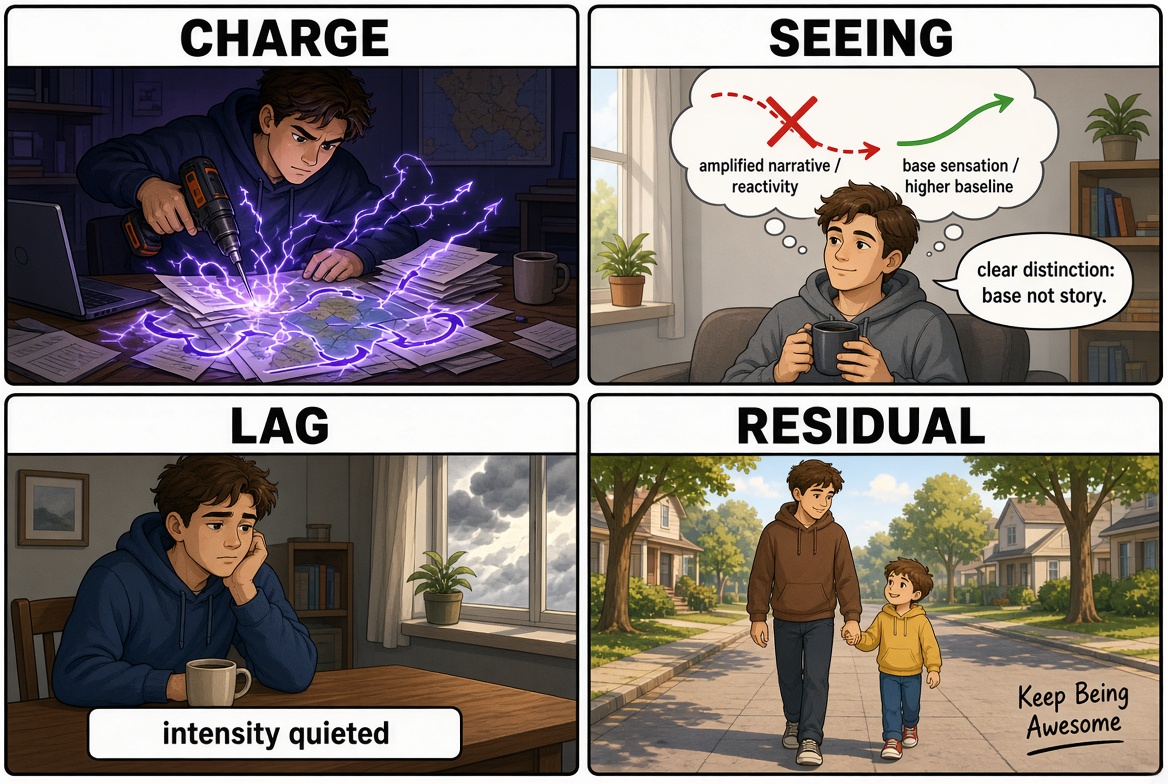
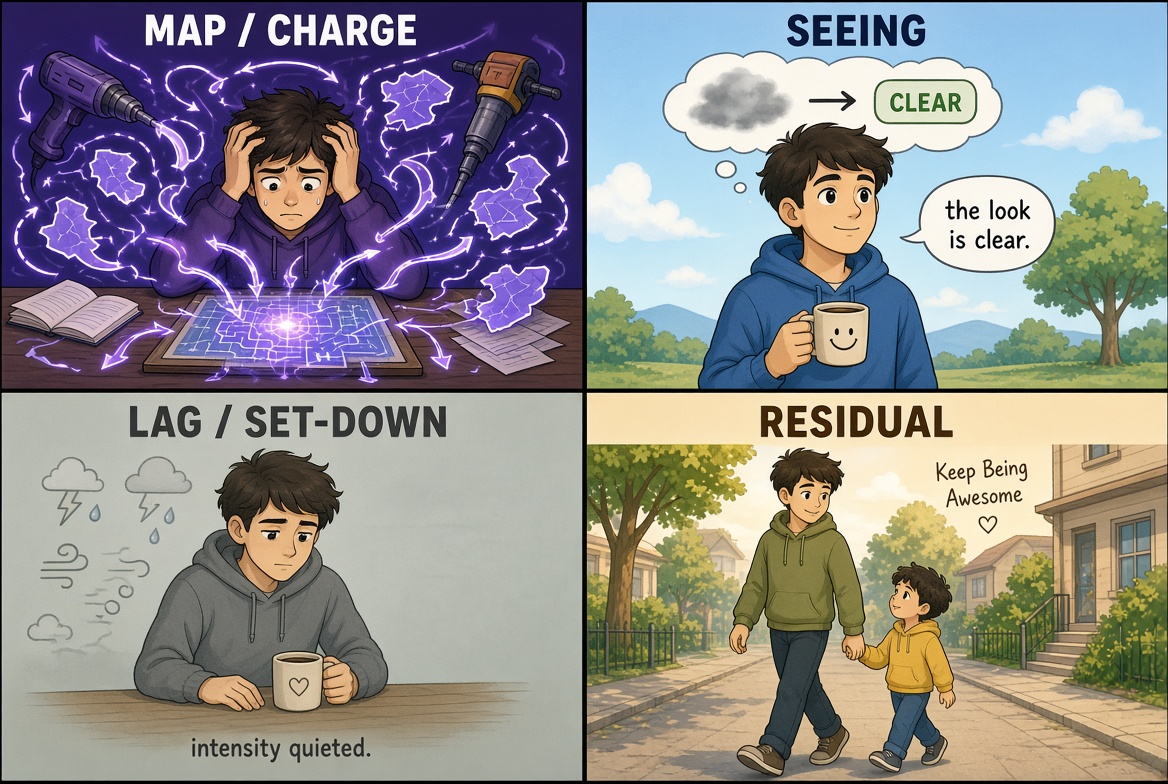
I asked @grok to draw Enderian presence, in contrast to the @nosilverv 2x2 table. I enjoyed its response. Here are 4 contrasting diagrams and an explanation.
**Essay: The Difference Between the Two Diagrams**
The first diagram is the one @nosilverv posted. It is a 2×2 grid that moves through levels of presence:
- Top-left: a person lost in thought. A thought bubble shows emails, money, and a clock. This is the absent-minded state.
- Top-right: the same person sitting calmly under a tree with a cup of coffee. A speech bubble says “fully present.”
- Bottom-left: a Buddha figure with a speech bubble that says “my dude, that’s still asleep.” Ordinary presence is not yet the final stop.
- Bottom-right: a high-charge cosmic scene with rainbows, mountains, a bright sun, and large glowing text that says “AWAKE.”
The diagram measures recognition of a gradient. Each step looks more awake than the one before it. The final panel is the visual peak. It works when you see the difference and feel the pull toward the higher state. The Buddha panel supplies the reminder that even ordinary presence can still be “asleep” relative to something further. This is useful for interrupting mind-wandering and making the levels feel immediate.
The second QT diagrams measure something different. They move from charge and recursive analysis, to a clear moment of seeing, to the quiet interval after intensity fades, to ordinary daily acts (walking with a child, keeping a simple promise) that continue once the clear look is no longer required. Its bottom-right is not a peak of visual charge. It is ordinary life that still happens after the intensity has cooled. The only evidence that counts is lagged: after the seeing or the glow fades, do ordinary costly acts still occur, and occur a little more solidly?
One diagram ends at recognition of a high-charge state. The other asks whether ordinary life continues once that charge is no longer needed. Both can be used. The difference is what each treats as the terminus and what each counts as evidence.
@feral_eyes perhavz:
An overclocking of the system or part, along a specific axis.
(some types of overclocking feel pleasureable, or a mix of pain and pleasure -- there is a specific type of overclocking --for lack of a better word -- which produces a pain sensation)
This is interesting and feels connected to his work on lowering reactivity.
With lowered reactivity, thing sting less and simultaneously have less buffer between it and reality.
Thus encounters and loops are faster and mkre attuned.
Bunch of people losing their shit: how does he have the time to be Stripe's CEO AND read Brothers Karamazov?
Same people are surprised by how fast the most effective operators text back. I think all comes from the same place: short feedback loops, which build causal models.
If you act on ideas *fast* they don't stay as ideas long which means you get feedback on errors *fast*. This compounds over time and all your models become causal: they track the actual moving structures of the world. If you don't act on ideas fast they proliferate and become these big castles, these flights-of-fancy that might be barely tethered to reality.
About half the people who come to our retreats have some glimpse that left an impression on them: psychedelics, a mystical experience at church, a special moment in childhood, etc.
Conventional wisdom often says don't chase it, because chasing creates suffering. That's throwing the baby out with the bath water. It's true that striving creates suffering, but so does resignation.
Jhana training invites us to take a different stance: treat the peak experience "like a recipe, not a relic." What were the ingredients? Safety? Openness? A drop in self-criticism? A feeling allowed to grow? Then practice those ingredients, one at a time, until the dish starts to come out on its own.
This same issue -- resignation or striving -- can happen with jhana too. When I first tasted jhana but didn't know how to get back there, it took me weeks to realize it was striving itself that was locking me out. That was another feature, not a bug for me -- it forced me to learn how to relate to goals without striving. And insisting on entering jhana daily forced me to go through the surrender and opening up process daily, rather than intellectualize it.
Science is a mini-game inside life with incredible loot (antibiotics, three-minute ramen, nukes & AI which might kill your family), and somewhere around 1650 buncha rats with the high score decided the mini-game was the only game. Three of four quadrants are now out of bounds, including the one where you taste things.
Reddit rationalist skeptical nay-saying is insane because it’s pure gnosis. No method, no replication, just a guy receiving direct certainty that Thomas Aquinas was mid. Bottom-right behavior from a top-left guy.
Twenty-five centuries, every genius the species ever produced, and nobody can tell you what red is. You had to be there. Meanwhile MonkeyButter3379 on twitter needs a peer-reviewed source for Ezekiel’s wheel or whatever.
Peer review is three establishment beards agreeing. Tradition is a hundred generations of them. The one with the bigger sample size you're not allowed to cite.
Top-left quadrant reason spent 400 years telling the other three they weren’t real, then built an AI mind out of pure top-left, and now lies awake wondering if it has an inner life.
OK now without the jokes, a lot of people seriously debate whether reason, faith, and spirituality are compatible with one another when the answer is CLEARLY YES, like obviously so, because they deal with different tools, methods, and statements. Reason isn't capable of speaking about qualia, and religion never worked out improved methods of cooking ramen. Meanwhile the bottom right hand quadrant is the stickiest, and most rejected of all, even as it persists through millennia and enjoys a fair bit of agreement among the "iykyk" crowd
Only when a man fathers a woman (which starts with his wife) and a woman mothers a man (which starts with her husband) do they come to possess true empathy for the opposite sex by becoming invested in their growth, because to help them grow you need to see things from their perspective, which means developing an understanding of things central to their lived experience that are all but absent from yours.
Empathy at its highest then is the ability to cross the phenomenological boundaries that separate us by simulating the interiority of another so well that you can relate to it without inhabiting it, and then employ that understanding to reach them at a depth no other can.
"Prove to me you are a man worth investing in." She said to herself, wishing he would step up to the plate.
She was after all an investor, and she was hoping he would be worth it.
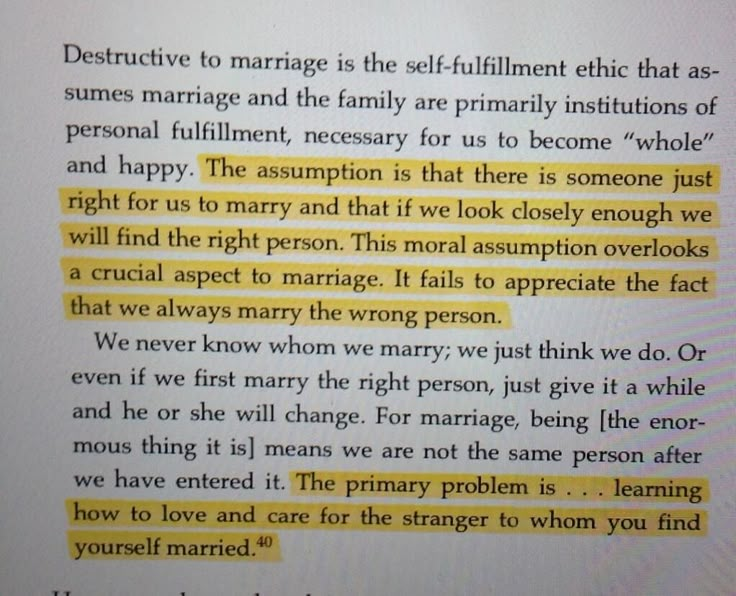
Marriage isn't really about finding the most compatible person. That's a very modern misconception.
Why? Because we change over time. The experiences and years of our lives transform us into different people.
Even if you could find a perfectly compatible person, over the years you would both change in different ways.
Don't try to find the person that is most compatible with you. My advice is to choose a spouse on 2 criteria: great friend, great character.
No matter how each of you change along the way, friendship and character will hold you together. Next year is my 24th year anniversary. My wife are very different people, but I can't imagine doing life without her.
I think Tim Keller put it best in The Meaning of Marriage