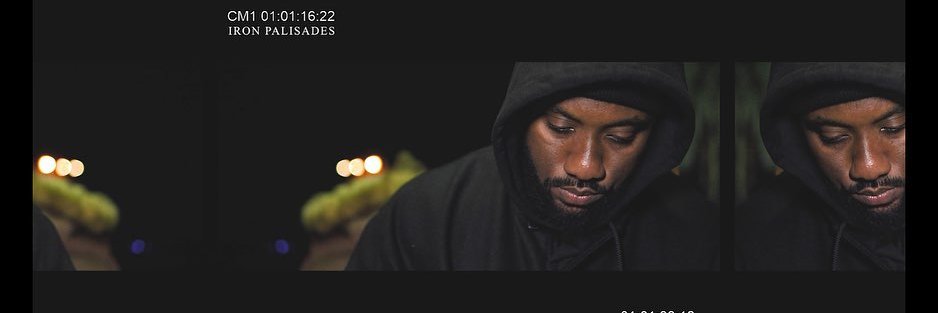
Doing a short set & Interview on June 18th at 'SoundSalon: A Live Talk Show', hosted by Jeremy Gloff | 7pm EST | 4220 N. Florida Ave. Tampa | Come thru!
@InternetReels Never buy a used car without letting a good mechanic look at it first. EVER. And if you get a used car with high mileage, just expect for it to have issues routinely, cause it will. Dont want issues for a while? Save up and buy a new car
Nas (and Large Professor) - “Number Man” (demo)
A snippet. From a 1992 demo. And you just know Nas is gonna blow…
No one could ever say that it was handed to Nas on a platter. He earned it. And it was Large Professor who gave Nas his most consequential first look on Main Source’s “Live at the Barbecue.”
Large Professor followed this up with with helping Nas get the deal that lead to the recording of the classic Illmatic (arguably the best hip hop/Rap album of all time).
But a demo in 1992?
What the “Number Man” demo shows is a young artist transitioning from his influences into his own artist. While Nas was undoubtedly influenced by on number of the late ‘80s era rappers, he is by and large a disciple of Kool G Rap.
On “Number Man,” we here Nas force tweaking his style, intentionally tooling with rhyme misdirection and slant rhymes in ways that enabled him to break away from G Rap and come into his own.
This is a critical point to understand. Nas was clearly aware that he sounded like Kool G Rap early on. And Nas was aware of how his connection to the rhyme school of Kool G Rap could impact him. Despite stealing the show with a blistering debut verse on Main Source’s “Live at the BBQ,” it wasn’t an automatic that Nas was ever going to get his own deal. At least not right away.
For instance, when Nas was shopping his demo, Def Jam records reportedly passed on Nas because Russell Simmons thought that Nas was nothing more than a low-budget Kool G Rap.
Nas persevered. He continued to shop his demo.
And fundamental to Nas’s perseverance was Large Professor.
It was Large Professor who provided Nas with the beats that allowed Nas to woodshop his style, flow, and delivery. And it was Large Professor who adamantly encouraged Nas and went around town (New York) with Nas shopping his demo.
As far as demos go, you can hear it. It’s all there. It was only a matter of time before Nas would breakout. The feeling at the time, among some but not all, was that Nas was gonna blow. Still, as smooth as Nas sounds on this beat, you can hear him working to differentiate himself, a feat every great artist achieves in order to stand on their own.
Finally, the beat.
What we hear on this Large Professor produced beat is some of the fundamental aesthetics of the beatmaking tradition as they were being established in 1992. Filtered bass lines, jazz horns, and hard hitting drums are all present on “Number Man.”
By 1994, practically every standard aesthetic, method, and technique in hip hop’s beatmaking tradition would be established. And Large Professor was one of the chief pioneers among the handful collective of beatmakers (producers) who contributed greatly to the development of these standards…
Ridley Scott's message to the critics of 'Blade Runner' (1982) - "Go F**k yourself":
""[The shoot] was a very bad experience for me. I had horrendous partners. Financial guys, who were ki!!ing me every day. I'd been very successful in the running of a company, and I knew I was making something very, very special. So I would never take no for an answer. But they didn't understand what they had. You shoot it, and you edit it, and you mix it. And by the time you're halfway through, everyone's saying it's too slow. You've got to learn, as a director, you can't listen to anybody. I knew I was making something very, very special. And now it's one of the most important science-fiction films ever made which everybody feeds off. Every bloody film.
I hadn't seen 'Blade Runner' for 20 years. Really. But I just watched it. And it's not slow. The information coming at you is so original and interesting, talking about biological creations, and mining off-world, which, in those days, they said was silly. I say, 'Go f**k yourself.'
You know, 42 years ago, Pauline Kael saw 'Blade Runner,' and the article begins with: 'Oh, baby, let it rain.' which is a serious case of sarcasm. She destroyed the film in four pages. I was so crushed. I had a hard time making it, and yet I thought I delivered something special. And then to have it ki!!ed. It actually affected the release of the movie. I took the four pages and I framed them on the wall of my office. They're still there today because there's a lesson in that, which is: 'When you think you've got it, you don't know s**t.'"
("Ridley Scott Has A Message For Blade Runner Critics: 'Go F*** Yourself'", Sandy Schaefer, Slash Film, 2023)