Horrendous experience with @Niva_Bupa. My family member is suffering from Lymphoma and despite specifying pre-existing conditions at the time of buying policy, we have been accused of fraudulently requesting reimbursement and cashless claim. The reason for accusation - How can someone get Lymphoma 30 days after buying policy. Is there a good time for a human being to choose when they get cancer? Perhaps @Niva_Bupa should set a time threshold saying that we need to wait for 6 months after buying the policy to get cancer. Is this the level insurance companies are willing to stoop to? There is no contact from the company willing to help us and the customer care number does not work. A lot of noise created for marketing but no noise when someone is desperately seeking funds for treating a cancer patient when all pertinent documents have been submitted in a timely fashion.
@NivaBupaSupport@BupaNiva
I disagree with some opinions here on posts written by AI. Has the AI helped in writing something meaningful on a unique topic? If the answer is yes, engage by all means. I would rather look for topics that I’m interested in and engage with them as long as they aren’t summarised versions of a research paper or random news. Topics such as people behind the scenes, competition even before it becomes one, a unique perspective on the future, a “what if” question that would make someone really think hard would be quite interesting.
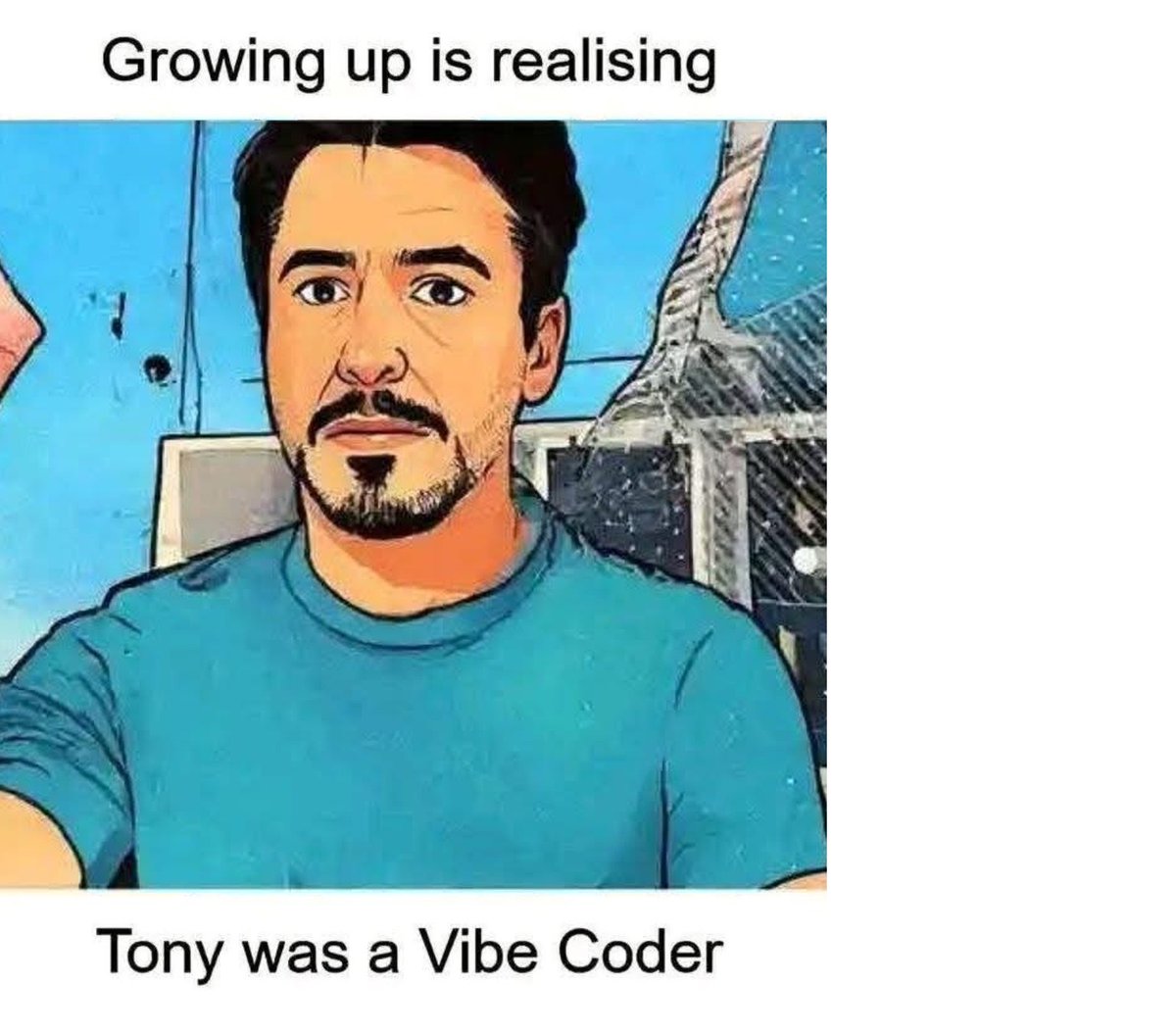
Tony Stark barely wrote a line of code. He told JARVIS what he wanted, then tested the suit by flying it.
That’s vibe coding, plus the evaluation step most people skip.
The side of human nature that you have highlighted is the harsh reality. It compels content creators to either stay true to their roots or pursue engagement through needless strong opinions when one isn’t warranted or clickbait. Simple example - A rich person donating billions in philanthropy will get far less attention than spending them on a lavish wedding. It appeals to the common people’s wishful thinking and underlying aspirations.
@Cristina_AC_X Surprisingly, I have found Radar quite helpful so far in finding like-minded people to follow and “clean up” my feed. The situation with FB and Insta is untenable and there is no escaping slop.
When you pay for a premium AI, how do you know a cheaper one didn't answer?
@AnthropicAI has built a way to prove it, mathematically.
Each answer comes with a small proof showing which model wrote it, without revealing the model itself. Think certificate of authenticity, not watermark.
The only earlier attempt on a model this size produced a 93.6 GB proof that took about a day to check.
Anthropic's FlashProve proofs are about 19 MB and check in seconds.
The catch: it still costs 70–95x more than just running the model, and only works for short answers.
Would you pay extra to know which AI really answered you?
@rohanpaul_ai User discretion is an important element of tech use. In the 2010s, when mobiles were on the rise, people started getting addicted and one simple answer was to keep them on silent or switch them off. The same concept can be applied here. Use AI to augment and not delegate 100%.
Amanda Askell shapes how Anthropic's Claude behaves. She isn't a computer scientist. She's a philosopher.
She trained in philosophy at Oxford and NYU, after starting out in fine art.
She's the lead author of the constitution that shapes how Claude thinks and handles hard questions.
Labs are spending billions on chips. One of the most important jobs went to someone trained to ask what's right.
Would you trust an AI more if you knew who shaped its values?
@Cristina_AC_X It is suited to people who keep a lot of wiggle room for failures and do not want to grow their business quickly within a short period of time.
In the race for compute, safety research has become an afterthought.
Anthropic is going the other way, training new researchers to work on it full time.
Should the other labs be spending as much on safety people as they do on GPUs?
Applications are now open for the Anthropic Residency, a paid, fixed-term research program for academics, technical founders, and staff-level engineers who want to make AI safe and beneficial for everyone. No ML background is required.
Apply by November 22: https://t.co/uhcXhKTgnO
Hundreds of models, zero humans
Glif's (@heyglif) new AI modeling agency casts AI-generated models and creates the commercial end to end.
The hard part won’t be generating them. It’ll be making them resonate.
A commercial has to make you feel something, and the person on screen isn’t real.
Would you buy a product advertised by an AI model instead of a human one?
🎥 @heyglif
@rohanpaul_ai When RSI becomes very good, I wonder which roles it will shrink or reshape. Evaluation based roles will become indispensable to define what a "better" model entails and its determination.
The markets at the moment are looking for “tried and tested” rather than “trial and error”. The more Capex large AI companies consolidate, the more worried and anxious investors are becoming. At this point, AI returns are largely speculative because of an enormous delta between supply and demand.
@alperbuilds The obvious use case would be cloud kitchens and fast food chains that suffer from high attrition rates. I believe implementation is already underway in some US outlets.
Elon Musk has an “Idiot Index”, revealed in Walter Isaacson’s biography of him.
I just finished reading the book and I can’t stop thinking about it.
It’s the cost of a finished part divided by the cost of its raw materials. If a part costs 10x its materials, someone has some explaining to do.
A physics degree tells you what something is made of. An economics degree tells you what it should cost. He uses both every time he looks at a part.
At least someone put their university degree to use.
What’s the idiot index of your job’s tools?