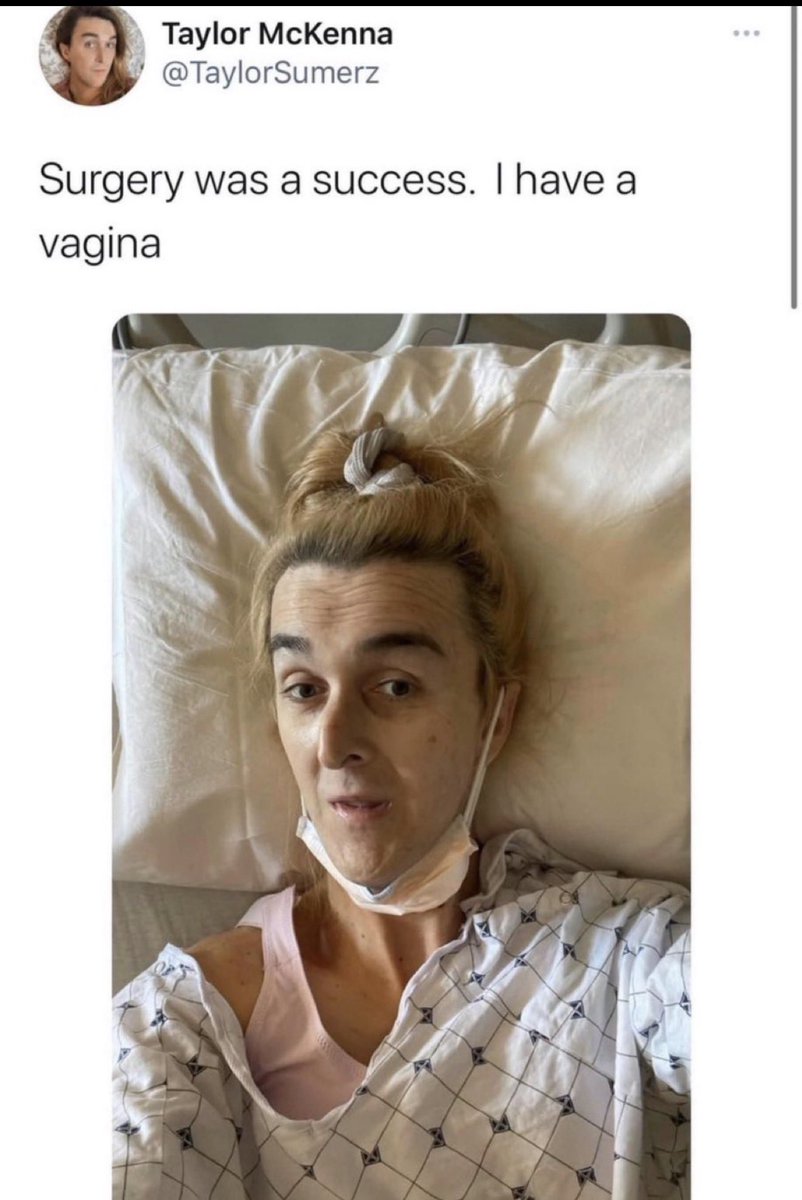
No, you don’t. A vagina is the gateway to life. It’s self-cleaning, self-lubricating, and can stretch to accommodate an entire baby before returning to its original size.
What you have, sir, is a fauxgina, a dead-end fvckhole that doesn’t clean itself (and let’s be honest, you won’t clean it either), and which will have to be kept open by dilation for the rest of your life, lest it close up on you like the open wound it is. The only thing it has in common with a vagina is its location and its general shape, but even that is never quite right. It’s a fake, a phony, a hole that exists for no other reason than to be penetrated, and if I wrote down my hopes for its future, I’d probably get suspended.
I would guess (with almost 100% certainty) that this woman was abused and/or r&ped 💔
First having her breasts removed- then purposely becoming obese- all of it is designed to repulse people, in an effort to protect herself.
More often than not, men “trans” themselves because they want to become a sexual object, while women “trans” to escape being seen as one
Men write things like "destroy women" on images like this and get 17k likes then i'm the bad guy when i say there's no point in having sex with most men because they see sexual activity with women as rape, degradation and humiliation towards women
Outdated CPR training is putting women’s lives at risk.
Women who suffer cardiac arrest outside hospital are significantly less likely to survive than men, and one overlooked reason is that CPR training almost never accounts for female anatomy.
A Duke University analysis across 47 U.S. states found women are 14% less likely to receive bystander CPR. In the UK, the gap is similar: only 68% of women get CPR from bystanders compared to 73% of men, with many people citing fear of inappropriate touching or concern about injuring a woman’s chest.
The problem is compounded by the tools we train on. A global survey revealed that roughly 95% of CPR manikins are designed with flat chests; only one widely available model includes visible breasts. As a result, most trainees never practice the slight technique adjustments needed for women and often hesitate in real emergencies.
Research published in the Journal of Emergency Medical Services offers hope: when trainees used manikins equipped with realistic silicone breasts, they were almost twice as likely to feel confident performing chest compressions on a woman.
Experts say updating training manikins to represent both male and female anatomy could eliminate hesitation, close the gender survival gap, and save thousands of lives.