Most people try to read more.
Few people become wiser.
The difference isn’t information.
It’s integration.
I study history, mythology, science, technology, psychology, relationships, and mental models
Then I distill them into practical summaries and frameworks you can actually use and learn.
Just condensed intelligence.
Welcome to The Insight Vault
How to win friends and influence people:
Carnegie observed and studied thousands of interactions across decades of teaching and consulting, and he codified his findings into a set of principles that anyone can learn and practice.
The principles are not tricks. They are not techniques for manipulation. They are habits of genuine regard for other people that, when practiced consistently, produce results that manipulation cannot match, because people can sense the difference between authentic interest and strategic flattery, and they respond to the two very differently.
Carnegie’s principles work not because they are clever but because they are true: they reflect the actual structure of human psychology, and when you align your behavior with that structure, the results follow naturally.
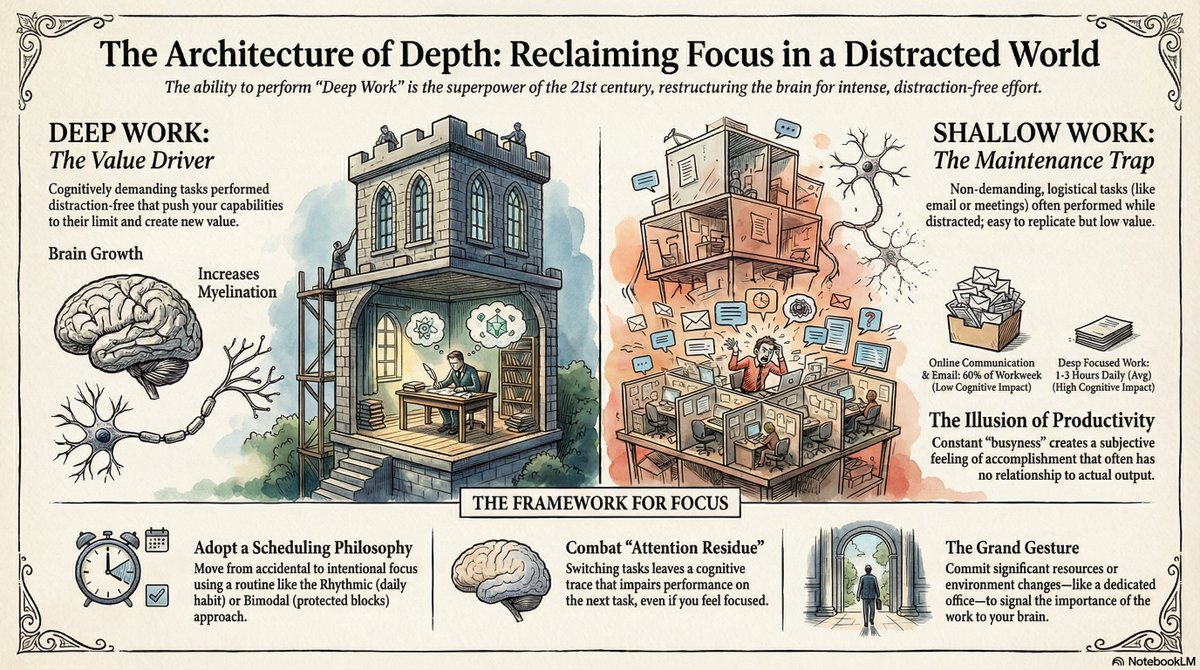
Cal Newport argument sounds counterintuitive in a world that celebrates connectivity, multitasking, and the perpetual availability that digital technology has made possible: the ability to perform deep work is becoming simultaneously more valuable and more rare.
This combination, increasing value and increasing scarcity, means that the individuals who cultivate the ability to focus without distraction on cognitively demanding tasks will have an extraordinary competitive advantage in the emerging economy. Deep work is, in Newport’s formulation, the superpower of the twenty-first century.
Carnegie told Napoleon Hill that the principles of success are learnable, and that the gap between the people who achieve extraordinary things and those who do not is not a gap of talent but of applied knowledge.
Consider whether you believe this. Most people say they believe it, but their behavior reveals a different belief: that success is for other people, people with more advantages, more connections, more luck. Hill spent twenty years proving that this is not the case.
The question is whether you are willing to take the proof seriously.
7 Rules of Power challenges the conventional belief that professional advancement is solely a product of merit and hard work. Power is a learnable skill rather than a personality trait, requiring individuals to master specific behaviors like strategic rule-breaking and relentless networking.
Shaping one's personal brand and projecting a powerful physical presence are essential for converting talent into tangible influence. Overcoming internal hesitation and "getting out of one's own way" is the first step toward navigating unfair organizational systems.
Success reframes past actions, as results often validate the assertive and unconventional methods used to achieve them.
Reflection:
Jim Rohn said that income rarely exceeds personal development. Consider your current income or level of professional achievement. Now consider the amount of time, energy, and money you have invested in developing yourself over the past year. Is there a gap between where you want to be and the investment you are making in getting there?
Rohn would say that closing the gap in your development will close the gap in your results, because results follow the person, not the other way around.
Reflection
Munger’s path to investing was anything but direct. He studied mathematics, physics, meteorology, engineering, and law before finding his way to finance. Rather than seeing this as wasted time, Munger considered every discipline a tool that he later applied to investment decisions. Consider your own nonlinear experiences. What skills, knowledge, or perspectives did you acquire in unexpected contexts that turned out to be valuable later? Munger would say that there is no such thing as irrelevant knowledge.
There is only knowledge you have not yet found a use for.
Reflection
Kant began by asking a question that most people assume has an obvious answer:
what makes an action morally right?
-Is it the consequences?
-The feelings behind it?
-The rules of your culture?
-The commands of your religion?
Consider your own moral framework. Where do you get your sense of right and wrong? Is it grounded in something that would hold regardless of your personal circumstances, your culture, and your time in history? Kant believed that if the answer is no, then you do not yet have a genuinely moral principle. You have a preference.
A Camus argued that Accepting meaninglessness produces freedom and passion rather than despair. Consider a moment in your life when certainty about the future collapsed, a job loss, a breakup, a plan that fell apart... Did you experience, alongside the pain, a strange sense of liberation? A sudden vividness to the world around you?
That experience is a glimpse of what the absurd offers when you stop running from it.
How fantastic it is to slowly collect our own Antilibrary...
As Nassim Taleb beautifully described:
The writer Umberto Eco belongs to that small class of scholars who are encyclopedic, insightful, and nondull. He is the owner of a large personal library (containing thirty thousand books), and separates visitors into two categories: those who react with “Wow! Signore professore dottore Eco, what a library you have! How many of these books have you read?” and the others — a very small minority — who get the point that a private library is not an ego-boosting appendage but a research tool.
Read books are far less valuable than unread ones. The library should contain as much of what you do not know as your financial means, mortgage rates, and the currently tight real-estate market allows you to put there.
You will accumulate more knowledge and more books as you grow older, and the growing number of unread books on the shelves will look at you menacingly. Indeed, the more you know, the larger the rows of unread books. Let us call this collection of unread books an antilibrary.
Reflection
Marcus Aurelius contemplated death not to cultivate despair but to sharpen his attention.
Try this: consider that you have a limited number of days remaining, not as a hypothetical but as a fact. Now look at how you spent today. Was it consistent with how you would spend your time if you truly understood its value? What would you change if you stopped treating your time as unlimited?
This is not a morbid exercise. It is the most practical question you can ask yourself.
Reflection
Paradigms exists everywhere.
Every profession, every organization, every culture operates within a set of shared assumptions that define what counts as a good question, a legitimate method, and a meaningful result.
Consider the paradigm of your own field or community. What assumptions are so fundamental that they are never questioned?
What kinds of evidence are automatically dismissed because they do not fit the accepted framework? The paradigm is most powerful precisely where it is most invisible.