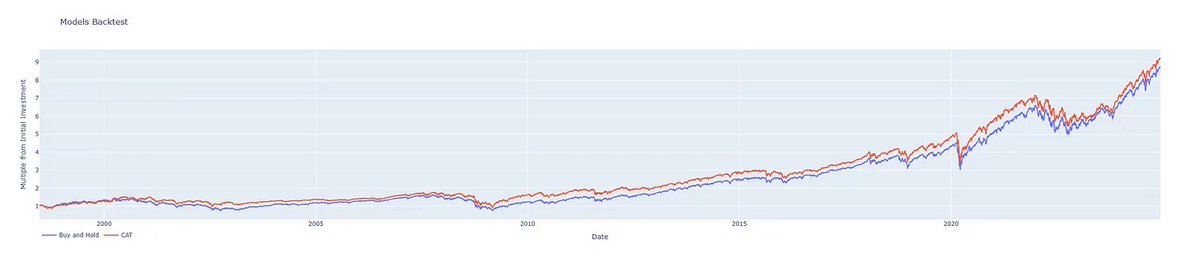
Walk-forward validation let's us test a strategy on a much longer timeframe. In the example below we were able to test a strategy over a very long period of 20+ years. If you want to go through the full post with the code used, go to my substack https://t.co/xZeaXAG4lI
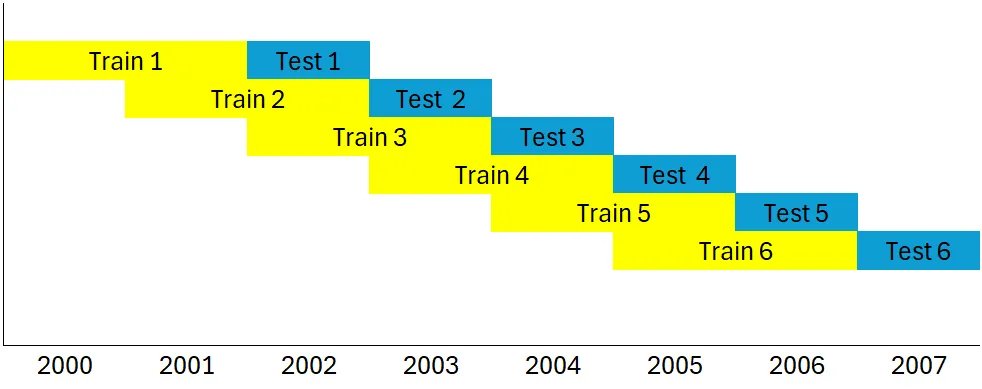
What is Walk-Forward Validation? It utilizes a rolling window approach where the model is trained and tested on consecutive periods. It creates a situation where the model is updated continuously, mimicking a process we would realistically take when trading this strategy. The chart below provides a good illustration of the process.
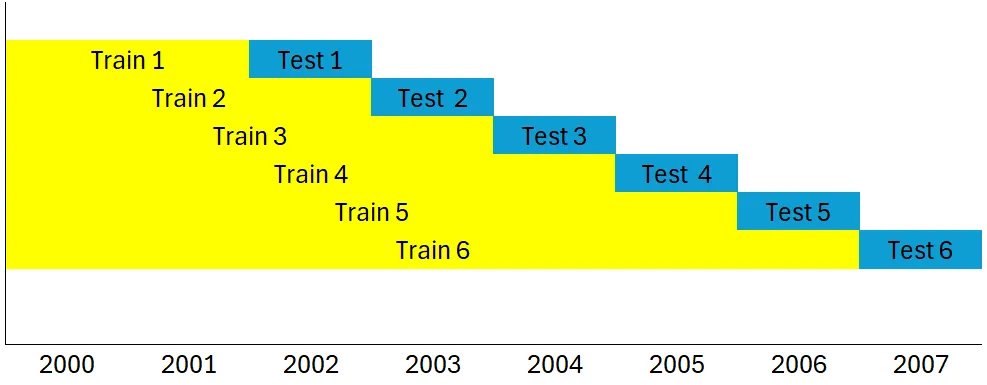
he example above represents an unanchored approach to walk-forward validation. There is also the anchored approach whereby the dataset of each training period gets longer as we progress through the iterations. Anchored means that the starting point of all periods is the same as the starting point of the first and we add more data to each training set. Below is a visual representation of the anchored approach.
You can check out my Substack for the full description of this trade, as well as some additional ideas on how to make it more profitable. https://t.co/FndvYwBMjX
Is it possible to get over 10% return from a bond without too much risk? The investment idea in question provides an investor whose base currency is USD a way to achieve some additional yield on their cash without a significant increase in credit risk. Here is the summary of the steps taken, and later in the post I will provide an example of this trade to make it clearer.
Finally, the table below shows the summary of the investment performance. To purchase the bond we convert 130,631 USD to EUR at a rate of 1.0575 and sell a single December 2024 futures contract at 1.07965. After one year we sell the bond and convert the entire EUR balance (including the coupon we received from the bond) into USD at a rate of 1.0884, ending up with 140,545 USD total. We also close out the futures contract at 1.089 for a loss of -1,169 USD.
@PiscoLitty By the way, Econoboi isn't even wrong, but I don't understand why he can't agree to a definition of "inelastic". It literally doesn't clash with any of his points
Bank of Japan's Uchida said today that they won't raise rates when the market is unstable. I am very impressed by BOJ's speedrun of their hiking cycle, this must be a new world record.
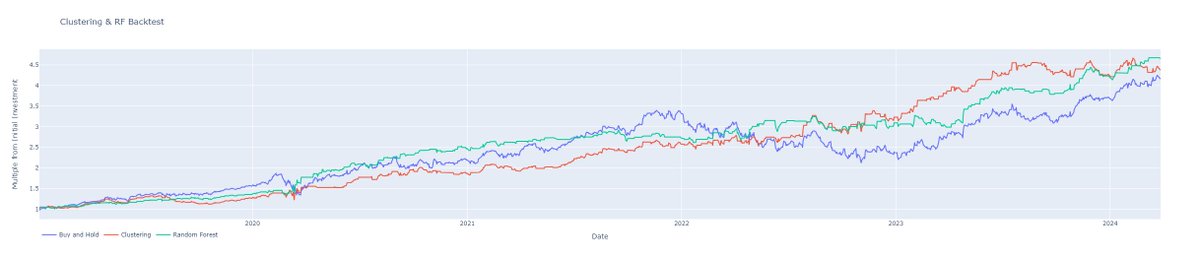
The real value of these strategies comes when looking at the drawdowns of both strategies: both are musch lower than our Buy-and-Hold benchmark. The Substack post has all the code and commentary, check it out! https://t.co/hZRsQLh297
In this post I explore the use of a Random Forest model to beat a Buy-and-hold benchmark for Microsoft stock $MSFT. Check out my free substack for full code and a detailed overview! https://t.co/hZRsQLh297
The backtest below is also promising: both the Clustering and Random Forest strategies outperform the Buy-and-Hold approach, although both lag it over some periods.
So what is the takeaway here? This doesn't change much, in my view. It only reinforces the idea that rate cuts won't come before June at the earliest. I don't think this print changes much for Fed either. Here is how I imagine Powell looks at today's data
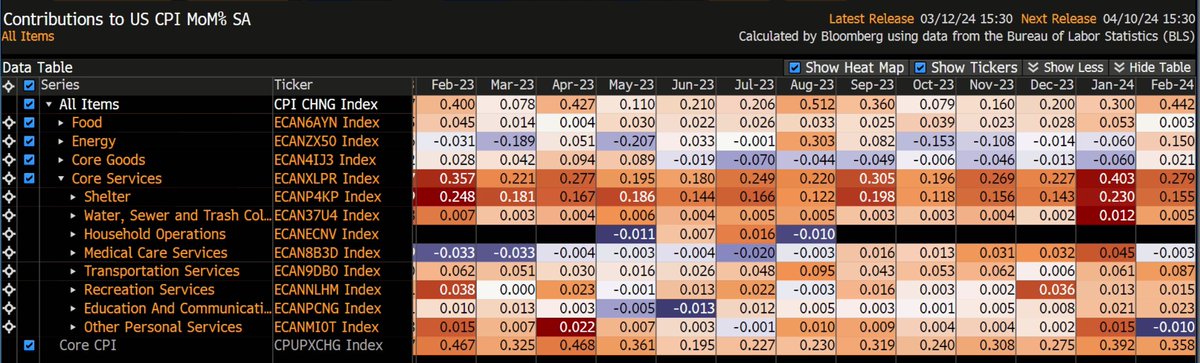
MoM Core CPI came in at 0.44%, also slightly higher than expected. Just like in January, the main culprit is Shelter: this month's reading isn't quite as high as January's, but still higher than expected #CPI#investing#StockMarket