🇧🇩 #OneLandManyVoices, a joint initiative by @ypfbd and @AABangladesh connected youths with the voices from grassroots. From stories of struggle to sparks of hope, the youth listened to it all, and now, it’s your turn. Video series coming soon, stay tuned!
💭 How can we motivate our young representatives to advocate for their rights in alignment with the Beijing Declaration and Platform for Action (BPfA)? How can Team Bangladesh work on noteworthy developments toward the Gender Equity Goal of 2025 and the Sustainable Development Target of 2030?
⁉️ To address these pressing questions and more, we are bringing you a dialogue featuring former Commission on the Status of Women (CSW) attendees to develop actionable strategies for enhancing the participation of Bangladeshi youth.
📣 Join us on September 22nd, sharp at 8 PM BDST, for a live discussion on “𝟑𝟎 𝐘𝐞𝐚𝐫𝐬 𝐨𝐟 𝐁𝐞𝐢𝐣𝐢𝐧𝐠 𝐃𝐞𝐜𝐥𝐚𝐫𝐚𝐭𝐢𝐨𝐧 & 𝐏𝐥𝐚𝐭𝐟𝐨𝐫𝐦 𝐟𝐨𝐫 𝐀𝐜𝐭𝐢𝐨𝐧: 𝐋𝐞𝐚𝐫𝐧𝐢𝐧𝐠𝐬, 𝐂𝐡𝐚𝐥𝐥𝐞𝐧𝐠𝐞𝐬, 𝐚𝐧𝐝 𝐭𝐡𝐞 𝐖𝐚𝐲 𝐅𝐨𝐫𝐰𝐚𝐫𝐝.”
♦️ Be part of this informative evening with our esteemed panelists from Naripokkho, @WreetuBD Healthcare and Wellbeing, Youth For Change, and the Dutch UN Youth Representative.
📌 We look forward to your participation in this enlightening discussion. Don’t forget to mark your calendars!
🗣️ 𝟑𝟎 𝐘𝐞𝐚𝐫𝐬 𝐨𝐟 𝐁𝐞𝐢𝐣𝐢𝐧𝐠 𝐃𝐞𝐜𝐥𝐚𝐫𝐚𝐭𝐢𝐨𝐧 & 𝐏𝐥𝐚𝐭𝐟𝐨𝐫𝐦 𝐟𝐨𝐫 𝐀𝐜𝐭𝐢𝐨𝐧: 𝐋𝐞𝐚𝐫𝐧𝐢𝐧𝐠𝐬, 𝐂𝐡𝐚𝐥𝐥𝐞𝐧𝐠𝐞𝐬, 𝐚𝐧𝐝 𝐭𝐡𝐞 𝐖𝐚𝐲 𝐅𝐨𝐫𝐰𝐚𝐫𝐝
📅 22nd September 2024
⏰ 8:00 PM - 9:00 PM (BDST)
🔴 Facebook Live
#BPfA
#CSW
#RHRN
#Bangladesh: Debunking the lies and misinformation spread by so-called Indian "strategic commentator" @Chellaney
In an opinion piece at @thehill on Bangladesh's recent political change titled "A quiet military coup in Bangladesh", Indian geopolitical commentator @Chellaney makes several inaccurate, faulty claims. Let's unpack his lies and misinformation:
Chellany: "In reality, the regime change in the world’s eighth most-populous country amounts to a quiet military coup behind a civilian facade."
Fact: Fact: Completely wrong. The military chief and top brass tried to protect Sheikh Hasina as long as possible. According to a military officer, on July 20th, the military received a "shoot to kill" order from the military leadership against protesters during a special meeting held in the Army Command Post at the underground bunker of Bangladesh Army Headquarters. On July 21st, forces affiliated with the 9th Division of the military were accused of firing thousands of bullets at protesters in Narayanganj, resulting in numerous casualties. Dozens of videos available on social media (link here) show the military actively and indiscriminately shooting at protesters. Additionally, military personnel seconded to the Rapid Action Battalion and Border Guard Bangladesh actively took part in shooting and killing protesters, even using UN-marked helicopters.
After its initial attempt to follow Sheikh Hasina's unlawful order to violently suppress the protesters, significant pushback emerged within the military ranks, with many junior and mid-ranked officers refusing to shoot their own people. Realizing the growing dissent within the force, the military senior leadership decided to disengage.
Therefore, your claim of a military-led coup is completely nonsense, detached from reality and demonstrates a troubling lack of understanding of the situation.
Please see these videos of military shooting at protesters:
https://t.co/xgKY27xolr
https://t.co/dtbFBVm3ol
Chellaney: "Its advisers work essentially at the direction of the military brass, especially the army chief, Gen. Waker-uz-Zaman, the power behind the throne."
Fact: This is totally incorrect. After Sheikh Hasina fled the country, the military leadership initially considered Salah Uddin Ahmed as the Chief Advisor. However, it was the student leadership that led the movement that pressed for Professor @Yunus_Centre to lead the interim government. They first reached out to Yunus and convinced him to take the charge of the transition government. The students even uncharacteristically unofficially announced the name of Chief Advisor in a press briefing days before even his name was confirmed by the military leadership.
It seems you have not been adequately informed or are not closely following the events—this undermines your credibility as an analyst.
Please read:
https://t.co/oax6h6wvrt
https://t.co/NWYBvzkCMf
Chellaney: "Violent student-led, Islamist-backed protests against Hasina’s 15-year secular but increasingly undemocratic reign helped force her out of office."
Fact: The protests were never violent until they were attacked by the regime goons. They were protesting peacefully until July 15, when Sheikh Hasina and her party secretary Obaidul Qader ordered its student wing, Chhatro League, to attack the protesters, which escalated into widespread anger. You have been deliberating mischaracterizing the protests, which undermines your accurate understanding of the situation.
Please read:
https://t.co/RE7wbd3OuA
https://t.co/MhldrbSB14
Chellaney: "Driving Hasina into exile appears not to have been a spur-of-the-moment military decision but rather central to a well-thought-out plan for an indirect army takeover."
Fact: This is an audacious claim, made with great authority! However, Mr. Chellaney provides no supporting evidence or additional insights to explain why he holds this view. Without substantiation, it remains an "uninformed" opinion, not informed analysis.
Chellaney: "Bangladesh’s cycle of political violence began with the predawn murder of Hasina’s father, Sheikh Mujibur Rahman, in a 1975 army coup."
Fact: Political violence in Bangladesh predates much before the 1975 coup. Between 1972-75, Sheikh Mujibur Rahman led a violent crackdown on opposition activists, with his paramilitary force, Rakkhi Bahini, reportedly killing thousands.
Please read:
https://t.co/08W5gV9ZyW
Chellaney: "Bangladesh has no regional adversary, yet it maintains a relatively large military."
Fact: The Bangladesh-India border has been one of the deadliest in the world with BSF indiscriminately killing Bangladeshis across the border. At least 1,236 Bangladeshis were killed and 1,145 injured in shootings by the Indian border force between 2000 and 2020.
What kind of friendly, peaceful neighbor kills its neighbor? Indian aggression and the senseless killing of Bangladeshis along the border have made it an adversary in practice. Moreover, India's blatant interference in Bangladesh's internal affairs—including deciding who can govern the country (as seen in their defense of Sheikh Hasina in the 2009, 2014, and 2018 elections) and who can invest in key projects like the Teesta project and the Sonadia deep seaport—positions India as an aggressor working against the interests of the Bangladeshi people.
Therefore, your notion that Bangladesh has no regional adversary is misleading. Unfortunately, India has become seen as an adversary and enemy by many Bangladeshis due to its deadly policies and complete disregard for Bangladeshi lives.
Please read:
https://t.co/nNp2Oj3AQa
https://t.co/0qy9pUzVrl
Dear Editorial Team @thehill – Conducting a fact check on any piece is a vital part of due diligence that would only enhance your credibility.
On July 18, we released a statement from Youth Policy Forum condemning the crackdown on student protesters by the government.
Further to that condemnation, we are calling for justice for students and citizens who lost their lives, were injured, and harassed through a letter signed by 50+ which includes YPF Advisors, YPF Fellows who are leading academicians, professionals and YPF team members.
Through this letter, we would like to reaffirm that we stand by students and citizens in their quest for justice, and we support their rightful and just demands. We strongly demand an independent and impartial probe into the killings of individuals and that exacting, appropriate judicial justice is carried out accordingly. We also strongly demand that all forms of harassment students and citizens have faced, or are facing, are halted in every manner. We condemn the detention of protestors, as well as the forcible custody of several protesting leaders. We also condemn all sorts of vandalism that ensued.
The letter reads as follows:
As citizens and friends of Bangladesh, and members of the Youth Policy Forum, we are greatly distressed by the unprecedented violence and repression that students and citizens have faced for the past two weeks. Our organization was established in 2018, in the aftermath of the first quota reform protests, with the belief that Bangladesh needed a peaceful, constructive space for policy dialogue and the promotion of reforms. The violence and repression of students runs counter to this belief, and we deeply condemn the perpetrators of this violence — primarily done by the government, police forces, as well as pro-government groups such as the Bangladesh Chhatra League.
We stand by students and citizens in their quest for justice, and we support their rightful and just demands. We strongly demand an independent and impartial probe into the killings of over 209 individuals (Prothom Alo, 27th July 2024) – a toll that is rising, and is underreported (Prothom Alo, 28th July 2024) – and that exacting, appropriate judicial justice is carried out accordingly. We also strongly demand that all forms of harassment students and citizens have faced, or are facing, are halted in every manner. We condemn the detention of protestors, as well as the forcible custody of several protesting leaders (Daily Star, 28th July 2024). We also condemn all sorts of vandalism that ensued.
As a youth-led organization, we lend our support – however possible – to the young people of this country who are simply standing up for what is right.
We pray for the families of the people who have lost their lives and continue to monitor the situation gravely.
28 July 2024, Dhaka
Signed by:
Professor Mushtaq Khan, Dina Hossain, Professor Naomi Hossain (@nomhossain), Asif M Shahan, Tarek Abdullah Al-Munim, Ahsan ul Haque Helal, Dr Marzia Hoque, Md Sakib Khaled, G M Rakibul Islam, Nasir Uddin Ahmed, Dr Md Samiul Haque, Dr. Sebastian Groh, Mohammed Abdul Baten, Shazzad Hossain Mukit, Dr M Tasdik Hasan, Md Raihan Maruf, Ayreen Khan, Dr. Raisa Sara, Raisa Shamma, Nahian Rashha, Fatema Tuz Johoora, Aamer Mostaque Ahmed, Md Abir Hasan, Farabi Mahmud, Tausif Hossain, G M Shuvo, Zaheer Abbas, Mahpara Nuren Ishfer, Nusanta Samayel Audri, Md. Sad Ebne Walid, Rashidul Hasan, Rifah Nanjiba Ridi, Muhammad Irfan Sadik, Jawad Shams, Zara Mustafa, Tasmia Sarwar, Muhammad Mujtaba, Nafees Ahamed, Asif Khan Ullash, Sharmin Akhter, Md. Khairul Islam, Nahian Nawar, Anika Bushra, Faria Jannat Prova, Faria Jahan Noor, Mehedi Hassan, Enam Ahmed Shuvo, Shabnam Sultana, Momtahina Ibnat, Syeda Mubassir Mahjabin Nahian, Tahrima Bhuiyan, Tahia Afra Jannati, Shakila Nahar, Sirazum Munira Raiyan, Tabassum Elahi, Aaqib Md Shatil, Safrina Kamal, Maysha Samiha Eshika, Anika Nasrin, Mysha Farah, Arman Mohsin Yamin
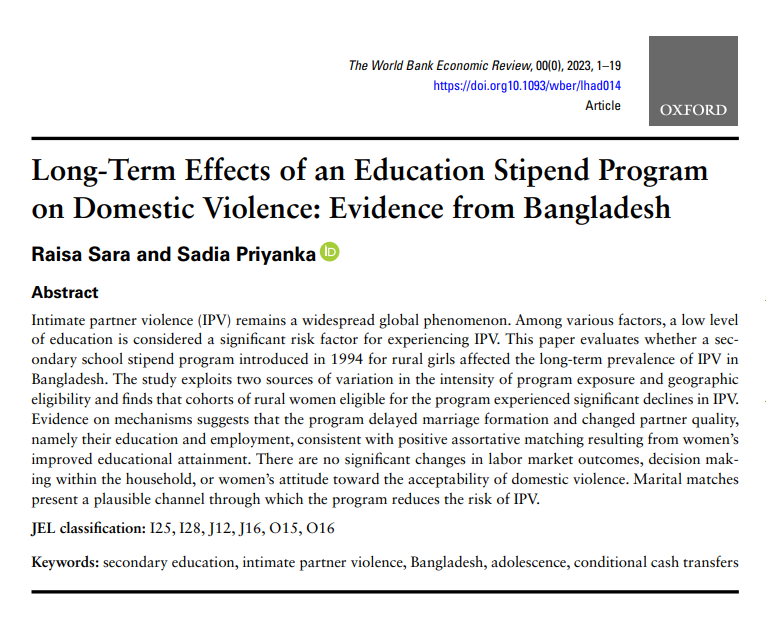
We are grateful to the referees and everyone who provided feedback to improve our paper. A special shout-out to @EdmondsEric for being an exceptional editor! (5/5)
Thrilled to announce the publication of our paper in WBER examining the long-term impact of the FSSSP program on domestic violence in Bangladesh, co-authored with the absolutely amazing @sadia_priyanka. (1/5) https://t.co/GL0vyOOrAC