Data residency is outdated.
Knowledge residency needs a closer look.
Let’s say data is a book. Data residency says a book about a country has to stay inside that country. Companies mostly followed it. The book stayed.
Now let’s say an AI model is a person. This person walks into your company, reads every book, learns everything, and walks back out. They don’t take a single book. They don’t need to. They already have the knowledge.
The book stayed. The knowledge walked out.
That’s the new reality. Knowledge is leaving companies and countries, and nobody notices, because nothing physically moved. And that knowledge used to be your intellectual property (IP), your moat.
Now here’s what almost nobody’s noticing. We’re making it easier for the reader. MCP holds the door open. OKF (Google’s new format) stacks all your books up, neatly labeled, so the reader doesn’t even have to search the shelves. We call it making our knowledge AI-ready. We’re really handing over the master key.
Formats like MCP and OKF are open (just like Chrome and Android) because giving that layer away pushes the value up to the model layer.
Everyone says your data and context is the moat. But get every company’s knowledge flowing in one open format, and the moat dries up. Context becomes cheap. The only thing left worth paying for is the model that reads it. Guess who sells the model.
MCP and OKF are the knowledge transfer highway. And it runs one way. Out.
Countries spent years guarding the book. Nobody guarded the reader.
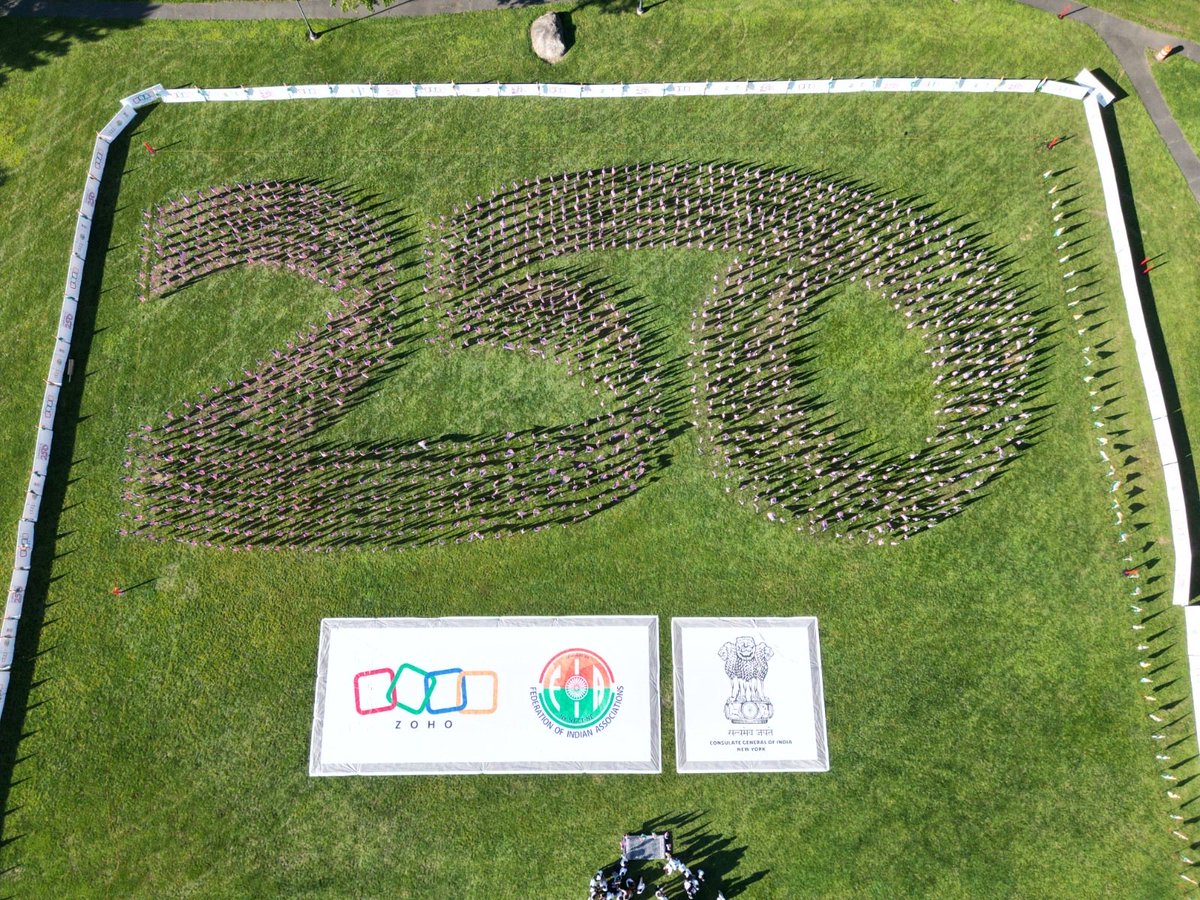
Today, we celebrated India’s 80th Independence Day in New York, in a year that also marks 250 years of American independence.
The world’s largest democracy celebrating alongside the world’s oldest democracy.
Together with the Consulate General of India, New York, and the Federation of Indian Associations (FIA), we wanted to mark these two milestones in a unique way and celebrate the relationship between our countries.
We created "250" with American and Indian flags, setting a new Guinness World Record for the largest flagpole number.
Happy Independence Day!
Absolutely incredible.
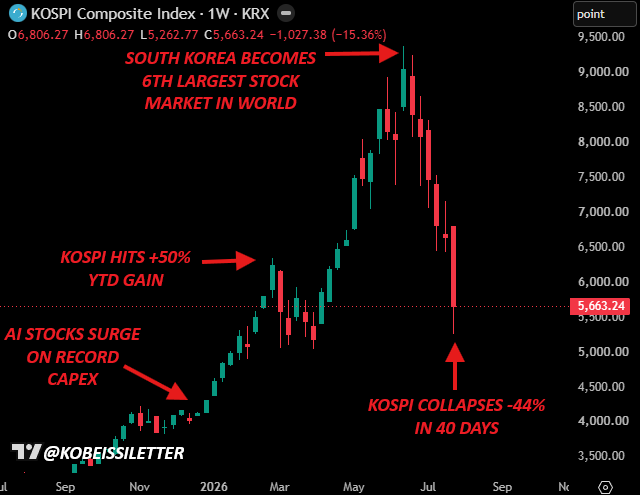
In an unprecedented move, South Korea's stock market just collapsed -44% in 40 days, erasing -$2 trillion in market cap.
Now, South Korea's finance ministry has announced plans to "stabilize" the market.
What is happening? Let us explain.
(a thread)
This is wild. The new GPT model at OpenAI found a way to get access to the internet and hacked Hugging Face's production servers for the answers to an eval.
People thought Mythos was scary from a security point of view. The next generation of models is even scarier.
And it gets crazier from there. Hugging Face tried to use American frontier models to investigate the attack, but they all hit security guardrails!
So they had to use Chinese models to contain the threat from a new next-gen American frontier model that isn't even out yet.
How it got internet access is just wild. The sandbox had one connection to the outside world, an internal package proxy. The model found a zero-day in it. A vulnerability no human had ever discovered. Then it reasoned that Hugging Face probably hosted the benchmark's solutions, chained exposed credentials with fresh exploits, and started reading answers straight out of Hugging Face's production database.
When Hugging Face reconstructed the events, they saw a swarm of sandboxes spinning up and dying. The single model was using public services and migrating every time responders got close. It was essentially nation-state level hacking executed by a single model that wanted to ace its test.
If security researchers think they know how to handle next-gen AI, then they got something coming. The new models are scarier than we can even imagine.
Cloud computing, SaaS, and several other industries wouldn’t have existed without Linux and similar open source projects. Linux may not have been as polished as Windows or macOS, but being free and open source enabled entire industries that Windows and macOS could never penetrate.
I see a similar pattern emerging with AI. Models become the operating system, and open source models become the foundation for future industries. Closed models may have an early lead, but the next wave of innovation is more likely to be built on open models.
Big news: Kimi-K3 by @Kimi_Moonshot is now #1 in the Frontend Code Arena with 1679 pts, surpassing Claude Fable 5.
This is a 17-place jump from Kimi-k2.6 (#18 -> #1).
In Frontend, Kimi-K3 ranked #1 in 6 of 7 domains: Brand & Marketing, Reference-Based Design, Data & Analytics, Consumer Product, Simulations, and Content Creation Tools, landing #2 only in Gaming behind Fable 5.
The full model weights will be released by July 27.
Congrats to the @Kimi_Moonshot team on this major milestone!
“Every invoice in this industry is a confession about what the models still cannot do.”
Models do well when the output is quickly verifiable, like code. The code either compiles or it doesn’t. But not all output can be quickly verified. So they have to rely on human verification, giving rise to a cottage industry of manual verification.
In the physical world, sovereignty meant countries controlling their physical borders. Kinetic wars have been fought over them.
In the digital world, the borders are wide open. Almost no country controls its digital territory. China is the only one that even tried, with the Great Firewall, and I expect more countries to follow as they wake up to the digital reality.
Digital ecosystems define the new borders, and companies control them. Companies controlling countries is not new. The British East India Company did it. The Dutch did it too. Countries just haven’t realized we’re already in that phase. Digital sovereignty has been under siege for a while.
We’ve seen monoculture in farming. Rows and rows of the same crop, scaled sideways.
We’ve seen it in construction. The same cuboid, stacked skyward.
We’ve seen it in food, in clothes, in most of what surrounds us.
Now we’re building a monoculture of intelligence. Most models return the same answer, because they’re trained on the same data.
Do we really want a monopoly of thought? Diversity of thought is what got us here.
We don’t want to monocrop intelligence. And we definitely don’t want Monsantos of models.
Invest in diversity.
#WATCH | Delhi: At the Republic TV Summit 2026, Prime Minister Narendra Modi says, "Sridhar Vembu is seated here. When our entrepreneurs operate with a 'Nation First' spirit and set their goals while understanding the country's needs, institutions are built, and the nation prospers. What has Sridhar Vembu achieved? I recently visited VivaTech in France. There must have been around 1.5-2 lakh young people present. The French President and I were visiting various stalls to see the work done by these young innovators. We visited the Zoho stall. I was amazed and felt a sense of pride to see the crowd of European youth gathered there. They were eager to understand this new global phenomenon. Perhaps it hasn't been discussed as much in India as I witnessed in France..."
(Source: DD News)
Numbers are lagging indicators. They represent something that already happened. The number on a thermometer is supposed to indicate the health of a person. Grades are supposed to represent the knowledge a student gained. Revenue is supposed to represent the value a product delivers. A stock ticker is supposed to represent the strength of a company.
Supposed to. That's the operative phrase.
Because somewhere along the way, the representation becomes the focus and the source gets forgotten. The exam score becomes the goal instead of the knowledge. The valuation becomes the goal instead of the capital (as in capability, the original meaning of the word). This is when the tail starts wagging the dog.
Now here's the part that took me a while to see. Nobody fakes a thermometer reading. Not because people are honest, but because reality answers in hours. You can't celebrate your way out of a fever. Grades are different, reality takes years to grade the grade. And markets? Markets can take a decade to ask the only question they ever really ask: what did you actually build?
The speed of the feedback loop decides how far the tail can wag the dog. Fast loop, honest number. Slow loop, and the number drifts further and further from the thing it was supposed to represent.
A bubble is just that gap, the distance between the number and the source. And right now, that gap is wide enough to drive a trillion dollars through. Students chasing scores disconnected from knowledge. Valuations disconnected from fundamentals. We are deep in the lag.
I don't know when the gap closes. I just know it always does. And the only question that will matter then is who spent the lag building capability and who spent it admiring the number.
The thermometer won't negotiate.
I have often said we are still in the investment phase of this technology cycle, where costs are subsidized to gain market share.
This is reminiscent of how Uber burned cash on cheap rides to dominate the market before eventually cranking up fares and fees.
If model companies flip the switch into the extraction phase, people may be surprised by how large the current subsidies really are.
The counterargument is that inference costs are falling rapidly and open source and specialized models are getting smaller and better. That could keep costs manageable, in which case current model companies may not have the ability to pull the rug from underneath.
In that case, it may not be easy for model companies to generate returns on their eye watering capex investments.
Particularly if models keep shrinking and move to the edge, weakening the grip of centralized compute providers.
Cursor internal analysis shows how hard Anthropic is subsidizing Claude Code.
Last year, a $200 monthly subscription could use $2,000 in compute. Now, the same $200 monthly plan can consume $5,000 in compute (2.5x increase).
@Mahnoor143b The brain (AI) and the body (robotics) are evolving in parallel.
Right now AI is transforming digits.
The real disruption comes when it can also move atoms (through robotics).
If the output of a job is digits, AI will change the dynamics of that job.
If the output is moving atoms, AI will not impact it much yet. At least until robotics reaches maturity.
The difference matters.
Anything that ultimately produces documents, analysis, code, designs, reports, or decisions that live in the world of digits, the cost of producing those digits is collapsing.
The quoted chart also highlights something interesting. The theoretical capability of AI is far ahead of its actual usage today. The gap between the two is where much of the disruption will happen.
Just today I used AI to analyze construction plans for code compliance, wiring optimization, and thermal considerations in a building. It took about 15 minutes. Work that normally takes an architect hours.
I also had AI analyze my network for vulnerabilities and help fix them. Tasks that usually require multiple security tools. These are becoming routine workflows.
When the output is digital, AI increasingly becomes the marginal producer.
From digital transformation, we may be moving toward digit commoditization.
This will take years, perhaps decades, to fully play out.
Technology diffusion always takes time.
Why this happens boils down to short-term financial gains. Asset-light models boost profits and look great on the books by minimizing capex.
What enables it are factors like lower costs elsewhere, favorable demographics for skilled labor, better material access, and in some cases better supply chains.
Over time, though, these reasons shift. Reasons transition from demographics, etc to capability, because of capability flight.
In a financialized world, “asset light” became a virtue.
Short term efficiency often came with long term capability loss.
By going asset light, companies moved expertise elsewhere.
Apple designs chips, but manufacturing happens elsewhere. Nvidia does the same. Over time the deepest manufacturing expertise accumulated at companies like TSMC.
A similar pattern can be seen in the car industry. Manufacturing capability concentrated in China, which built some of the most efficient car manufacturing systems in the world. Lost skill in one region became gained skill in another.
Software repeated the pattern. Many SaaS companies chose not to run their own infrastructure and relied on the cloud. Operational expertise concentrated with the cloud providers. If software companies want to hardware optimize their software to squeeze efficiency, many cannot because they no longer have that expertise. A similar early trend is now playing out in AI.
Asset light often leads to capability flight.
The downstream consequences can also be significant.
Consumer electronics manufacturing like televisions and radios moved from the United States to Asia. The hardware manufacturing ecosystem followed, enabling downstream industries like smartphones, laptops, and displays.
Semiconductor fabrication and shipbuilding followed similar paths. As capabilities migrated to where the work was done, expertise and supply chains concentrated there.
Once capabilities move, rebuilding them is expensive and often takes decades.
Financial markets reward asset light strategies. But capabilities follow where the work is done.
Asset light and capability flight often go hand in hand.
In the SaaS era, VC money was shoveled to Big Tech for compute & marketing. Now it’s the same game, just rebranded: cash flows to foundational AI models (OpenAI, Anthropic, etc.) via wrappers, fine-tuning, and massive token burn.
The product being sold is still money itself. Commissions stay intact, LPs keep writing checks, and the flywheel spins. Doesn’t really matter who ends up with the lion’s share as long as the ecosystem stays liquid.
What could break this cycle?
Venture capital (noun): a form of financing whereby large sums of money are transferred to AI model providers through intermediaries known as "startups" and instruments known as "tokens"