🇬🇧 THEY TOLD YOU A STORY. 🇬🇧
Colonisers. Slavers. Oppressors. And you were supposed to feel ashamed.
Not for what you done... But for WHO YOU ARE. 🇬🇧
So we tested it. Britain wrote everything down, so we opened the books. 📖
Turns out fewer than 1 man in 10 could vote in the year Britain banned the slave trade. No woman could. Your ancestors could hang for stealing a sheep, get shipped across the world for petty theft, or go down a mine at 8 years old. In Manchester, the average age of death in a labouring family was 17.
They weren't running the slave trade. They were underneath it too.
Which is what makes what happened next worth knowing.
In 1772 an enslaved man named James Somerset walked free from an English court, because English law couldn't hold a slave.
In 1791, 300,000 families just stopped buying slave sugar. No march, no riot, just a decision made at 300,000 kitchen tables.
In 1792, 519 petitions carrying 390,000 names hit Parliament, most signed by people who couldn't vote themselves.
In 1807, Britain banned the trade.
Then the slave owners sent Britain a bill for the 800,000 people they still held. 💷 £20 million. About 40% of the entire government budget at the time.
The Treasury says it wasn't paid off until 2015. So if your family paid British tax before then, they helped buy 800,000 people their freedom.
From 1808 the Royal Navy spent 60 years hunting slave ships at sea: 1,600 stopped, 150,000 people freed, and 1,600 British sailors dead, mostly of disease, buried thousands of miles from home. ⚓
In 1816 they ended two centuries of Barbary corsairs enslaving Europeans.
In 1896 a war that lasted 38 minutes ended slavery in Zanzibar. 🇹🇿
Almost every country on Earth outlaws slavery today.
That fight was paid for largely at British expense, by British hands.🇬🇧
So why haven't you heard any of this?
Because within living memory, someone rewrote the story. You got taught the crime. Not the cure.
The powerful exploited the world. They exploited their own people first. It was those people who ended slavery. 🇬🇧
━━━━━━━━━━━━━━
History got rewritten once, in living memory, by no one who was ever named or held to account.
We are ordinary people doing what ordinary people have always done. Opening the books. Refusing to look away.
This is how we fight back. Fact by fact. Story by story. Name by name.
We are the home of British heroes. There is a place for you in it.
If you can afford to support what we do: https://t.co/rih7iKwnvf
Be part of us. ☝️🇬🇧 Be Proud Of Us. 🙏🇬🇧
Yesterday I had the privilege of attending Marc Bloch's reburial ceremony at the Panthéon – Paris' monument to the most outstanding citizens of France. Bloch was honored not only as one of the greatest French historians, but also as a man who chose resistance over safety when his country fell into darkness.
Bloch fought in two World Wars, and received multiple awards for bravery. By the time the pro-Nazi Vichy regime came to power in 1940, Bloch was already recognized as perhaps the preeminent historian of medieval France. He continued to teach history, and during that time wrote 'Strange Defeat', a book explaining the French defeat in 1940, and 'The Historian’s Craft', a meditation on history and historiography. Bloch also joined the Résistance and became one of its leaders.
On March 8, 1944 Bloch was captured during a crackdown on the Résistance by the Nazis and their French collaborators. At the time, collaborationist French newspapers celebrated Bloch’s capture. They highlighted his Jewish identity, and referred to the historian as a traitor to France, describing the Résistance as a Jewish-Bolshevik terrorist organization. Bloch was imprisoned and tortured at the Gestapo headquarters in Lyon, and was executed on June 16, 1944, ten days after the Allied landing in Normandy.
I am a medievalist by training, and have been deeply influenced by Bloch. What moved me most about Bloch is his uncompromising commitment to truth. For him, history was never nostalgia or mythmaking, but a discipline of honesty – a way of resisting propaganda, prejudice, and the comfort of convenient fictions. For Bloch, truth was not just an intellectual position, but a spiritual practice. Anticipating his death at the hands of the Gestapo and the Vichy regime, the Jewish historian and freedom fighter left behind detailed instructions for his burial. He wrote:
“I have not asked to have read above my body those Jewish prayers to the cadence of which so many of my ancestors, including my father, were laid to rest. All my life I have striven to achieve complete sincerity in word and thought. I hold that any compromise with untruth, no matter what the pretext, is the mark of a human soul’s ultimate corruption. […] That is why I find it impossible, at this moment of my last farewell, when, if ever, a man should be true to himself, to authorize any use of those formulae of an orthodoxy to the beliefs of which I have ever refused to subscribe.
But I should hate to think that anyone might read into this statement of personal integrity even the remotest approximation to a coward’s denial. I am prepared, therefore, if necessary, to affirm here, in the face of death, that I was born a Jew: that I have never denied it, nor ever been tempted to do so. […] A stranger to all credal dogmas, as to all pretended community of life and spirit based on race, I have, through life, felt that I was above all, and quite simply, a Frenchman. A family tradition, already of long date, has bound me firmly to my country. I have found nourishment in her spiritual heritage and in her history. I can, indeed, think of no other land whose air I could have breathed with such a sense of ease and freedom. I have loved her greatly, and served her with all my strength. I have never found that the fact of being a Jew has at all hindered these sentiments. Though I have fought in two wars, it has not fallen to my lot to die for France. But I can, at least, in all sincerity, declare that I die now, as I have lived, a good Frenchman.”
By his request, a Latin epitaph was carved on Bloch’s grave: dilexi veritatem (“I have loved the truth”).
Watching Bloch's memory honored at the Panthéon yesterday did not feel like a tribute to the past as much as a challenge to the present. As dark clouds gather once again, how many of us today can demonstrate Bloch's level of integrity and fearlessness?
1⃣ Marsch durch die Institutionen angetreten. Am Ziel angekommen und gut eingerichtet. Einfluss und Status genossen, mediales Wohlwollen inklusive. Dann aber: Feststellen, dass (herrschafts-) freie Diskurse neue Wege gehen, Illusionen von Realität umzingelt werden und eigene Narrative verwelken.
2⃣ Bröckelnde Dominanz beklagen, besseren Zeiten nachtrauern, Polarisierung anprangern und vehement Gefolgschaft einfordern. Sich als einziger Systemgarant begreifen und Kritiker/Widersacher immer abstruser diffamieren. Karawane zieht trotzdem weiter. Ergebnis: Mix aus Frust, Wut und Panik.
3⃣ Könnte erklären, warum (ehemals) „#Progressive“ mitunter so autoritär-gestrig auftreten und offen mit freier Rede hadern. Am Ende eines langen Weges wirken sie so, wie sie nie sein wollten. Indem sie das selbst spüren, schürt diese Dissonanz weitere Aggression.
➡️ Ist für alle Beteiligten schmerzhaft, aber wohl der Preis eines heilsamen Korrekturprozesses, zu dem das westliche Modell der liberalen #Demokratie wie kein anderes in der Lage ist. Wendepunkte schlagen Wunden, aber es fließt kein Blut. Die langen Wellen der Politik schließen Repräsentationslücken und führen aus ideologischen Sackgassen heraus. Zeigt sich im Zeitraffer und aus der Distanz klarer als mittendrin.
Explore the world of New Traditional Architecture! Now you can easily discover new projects (with photos of course) and architects with this ever expanding atlas. Go to (https://t.co/kNaF7ge8T9) and start your journey :)
🇳🇱MANY SMALL IMPROVEMENTS: Like countless city centers, the one of Veghel (NL) has been ravaged by modernists. Attractive street scapes have been replaced by "progress" and slowly but steadily many areas lost their attraction. But things can be turned around with the right will, which I regularly stweet about.🧵
@itsolelehmann https://t.co/IygJazuG4z (A) they do the whole value chain of electrification (in a gold rush, sell shovels) — (B) they're in robotics, too.
@ThomasPercy95 Eine Politik, in der Stellenwachstum nicht in die Verwaltung geht, und die den industriellen Missbrauch des Asylrechts bekämpft. Dann würde 1. weniger Arbeitspotential durch überbezahlte Verwaltungsjobs abgesaugt, 2. weniger «Migranten» mit Zero Berechtigung. Rest wäre voll okay
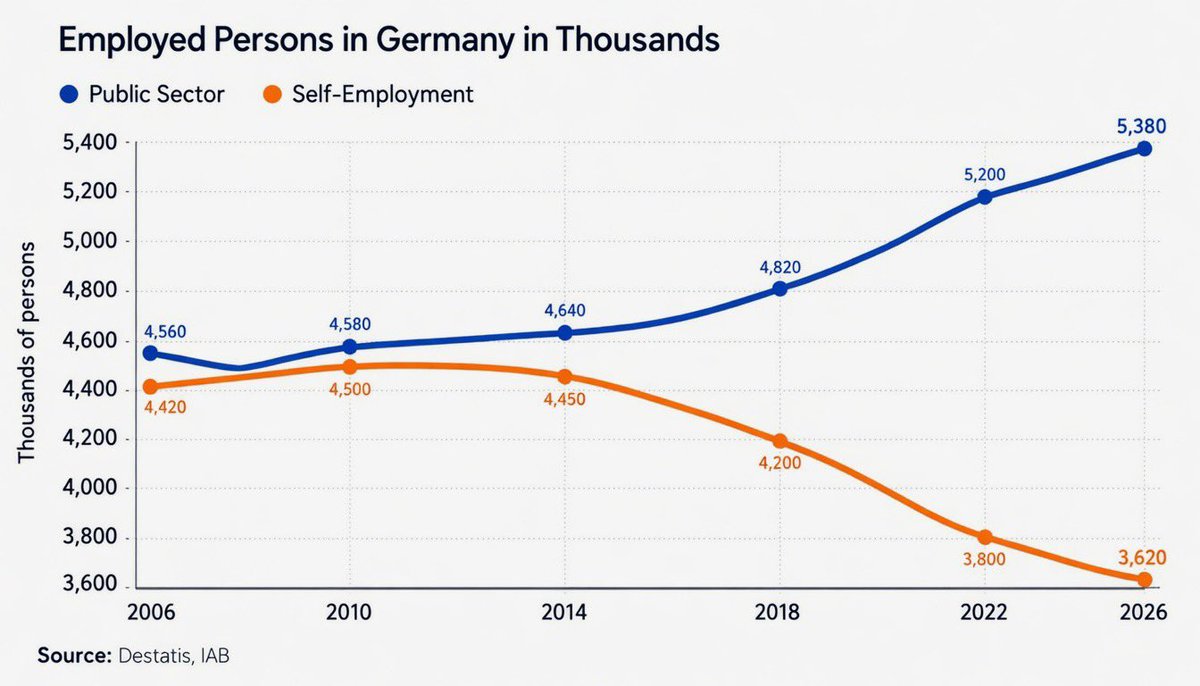
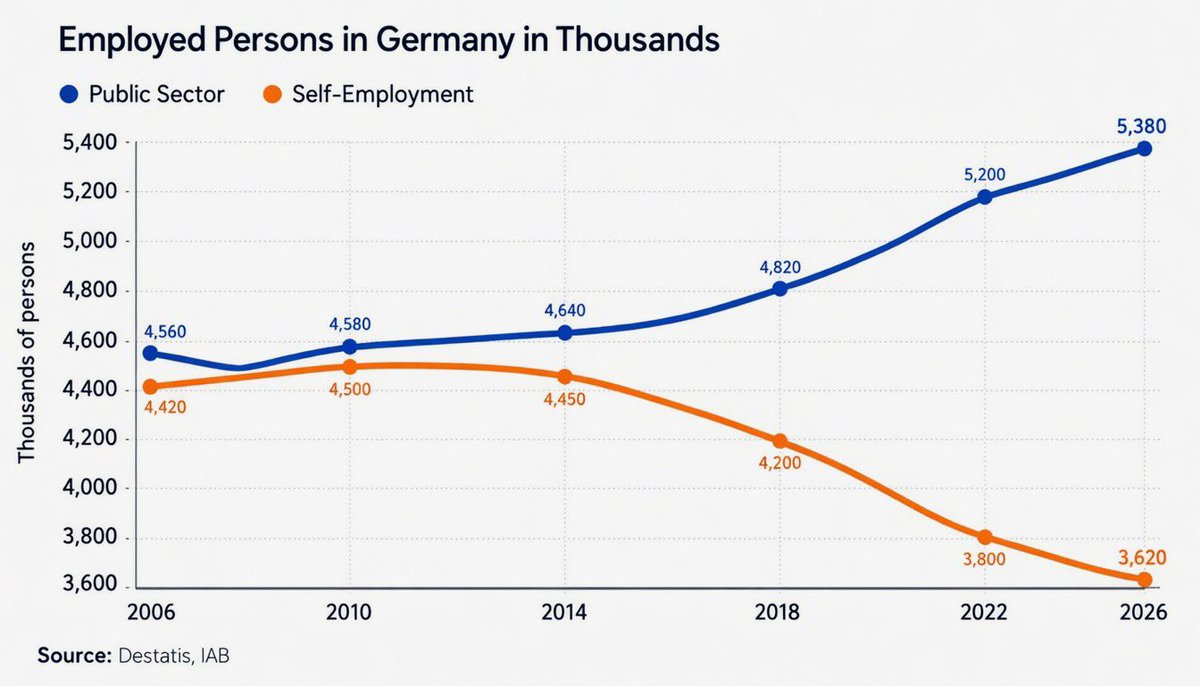
This chart helps explain why the German economy is falling apart. Instead of starting small businesses, Germans prefer to "work" for the government.
A nation cannot stay prosperous with such a mindset. Only entrepreneurialism and free markets create prosperity, not the state.
When an empire runs out of its own money, it is able to increase the supply of money. However, printing more money causes borrowing to increase creating a financial bubble. I urge you to watch “Principles for Dealing with the Changing World Order” on my YouTube channel in the comments below to understand how, and what it means for all of us.


![harari_yuval's tweet photo. Yesterday I had the privilege of attending Marc Bloch's reburial ceremony at the Panthéon – Paris' monument to the most outstanding citizens of France. Bloch was honored not only as one of the greatest French historians, but also as a man who chose resistance over safety when his country fell into darkness.
Bloch fought in two World Wars, and received multiple awards for bravery. By the time the pro-Nazi Vichy regime came to power in 1940, Bloch was already recognized as perhaps the preeminent historian of medieval France. He continued to teach history, and during that time wrote 'Strange Defeat', a book explaining the French defeat in 1940, and 'The Historian’s Craft', a meditation on history and historiography. Bloch also joined the Résistance and became one of its leaders.
On March 8, 1944 Bloch was captured during a crackdown on the Résistance by the Nazis and their French collaborators. At the time, collaborationist French newspapers celebrated Bloch’s capture. They highlighted his Jewish identity, and referred to the historian as a traitor to France, describing the Résistance as a Jewish-Bolshevik terrorist organization. Bloch was imprisoned and tortured at the Gestapo headquarters in Lyon, and was executed on June 16, 1944, ten days after the Allied landing in Normandy.
I am a medievalist by training, and have been deeply influenced by Bloch. What moved me most about Bloch is his uncompromising commitment to truth. For him, history was never nostalgia or mythmaking, but a discipline of honesty – a way of resisting propaganda, prejudice, and the comfort of convenient fictions. For Bloch, truth was not just an intellectual position, but a spiritual practice. Anticipating his death at the hands of the Gestapo and the Vichy regime, the Jewish historian and freedom fighter left behind detailed instructions for his burial. He wrote:
“I have not asked to have read above my body those Jewish prayers to the cadence of which so many of my ancestors, including my father, were laid to rest. All my life I have striven to achieve complete sincerity in word and thought. I hold that any compromise with untruth, no matter what the pretext, is the mark of a human soul’s ultimate corruption. […] That is why I find it impossible, at this moment of my last farewell, when, if ever, a man should be true to himself, to authorize any use of those formulae of an orthodoxy to the beliefs of which I have ever refused to subscribe.
But I should hate to think that anyone might read into this statement of personal integrity even the remotest approximation to a coward’s denial. I am prepared, therefore, if necessary, to affirm here, in the face of death, that I was born a Jew: that I have never denied it, nor ever been tempted to do so. […] A stranger to all credal dogmas, as to all pretended community of life and spirit based on race, I have, through life, felt that I was above all, and quite simply, a Frenchman. A family tradition, already of long date, has bound me firmly to my country. I have found nourishment in her spiritual heritage and in her history. I can, indeed, think of no other land whose air I could have breathed with such a sense of ease and freedom. I have loved her greatly, and served her with all my strength. I have never found that the fact of being a Jew has at all hindered these sentiments. Though I have fought in two wars, it has not fallen to my lot to die for France. But I can, at least, in all sincerity, declare that I die now, as I have lived, a good Frenchman.”
By his request, a Latin epitaph was carved on Bloch’s grave: dilexi veritatem (“I have loved the truth”).
Watching Bloch's memory honored at the Panthéon yesterday did not feel like a tribute to the past as much as a challenge to the present. As dark clouds gather once again, how many of us today can demonstrate Bloch's level of integrity and fearlessness?](https://pbs.twimg.com/media/HLliH6MWUAAvbZS.jpg)