GTA 6 did $3.79 billion on day one with no GTA Online.
I hope Rockstar takes its time with Online anyway.
GTA 5 got zero story DLC in 13 years. After 2013 it was all Online, because Online printed money.
Now story mode alone just had the biggest launch in entertainment history.
Rockstar hasn't given Online a date. Good. Give me a Lucia and Jason expansion first.
Online: 2027 or 2028?
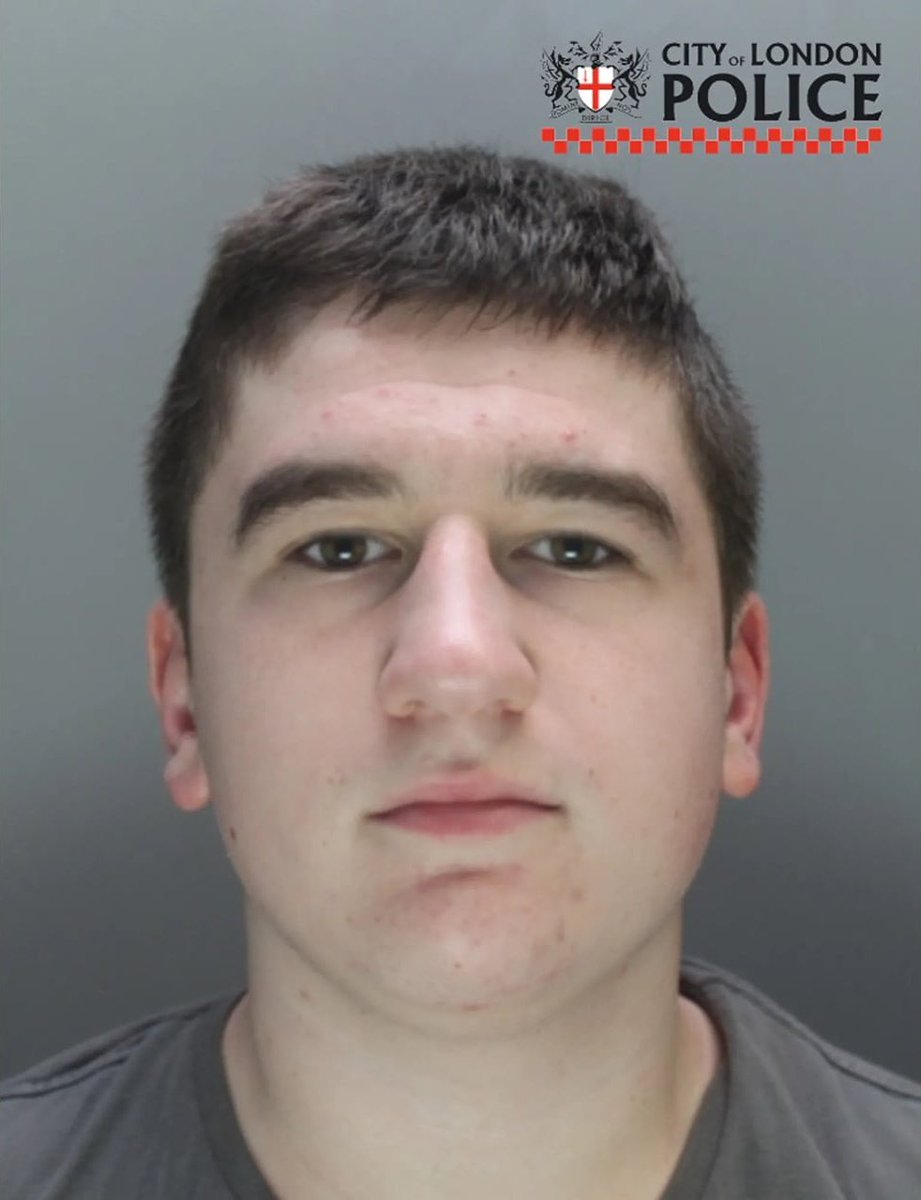
In September 2022 a 17-year-old leaked almost an hour of GTA 6. His tools: a hotel TV, a phone and an Amazon Fire Stick. So the police had put him in that hotel room. He was out on bail for hacking.
Rival hackers were after him, so the police moved him to a Travelodge for his own safety. He plugged a Fire Stick into the TV, got into Rockstar’s Slack, and told the company to negotiate with him on Telegram.
What one night cost Rockstar:
> dozens of clips of an unfinished game, all over the internet
> $5 million to clean up, by its own count
thousands of hours of staff time
In 2023 doctors said he was not fit to stand trial, and a judge sent him to a secure hospital with no end date. This January that changed and he was moved to a regular prison.
On Monday he pleaded guilty in a London court. He is 21 now, and the game he leaked comes out on Thursday.
Who looks worse in this story, the kid or Rockstar’s security?
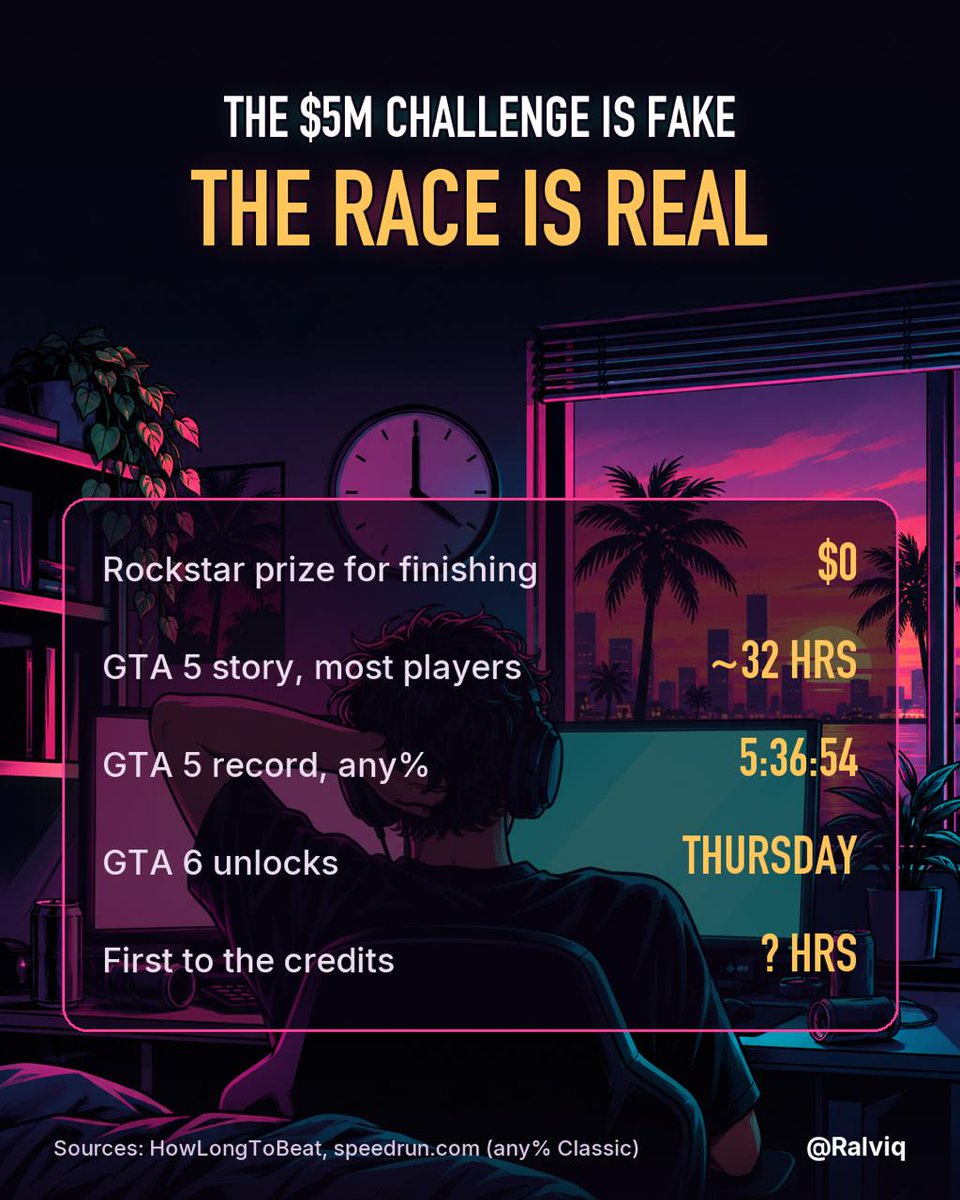
This $5 million challenge is fake. Rockstar never announced it.
The race to the credits is real though. The GTA 5 record is under 6 hours.
No outlet has the prize story, and Rockstar's channels say nothing about it.
What finishing a GTA actually looks like:
- GTA 5's story takes most players about 32 hours
- The fastest any% run is 5 hours 36 minutes, after 13 years of practice
- On launch day in 2013, nobody knew the routes yet
GTA 6 unlocks on Thursday. Some streamer is going to play from minute one and not sleep.
How many hours until the first person sees the credits?
Rockstar Games is reportedly planning a massive $6 million reward challenge for GTA 6 players.
The first player worldwide to complete all main story missions could receive $5 million, while players who complete 200 hours of gameplay and unlock a special trophy could win $1 million.
Jensen Huang is out as NVIDIA's CEO, amid reports of an affair with an alleged Chinese spy.
30 years ago he almost lost NVIDIA another way. He told Sega the chip had failed, then asked for the money anyway.
"I unfortunately still need the money."
NVIDIA had blown a $12 million contract. The chip didn't work. Without cash, the company was dead.
The way Jensen tells it, Sega's CEO, Shoichiro Irimajiri, put it like this:
"What I contracted you to do, you can't do, but you would like all the money on the contract."
"You got it. That's exactly right."
Sega said yes. $5 million.
That money kept NVIDIA alive. Then, Jensen says, Sega sold its stake the moment NVIDIA went public. For $15 million.
NVIDIA is still worth about $4 trillion. Even after this week.
Genius move by Sega, or the worst trade in tech history?
Every morning Warren Buffett tells his wife one of three numbers: $2.61, $2.95 or $3.17. It's how much he spends on breakfast, and the stock market decides which one.
In the HBO documentary "Becoming Warren Buffett", he explains it on the drive to work. Every morning, while he shaves, he tells his wife one of three numbers. She puts exactly that much in a little cup in his car.
> $3.17 when he feels prosperous: bacon, egg and cheese biscuit
> $2.95 on a normal day
> $2.61 when the market is down: two sausage patties, and he puts them together himself
He has called the house the third best investment he ever made. The first two were his wedding rings.
Would you still live in your first house if you had his money?
Russell Brand could have walked away with $20 million of Katy Perry’s money, but he dumped her over a text instead.
No prenup. Roughly 45% of her fortune was right there for the taking, yet he didn't touch a single dollar.
Shortly after the split, he sat down on TV with Piers Morgan. When asked about his marriage ending, Brand just shrugged. He called the legal divorce a simple "administrative finality" that didn't matter much to him.
Instead of showing real feelings, he turned on the host. He called Piers an architect of a "citadel of nonsense" and hid behind talks of yoga, meditation, and hard work.
I see a man who was way too proud to take her money, but far too cowardly to look his own wife in the eye.
Leaving $20 million on the table wasn't about being a peaceful soul: it was just his way of acting superior while treating a whole marriage like trash.
Was he actually holding high moral standards, or did he just pay $20 million for the ultimate power trip?
In 1976, Ronald Wayne owned 10% of Apple. He quit after 12 days and took $800.
Apple is worth about $5 trillion now. That's not even the part he regrets.
Jobs and Wozniak took 45% each. Wayne got the last 10% so he could break their ties. He wrote the partnership agreement himself and drew Apple's first logo.
Then Jobs took out a $15,000 line of credit. Wayne had already lost money on a failed slot-machine business, and he had a house and savings the creditors could reach. Twelve days in, he went back to the county office and took his name off.
"It was like having a tiger by the tail."
his stake: $800
a year later, to drop any future claims: $1,500
his signed copy of the founding contract: sold for $500
the same contract at auction years later: $2.51 million
If he'd stayed, he said, he "probably would have wound up the richest man in the cemetery."
In the video below, he explains where the $800 actually came from.
Who lost more here: the man who took an $800 check to walk away, or the man who sold the paper for $500?
In 2008, Taraji P. Henson played next to Brad Pitt in a movie that made $335 million. After taxes and fees, she kept about $40,000.
The role got her an Oscar nomination. A year later, one man paid her a million.
She asked for $500,000. She was third on the poster, after Brad Pitt and Cate Blanchett. The studio wouldn't go past $150,000.
Then came the cuts. Her team took its share, taxes took more, and New Orleans was on her. In her memoir she wrote that she paid for her own travel and a hotel suite for the three months of filming. She has said the rest went toward her son's tuition.
- asked: $500,000
- paid: $150,000
- kept: about $40,000
- box office: $335.8 million
Oscar nomination: Best Supporting Actress
In 2009 Tyler Perry cast her in I Can Do Bad All By Myself and paid her what she felt she was worth. It was her first million-dollar payday.
After that, she wrote, she never again had to take a role for "the rock bottom of six figures."
Her line about him: "I'm grateful to Tyler for putting me on the road to being paid my worth."
Would you have taken the $150,000, or walked away from a Brad Pitt movie?
In 2018, Steve Jobs' daughter went on TODAY and repeated what he kept telling her before he died:
"I owe you one, and I'm so sorry."
When she was a baby, he was worth over $200 million and paid $385 a month for her.
Jobs was 23 when Lisa was born. For two years he said she wasn't his. In a deposition he swore he as sterile and named another man as her father.
Her mother cleaned houses, waited tables and went on welfare. In 1980 San Mateo County sued him. A paternity test said he was the father, and the court made him pay back the welfare.
That same year Apple went public.
> $385 a month in child support
> over $200 million on paper at 25
> a computer called the Lisa, which he said stood for "Local Integrated Systems Architecture"
> At 14 she moved in with him. Decades later she sat by his bed while he was dying of cancer.
On TODAY she was asked if she forgave him.
"I think not at the time."
Then: "In many ways, yes."
Would you have forgiven him?
While Detroit begged Washington for billions just to stay alive, in 2008 Elon did something every traditional auto executive called completely impossible.
When the media mocked the $109,000 Roadster as an "expensive toy for rich people," he dropped a jaw-dropping confession that shattered the entire legacy auto playbook.
Watch until 03:35 to see how he exposed the exact moment the industry knew they were finished.
The Bailout Hypocrisy: While Congress handed billions to legacy automakers for survival, Tesla fought for every single dollar of statutory green vehicle development funds.
The Master Plan: You cannot build a cheap, mass-market electric vehicle without starting with an expensive, low-volume tech pioneer.
The Zero-Dividend Rule: Every single penny from the Roadster went straight back into R&D. Musk took minimum wage as a volunteer and refused to issue company dividends.
Did Elon outplay the entire legacy auto industry, or did he just ride a wave of government subsidies?
Steve Jobs lied to his best friend for $4,650, and it set the template for his entire career.
In 1975, Atari paid Jobs $5,000 to build a new arcade game called Breakout.
Jobs couldn't build the hardware, so he begged Steve Wozniak for help. He told Woz the job only paid $700, handed him a check for $350, and pocketed the other 93%.
Woz worked four straight days with zero sleep while keeping his day job at HP. Both of them ended up in bed with mononucleosis from extreme exhaustion.
Woz pulled off an engineering miracle:
Built the entire game with just 45 microchips
Saved Atari massive manufacturing costs
Beat Atari’s own engineers, who needed 150 chips to do the exact same job
Woz took his $350 and went home happy. Jobs took the rest of the cash to buy into an apple orchard farm in Oregon.
Ten years later, Woz read the real $5,000 figure in an Atari history book. By then, Apple was an international empire and both men were rich.
When asked about it, Woz said that if Jobs had simply asked for the money, he would have given him all of it.
"You care about friendship and honesty. Not money."
It was a pattern Jobs repeated for life. Right before Apple went public in 1980, Jobs refused to grant a single stock option to Daniel Kottke, their college friend who helped hand-assemble the very first Apple computers.
Woz did the exact opposite. He gave away millions in his own personal Apple equity to early employees who Jobs cut out.
One founder cheated his best friend for a 93% cut. The other gave away a fortune to make sure the team got paid.
Was Steve Jobs' legendary ruthlessness mandatory to build a trillion-dollar empire, or was he just a toxic partner who got lucky finding Wozniak?