Aspiring student passionate about politics,current affairs & ♟. Constantly learning and exploring new ideas. Join me in dissecting the trends shaping our world.
This summer, I’m focusing more on learning and consistency 🚀
Just joined the Summer SkillUp 2026 initiative by @GeeksforGeeks. Looking forward to exploring new tech domains, improving my skills, and making the most of this opportunity.
#SkillUpWithGFG#AIWithGFG#SummerSkillUp
Day 24 — POTD
Three sorted arrays today.
Went with three pointers instead of anything fancy.
Move the smallest, match when all align.
Clean logic once it clicks.
@GeeksforGeeks#POTD#DSA#100DaysOfCode
Day 23 — POTD
Stack + collision logic today.
Initially handled only one case of opposite signs and failed a test case. Fixed it by checking all opposite sign scenarios.
Small condition, big difference.
@GeeksforGeeks#POTD#DSA#100DaysOfCode
Day 22 — POTD
Counted buildings that can see sunlight.
Just tracked the tallest so far while moving left to right.
If current ≥ max till now → visible.
Simple pattern, clean logic.
@GeeksforGeeks#POTD#DSA#100DaysOfCode
Day 21 — POTD
Tried splitting array into two equal-sum parts.
Key check: total sum must be even, then look for a prefix hitting half.
Simple idea, but easy to miss at first.
@GeeksforGeeks#POTD#DSA#100DaysOfCode
Day 20 — POTD
Range mean queries today.
Doing sum every time felt slow, so used prefix sums.
Made each query constant time.
Small idea, big difference.
@GeeksforGeeks#POTD#DSA#100DaysOfCode
Day 19 — POTD
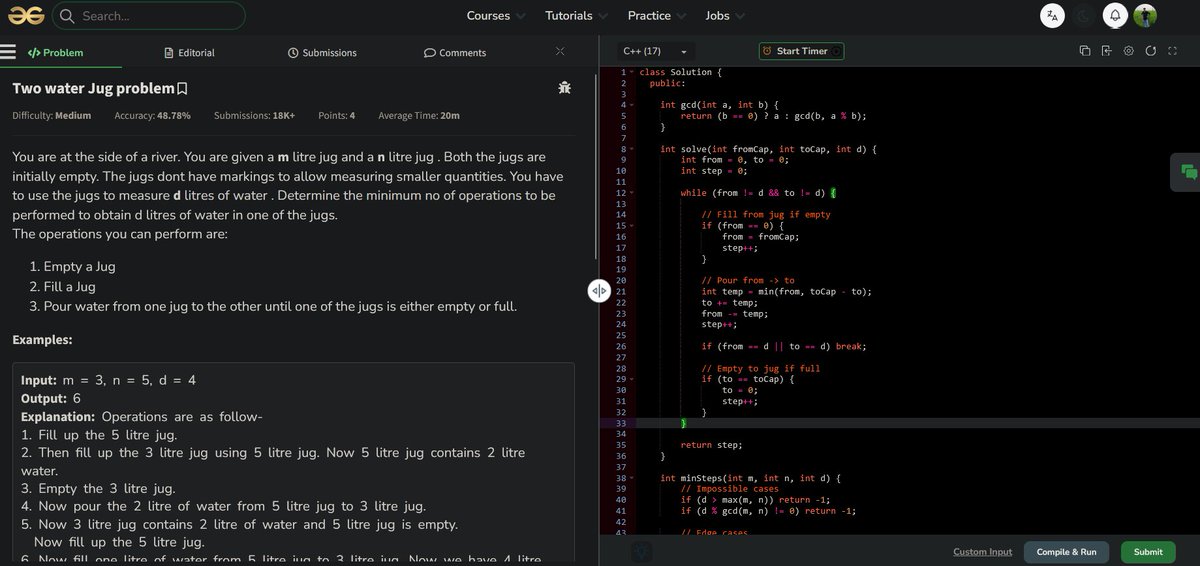
Water Jug problem today.
Had the logic right, but missed a simple edge case (when target equals one jug). Fixed it after a failed test case.
Good reminder: sometimes the bug isn’t in logic, it’s in what you didn’t check.
@GeeksforGeeks#POTD#DSA#100DaysOfCode
Day 18 — POTD
Worked on derangements today.
At first it looked like permutations, but the recurrence made it manageable.
D(n) = (n-1)(D(n-1) + D(n-2)).
Nice mix of math + DP.
@GeeksforGeeks#POTD#DSA#100DaysOfCode
Day 17 — POTD
Checked if one number is a power of another.
Just kept dividing instead of overthinking it.
If it reaches 1 cleanly, it works.
Simple idea, but easy to miss at first.
@GeeksforGeeks#POTD#DSA#100DaysOfCode
Day — 16 POTD
Flip 0s and 1s problem.
Turned it into a max subarray problem by treating 0 as +1 and 1 as -1.
Kadane’s made it click.
@GeeksforGeeks#POTD#DSA#100DaysOfCode
Day 15 — POTD
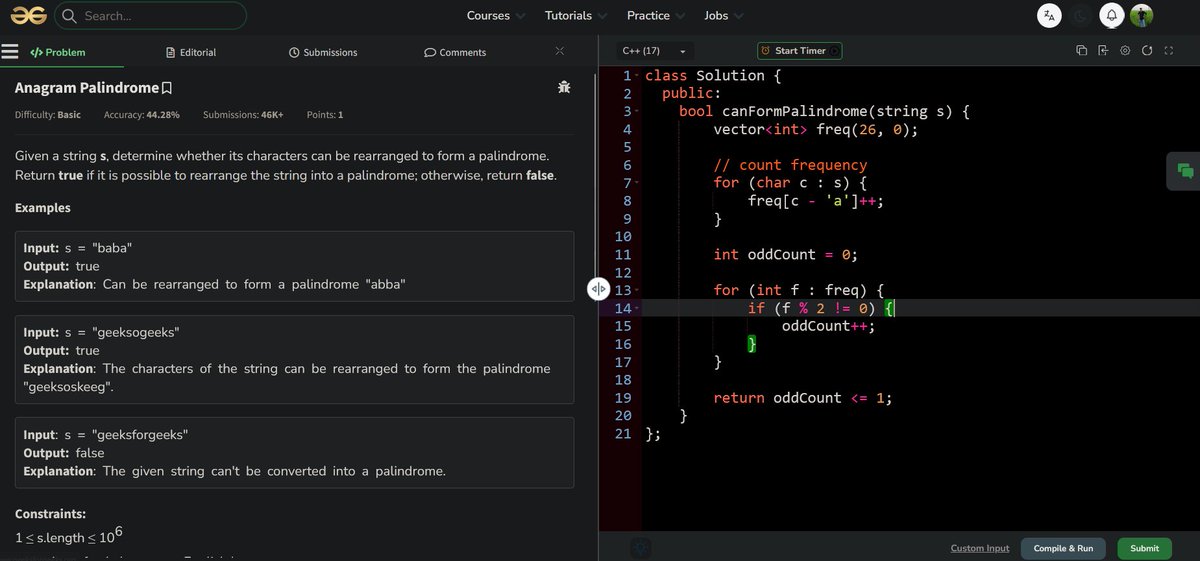
Palindrome rearrangement today.
Didn’t need to actually build it, just checked counts.
If more than one character has odd frequency → not possible.
Nice little logic check.
@GeeksforGeeks#POTD#DSA#100DaysOfCode
Day 14 — POTD
Tried implementing atoi today (string → integer without using built-ins).
Handling spaces, signs, and especially overflow took more thought than I expected. One small miss and the whole logic breaks.
@GeeksforGeeks#POTD#DSA#100DaysOfCode
Day 13 — POTD
Replaced spaces with %20 in a string.
Simple traversal, but a good reminder to handle string operations carefully.
@GeeksforGeeks#POTD#DSA#100DaysOfCode
Day 12 — POTD
Today’s one was simple, just removing spaces from a string.
Nothing complex, but yeah… consistency going on.
@GeeksforGeeks#POTD#DSA#100DaysOfCode
Day 11 of POTD 🚀
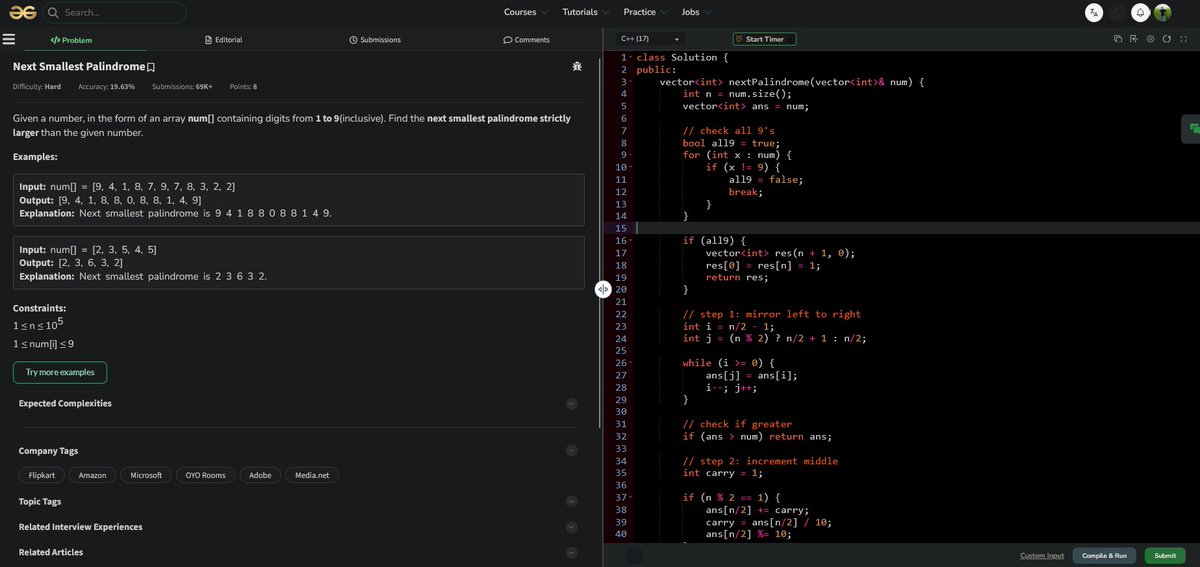
Solved Next Smallest Palindrome problem
Key idea: mirror the number, and if not greater → increment middle & handle carry
Tricky edge cases made it interesting 💻
@GeeksforGeeks#POTD#DSA#coding#100DaysOfCode
Day 10 of POTD 🚀
Solved Toeplitz Matrix.
Key idea: each element should match its top-left diagonal neighbor.
Simple traversal, clean logic 💻
@GeeksforGeeks#POTD#DSA#coding#100DaysOfCode
Day 9 of POTD 🚀
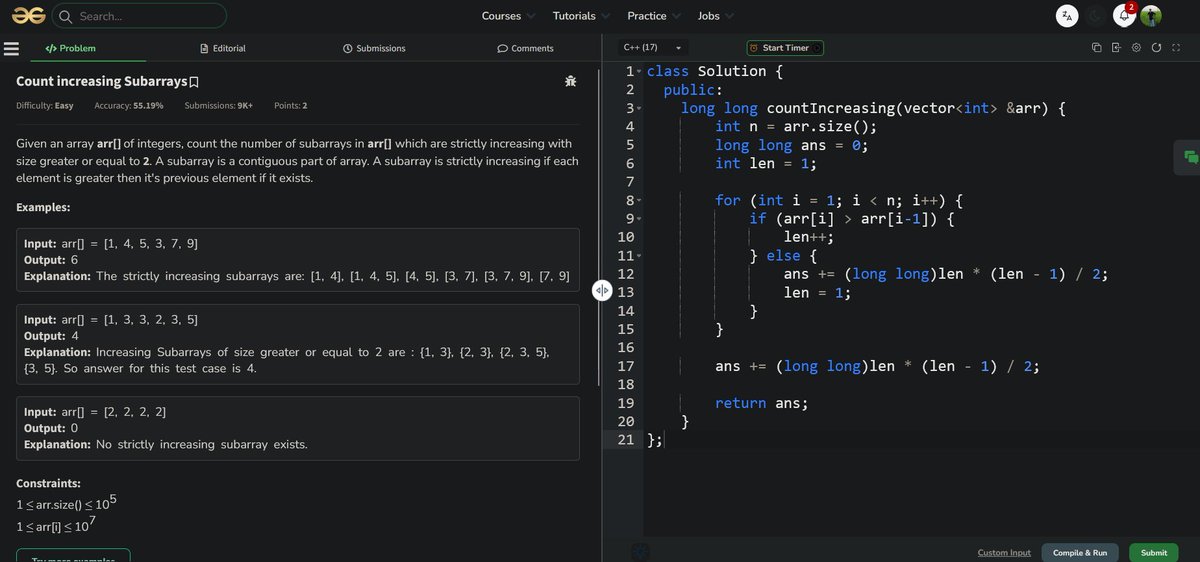
Solved Count Strictly Increasing Subarrays.
Instead of checking all subarrays, tracked increasing streaks and used n(n-1)/2.
Key idea: count patterns, not brute force.
@GeeksforGeeks#POTD#DSA#coding#100DaysOfCode
Day 8 of POTD 🚀
Solved Increasing Subsequence of size 3.
Used prefix min and suffix max to optimize from brute force.
Key idea: find arr[i] < arr[j] < arr[k] efficiently in O(n).
@GeeksforGeeks#POTD#DSA#coding#100DaysOfCode
Day 7 of POTD 🚀
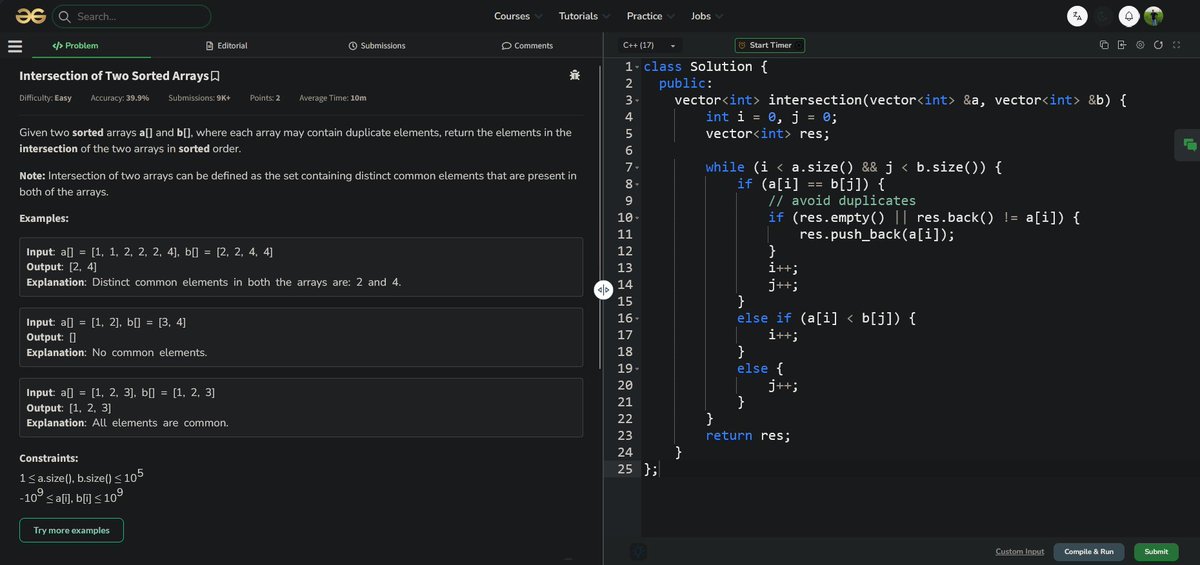
Solved Intersection of Two Sorted Arrays.
Used two pointers to traverse both arrays efficiently and handled duplicates carefully.
Key idea: sorted arrays + pointer movement = optimal solution.
@GeeksforGeeks#POTD#DSA#coding#100DaysOfCode