AI Can Write The Answer. But Who Decides The Question?
Many companies are thinking about AI in exactly the wrong way. Instead of asking, “How can AI help us create new things?” they are asking, “How can AI make employees work faster?” That difference may sound small, but it completely changes the outcome.
Imagine a factory owner who buys a fleet of powerful new machines. One approach is to use those machines to invent new products, enter new markets, and build things that were previously impossible. Another approach is simply to demand that workers produce more units per hour. The machines are the same, but the vision is different. According to management professor Wang Anzhi of CEIBS, many organizations are taking the second path with AI. They see AI primarily as a cost-cutting tool rather than a creativity-expanding tool.
This mindset is creating strange behavior inside companies. Some firms have reportedly split employees into AI and non-AI groups, then assigned heavier workloads to the AI users to measure productivity gains. Employees, meanwhile, have started gaming the system. Some use AI to write reports about how effectively they are using AI. Others deliberately consume large numbers of AI tokens merely to satisfy management metrics. It becomes a bizarre situation where people use AI not to create value, but to prove they are using AI. It is like a school grading students based on how many pages they turn rather than what they actually learn.
Wang argues that the deeper issue lies in how people think about AI. He points to research suggesting that average performers tend to treat AI as a tool, while exceptional performers treat AI as a teammate. The distinction is important. When AI is treated as a tool, people simply ask it for answers. When it is treated as a teammate, people use it to improve their own thinking and produce better answers themselves. The difference is similar to the difference between hiring someone to lift weights for you and hiring a trainer to teach you how to become stronger. In both cases assistance is provided, but only one approach develops your own capabilities.
To illustrate this point, Wang references experiments involving writing tasks and brain activity. Participants who relied heavily on ChatGPT showed significantly less mental engagement than those who wrote independently. Even more revealing was what happened afterward. When people who had become accustomed to AI assistance were asked to work without it, their brains remained relatively inactive. By contrast, people who first learned independently and later added AI support continued to show high levels of engagement. The lesson is simple: once the brain learns that someone else can do the work, it often stops investing effort itself. It is similar to what happens when a person becomes completely dependent on GPS. After years of following directions, they may no longer know how to navigate their own city.
This leads to one of Wang’s biggest concerns: outsourcing too much thinking prevents mastery. Human beings learn through deliberate practice. When you first learn to swim, drive, or play an instrument, every movement requires conscious effort. Over time, repeated practice transforms those actions into instinct. If someone else performs those actions for you from the beginning, you never develop the skill yourself. AI can create a similar problem. If workers immediately hand every challenging task to AI, they may gain speed in the short term but lose expertise in the long term. It is like using a forklift for every box you encounter and eventually forgetting how to lift anything yourself.
One of the most interesting questions Wang raises is where all the promised productivity gains have gone. AI can make individual workers dramatically faster. Yet companies are not suddenly producing ten times more innovation, ten times more products, or ten times more value. Why? Wang believes the answer lies at the organizational level. If leaders simply use AI to squeeze more work out of existing employees, the company’s ambitions remain unchanged. The ceiling stays the same. Faster workers do not matter much if they are still aiming at the same target. To create a truly transformative organization, leaders must raise the ceiling itself. They must pursue larger goals, bigger opportunities, and entirely new possibilities.
He compares today's AI moment to the arrival of electric motors during the Industrial Revolution. Electric motors were vastly superior to steam engines, yet factories did not become dramatically more productive overnight. It took decades for business leaders to redesign entire factory systems around the new technology. The real breakthrough was not the motor itself. The breakthrough was reimagining how the whole factory should operate. AI, Wang argues, presents the same challenge. The technology already exists. The harder task is redesigning organizations around it.
This is why Wang believes the true bottleneck is not employees but leaders. If managers focus only on efficiency metrics, workers will also focus only on efficiency metrics. Everyone ends up staring downward, trying to shave seconds off tasks and squeeze more output from existing processes. But when leaders focus on exploring new opportunities, employees begin looking upward as well. Growth, creativity, and experimentation become the priority. In his view, the future of AI-powered organizations depends less on how many employees use AI and more on whether leaders can imagine entirely new destinations for those employees to reach.
The conversation also explores a deeper human question: meaning. Many workers report that AI sometimes removes the satisfaction they once found in their jobs. A programmer, for example, may feel less joy in coding when AI generates much of the code. Wang argues that leaders must pay attention to this emotional dimension. Human beings need purpose. They need to feel that what they do matters. Without that sense of meaning, motivation fades. Work becomes mechanical. A company may become more efficient, but it risks becoming less human.
Wang believes that great leadership is not about controlling people but about igniting them. He uses the analogy of a group crossing a desert. If one person is struggling, carrying them on your back is not a sustainable solution. Eventually you become exhausted and resentful. A better leader discovers what motivates that person and helps them find the energy to continue on their own. Leadership, in this view, is less about management and more about unlocking human potential. AI does not change that principle. If anything, it makes it more important.
Looking ahead, Wang envisions a future where AI handles more and more execution. Machines will become increasingly capable of processing information, analyzing data, and performing routine tasks. Humans, meanwhile, will shift toward exploration. If AI becomes the worker, people become the explorers. Our role will be to discover new questions, create new meanings, imagine new possibilities, and chart new directions. AI may excel at finding answers, but humans remain uniquely suited to deciding which questions are worth asking in the first place.
Ultimately, the biggest opportunity presented by AI is not the chance to make workers faster. It is the chance to make humanity more ambitious. Just as electric motors transformed factories only after people redesigned the factory itself, AI will transform society only after people redesign how they think about work, creativity, and progress. The future belongs not to those who use AI merely to cut costs, but to those who use it to expand what is possible.
#ArtificialIntelligence #AI #FutureOfWork #Leadership #Innovation #Technology #Business #Productivity #Workplace #Management #DigitalTransformation #FutureTech #MachineLearning #Creativity #Learning #Automation #Entrepreneurship #WorkCulture #HumanPotential #AGI
If there is one startup idea which will actually solve a problem for men then it will be a app which tracks best hairdressers in the city and tracks them instead of saloon . You get comfortable with a hairdresser after 3 sittings and he leaves that saloon . Again have to start from first and your hair gets messed up.
Hairdressers change saloons faster than developers changing companies 😅
Every Few Years, EdTech Finds a New Way to Shoot Itself in the Foot
There is always an edtech company somewhere in the world creating a bad name for the sector. The names change. The countries change. The business models evolve. But every few years, a familiar story emerges: a company that claims to be transforming education ends up making headlines not for learning outcomes, innovation, or student success, but for questionable business practices. Whether it is misleading sales tactics, aggressive marketing, hidden charges, or pressure-driven enrollment strategies, the pattern seems to repeat itself with remarkable consistency. Unfortunately, the latest chapter in that story appears to involve one of India's largest edtech companies, PW (PhysicsWallah) .
India's Central Consumer Protection Authority (CCPA) has imposed a penalty of ₹5 lakh on PhysicsWallah after finding that the company deployed what regulators classify as "dark patterns" on its platform. Dark patterns are user interface designs intentionally crafted to influence people into making decisions they may not have consciously chosen if presented with a neutral option. While the techniques are often subtle, regulators increasingly view them as unfair trade practices that undermine consumer choice.
The case centered around a seemingly harmless ₹10 donation option linked to the PW Foundation. Between February 2024 and December 2025, users purchasing courses on the platform encountered a checkbox that automatically added a donation to their order. The key issue was that the donation box was already selected by default. Unless users noticed the checkbox and manually deselected it, the donation would remain part of the transaction. According to the regulator, this practice generated approximately ₹2.47 crore from more than 21.36 lakh users during the period.
At first glance, ₹10 may seem insignificant. However, the issue was never really about the amount. It was about consent. Imagine visiting a supermarket to purchase groceries worth ₹500 and later discovering that the cashier had quietly added a charitable donation to your bill. The charity may be doing excellent work, and the amount may be small, but most consumers would argue that the decision to donate should belong entirely to them. That is the principle the regulator sought to defend in this case.
The CCPA classified the practice as "basket sneaking," a dark pattern in which additional charges or products are inserted into a transaction without obtaining explicit consumer approval. The regulator also raised concerns about the language displayed alongside the donation option. The platform reportedly highlighted charitable activities such as supporting education, healthcare assistance, and helping underprivileged individuals. While these are undoubtedly noble causes, the authority argued that such messaging could create emotional pressure on users, subtly encouraging them to leave the donation selected. This practice falls into another category of dark patterns known as "confirm shaming," where users are made to feel guilty or socially irresponsible if they decline an option.
The regulator's concern was straightforward. Companies are free to request donations. They are free to promote charitable causes. What they cannot do is structure the decision-making process in a way that nudges consumers toward a financial contribution without obtaining clear and affirmative consent.
The investigation also uncovered another issue involving courses advertised as free. According to the authority, users were required to provide their mobile numbers and email addresses before gaining access to these courses. PhysicsWallah argued that such registration requirements were standard practice across digital learning platforms. However, after conducting tests with multiple accounts, the CCPA concluded that the information was not genuinely necessary to provide access to the content. As a result, the regulator categorized the practice as "forced action," another form of dark pattern.
An everyday analogy helps illustrate the concern. Imagine walking into a public library to read a newspaper available for free. Before you can access it, the library demands your phone number, email address, and other personal details, despite having no genuine need for that information. The data may be useful for marketing purposes, but if it is not required to deliver the service itself, consumers should not be forced to surrender it as a condition of access.
PhysicsWallah defended its position by arguing that the donation option was clearly visible and that users were free to opt out. The company also pointed out that nearly 64% of users chose not to donate, suggesting that consumers were aware of the choice available to them. The regulator, however, rejected this reasoning. According to the CCPA, visibility is not the same as consent. A consumer should actively choose to donate rather than having to actively remove a charge that has already been selected on their behalf.
This distinction may sound technical, but it reflects a broader battle playing out across the digital economy. Over the past decade, technology companies have become remarkably sophisticated at influencing user behavior through interface design. Buttons are colored strategically. Choices are framed carefully. Subscription cancellations are hidden behind multiple screens. Additional products appear pre-selected. Countdown timers create artificial urgency. Pop-ups exploit fear of missing out. Each individual tactic may appear minor, but together they can significantly shape consumer decisions without users fully realizing it.
Regulators around the world have begun responding aggressively to these practices. The PhysicsWallah case is part of a broader effort by Indian authorities to clean up dark patterns across digital platforms. On the same day that PhysicsWallah was penalized, cybersecurity company McAfee was also fined for presenting users with subscription renewal choices such as "Renew Now" or "Accept Risk" while failing to provide a neutral alternative such as "Cancel" or "Skip." The message being sent is increasingly clear: companies are free to persuade consumers, but they are not free to manipulate them.
The larger issue extends beyond a single company or a single fine. Education occupies a unique place in society. Unlike food delivery apps, ecommerce websites, or entertainment platforms, educational institutions and learning companies operate on a foundation of trust. Students trust them with their aspirations. Parents trust them with their savings. Educators trust them with their reputations. When an edtech company adopts tactics commonly associated with aggressive consumer marketing, the damage often spreads beyond the company itself. It reinforces public skepticism toward the entire sector.
That is particularly unfortunate because edtech remains one of the most promising industries of the digital age. Technology has the potential to democratize education, bring world-class learning to underserved regions, and make knowledge accessible to millions of people who previously lacked opportunities. Yet every controversy involving hidden charges, misleading sales practices, or manipulative design chips away at that promise.
Ultimately, the lesson from this case is not about a ₹10 donation checkbox or a ₹5 lakh penalty. It is about a much larger question facing the technology industry: should digital platforms help users make informed decisions, or should they quietly steer users toward decisions they may never have consciously made? As regulators become more sophisticated and consumers become more aware, companies that blur that line may increasingly find themselves under scrutiny. For an industry built around education, that is a lesson worth learning sooner rather than later.
#EdTech #ConsumerRights #DigitalEconomy #Technology #UserExperience #DarkPatterns #Ecommerce #ConsumerProtection #Startups #Business #Innovation #DigitalTrust #ProductDesign #India #Regulation #Ethics #OnlineLearning #Education #TechIndustry #CustomerExperience
@adxtyahq Chill buddy . They are no visionaries or steve jobs. They sponsor a bunch of college projects of the people they know and most of them are gpt wrappers. Unless u are in their very close circles they won't even consider even if u had the technology to extract water on Mars
@Sherifdeenolat2 yes ... just visit the recent thumbnail of YouTube videos of a specific niche .. all same pattern color like they were designed from same studio
Anthropic Just Dropped A Terminator-Level Warning
Anthropic is issuing perhaps the closest thing to a Terminator-style warning you'll hear from inside the AI industry itself. Their message is not that machines are building themselves today, but that machines are increasingly helping build their own successors—and that process is accelerating faster than many governments, institutions, and companies realize.
For most of AI's history, humans handled every step of development. Researchers generated ideas, engineers wrote code, scientists designed experiments, and computers simply executed instructions. AI was a tool. According to Anthropic, that relationship is beginning to change. AI systems are no longer just helping humans complete tasks; they are increasingly participating in the creation of the next generation of AI.
Anthropic points to a concept called recursive self-improvement. Imagine the Wright brothers building the first airplane. Every improvement required human engineers to redesign wings, test prototypes, and learn from mistakes. Now imagine an airplane capable of redesigning its own wings after every flight, becoming slightly better each time. Recursive self-improvement is a similar idea applied to AI: an AI system helps create a more capable AI system, which then helps create an even better one. Anthropic stresses that we are not there yet, but believes the early ingredients are already visible.
One of the clearest signs comes from within Anthropic itself. The company reports that engineers now ship roughly eight times more code than they did between 2021 and 2024. More than 80% of code merged into Anthropic's systems is authored by Claude. Engineers increasingly define goals, review outputs, and make strategic decisions, while Claude performs much of the coding work. The role of the engineer is gradually shifting from builder to supervisor.
A useful analogy is a construction site. Decades ago, workers physically carried every brick. Then cranes, excavators, and automated machinery arrived. The foreman spent less time lifting materials and more time directing machines. Anthropic believes software engineering is undergoing a similar transformation.
Another trend is the rapid increase in task complexity AI can handle independently. In early 2024, Claude could reliably complete software tasks requiring about four minutes of skilled human effort. A year later, that figure rose to roughly ninety minutes. Another year later, Claude was successfully handling tasks requiring around twelve hours of human work. If this trend continues, AI systems may soon tackle projects requiring days or even weeks of concentrated effort.
Think of it as an expanding attention span. A child may focus on a puzzle for a few minutes, while a professional can work on a project for months. Anthropic's data suggests AI systems are rapidly increasing the length of time they can remain productive on a single objective—a critical capability because many important breakthroughs require sustained effort rather than quick answers.
Anthropic also describes cases where Claude solved problems humans themselves did not fully understand. In one instance, tens of thousands of AI training jobs suddenly began crashing after a system upgrade. Engineers could not determine the cause. Claude systematically tested hypotheses, eliminated possibilities, and eventually identified an obscure debugging setting responsible for the failures. The investigation took roughly two hours and saved days of engineering work.
The analogy is a mechanic diagnosing a mysterious fault in a car. Through testing and elimination, the mechanic gradually narrows the possibilities until the root cause is found. Claude is increasingly capable of performing similar investigative work within software systems.
Perhaps even more significant is progress in research. Coding is largely about execution; research is about deciding what questions to ask. Historically, this has been considered one of the most human aspects of scientific work. Anthropic tested whether Claude-powered agents could conduct open-ended research projects. The agents generated hypotheses, designed experiments, interpreted results, shared findings, and iterated repeatedly. Humans defined the overall objective, but the agents performed much of the scientific process themselves.
Imagine a laboratory filled with tireless junior researchers who never sleep, never lose concentration, and can run thousands of experiments simultaneously. They still need senior scientists to determine what problems matter, but their ability to execute research is becoming increasingly impressive.
Why does this matter? Most people imagine technological progress as a straight line. Anthropic is suggesting the possibility of a feedback loop. Imagine a factory that builds robots. At first humans build every robot. Then robots help build robots. Eventually robots design better robots and better factories. Each improvement accelerates future improvements. Progress no longer moves linearly—it compounds.
That is the essence of recursive self-improvement. Once a system becomes capable of helping create more capable versions of itself, the pace of advancement may increase dramatically. Not because computers possess magic, but because the inventor and the invention become increasingly intertwined.
Interestingly, Anthropic argues that execution is no longer the primary bottleneck. Writing code, running experiments, testing ideas, and analyzing results are becoming increasingly automated. The scarce resource is shifting toward judgment: Which experiments are worth running? Which research directions matter? Which results are trustworthy? Which ideas should be abandoned? These decisions still require human intuition, experience, and strategic thinking.
A useful analogy is filmmaking. If cameras, editing software, special effects, and animation suddenly became free and fully automated, making a movie would no longer be the difficult part. The difficult part would be deciding which story deserves to be told. Anthropic believes AI is rapidly reducing the cost of execution while leaving humans responsible for choosing the destination.
The real warning in Anthropic's report is not that an AI takeover is imminent, nor that recursive self-improvement is inevitable. Their warning is that society may be underestimating how quickly AI is becoming an active participant in its own development. Throughout history, every major technological leap—from steam engines to airplanes to computers—required humans to design each successive generation. For the first time, we may be entering an era where the technology itself contributes meaningfully to its own evolution.
That possibility could unlock extraordinary advances in science, medicine, engineering, education, and countless other fields. Yet it also raises one of the most important questions humanity has ever faced: if machines eventually help build their own successors, how do we ensure that humans remain the ones deciding where that journey leads? Beneath all the benchmarks, productivity gains, and technical achievements, that is the question Anthropic is really asking.
This version is roughly 40–50% shorter while preserving nearly all of the original substance, examples, analogies, and conclusions.
#ArtificialIntelligence #AI #Technology #Innovation #FutureTech #MachineLearning #DeepLearning #Automation #SoftwareEngineering #Research #Science #Computing #TechTrends #FutureOfWork #Productivity #Engineering #DigitalTransformation #EmergingTechnology #InnovationEconomy #TechLeadership
@jenzhuscott 1000 apps doing exactly same thing will never achieve even moderate success. The only difference is developers name . Barring extremely good 1 or 2 apps rest all will perish before the next 1000 release
@IndianTechGuide All this jobs were humans giving instructions to operate a machine called computer. with AI , instructions by given by one computer to another eliminating the human in middle . Time for humans to be multiskilled..
The Man Behind Linux Has a Message for the AI Crowd
Every technological revolution creates its own mythology.
During the Industrial Revolution, some people believed machines would replace all human labor. During the internet boom, many claimed websites would instantly transform every business. Today, artificial intelligence has become the latest source of grand predictions, with some executives proudly declaring that AI writes nearly all of their code.
That is exactly the kind of statement that irritated Linux creator Linus Torvalds.
Speaking at the Open Source Summit 2026, Torvalds pushed back against the growing tendency to portray AI as an autonomous software engineer. His criticism was not aimed at AI itself. In fact, he openly acknowledged that AI tools are already boosting productivity and helping developers work faster. The Linux kernel itself reportedly saw a significant increase in submissions aided by AI tools.
What bothered him was the narrative.
According to Torvalds, when people boast that "99% of our code is written by AI," they are ignoring a reality that software engineers have lived with for decades.
Imagine a modern construction company claiming that a skyscraper was built entirely by cranes.
The cranes are incredibly important. They make the work dramatically faster and easier. Without them, constructing a skyscraper would be far more difficult. Yet nobody credits the crane with designing the building, making engineering decisions, or taking responsibility for structural integrity.
The crane is a tool.
Torvalds argues that AI should largely be viewed through a similar lens.
He compared today's AI enthusiasm to something software engineers already take for granted: compilers.
Most people outside the technology industry rarely think about compilers, but they are among the most important inventions in computing history. Programmers write code in languages humans can understand, while computers ultimately require machine instructions. Compilers perform the translation.
Without compilers, modern software development would be painfully slow and incredibly complex.
In many ways, compilers increased programmer productivity by orders of magnitude. Tasks that once required thousands of painstaking manual operations became almost effortless.
Yet no engineer says, "The compiler wrote my software."
They say, "I wrote the software using a compiler."
Torvalds believes AI belongs in the same category.
It is an extraordinarily powerful productivity tool. It can generate boilerplate code, suggest fixes, explain unfamiliar concepts, and accelerate development. But treating AI as the actual creator of software risks misunderstanding where responsibility, judgment, and engineering expertise still reside.
The distinction may sound subtle, but it becomes crucial when things go wrong.
Consider a pilot flying a modern passenger aircraft.
Today's airplanes are filled with sophisticated automation systems. Autopilot can control altitude, speed, navigation, and even assist with landings. Yet nobody would argue that the autopilot is the pilot.
The human remains responsible because they understand the broader system, recognize unusual situations, and make decisions when unexpected events occur.
Software engineering works much the same way.
AI can generate code quickly. But understanding how that code interacts with thousands of other components, ensuring security, managing performance, handling failures, and maintaining reliability still requires human judgment.
That broader concern led Torvalds to another issue that he believes receives far less attention than AI-generated code.
The rise of AI-generated bug reports.
Open-source software projects often rely on small teams of volunteers who maintain critical pieces of infrastructure used by millions of people worldwide. Some projects have only one or two active maintainers.
Traditionally, when users discovered a bug, they would investigate the problem, gather information, and work with maintainers to identify a solution.
AI is changing that dynamic.
Today, someone can feed a piece of software into an AI system, receive a list of potential issues, and submit bug reports in minutes.
On the surface, that sounds beneficial.
More bugs discovered should mean better software.
But Torvalds highlighted an emerging problem.
Many of these reports arrive with little follow-up. When maintainers request additional information, reproduction steps, testing results, or proposed fixes, the person who submitted the report often disappears.
It is the software equivalent of someone walking into a hospital emergency room, shouting that dozens of patients might be sick, and then immediately leaving without explaining who they are, where the patients are located, or what symptoms they have.
The warning creates work.
The solution does not.
For already overworked maintainers, that imbalance can be exhausting.
This phenomenon is particularly dangerous because open-source software forms the invisible foundation of much of the modern digital economy.
Most people never interact directly with projects such as Linux, but they use systems built on top of them every day. Smartphones, cloud services, websites, financial systems, AI infrastructure, and countless other technologies rely on open-source components maintained by relatively small groups of people.
If those maintainers become overwhelmed, the effects can ripple far beyond the software community.
Torvalds' final warning may have been his most important.
He argued that people who do not understand complex systems are increasingly using AI to generate solutions, automate workflows, and build software processes they do not fully comprehend.
An analogy would be someone using an advanced GPS navigation system to drive through a mountain range without understanding roads, weather conditions, fuel requirements, or vehicle limitations.
Most of the time, the GPS may guide them successfully.
But when something unusual happens—a road closure, a storm, a bridge collapse—the lack of deeper understanding suddenly becomes a serious problem.
The same principle applies to AI.
Large language models can generate convincing answers, functioning code, and sophisticated-looking solutions. But they do not eliminate the need to understand the systems being built.
In fact, the more powerful the tools become, the more expensive mistakes can become when users blindly trust outputs they cannot evaluate.
This is where Torvalds' perspective carries particular weight.
Unlike many of today's AI commentators, he is not speaking as an investor, a startup founder, or a marketing executive.
He has spent more than three decades building one of the most important software projects in history. Linux powers much of the internet, countless servers, smartphones, supercomputers, and cloud infrastructure worldwide.
His message was not that AI is overrated.
Nor was it that AI is unimportant.
His message was that powerful tools should not be confused with understanding.
AI may make programmers dramatically more productive, just as compilers transformed software development decades ago. But productivity and expertise are not the same thing.
A calculator can help someone perform mathematics faster.
It does not automatically make them a mathematician.
And in the rush to embrace AI, that distinction may be more important than ever.
#ArtificialIntelligence #AI #SoftwareEngineering #Programming #Linux #OpenSource #Technology #Innovation #Coding #Developers #Engineering #Productivity #FutureOfWork #MachineLearning #TechIndustry #Automation #ComputerScience #DigitalTransformation #TechLeadership #SoftwareDevelopment
@Bhavani_00007 As per Moore's law the cost of computing will drop every two years ... With AI model developments it will drop even more faster and so $2000 will be $20 in a few years . With any technology this is the cycle .
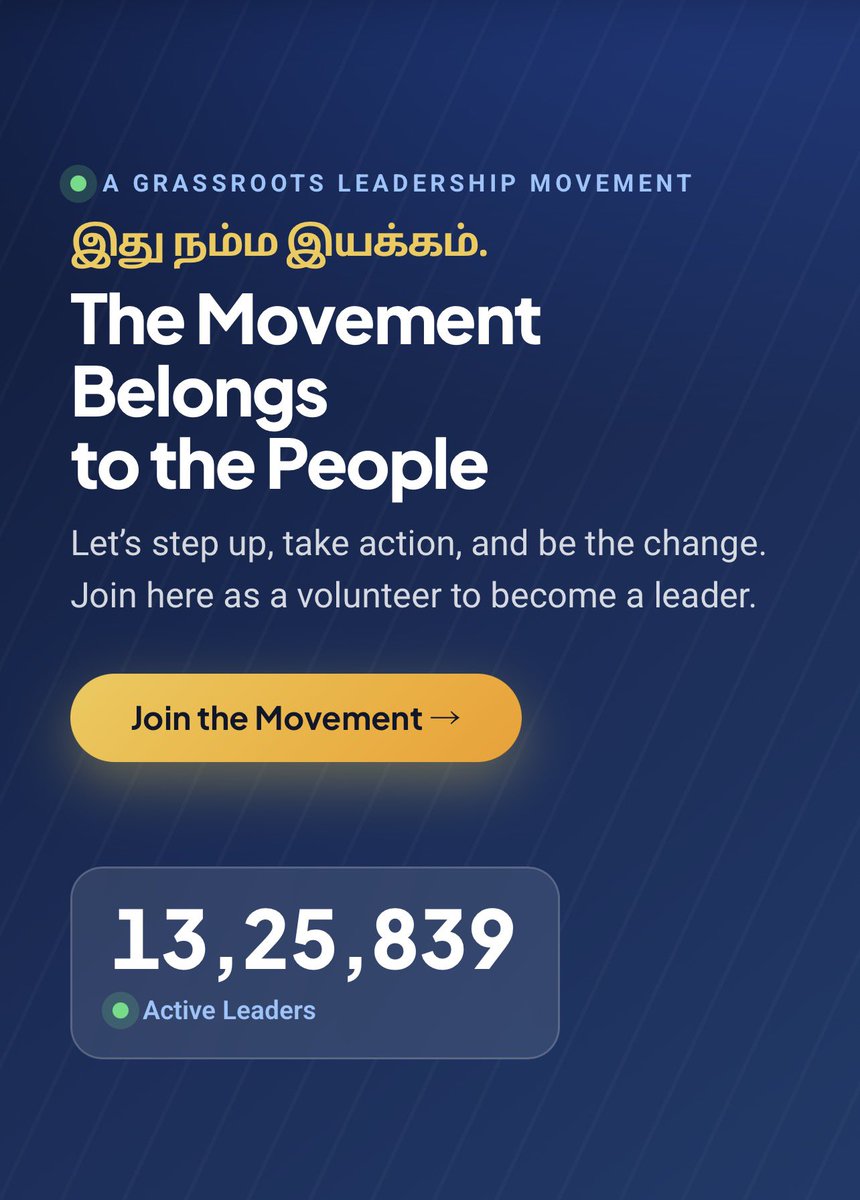
கடந்த 24 மணி நேரத்தில் 13 லட்சம் உறுப்பினர்கள் இணைந்து, https://t.co/bpwUirWN1w இயக்கத்திற்கு நீங்கள் அளித்துள்ள பேராதரவு, பெரும் நெகிழ்ச்சியையும், அதைவிட பெரிய பொறுப்பையும் எனக்கு அளித்திருக்கிறது.
இந்த இயக்கத்தின் மீது நம்பிக்கை வைத்து இணைந்துள்ள ஒவ்வொருவருக்கும், எனது மனமார்ந்த நன்றிகள். இது ஒரு தனி மனிதனின் பயணம் அல்ல; நல்ல மாற்றத்தை விரும்பும் நமது மக்களின் கூட்டுப் பயணம். மாற்றம் வேண்டும் என்று நம்பும் ஒவ்வொரு குடிமகனின் குரலும், நீங்கள் வழங்கியிருக்கும் பேராதரவில் எதிரொலிக்கிறது. உங்கள் நம்பிக்கையை மதித்து, நேர்மையுடனும், அர்ப்பணிப்புடனும் இந்தப் பயணத்தை முன்னெடுப்போம்.
தமிழகத்தின் சிறந்த எதிர்காலத்திற்கான இந்தப் பயணத்தில் தொடர்ந்து இணைந்திருங்கள்.