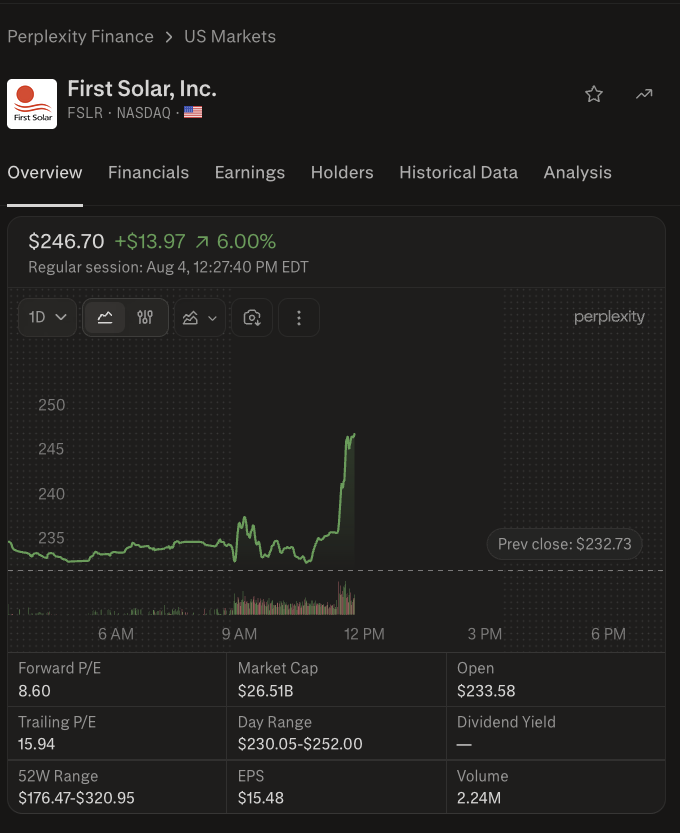
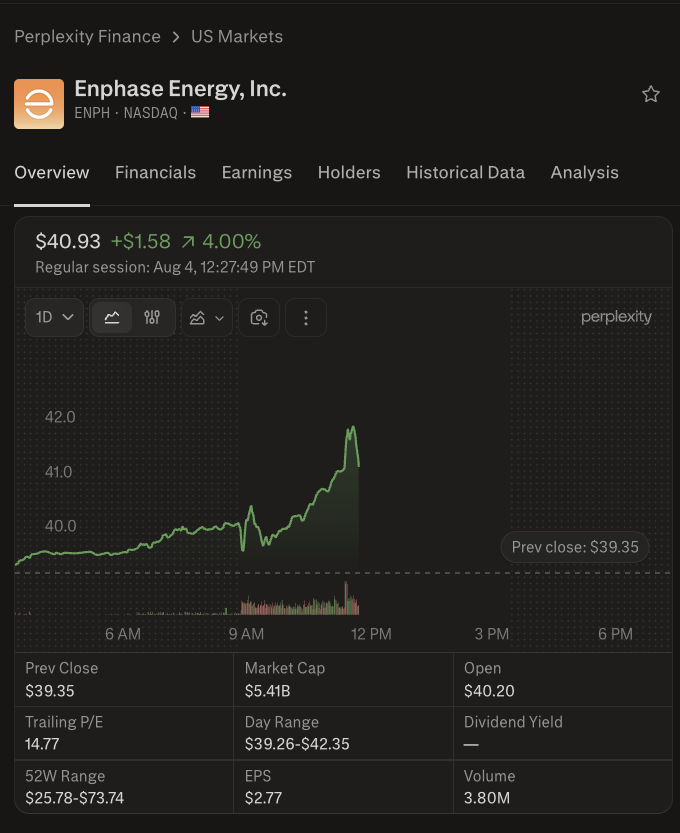
$FSLR $ENPH $TE
U.S. WEIGHS POLYSILICON PRICE FLOOR AND TARIFFS TO COUNTER CHINA - Reuters
The Trump administration is preparing a minimum import price and tariffs on polysilicon and related products, with a decision expected later this month.
Polysilicon is a critical input for solar panels and semiconductor chips.
The plan aims to protect domestic producers Hemlock Semiconductor, a joint venture between
Corning and Shin-Etsu, and Wacker Chemie while reducing dependence on China, which controls roughly 80% of global solar manufacturing capacity.
Importers investing in U.S. wafer and solar-cell production may be allowed to offset some of the added costs. The proposal is not yet final.
Demand for American solar remains strong. T1 has signed a 641MW offtake agreement with Clearway Energy, a leading American integrated clean energy company, for solar modules built with domestic solar cells from G2_Austin.
We Build Energy.
Link in 1st comment
Woke up this morning and got a strong feeling that a Black Monday Crash will happen tomorrow
Today is the last day to enjoy life before a second Great Depression starts
PULLING BACK THE CURTAIN ON SOME PERSONAL THOUGHTS
People ask me all the time what it feels like to have a platform where I can share my thoughts on something I genuinely love (investing and the stock market) while reaching nearly 100 million impressions every month and the honest answer is that I have deeply conflicting feelings about it.
I'm incredibly grateful because this platform accelerated my career at a very young age and opened doors that probably would have taken me many more years to reach otherwise but the larger the platform becomes and the more media appearances I do, the more obvious it becomes that public visibility also attracts resentment from people I have never met, followed, spoken to or affected in any meaningful way.
The Leopold Aschenbrenner situation reminded me of this because “hating up” is absolutely real (especially online) where people often feel more comfortable attacking someone who is visible than examining why that person’s success bothers them so much.
Also a reminder that celebrating someone’s destruction because their position was overleveraged doesn't make anyone a better investor and pretending the original insight had no merit simply because the portfolio couldn't survive the path is not a groundbreaking thought.
Sometimes I share an idea that people find useful and someone becomes upset because they believe I took the insight from them even though I don't even follow them and have never seen their work. Other times they disagree with a thesis and decide that disagreement means I know nothing which usually leads them back to the same early-morning television appearance from a year and a half ago when I was clearly not acting like myself and had what I would consider the lowest professional moment of my career. The fact that this is still the only example people can repeatedly point toward probably says more about the body of work than the clip itself but public platforms allow one uncomfortable moment to become a permanent shortcut for anyone who already wants to dislike you.
Leopold was in his early twenties when he was fired by his boss (OpenAI) then responded by doing something very few people would have the courage to attempt at any age which was starting a fund and putting enormous conviction behind his view that power would become one of the defining bottlenecks of the new AI economy.
His thesis appears to have been directionally right but his risk management was wrong and those are two very different conclusions. The first speaks to his ability to identify an important structural trend before most people understood it while the second reflects mistakes around position sizing, leverage, concentration, liquidity or whatever combination ultimately caused the strategy to fail and those are skills that can be learned.
He received an incredibly expensive lesson at a very young age but I would be surprised if he doesn't receive another opportunity because people capable of developing original and correct frameworks are rare while portfolio management can improve through experience, humility and pain.
I feel similarly about @ChrisCamillo putting enormous conviction behind $AMZN and using earnings as a catalyst for his AI thesis. Did he add more risk through options after experiencing a difficult month? Yes but the part people overlook is how difficult it is to place your real name, face, reputation and capital behind a public thesis while explaining exactly how you are acting on it.
There are many large accounts that share ideas without showing their identity (which is completely their choice and not something I'm trying to criticize) but the level of scrutiny changes dramatically when people know who you are, watch you explain the thesis on camera, track the position in real time and wait for the first moment they can use against you.
Being wrong privately costs money but being wrong publicly can also cost reputation, confidence and peace of mind which is why I have respect for anyone willing to stand behind their work in public even when I disagree with the way they sized the risk.
My own experience has made me increasingly aware that the more visible someone becomes, the easier it is for strangers to reduce them to a single mistake, clip, trade or bad day while ignoring the years of work that created the platform in the first place. I played college basketball so the criticism and competition aren't unfamiliar to me and I have developed thick enough skin to continue doing the work even when the comments become personal.
At the same time, I grew up Buddhist andbelieve deeply in karma so I have never understood why people choose cruelty when encouragement costs nothing. You can disagree with someone’s thesis, criticize their process or point out where the risk management failed without enjoying their humiliation or acting as though one painful outcome invalidates everything they have ever accomplished.
I remain unbelievably grateful for this platform because it gave me a career, a community and the ability to spend every day studying the subjects I care about most but I would be lying if I said the toxicity hasn't become worse as the audience has grown.
I also really hope don't read this and think what I'm saying is that the solution is to stop criticizing ideas because accountability matters (especially in markets where confidence can influence other people’s decisions) but there is a meaningful difference between analyzing someone’s mistakes and rooting for their collapse since one helps everyone learn while the other usually reveals more about the person watching than the person who failed.
Markets eventually humble everyone which is why grace matters so much because every investor who stays in this long enough will experience a thesis that breaks, a position they sized too aggressively, a drawdown that exposes a weakness or a moment they wish had never happened in public but it costs nothing to root for people, show grace when they fail and remember that being publicly wrong once does not erase the courage it took to try.