Perhaps the deeper question isn’t about either tweet and their respective positioning of Zambia…BUT more about which parts of Zambia we instinctively reach for when constructing a national story, and which fade into scenery. That’s a conversation worth having seriously.
Hello Muloongo,
I am quite uneasy with your characterisation of, say, Northern and Muchinga provinces against, say, Southern, Western, Central and Eastern provinces of Zambia. I find your thinking, which was at the heart of colonial stereotypes about certain ethnic groups and places, as one that nurtures erasure and even fosters dehumanisation. Let me illustrate my point using your problematic examples.
First, your post presents Southern Province as inhabited by human beings. You depict these human beings as business-minded, wealthy, quiet and not noisy (as if other people elsewhere make noise when they have money!). The province is also presented as endowed with natural and attractive sites that are so well known that they carry the country’s “tourism economy.”
Second, your post presents Western Province as inhabited by human beings. You depict these human beings as people of a “Strong cultural identity” and “proud traditions”.
Third, your post presents Central Province as inhabited by human beings. You depict these human beings as people who are engaged in productive economic activities: farming, transport, mining, and logistics. You even added that the human beings in this province are so politically conscious that they help determine national electoral outcomes as they are a “swing province”.
Fourth, your post presents Eastern Province as being inhabited by human beings. You depict these human beings as “hardworking people” (as if to contrast them with the lazy lot elsewhere) who are engaged in “Agriculture” and are “quietly influential politically” (as if to evoke some contrast with others elsewhere who may be influential politically but in a noisy manner).
What emerges from this considered presentation is that these four provinces have PEOPLE who are doing something. They are either engaged in PRODUCTIVE economic activity, have a STRONG cultural IDENTITY, or are so POLITICALLY CONSCIOUS that they do not put up with politicians who fail to deliver. These are all very admirable human traits and qualities that should inspire us all.
Now, let us examine how you treat the other two provinces.
First, your post presents Northern Province as not inhabited by people. You depict the province as one that only has what nature gave it: “Rain, greenery, lakes, waterfalls and underrated natural beauty.” If this province has people, then they are unrecognised and passive (at least in your post). One is even left to wonder if the referenced natural beauty is underrated by the unrecognised inhabitants, or by the other provinces that have distinguishable people living in them, or by the outsiders including those who go to the province that carries Zambia’s tourism economy .
Second, your post presents Muchinga Province as not inhabited by people. You depict the province as one that only has “Mountains, scenery, adventure, [and] wilderness”. If this province has people, then they are unrecognised and passive (at least in your post). One is even left to wonder if the referenced “people [who are] forgetting how beautiful it [i.e. Muchinga Province] actually is” are the unrecognised inhabitants, or the inhabitants of other provinces that have distinguishable people living in them, or the outsiders including those who go to the province that carries Zambia’s tourism economy.
What emerges from this considered presentation is that Northern and Muchinga provinces have NO PEOPLE living in them. They only have natural vegetation. If the two provinces have people living in them, then they are not engaged in any known productive economic activities, have no known cultural identity, and have failed to do wonders with what nature has given them. These are all very bad human traits and qualities that should make the inhabitants of these provinces – assuming there are any – totally ashamed. No wonder they are unrecognizable – in your posts. No wonder you have erased or diminished their significance in relation to other groups – in your posts.
I do not know if you are doing this consciously or ignorantly. What I know is that this is how stereotypes are formed, perpetuated, and sustained. It would have been more helpful to develop clear criteria behind the characteristics you were hoping to feature and to then consistently apply said characteristics across the provinces. These characteristics could be people, nature or the environment, economic base, and the politics. As it stands, your depiction of the two provinces conjures up Western stereotypes about, say, Africa: as a pristine place without inhabitants and where people go to enjoy the natural wild. If there are people living there, they are invisible and not engaged in anything meaningful.
Anyway.
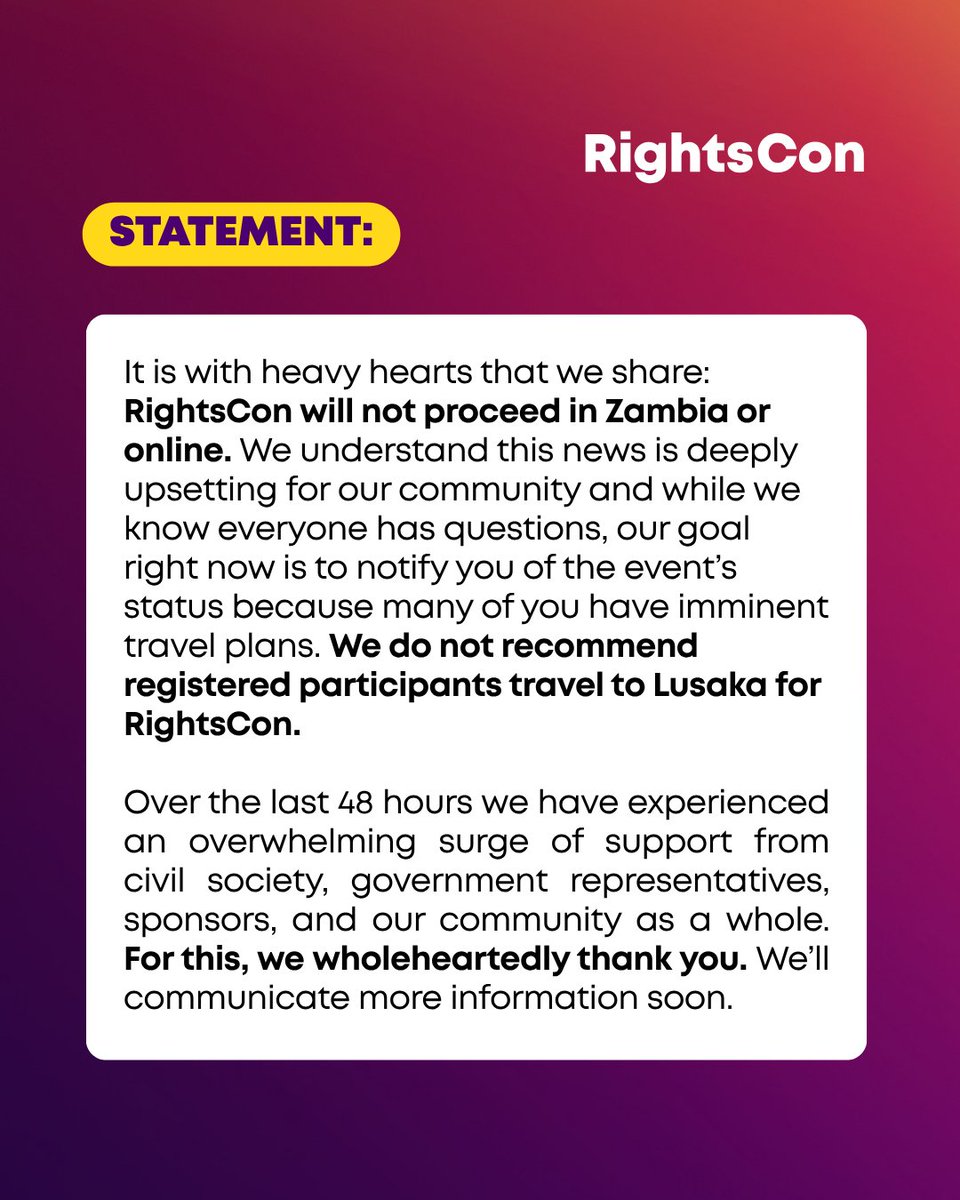
And this is one of the many reasons we can’t have nice things. What do you mean “postponed” owing to a need for “alignment” and “national values” concerns just a few days the conference is to start?
Shame on the @UPNDZM govt and @HHichilema by extension! Do better!
@denisyurchak@initjean i honestly don’t remember the last time i worked in an office. Most people know work in cafes across Amsterdam. What are you on about?
Assuming that the political strength of one party is inherently tied to the health of democracy is a flawed logic 💁🏽♂️
…one could argue the opposite: the peaceful removal or decline of a dominant party can signal democratic resilience.
People celebrating the decimation of PF don't realize or understand that it's decline is directly proportional to the decline of democracy in Zambia. Most of you will realize the consequences of when it's too late. Lwenu.
Saying “it’s about scale” doesn’t fix the comparison. You’re still putting one export stream against total GDP. The intuition is fine, the framing isn’t 🤦🏽♂️
Hope that helps 😏
That’s exactly the point; scale, not a like-for-like comparison. You’ve explained my point in more words while calling it flawed 🤷♂️ That’s twitter for you😃
@briansimasiku The comparison is flawed ( You’re putting one export stream against total GDP., but for sure, the discomfort is valid. It shows the scale that a dominant export like oil can reach. The question is less about Iran vs Zambia, and more about how we build higher-value export streams
@BuyoyaJonah@shuzlately can’t tell if they are flexing having the minister on speed dial or if they are pointing out at how dysfunctional communication is between the public and authorities
@JoshuaMinyoi This argument collapses on basic logic. You can’t industrialise with an unhealthy population. Health workers are part of productivity, not separate from it.
@Malik_ZMB It sounds intuitive, but that’s not how it works. The $5bn isn’t sitting in Zambia as cash, it’s spread over time and largely spent on imports and capex. The benefits are real, but you wouldn’t see the kwacha crash to K10 from that alone.
This really confirms my masters thesis’s core assertion:
Zambian online culture leans heavily into humour as a coping mechanism: frustration is often processed through irony rather than direct confrontation.
💡🤞🏽
@Stantezza@BuyoyaJonah@kaonde_king because most african countries have yet to get their identities figured out (internally) beyond just being “African countries”
@NNyashaYessur@The_SARWatch Angola and Zambia signed a $5 billion oil pipeline deal to build a pipeline linking the two countries. The construction started in 2026. Zambia has also secured a 26% stake in the Lobito oil refinery. This project was in part funded by the Development Bank of southern Africa