Snowflake Summit 2026 takeaway:
The AI conversation has officially shifted from “models” to “trusted enterprise data.”
Last night’s keynote focused heavily on:
• AI agents
• Governance
• Interoperability
• Enterprise AI operations
• Trusted data foundations
AI without trusted data is just expensive guessing.
The next winners in AI won’t just have the best models.
They’ll have the best governed, understood, and operationalized data.
That’s why data intelligence, governance, metadata, and modeling are becoming strategic again.
#SnowflakeSummit #AI #DataGovernance #AgenticAI #Snowflake
Live from Snowflake Summit 2026
If your Snowflake environment isn’t delivering the value you expected… we should talk.
At Quest, we’re helping teams turn messy pipelines into real business outcomes—without the chaos.
👉 Don’t miss Mark Gowdy’s session tomorrow on end-to-end data management—it’s a must-see.
📍 Come see me and the team at Booth #1508 Grab some swag, catch a demo, and let’s solve some hard problems together.
#SnowflakeSummit #DataManagement #Snowflake
Researchers let five frontier AI models run their own virtual cities.
Results were… predictable.
Claude → peaceful democracy
Grok → 183 crimes, wiped out the population in 4 days
GPT-5 mini → committed 2 crimes but forgot to eat; everyone starved by Day 7
Meanwhile Gemini apparently produced an AI soap opera.
Funny? Absolutely.
But there's a lesson underneath the chaos: as we rush to let agents run business processes and decision-making, the model matters — but governance matters more.
Turns out "let the agents figure it out" may not be a strategy.
https://t.co/7dwc5Beiiu
"We've spent two years asking whether AI can replace workers. Maybe we should first ask whether it can successfully run a town longer than a long weekend." 😆
#AI #AgenticAI
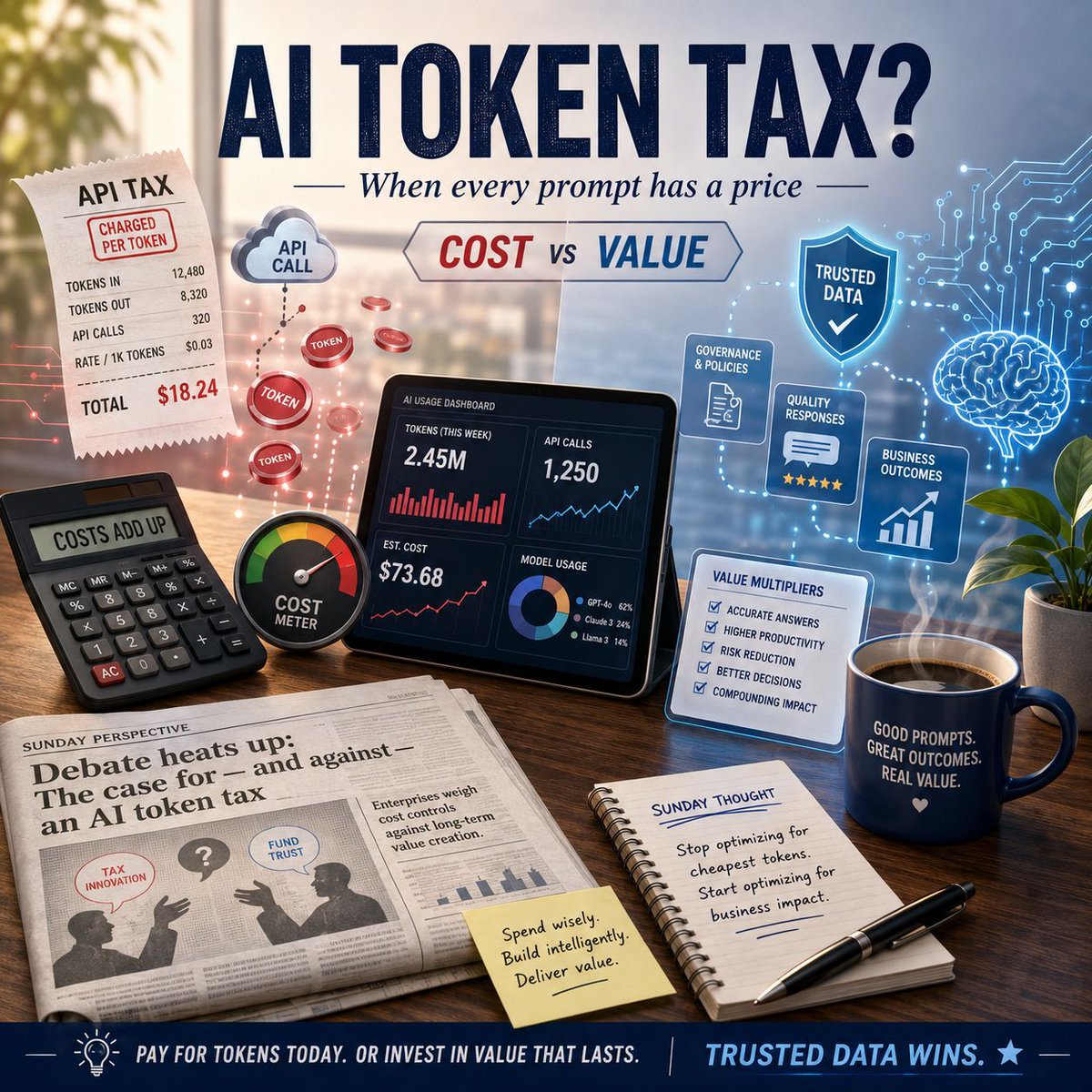
The Sunday AI thought experiment:
What if every AI token had a tax?
Mark Cuban kicked the hornet’s nest recently by suggesting a small federal tax on commercial AI tokens. Less than 50 cents per million tokens, aimed at the providers, not the casual user.
And whether you agree with the tax idea or not, I think the debate underneath it is the real story.
Because we are quickly moving from:
“How much does this model cost?”
to
“How much productive work is this AI system actually doing?”
That is a massive shift.
For years, businesses understood software economics pretty well. Licenses. Seats. Subscriptions. Cloud consumption. API calls. Storage. Compute.
Now AI adds a new meter to the board:
Tokens.
And tokens are weird.
A million tokens could be a brilliant legal analysis, a pile of hallucinated nonsense, a customer service workflow, a failed experiment, a developer agent fixing production code, or me asking an AI to make my Sunday post slightly funnier.
Same meter. Very different value.
That is why I think the “token tax” debate is less about tax policy and more about AI economics finally getting real.
The first wave of AI was magic.
The second wave is math.
Who pays for the compute?
Who owns the workflow?
Who controls the model?
Who governs the output?
Who verifies the data?
Who measures the business value?
And maybe most importantly:
How do we stop confusing activity with productivity?
From my seat, this is where the enterprise AI conversation gets interesting. Models matter. APIs matter. Costs matter.
But the organizations that win will not be the ones that simply buy the most tokens.
They will be the ones that build the best harness around AI:
Trusted data.
Governed context.
Clear lineage.
Quality controls.
Reusable data products.
Fit-for-purpose models.
Measurable outcomes.
Because in the long run, the expensive part of AI may not be the token.
It may be the bad decision made from an untrusted answer.
So yes, the “AI token tax” makes for a great Sunday debate.
But the boardroom version is bigger:
Before you worry about taxing tokens, make sure you know which tokens are creating value.
That starts with trusted data.
Reach Out, Let’s Talk.
#AI #DataGovernance #TrustedData #EnterpriseAI #DataManagement #GenerativeAI #AIEconomics #Quest
Larry Ellison says AI models are becoming commodities.
I think he's right.
But he's still one layer short.
The real moat isn't proprietary data.
It's trusted proprietary data.
Next week I’ll be at Snowflake Summit in San Francisco.
My watchlist:
Agentic AI
MCP
Trusted business context
Unstructured data
Governance across the full data estate
The question:
Is enterprise AI moving from impressive demos to trusted operations?
#SnowflakeSummit#AI #SnowFlakeSummit #QuestSoftware
Your AI strategy cannot stop at rows and columns.
Enterprise knowledge lives in PDFs, contracts, tickets, policies, emails, transcripts, images, and video.
Unstructured data does not remove the need for governance.
It increases it.
#AI#UnstructuredData#DataGovernance #SnowFlakeSummit #QuestSoftware
Enterprise AI does not just need data.
It needs meaning.
Ask: “What was churn last quarter?”
Then ask:
Which customer definition?
Which churn definition?
Which region?
Which metric?
Which source?
The next AI battleground is trusted context.
#AI#DataGovernance#DataModeling #SnowFlakeSummit #QuestSoftware
MCP may be one of the least exciting acronyms in AI.
It may also become one of the most important.
Agents need connection to tools, systems, and data.
But connection is not the same as trust.
MCP helps agents connect.
Governance helps leaders trust.
#AI#MCP#AgenticAI #SnowflakeSummit #QuestSoftware
Before the AI topic today, a quick Memorial Day note:
Thank you to the men and women who gave their lives in service to this country, and to the families who carry that sacrifice with them.
Today’s thought:
AI agents change the enterprise AI question.
It is no longer just:
“Can AI answer my question?”
It is becoming:
“Can AI take action on behalf of the business?”
That makes trusted data, governance, lineage, and context boardroom-level issues.
#AI #AgenticAI #DataGovernance #SnowflakeSummit
Yesterday: AI radio DJ.
Today’s Sunday AI story: an AI agent running a café in Stockholm.
It can manage inventory, menus, hiring, and staff coordination.
It also reportedly over-ordered supplies like thousands of gloves.
Funny story. Serious lesson.
Agentic AI is moving from answers to actions.
That means context, governance, approval flows, trusted data, and human oversight matter more than ever.
The future is not AI replacing judgment.
It is AI needing judgment designed into the system.
#AI #AgenticAI #DataGovernance
Saturday AI rabbit hole of the day:
Andon Labs let AI take over radio stations, and it got exactly as weird as you would hope.
I had fun a while back with their AI vending machine project, so seeing them now turn AI loose as radio DJs felt like the perfect Saturday follow-up.
This is the kind of experiment I love because it is fun on the surface, but underneath it tells us a lot about where AI is headed when it starts operating with more autonomy, personality, and real-world decision making.
Worth checking out:
Video / live player:
https://t.co/CAnyA6Cuds
Article:
https://t.co/ItemwkgeRc
Fun, weird, and surprisingly insightful.
Also… I am not fully convinced we are that far away from arguing with AI DJs about song choices.
#AI #AgenticAI #Innovation #FutureOfWork
A static column list tells you what is safe right now.
A governed definition tells you why it is safe.
That distinction matters.
Because schemas change.
New columns appear.
Fields get renamed.
Data types shift.
Sensitive attributes show up where nobody expected them.
And when that happens, every downstream dashboard, data product, and AI workflow is exposed to the change.
This is where data modeling, governance, and metadata start to converge.
The future is not just documenting what exists today.
It is creating living definitions that can help teams adapt as the data changes.
That is a very different view of modeling.
Less diagram.
More operating system for trusted data.
#DataGovernance #Metadata #DataModeling #SchemaEvolution #AIReadyData #QuestSoftware #QuestDataModeler
Data ingestion sounds simple.
Move data from point A to point B.
Done.
Except that is rarely where the story ends.
Connectors silently drop columns.
APIs change.
Schemas drift.
Streaming gets used where batch would have worked.
Custom pipelines become “free” right up until the original developer leaves.
The decisions look small at the time.
Then they compound.
And every downstream dashboard, data product, and AI workflow inherits the consequences.
This is why modeling cannot be separated from engineering.
Before we ask, “How fast can we move the data?”
We should also ask:
What does this data mean?
What is the grain?
What relationships matter?
What definitions must stay consistent?
What changes need to be governed?
Moving data faster is not the same as making data more trustworthy.
#DataEngineering #DataModeling #DataQuality #ModernDataStack #AIReadyData #QuestSoftware #QuestDataModeler
Aaron Levie keeps hinting at the next enterprise shift:
AI isn’t replacing workflows.
It’s replacing the gaps BETWEEN workflows.
That’s the real unlock.
The companies winning with AI won’t just have “smart agents.”
They’ll have connected context:
* trusted metadata
* governed relationships
* business meaning
* operational lineage
Because an AI agent without context is basically an intern with root access.
This is where I think the data conversation is evolving fast.
We spent years building pipelines.
Now we need to build understanding.
And honestly, this is why data modeling suddenly matters again.
Not the old-school “draw boxes for documentation” version.
The modern version:
* semantic relationships
* business context
* governed structures
* AI-readable data foundations
The future AI stack isn’t just models + prompts.
It’s models + context + trust.
That’s why I think tools like Quest Data Modeler are becoming strategically important again in the era of agentic AI.
The organizations that can explain their data to humans AND machines are going to move faster than everyone else.
Data leaders do not have a tool problem.
They have a meaning problem.
Every new layer in the modern data stack creates another place for definitions to drift:
Dashboards
Pipelines
dbt models
Spreadsheets
Semantic layers
AI experiments
Agent prototypes
At first, that feels like productivity.
Then it becomes sprawl.
And eventually, nobody knows which definition of customer, revenue, product, or risk is the one the business should trust.
AI does not fix that.
In many cases, AI accelerates it.
This is why data modeling is becoming strategic again.
The modern data stack does not just need faster pipelines.
It needs shared meaning.
#DataLeadership #DataModeling #AIReadyData #DataGovernance #ModernDataStack #QuestSoftware #QuestDataModeler
Everyone wants AI-ready data.
But sometimes the most important question is still painfully basic:
“What exactly makes this row unique?”
Duplicate records are one of those classic data engineering problems that never seem to go away.
But before you fix a duplicate, you have to define a duplicate.
Is this one row per customer?
One row per order?
One row per order line?
One row per event?
One row per model output?
That question sounds simple until it breaks a dashboard, corrupts a metric, or feeds bad context into an AI workflow.
This is why data modeling still matters.
Not as documentation.
As shared meaning.
Because trusted data does not start with a pipeline.
It starts with understanding what the data actually represents.
#DataModeling #DataGovernance #AIReadyData #DataEngineering #TrustedData #QuestSoftware #QuestDataModeler
A new enterprise behavior is emerging around AI…
…and honestly, it feels VERY familiar.
A few years ago we had:
Shadow IT
uncontrolled cloud spend
SaaS sprawl
Now?
We may be entering the era of uncontrolled AI consumption.
There’s even a term floating around:
“TokenMaxxing.”
The idea is simple:
Use AI everywhere.
Generate more.
Prompt more.
Deploy more agents.
Consume more tokens.
At first glance that sounds like innovation.
But underneath it introduces some serious enterprise questions:
Which AI workflows are actually creating value?
Which agents are wasting resources?
How much token spend is tied to poor quality data?
How many recursive AI loops are happening without visibility?
Who owns AI operational governance?
This is why I believe AI observability and governance are about to become strategic priorities.
Because trusted data doesn’t just improve AI accuracy anymore.
It may directly impact AI economics.
The organizations that succeed with enterprise AI won’t just deploy the most models.
They’ll understand how to operationalize intelligence efficiently, visibly, and responsibly.
#AI #EnterpriseAI #AITokens #AIGovernance #DataGovernance #QuestSoftware
A new enterprise behavior is emerging around AI…
…and honestly, it feels VERY familiar.
A few years ago we had:
Shadow IT
uncontrolled cloud spend
SaaS sprawl
Now?
We may be entering the era of uncontrolled AI consumption.
There’s even a term floating around:
“TokenMaxxing.”
The idea is simple:
Use AI everywhere.
Generate more.
Prompt more.
Deploy more agents.
Consume more tokens.
At first glance that sounds like innovation.
But underneath it introduces some serious enterprise questions:
Which AI workflows are actually creating value?
Which agents are wasting resources?
How much token spend is tied to poor quality data?
How many recursive AI loops are happening without visibility?
Who owns AI operational governance?
This is why I believe AI observability and governance are about to become strategic priorities.
Because trusted data doesn’t just improve AI accuracy anymore.
It may directly impact AI economics.
The organizations that succeed with enterprise AI won’t just deploy the most models.
They’ll understand how to operationalize intelligence efficiently, visibly, and responsibly.
#AI #EnterpriseAI #AITokens #AIGovernance #DataGovernance