The biggest AI content mistake is easy to miss - using tools without a real workflow. The best gains come when AI removes handoff chaos, not when it writes flashy copy.
Want to know a system that does this at scale? Read more: https://t.co/dUJG8iLPju
18/18
Important caveat: these aren’t controlled experiments, so they don’t prove RankPanda caused every increase.But the pattern is consistent:
More visibility.
More search opportunity.
More data to optimize.
That’s the benchmark that matters.
1/18
What do 3 real SEO campaigns reveal about RankPanda as an AI content writing tool?
Across the campaigns: 40,960 organic impressions + 1,284 clicks.
The bigger story? All 3 saw measurable growth in search visibility.
Read on: 🧵
17/18
Is RankPanda the “best” AI content writing tool?
There’s no universal best.
But if your goal is search-focused content inside a repeatable SEO workflow — not just drafting paragraphs — these 3 campaigns make a stronger case for it.
16/18
RankPanda doesn’t remove the need for SEO judgment.
When visibility rises faster than clicks, teams still need to improve metadata, relevance, internal links, content depth and rankings.
AI builds the content base. SEO compounds it.
15/18
This is a better way to judge AI writing tools than asking whether the copy “sounds good.”
Impressions = visibility.
CTR = snippet + intent appeal.
Position = ranking strength.
Search data gives content teams a measurable feedback loop.
14/18
Across all 3 campaigns, the common outcome was expanded organic visibility.
Case 1: fast activation.
Case 2: stronger finish.
Case 3: growth from a tiny footprint into sustained weekly volume.
Different baselines. Same broad pattern.
12/18
Weekly growth in Case Study 3 was even more striking.
Baseline week: 10 impressions.
Peak week: 871 impressions.
That’s +8,610%.
And the final 3 weekly periods all stayed above 500 impressions.
11/18
Case Study 3 started with just 4 impressions on its first recorded date.
By the latest date: 49.
Peak day: 216.
That’s +5,300% from the starting daily baseline at the peak.
The percentages are huge — but the baseline was tiny.
There was still a conversion gap.
In Case Study 2, impressions grew while CTR and average position weakened.
The next job was clear: improve titles, meta descriptions, internal links and rankings for high-impression queries.
9/18
The final 7 dates in Case Study 2 averaged 56.14 impressions/day vs. 36.86 in the first 7.
That’s a 52.3% improvement.
This is what SEO teams want: not just faster publishing, but a higher visibility range over time.
8/18
The strongest signal in Case Study 2 came later.
The first partial week had 155 impressions. The final week hit 393 — the campaign’s strongest week.
That’s +153.55% vs. the partial baseline week.
7/18
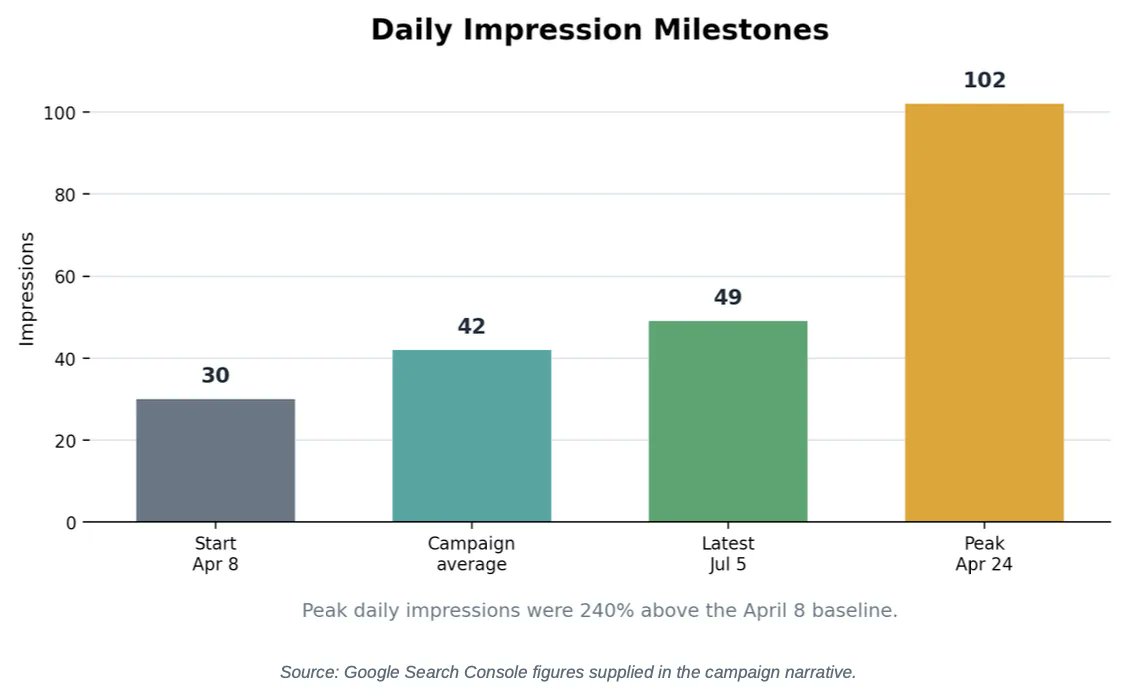
Case Study 2 started much smaller: 30 daily impressions.
By April 24, it reached 102.
That’s a 240% increase.
Average daily impressions across the campaign were 40% above baseline.
6/18
Growth wasn’t linear.
Weekly impressions peaked at 3,036, then fluctuated — but every full week shown remained above the 1,900-impression raw baseline week.
SEO growth rarely means a chart that only moves up.
5/18
In Case Study 1, daily impressions rose from 332 to 569 in just 6 days.
That’s a 71.39% lift.
Average daily impressions across the 89-day period stayed 11.22% above the starting level.
3/18
RankPanda’s workflow goes beyond drafting.
It connects brand context, keyword strategy, research, article structure, metadata and CMS-ready exports.
The goal: turn content production into a repeatable SEO system.
2/18
Speed is easy to measure with AI writing tools.
Search impact is harder.
The real question isn’t “How fast can it generate content?”
It’s: can that content earn measurable visibility in Google?
AI-sourced sessions jumped 527% YoY—so SEO teams need more than faster drafting. The winning workflow connects research, writing, internal links, metadata, publishing, and iteration. See how to build it.
Read more: https://t.co/NTvMPGpVPJ