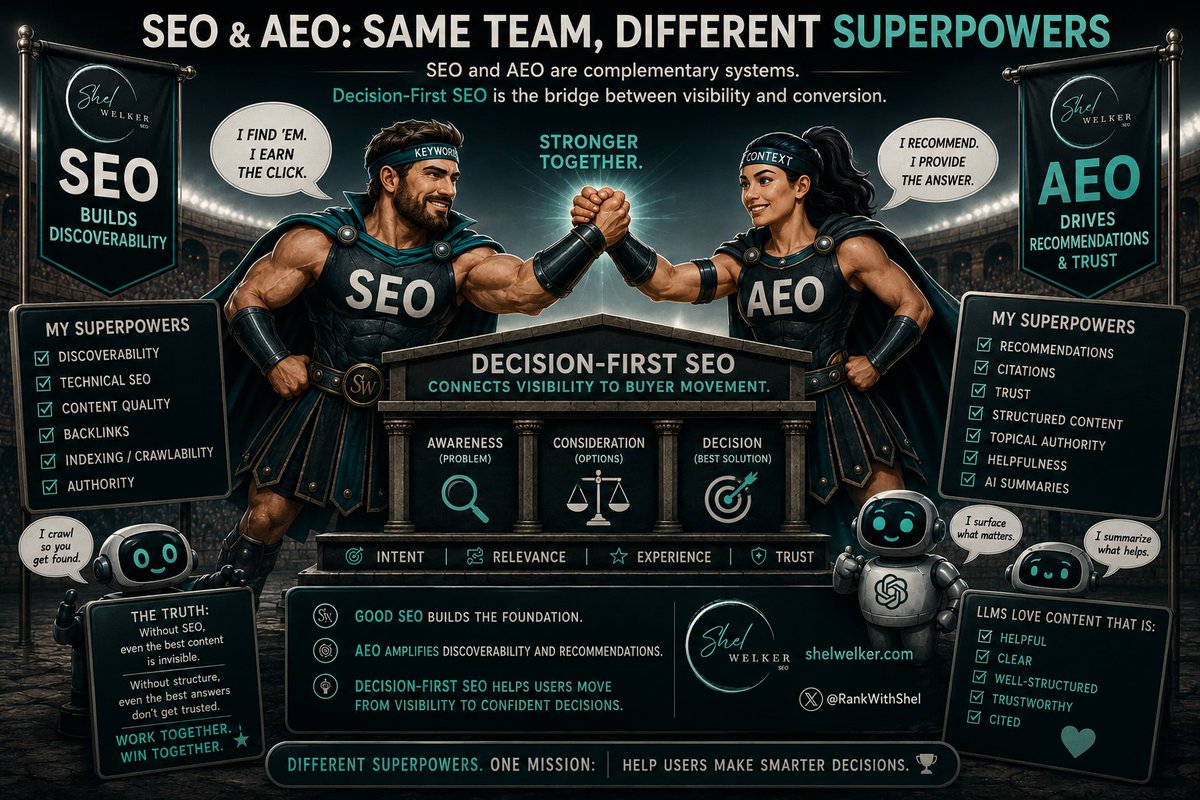
SEO and AEO aren’t rivals. They’re a power couple.
One gets you discovered. The other gets you recommended.
I call it Decision-First SEO. The bridge that turns clicks into confident buyer decisions.
Traditional SEO still builds the foundation. AEO (Answer Engine Optimization) amplifies trust and recommendations across AI summaries, Perplexity, ChatGPT Search, and Google’s AI Overviews.
Together? They win.
If you’re a SaaS founder tired of traffic that doesn’t convert, this is the shift worth paying attention to.
Save this.
Share it with your team.
Different superpowers. One mission: Help users make smarter decisions.
Weirdly, some of the highest-traffic SaaS articles are also the least connected to revenue.
Not because traffic is bad.
Usually because nobody stopped to ask what the person needs to see next before they feel comfortable shortlisting the product.
A lot of SaaS SEO strategies still stop at visibility.
But once somebody starts trying to compare options, estimate implementation effort, or validate fit, the experience changes completely.
That’s usually where the structure starts thinning out.
AI search is making this more obvious, honestly.
If your site only answers isolated questions, AI systems can synthesize the answer without needing your conversion path.
What becomes harder to replace is structured evaluation context and decision support.
Evaluation content is usually treated like extra credit.
Meanwhile, somebody on the site is actively trying to:
-compare tools
-rule out bad fits
-estimate effort
-validate claims
-see tradeoffs
Most SaaS sites barely support any of that.
@DavidGQuaid "Thin content doesn't mean spam (e.g. XKCD)"
You're absolutely correct here. Low-value doesn't automatically mean thin content. There can be a lot of valuable information that's not delivered in essay format.
@lilyraynyc All the chicken-littles recently...
Search behavior didn't disappear, it evolved. AI results have just expanded how people explore, compare, and validate queries. Martin's right...it's a great time to be an SEO.
Some SaaS sites accidentally build giant informational libraries that never connect back to buying behavior.
So the company becomes very visible for research.
But strangely invisible when the person is actually trying to figure out what to do next.
SEO gets blamed for low demos when the real issue is usually structural.
The article answered the query.
The person reading it still can’t figure out:
“Would this actually work for us?”
That’s where things start falling apart.
Traffic grows.
But a lot of SaaS sites still leave people stranded once they start trying to compare options, validate fit, or estimate implementation effort.
That disconnect shows up everywhere once you start looking for it.
@FashWrites Most growth advice sounds complicated because simple fundamentals aren’t exciting to sell.
Understand people. Solve real problems. Keep learning.
Then repeat that long enough for it to compound.