Bending Spoons has inspired me to launch Bending Forks.
We acquire beloved family-owned restaurants, fire 80% of the staff, replace homemade meals with frozen food and double the prices.
Within six months, every restaurant will be more profitable than it’s ever been.
We’ll keep the original owner’s name above the door and their grandmother’s photo on the wall.
It’s important to preserve the family heritage.
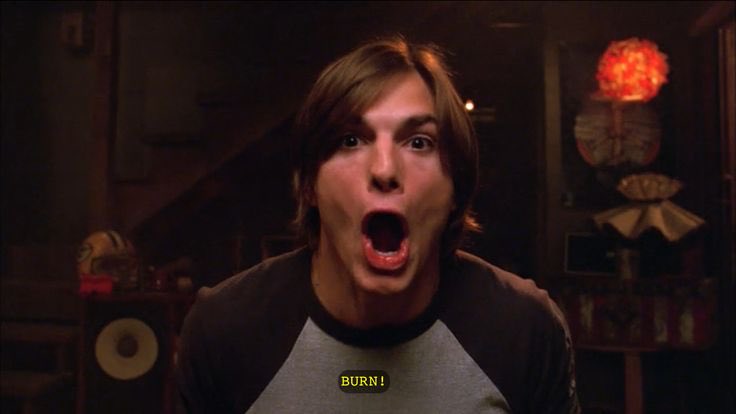
Ashton Kutcher’s career trajectory is insane.
- 1998: Gets paid to pretend he’s an idiot on That ’70s Show.
- 2000: Stars in Dude, Where’s My Car?
- 2003: Makes celebrities cry on Punk’d.
- 2010s: Invests in Uber, Airbnb and Spotify.
- 2020s: Backs Anthropic, potentially becomes a billionaire.
Somewhere there’s a Harvard MBA working 90 hours a week who just threw his Bloomberg Terminal out the window.
In 2012, Aaron Krause appeared on Shark Tank with a sponge shaped like a smiley face.
Lori Greiner invested $200,000 for 20% of Scrub Daddy.
The business had made around $100,000 in sales at the time.
Today, Greiner says Scrub Daddy has generated over $2.9 billion in sales since appearing on the show.
What’s even more interesting is that 3M had previously passed on the sponge.
It sat in a box for years before Krause rediscovered it and turned it into a business.
Anyway, I’m off to check what’s sitting in my garage.
If Nvidia crashes, the entire AI economy collapses.
Imagine explaining to the SEC that your $400 billion revenue forecast was based on Nvidia giving OpenAI $10 billion, which OpenAI gave Microsoft for cloud computing, which Microsoft used to buy Nvidia chips, which Nvidia used to invest in CoreWeave, which bought more Nvidia chips, which it rented back to Microsoft, which rented them to OpenAI, which paid using another $20 billion from SoftBank, which borrowed against its Nvidia shares.
Six companies. $800 billion in transactions. The same $10 billion doing 80 laps around Silicon Valley.
And the entire thing could collapse because Jensen Huang couldn’t keep his pants on.
For the sake of my portfolio, Jensen Huang’s wife needs to pull a Hillary Clinton and stand by her man.
I don’t care what happened. Get on national television, hold his hand, forgive the unforgivable and tell Wall Street your marriage is stronger than ever.
I have leveraged positions and absolutely no moral compass left.
I’m raising $10 million for a corporate espionage startup. Our entire technology stack consists of Alice Huang, two bottles of champagne and a hotel room with good Wi-Fi.
Masayoshi Son reportedly defaulting on gas turbine orders for AI data centres.
This is the same man who gave WeWork billions because a guy walked into a room barefoot and said the word “community.”
What could possibly go wrong?
🚨 JUST IN: $23.6 BILLION Bitcoin options to expire next Friday
- Calls are clustered at $100,000 and $120,000
- Puts are concentrated around $85,000
- Max Pain is $96,000
One of the biggest Bitcoin options expiry events of all time 👀
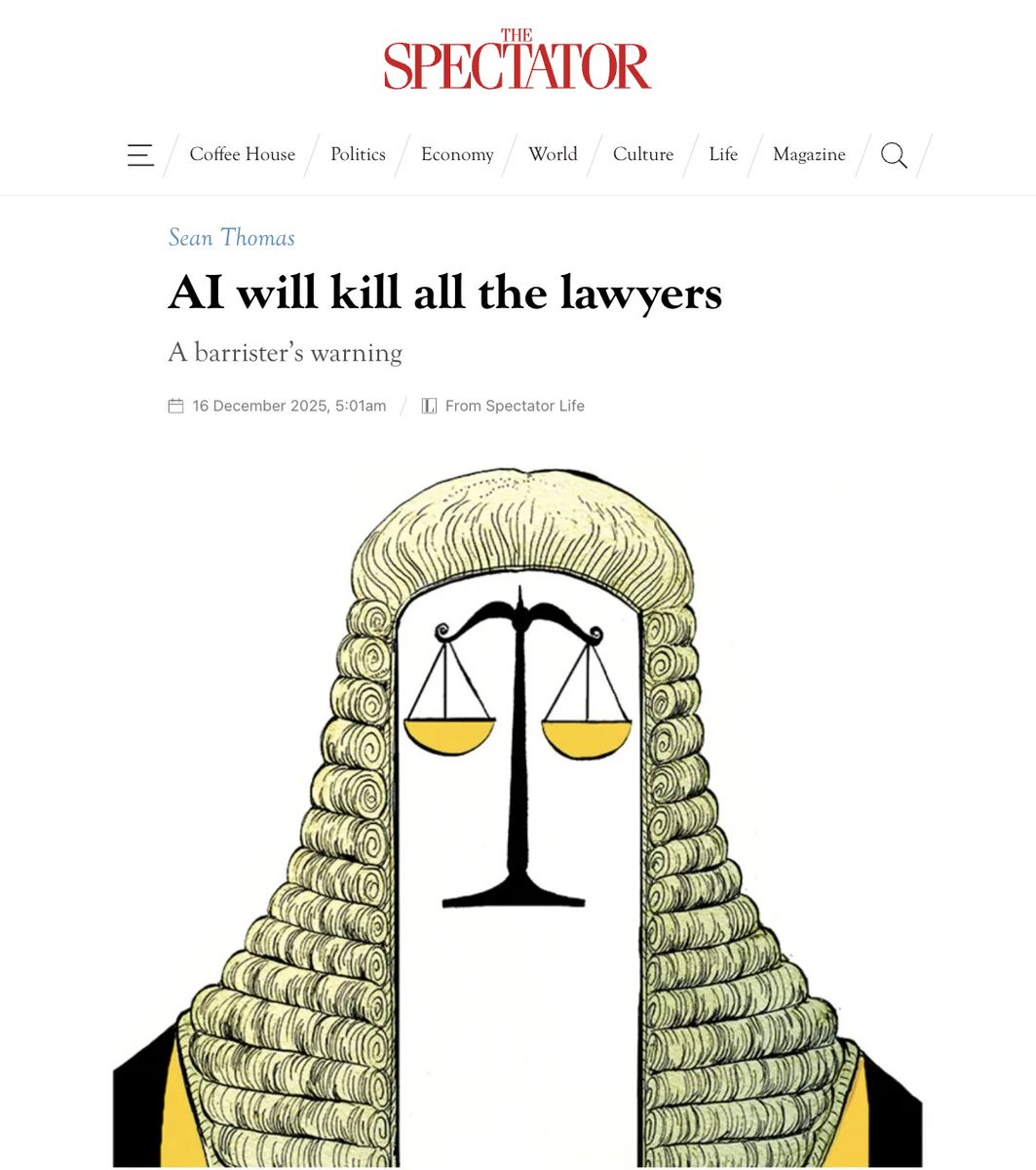
This Spectator piece reads like gossip until you realize it’s actually a warning.
A senior English barrister takes a real appeal he spent a day and a half writing, feeds it to an AI model, and gets back something better in 30 seconds. It matched the standard of the very best barristers, and it did it instantly, for pennies.
That’s the moment the illusion breaks.
Law has always sold itself as irreplaceable because it’s complex, nuanced, and human. But most of the value in modern legal work isn’t wisdom. It’s pattern recognition, structure, precedent matching, argument assembly, and risk framing. That’s exactly the territory AI eats first.
The scary part isn’t that AI can draft contracts or scan case law. That’s already obvious. The scary part is that once the output quality crosses a threshold, the pricing logic collapses. Clients don’t care how many years it took you to become a barrister if the document they receive is objectively worse than something generated in seconds.
So the profession reaches for comfort stories.
“AI is just a tool.”
“There will always be a human in the loop.”
“Judges and clients want a human face.”
Those are emotional arguments, not economic ones. And economics always wins.
The barrister in the piece understands something most of his peers don’t want to admit. Law isn’t protected by status or tradition. It’s protected by cost and friction. Once those disappear, so does the moat.
The first to go are process lawyers. Then drafting specialists. Then advisory roles with no client relationship. Eventually people start asking why they’re paying six figures for a human to read out arguments an AI already wrote better.
What makes this explosive isn’t just unemployment. It’s who lawyers are in society. They sit at the top of institutions. They write rules. They shape policy. They’re used to being indispensable. Replacing them doesn’t just disrupt jobs. It destabilizes power.
That’s why the resistance will be fierce. There will be calls to ban AI. To regulate it out of courtrooms. To slow it down. But you can’t regulate away a cost advantage that large.
The most honest line in the whole piece is the advice to his niece. Don’t take on decades of debt for a career whose core value has already been automated. Not in twenty years. Now.
This isn’t anti law. It’s anti denial.
AI isn’t coming for lawyers because it hates them. It’s coming because much of what they do turned out to be legible, compressible, and cheap.
And once that happens, respect doesn’t save you. Only reality does.
🚨🟡🔴 AS Roma are advancing in talks with Joshua Zirkzee on personal terms as top target for January.
Deal still depends on #MUFC decision as Roma want Zirkzee as soon as possible…
…but Man United have several players out for injury/AFCON.
🎥🇮🇹 https://t.co/ru24DebZjd
One thing https://t.co/Er4i2xtVRV does well is being upfront about how its net worth figures are calculated.
Instead of recycling inflated numbers, it leans on verified data, explains assumptions, and states when information is limited.
Methodology here: https://t.co/6SKeFWH0HL