The conversion of Hagia Sophia into a mosque and Muslims praying in a building that does not belong to their historical or civilizational heritage, is the clearest proof that Islam is a barbaric religion that does not create, but only conquers and destroys.
I will show you how the Iliad and Odyssey should be taught. No one will ever teach you what you will read in this post.
Alexander the Great loved literature and reading. His teacher Aristotle gave him a copy of the Iliad, which he had annotated with comments on its symbolism and the secrets hidden by Homer. Alexander always kept it, along with his dagger, under his pillow. (Plutarch, Alexander 8.2).
Here is an example:
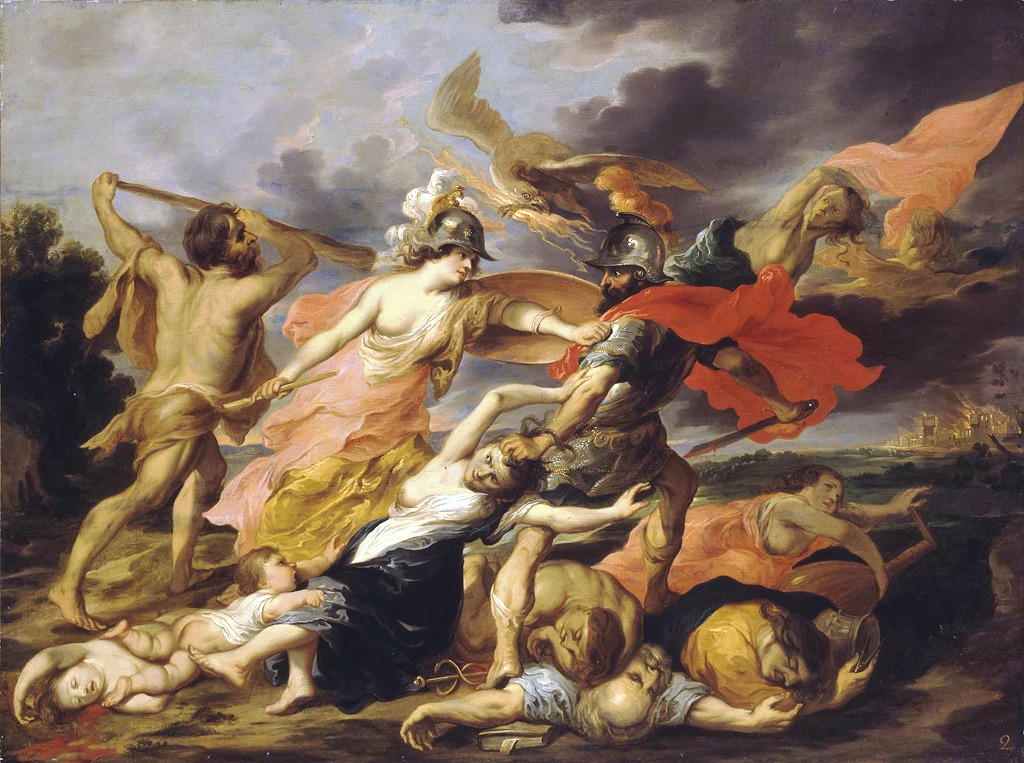
Athena and Ares are both war gods; she fights on the side of the Achaeans, while he fights on the side of the Trojans. Yet in the description of Achilles' shield, the two siblings appear as divine guides of the same army.
In the Iliad, Homer presents the battle between Athena and Ares, the goddess of wisdom and the god of war and rage. Think about it a little: on one side logic, calm, wisdom, and on the other her eternal opponent, the conflict in our mind, rage and recklessness and anger that, when it overtakes us, we lose our reason and do not act with wisdom.
Ares symbolizes our rage. Rage is something very important for humans. It belongs to the passions that man does not control from birth. Ares does not act with prudence; he is that anger that we must tame in difficult moments. After all Iliad is a work focused on Achilles' anger. That's where wisdom comes in, that is, Athena.
Athena is always the one who will appear in battle against Ares and drive him away. Zeus, who symbolizes intellect, together with Hera who symbolizes flow, gave birth to Ares who symbolizes rage and to Athena who symbolizes wisdom. In the human mind there is this duality: if one wants to take a step toward philosophy (philo-sophia), they must tame the irrational parts of the soul, control situations without being dominated by rage.
Athena will appear on the battlefield, but wearing the helmet given to her by Hades that makes her invisible. There she will turn the spear of the war god, who was fighting in front of the walls of Troy alongside Hector, saving Diomedes and giving the Greek warrior the opportunity to wound Ares. The wound was tended by Zeus himself, because the only one who can heal our soul is our own intellect, symbolized by Zeus. The entire battle being fought is inside our mind, and we must emerge victorious.
When the philosopher Heraclitus wrote "War is the father of all and king of all," the phrase was ambiguous, with double meaning, something very common for the philosophers of that era. He did not mean only some bodily battle; he meant this eternal mental battle of duality that we must win and escape from, so as to reach deification with the help of prudence (phronesis).
The duality of rage and wisdom is one of the many dualities that keep us imprisoned in the material world. The eternal battle toward the path of virtue.
The Iliad is a work of immense teaching. One part of this teaching is how we will go from rage to the absence of rage. Once we achieve that, then we move on to the Odyssey, where as wise people, always having Athena by our side, we will manage to survive and return to our Ithaca. There lies our final labor: the victory over the Suitors who symbolize our passions that keep us enslaved. But as truly resourceful people, we will defeat them and secure a place in the Elysian Fields. There where the soul is freed from its bonds.
- Homer Pavlos.
There are some powerful secrets in Odyssey that you can only understand if you speak Greek. Let me give you an example.
The Odyssey, apart from being a literary work, also conceals a profound philosophy that most people are unaware of, not intentionally, but because this philosophy cannot be fully understood in the English language; it can only be grasped in Greek, thanks to the richness of its philology and the etymology of its words.
The three most important suitors who die are Antinous, Eurymachus, and Amphinomus. In English, these names mean nothing, but in the Greek language, they carry great significance due to Homer's deliberate choice of them.
The name Antinous means the one who opposes rational arguments, the irrational one ('anti' + 'nous' = mind/intellect).
Antinous is the first to speak, the most irreverent of all, and the first to be killed. Odysseus reveals his true self, he has changed after ten years fighting at Troy and another ten struggling against the seas. The first trial he faces upon his return is a war within his own mind, his reason. That is why Homer creates Antinous as his first enemy: the one who fights against logic, according to his name. Odysseus triumphs over him.
Next comes Eurymachus. He is warlike but also two-faced. His name means the broad, great fighter ('eurys' = wide/broad + 'machos' = fighter). Eurymachus puts Odysseus in a dilemma and tries to shift the blame onto Antinous. He personifies discord and duplicity, a man without morals, capable of anything to avoid punishment. Yet Odysseus overcomes this obstacle as well, which symbolizes moral superiority. He does not yield, and his mind is not poisoned.
Third is Amphinomus. His name means the one who distorts the law ('amphi' = around/both sides + 'nomos' = law). He is the most compassionate of the suitors. Amphinomus tries twice to discourage the other suitors from murdering Telemachus. Odysseus even tries to warn Amphinomus to leave the house before the final battle. Nevertheless, Amphinomus stays and dies along with the others.
Through this, Odysseus, and by extension Homer, teaches us that in life, sacrifices are required, even when they demand that we show no compassion when the goal is more important and serves a greater purpose that will improve things overall. These are sacrifices that most people, even brave and heroic ones, cannot make.
That is why there are many people, but few are truly brave and heroes.
I often see claims that movies adapted from manga are always bad, but maybe people should read more shoujo and josei. Some of the most beautiful Japanese films are adapted from them, like Helter Skelter, Blue, Our Little Sister, A Gentle Breeze in the Village and Drowning Love.
A powerful scene in the Odyssey happens when Odysseus finally returns to Ithaca after twenty years of war and wandering.
You would expect the story to end with celebration, with the hero coming home, the family reunited, and order restored.
Homer does something far stranger.
Odysseus arrives disguised as a beggar, because Athena warns him that the palace has been taken over by more than a hundred suitors who have been living there for years, eating his food, drinking his wine, and pressuring his wife Penelope to marry one of them.
They believe Odysseus is dead and in their minds the kingdom is already theirs.
So the king of Ithaca walks through his own halls dressed in rags while the men stealing his house sit comfortably at his tables. They mock him, throw scraps at him, and one of them even strikes him, and Odysseus takes it. That is the remarkable part, because the same man who blinded the Cyclops and survived twenty years of disasters now stands quietly while strangers insult him in his own home. Homer tells us his heart burns inside his chest and that he wants to attack them immediately, yet he restrains himself and waits.
Instead of striking, Odysseus studies the room carefully. He counts the men, watches their habits, and quietly observes which servants remain loyal and which have betrayed him. The hero of the Odyssey does something most people cannot do, which is delay revenge until the moment is right.
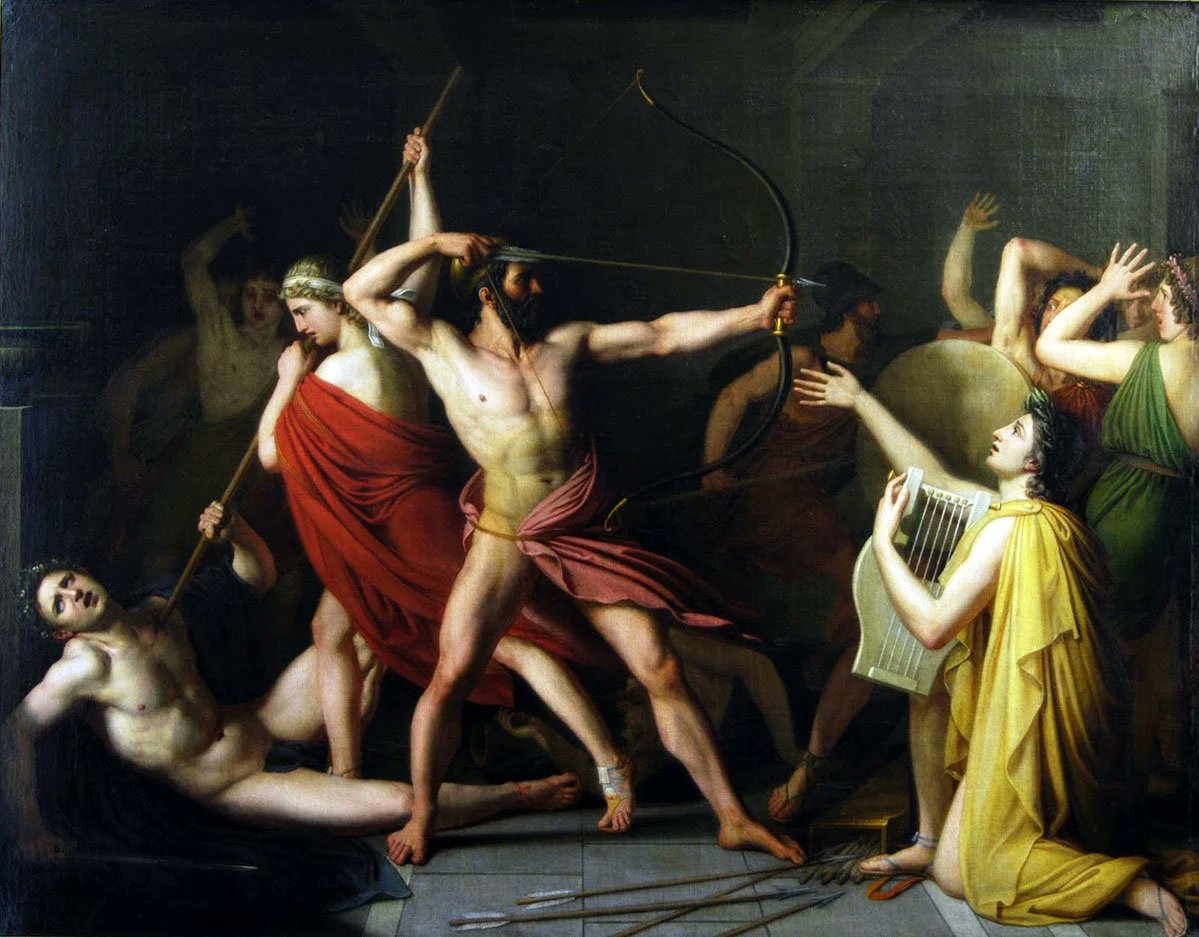
Eventually Penelope announces a contest and brings out Odysseus’ great bow, declaring that she will marry the man who can string it and shoot an arrow through twelve axe heads lined up in a row. One by one the suitors try and fail, because none of them can even bend the bow. Then the beggar asks for a turn. The suitors laugh at first, but the bow is eventually handed to him.
Odysseus takes it in his hands and strings it effortlessly. Homer says the sound of the bowstring tightening rings through the hall like the note of a swallow. Then he places an arrow on the string and sends it cleanly through all twelve axe heads.
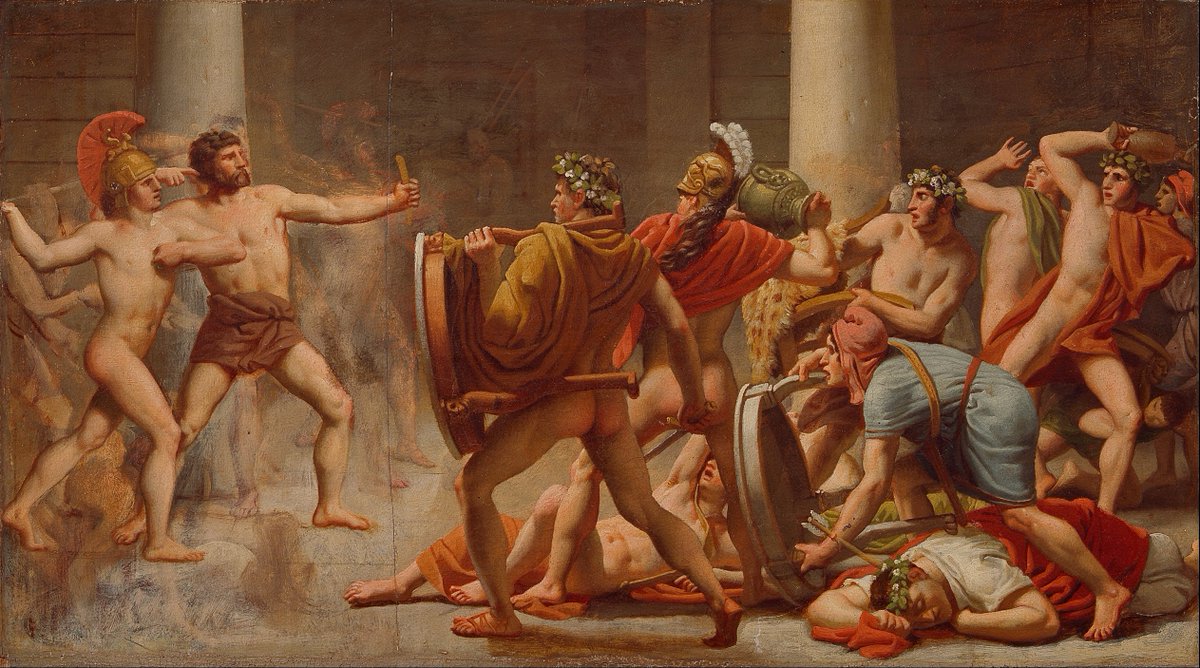
In that moment the beggar disappears. Odysseus turns the bow toward the suitors and reveals who he is.
What follows is one of the most brutal scenes in Greek literature. The doors are sealed and the suitors realize too late that they are trapped inside the hall. Odysseus, his son Telemachus, and two loyal servants begin killing them one by one. There is no escape, no mercy, and no negotiation. The men who spent years consuming another man’s house die inside it.
It is a violent ending, but Homer wants you to understand something important. The real danger to Odysseus was never just the monsters and storms on the long journey home. It was the possibility that someone else might take his place while he was gone. When Odysseus finally returns, he reminds everyone in Ithaca of a simple truth: a man’s home is not truly his unless he is willing to fight for it.
Animal welfare might be seen by some as a secondary issue. Some may treat animals as morally insignificant, beings for whom no bell ever tolls and to whom we owe no direct responsibilities. But no moral principle can excuse ignoring the basic obligations of kindness we owe them, obligations that set clear limits on our behaviour and that are far too often disregarded today.
posta que me encantaría tener la autoestima y la caradurez que tienen los tipos heterosexuales, qué increíble el tupé de pensar que con esa carita te pareces a JFK Jr jajsjja mamita querida
Le fait qu’elle tremble de peur pour ses petits et pas pour elle montre que même chez les animaux une mère pense d’abord à ses bébés. Bonne Journée des droits des femmes à toi aussi bichette.