one of the quotes i find most inspiring on a hard day:
"Whatever your hand finds to do, do it with all your might, for in the realm of the dead, where you are going, there is neither working nor planning nor knowledge nor wisdom"
Ecclesiastes 9:10
How I Upscaled myself with AI:
A Journey from Graduating in 2023 to $100,000+ earned as a Full Stack AI/ML developer & consultant.
Long post, but I will teach you how to UPSCALE yourself up with AI.
If you don't know me, feel free to read the pinned article in my profile about how I got a job in 30 days.
Spoiler alert: I graduated in 2023 and got a “job offer” in Fall 2024 for a job that would start in Spring 2025. I quit that job before I even started and instead continued full-time consulting/software building and doing contract work for clients.
But, I am still trying to get into the industry, but only for the right opportunities (Google, please I love Gemini).
Here's what I will cover in this post:
---- Prelude
---- Upscaling with AI: Staying Fundamentally Driven
---- Complacency is your downfall.
---- My $100,000 Results
---- Prelude:
It's Fall 2022, my senior year of University. Layoffs are rising, ChatGPT is released, and I have a terrible portfolio with no real projects. I built a foundation from four years of schooling, but so what? C, C++, Java, Assembly, Python, HTML/CSS/JavaScript, R, Differential Equations, Computer Networking, Calculus, Discrete Math... you get the point.
My passion was in Data Science & AI/ML, working on projects that had you label data, run analysis, and train a model on my cute little 3060ti at home.
But what does that matter if ChatGPT just came out and absolutely STOMPED my future into the ground? (or so I thought…)
Late December 2022, around my 28th birthday, my girlfriend predicted the market for me.
She said this would happen:
- More layoffs.
- Tons of competition (from laid-off workers and recent grads).
- AI is going to take your job if you don’t do anything about it.
So, Spring 2023. I'm heading into my final semester with:
- Zero internships.
- Zero job offers.
- Zero marketable skills.
Layoffs hit an all time peak in Spring 2023, something like 250k laid off.
I basically resigned to my fate as a McDonalds worker, just putting the fries in the bag.. (No disrespect to fast food workers – it's honest work – but after four years of a CS degree? Come on man I’m not going back. Stay humble I guess.)
Then, my girlfriend drops another drop of wisdom:
"Stop looking at LinkedIn and Indeed. That is where everyone else is looking. Check Craigslist. Do something different."
BOOM.
I found a contract gig with one of the biggest IT firms in my area. During the interview they said they wanted to build an enterprise-level AI application for their company and for their 150 clients – law firms, schools, real estate, dentist office, you name it.
Think about that for a second.
A NEW GRAD, with a portfolio full of Jupyter Notebooks and PyGUI scripts, tasked with building a Full-stack AI/ML application for hundreds of businesses.
DOOOOMED.
Graduation day. I walk off stage, diploma in hand, and my phone rings. It's the CEO. "You're hired. Let's start tomorrow." Literally walking off the field I got that first client. BLESSED.
I thought there was absolutely no chance I would be able to pull this off. I was still trying to figure out the difference between NextJS and Vite (WHICH ONE SCAAALES BETTER?!). I was still trying to figure out what truly makes someone a Senior or Principal developer. I spent 4 months figuring out a database schema lmao.
No worries though. I just had to lock in and do what I do best - work.
I knew the ONLY way I can stay relevant in the midst of all this competition is to get better.
I need to UPSCALE myself, QUICK.
---- Upscaling with AI: Staying Fundamentally Driven
It wasn't about memorizing some textbook, watching another YouTube tutorial, or chasing the latest shiny tool.
This was a mindset. A philosophy. A LIFESTYLE that I needed to understand.
I realized that AI is a powerful tool, but it's not a replacement for understanding the fundamentals.
So, as of today I spent the last 22 months speed running my career journey by burning at 10-16 hours a day 6-7 days a week THROUGH HOLIDAYS.
This is not the level of sacrifice you should go through and I hope this helps prevent that for you because I would not wish it upon anyone.
Also, here's the thing: Most people will screw this up. They'll assume AI has the perfect code, that it's fundamentally right. Newsflash: AI can't handle super complex systems. You will run into situations where it fails.
So, how do you not become automated by AI?
By understanding the WHY behind the code, not just the how. And a lot of that "why" is stuff you could have learned in school, if you weren't just coasting.
I will be using the “Enterprise on AI” project from early 2023 as my leading example. I am not going to give you some cookie cutter, "5 steps to success" BS.
This is just how I figured my shit out.
Frontend:
Building an AI chatbot in early 2023 wasn't hard, but it wasn't as accessible as it is now... There weren't many examples or guides that truly showed how to build it from start to finish.
How do you fetch messages? How do you send them? How do you connect to a backend? How do you display the messages in order? What should the data model look like?
I sorted the conversation messages three times at some point: backend while fetching, backend before sending, and frontend when receiving.
OVERKILL AND BLOATED.
Most of this stuff wasn’t even specific to AI chatbots too, which is even more embarrassing for me. But my brain thought to only look for AI chatbot examples.
I used React, create-react-app to be specific (RIP).
I read a bit of the docs and thought I understood React well enough to just start building - this is a good instinct to be honest. Better than tutorial hell.
The PROBLEM, was that I asked ChatGPT for help, got some code, and quickly found myself three hours deep into debugging the same thing over and over and over.
Messages sent twice, messages not sent on "Enter", and chat freezes after 30 messages.
All I'm typing to ChatGPT is:
"this code is broken, can you fix it?" -> "THE CODE IS BROKEN, PLEASE FIX" -> "I SWEAR IF YOU DON'T FIX THIS I WILL END -"... yeah you've probably been there too.
I took a step back and saw simple things like useEffect being placed too deep in a component that would re-render often. I didn't memoize certain components that could have been memoized. Or to be honest maybe I THOUGHT I understood the component lifecycle but I just didn't? I was letting AI handle the how without understanding the why of React's rendering.
Then I spent another 30 minutes re-reading the documentation, looked online for a bit more examples, and typed out the changes myself after asking ChatGPT for examples of re-rendering and what to look out for in my react code.
The questions changed from "Why is this broken?" to "Explain the difference between using useEffect to fetch data and why I shouldn’t over use it?", or even “What is the component life cycle and how does the DOM really work?” and even then I had more to learn - But I broke the cycle of endless debugging and trusting AI too much when I could have just read it myself and trusted myself to understand the BASICS.
My root issue was not going to be cured by generating more code.
it was going to be cured by taking the time to ask questions and UNDERSTANDING the topics with the help of AI.
After it was all over, I made sure to take notes and save it so I can learn from my mistakes. This is something you should do because it can help future teammates from wasting time on the same issue ( WINK WINK THIS IS WHAT MAKES YOU A GOOD TEAMMATE IN THE INDUSTRY, at least that is what I have been told but I can't confirm as I have not worked in it yet)
Backend:
I was using Neo4j because I was familiar with it during my University days and graphs made sense for highly connected SME data. Vector embeddings were supported by Neo4j and it was becoming an increasingly requested feature to improve on across all database ecosystems. Eventually I switched to MongoDB and Qdrant because they were new shiny tools.
But it didn't matter, I still ended up fighting against AI in understanding and implementing how these databases should fundamentally work.
I was trying to store 500 emails at once in Neo4j - this is a small task for data ingestion, right? To some this is basic and pathetically simple, but you have to understand that the ones who think this are the ones might have forgotten what its like to learn this stuff and gain the intuition.
But yeah I struggled with this early on lol.
Transactions are a thing and if the creation of a node failed then they all failed. I didn't really understand ACID to the level of care that I needed to, but then I saw that I could add a keyword argument that basically said "if one fails still push up the rest". Still not the best, but it beats my first few tries of just “for looping” individual node creations.
I knew about transactions and how databases worked, but I hadn't connected the dots to the practical implications of data integrity. Thankfully I gave a shit about my database class, otherwise I wouldn’t have even known what types of questions to ask.
But as I kept asking for fundamental questions, I found myself stuck in loops of debugging outdated syntax and fighting against AI that did not have the latest information.
ChatGPT did not have much support for Neo4j, MongoDB, or Qdrant as they were all rolling out new features. I needed to learn how to optimize queries because data ingestion was taking like 5-10 minutes each time a user would connect their data.
I looked up community examples and documentation to learn how to use "CALL" in Neo4j or how to properly batch up documents in MongoDB, or even simply using list comprehensions and asynchronous libraries in python - they all made the difference in the performance of the application.
I had to move beyond AI-generated code and understand why certain approaches were faster and more efficient.
As I came across each topic I would ask: "What is the difference between concurrency vs parallelism in this case?" -> "What are the low level costs of indexing a property? Is it bad to have too many indexes?"
All of these topics are covered in school, so understanding them helped.
But you are removing the opportunity of gaining INTUITION and connecting your two brain cells if you just let ChatGPT do the work for you.
Cloud shenanigans:
Cloud networking was overwhelming when I got into it. I'm not even going to pretend I'm anywhere close to an expert. This is where the difference between "knowing the terms" and "actually making it work without setting everything on fire" becomes painfully clear.
I Dockerized my backend, pushed it up to ECS, and then launched an EC2 instance behind a VPC.
That one sentence? Weeks. WEEKS of figuring out the little nuances that NOBODY tells you about, but you just have to do it. Fighting with the AWS console, setting up IAM permissions, and using the terminal… let alone just staring at all that documentation. It was overwhelming, but I needed to do it. ChatGPT was useless for the account setup – the stuff that isn't code, but about understanding how each Cloud provider works, getting used to the overwhelming feeling of the web page, and relentlessly digging for information.
Asking AI "What's a VPC?" gets you a definition, not a solution.
I knew about security, theoretically. But I hadn't fully connected it to the reality of VPCs, security groups, and all that. Result? I almost left my servers wide open.
Ports, protocols, network topology – all are familiar in my brain because of my Computer Networking class but you need to go through the motions to get the intuition.
There was a point in time where my Blizzard app was downloading Call of Duty and I didn’t realize it was blocking Neo4j. Why? Same port, apparently.
But Wireshark saved my ass because I learned how to inspect packets in school. That was a school fundamental saving me. A direct application of something I'd learned from school, WOOOW CRAZY.
Lesson? Docs first. Fundamentals FIRST. Then AI.
"Why care about network security if my app is secure?" becomes a different question after you (sort of) understand VPCs.
Also, even understanding latency was a simple thing in hindsight, but an easy thing to miss. Frontend hosted in California? Backend hosted in New York? 90ms delay. So you think the time to first token is long but really it was your infrastructure.
Also friendly reminder to clean up your logs other CloudWatch will laugh at you, smack you, and take your money.
AI/ML:
Applied LLMs for Full Stack apps in 2022 was basically a free for all.
I knew about embeddings, semantic search, KNNs, not training on test set, how to make a neural network from scratch, tranformers, and a ton of AI/ML stuff at a pretty granular level. It was my passion in school, so I was glad I had a decent advantage.
Vector embeddings, hybrid search, chunking, AI as a Judge, rerankers - most people just used these chucked these buzzwords everywhere and there were not many real world examples to help you learn what it is like to put these into an application.
So you just had to do it yourself.
I am CONVINCED that anyone who was doing this around this time laughed when “AI Agents” came out because we were already making agents by early 2023.
But even then my lack of experience hit like a brick wall.
How do you retrieve data for different users, with the same question? How do you protect sensitive data?! YES IT WAS THAT BAD. But I had to learn. Also, for what its worth I told the client this and he was patient with it. Truly the GOAT.
Anyways, I was using tools without understanding the nuances. I knew the theory, but I hadn't dealt with the practical challenges of relevance and context.
YouTube, skimming blogs. Not enough. I was living and breathing Jason Liu’s early RAG videos and office hours and even then I didn’t have the intuition to really build out a full information and recommendation retrieval system.
I started asking better questions:
"Why is just vector similarity often garbage?" -> "How do I combine search methods without the database supporting it?" -> "How do I know if the results are good?" -> “What is a proper evaluation method when you get 100 data results and each user expects different data points?”
I needed to understand not just how to use embeddings, but when and why they worked (or didn't). I had to move beyond "magic black box" to understanding complex information retrieval systems.
By reading docs, research papers, and joining communities, I was able to ask better questions and quickly found myself finding a rhythm.
Not just using AI for outputs, but using my intuition to find better questions to ask AI.
If you find yourself relying on AI to generate the right answers for you instead of generating answers you already know, you are going to have a bad time.
The Flow State:
It wasn't linear.
All of this happened at once: learning, failing, succeeding. But a pattern did show up!
1. Screw Up: Run into a wall, usually because I missed a fundamental or didn't apply what I should have known.
2. Read the Docs (Finally): Actually read the documentation.
3. Ask Smarter Questions: Use that to ask AI questions that weren't useless.
4. Learn & Iterate: Use AI's answers, fix it, write it down.
5. Repeat. Constantly.
Also I tricked you lol this is totally 5 steps and they are purposefully generic because if you didn’t read the content you won’t understand the intuition of how you get there.
Have you ever noticed how a distillation of information always results in hindsight light bulbs? Yeah that’s you automating yourself away.
The reason I say “Upscale” and not “Upskill” is because you can learn so much if you just ask the right questions and stop being complacent.
School is useful – not just for the paper, but for the fundamentals – if you apply it.
If you didn’t go to school, you’re still going to make it. Because you don’t need a degree to give a shit.
Don't coast. Don't let AI think for you. Use it to think better and get through problems quicker.
---- Complacency is your downfall.
This isn't just for new grads.
This is for anyone.
Devs, business owners, literally ANYONE – who thinks they can coast.
I've seen it. Developer friends at small companies, too comfortable, not learning. They get laid off, no side projects, screwed. They didn't use AI to UPSCALE themselves; they let it make them obsolete.
Complacency kills careers, regardless of AI existing or not.
I've seen businesses lose clients because another company offered better solutions, PoWereD By AI.
Or worse, they didn't bother to ask simple questions.
You don't need a whole new app.
Ask ChatGPT: "How can I improve my business? Here's what I do… {business info here}"
Be proactive, not reactive.
Hot take: The people working in the industry right now, the ones who have not had the time to catch the AI wave, THEY ARE THE SCARIEST ONES. NONE OF THIS IS NEW TO THEM (at least the good ones). Once they have time to catch up, it’s over for me. So I need to keep UPSCALING myself to stay relevant.
Strong fundamentals + AI = super-powered generalist, fast.
Complacent? Just put the fries in the bag (again not a bad thing, I’ll probably be there soon tbh)
---- My $100,000+ Results (Not a Brag, a Warning)
I am grateful and humbled to say I barely survived and made a living over the last 22 months. From back then to January 1st 2025 I made over $100,000 (taxes are going to ruin me).
Compared to then, I am now a way better developer but on top of that I am an even better problem solver. You can just CARE about things.
Also, this is not a flex.
THIS IS A WARNING.
I was not able to get an internship during my time in school and I did not graduate with a job. Just a 28 year old dude (now 30) that was forced to find ways to put food on the table for me, my girlfriend, and our cat. IT SUCKED. IT SUCKED ASS MAN. We sacrificed so much and I wish I had me from the future tell me to do something about it sooner.
Somehow, I, a zero-credential chill guy, was able to build a portfolio of successful cases (and failures) in which I impacted local Small-Medium Enterprise businesses.
It all started with the Enterprise on AI application where I got to see the landscape of so many different companies and I worked my ass off to understand how to truly impact them.
It wasn’t in the shiny code tools, it wasn’t because I learned how to use Server Side Rendering in Nextjs, and it wasn’t because I spent time picking a new Agent framework because it promised to SCALE better.
It was because I wasn’t afraid to ask questions, I wasn’t afraid to look stupid, and I put the tech second to finding solutions.
Everyone you are competing with is coding up some new SaaS and showcasing it. I get it, ITS OVERWHELMING. HOW DO YOU KEEP UP?
You need to find a way to make yourself stand out and push ahead. I did so by removing all complacency that was holding me back and just grinded away.
I used my life experience and background to help bridge the gap of my lack of “Experience” in the tech industry.
My fundamental background helped me get ahead.
I studied over 150 different businesses within over 30 different industries that I didn't even know existed, AND interviewed a few dozen CEOs.
But what good is that experience if I don't DO ANYTHING WITH IT? The same way those who went to school think back as if school wasn't valuable. The same way the people in the industry with no degree think that they will be replaced. You just need to find your fundamental value and run with it. Because your background won't matter. Just DO things.
Don't get me wrong though I didn't implement specific AI workflows for all of them. I had a chance to research them and understand their needs and did some work that would impact all of them at general levels and tackled a few specific workflows for their businesses... but not all of them lol.
At this point I have only helped <20 SMEs directly…
It’s interesting knowing that I have directly impacted millions and millions in revenue - whether it was from proposal automation, analyzing phone call sentiment to improve customer relations, or improving Lead Generation workflows to get new clients.
It does come with a lot of downsides too though...
Watching people get laid off because I “automated” their jobs (stupid choice by businesses in my opinion. You should be ENHANCING individuals, not outright replacing them).
I led teams of devs with WAY more experience than me and I'm grateful that they gave me more respect than I deserved. All this while still knowing my place though.. It was tricky to manage. I was humbled and mentored multiple times over... I just wanted to LEARN things.
Now? Titles don't really matter at the end of the day. People just want to work with people that can respect the fact that we are all working towards the same goal.
I am probably a junior engineer in some cases, a principal in others, or maybe at best an intern? I don’t really know.
The real warning:
Don’t be complacent. Stop assuming so much of AI and start reviewing the fundamentals as you learn things.
I wrote this out of frustration of some peers who accepted defeat within the tech job market and also out of frustration of recent experiences in the business world...
I just don't want people wasting time by making the same mistakes I made.
I hate watching people stay complacent.
You have an open opportunity to UPSCALE yourself but you choose to “Accept” vibe code your way to automation without first learning the fundamentals.
The ones who can vibe code their way to success have years of experience under their belt to allow them to do that, whether they know it or not.
Tl;dr - eat a chipotle bowl for me. I'm not summarizing this. You will likely run this through AI to summarize this and that is OK with me. As long as you put in the work at some point in time down the line.
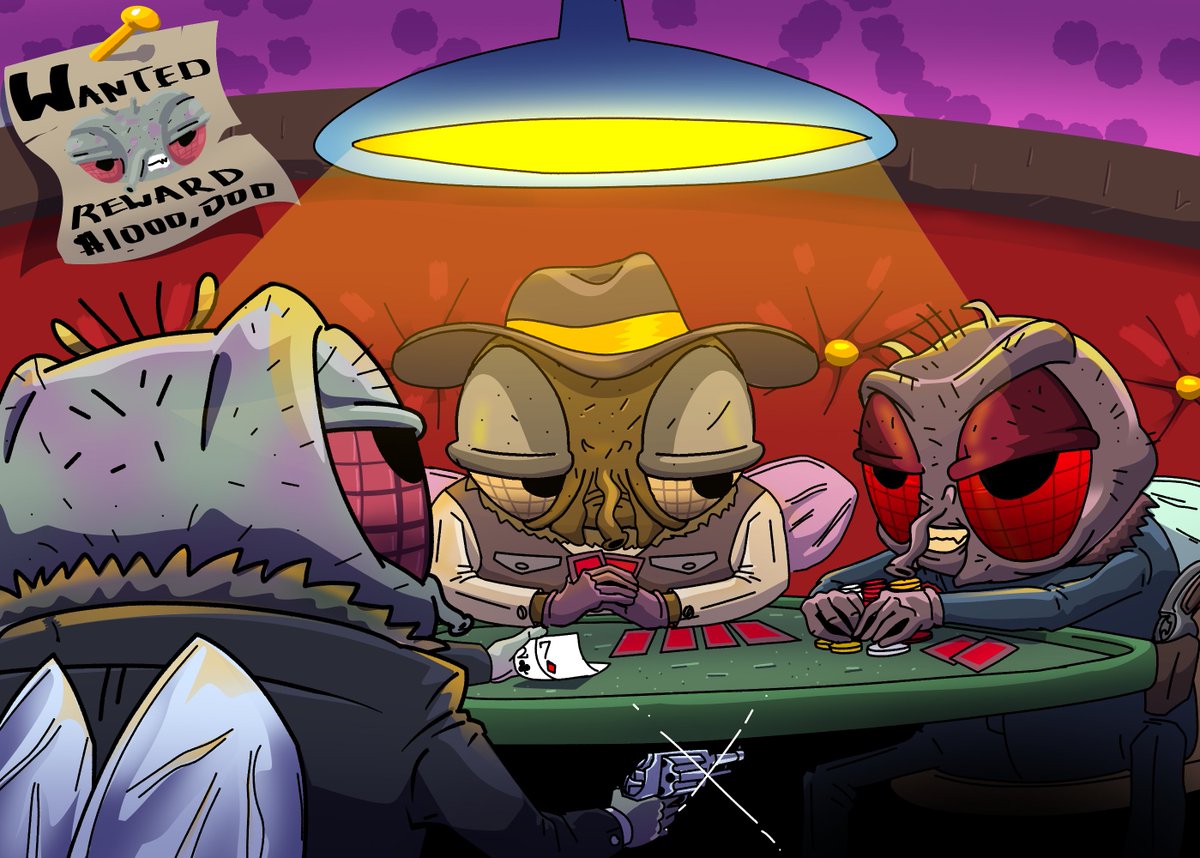
Always be careful in the HQ dangerous flies among us, always there with a stinking threat to the gang, be alert and wary even when playing poker in the HQ♠️♥️
Original art by myself for @BlowFlyHQ art contest
Details and timelapse below🎥
They call him QUICKDRAW HOLLOW, both tell his story with fear in their eyes, the sharperst shooter in all of the west, as dangerous as he is stylish, the last thing you see when you oppose him is the hardest fit🔥🔫
My fan art entry for @hollows_nft and @0itsali0
They call him QUICKDRAW HOLLOW, both tell his story with fear in their eyes, the sharperst shooter in all of the west, as dangerous as he is stylish, the last thing you see when you oppose him is the hardest fit🔥🔫
My fan art entry for @hollows_nft and @0itsali0