Abandoned, on fire & laden with a million barrels of #crudeoil, the #Sounion tanker poses a serious navigational and environmental hazard in the #RedSea.
BlackSky has been monitoring the ship in real time since the Houthi attack on Aug. 21. This series shows the fires burning topside throughout the day & night. Today's afternoon image was captured & delivered in under 90 minutes & traces a ~4 km visible trail on the surface of the water extending from the stern. #maritimesecurity #OSINT
@trengriffin This is an issue of demand. Few people want bespoke fishing reels, hence the high price difference. For something like milk, the price difference is minimal. SX’s success isn’t just due to its manufacturing prowess; many skilled manufacturers exist…
@TMFAssociates Satcom is a well-established market, unlike smart speakers. Amazon has succeeded with Kindle and, more recently, Ring in creating a direct revenue stream like Kuiper will.
The big issue with stainless steel is its weight. A carbon fiber vehicle can be significantly smaller and lift more payload. Stoke needs the same level of infrastructure and more hardware to achieve 60% less payload capacity than Neutron.
$RKLB Really enjoyed this older interview (link 👇) with @stoke_space CEO Andy Lapsa. He seems to have a lot of technical knowledge and a solid business plan, but probably they still have a long way to go. In the interview he also acknowledges that certain materials have certain advantages and disadvantages and that both stainless and composites can work.
He makes a number of interesting observations, but the one in the clip really triggered me. Basically he mentions that one of the downsides of using (carbon) composites is that it requires a lot of expensive fixed tooling in factories and that the unit economics for the rocket industry are unfavorable due to the relatively small number of units produced compared to traditional manufacturing.
Essentially you have very expensive machines being idle for a big number of time. When Neutron is delivered in the final iteration you have a number of Neutron's in the fleet that can do 20+ missions, which will result in your expensive machines being even used less then in the beginning of the program making idle times worse. Only second stage need to be produced, since they are expendable.
He has a very good point there, but Peter Beck is a very smart guy and Rocket Lab is the only one in the launch industry that solved that problem.😉That made me realize that Rocket Lab's carbon fiber materials moat resulting in lightweight high performance structures compared to the launch competition is very underappreciated by the general market.
Pure play launch companies cannot copy Peter Beck's strategy and thus are forced into other materials like stainless steel (Stoke) or are forced to bear the cost of expensive machines sitting idle for a large period of team (Relativity and Firefly) which is very expensive.
Why they cannot copy the strategy?
That's because it requires a space systems and external composites business, essentially Rocket Lab is using a lot of the composite machines internally for launch, space systems programs and merchant component sales. On top of that Rocket Lab also recently opened an aerospace composite structures business for which they already have the first external customers. This allows them to spin the machines at utility rates unmatched in the industries resulting a lower manufacturing cost per carbon composite material. This flywheel will only increase, once Rocket Lab scales and thus the advantage will grow over time!
Link: https://t.co/hhVShtF2IR
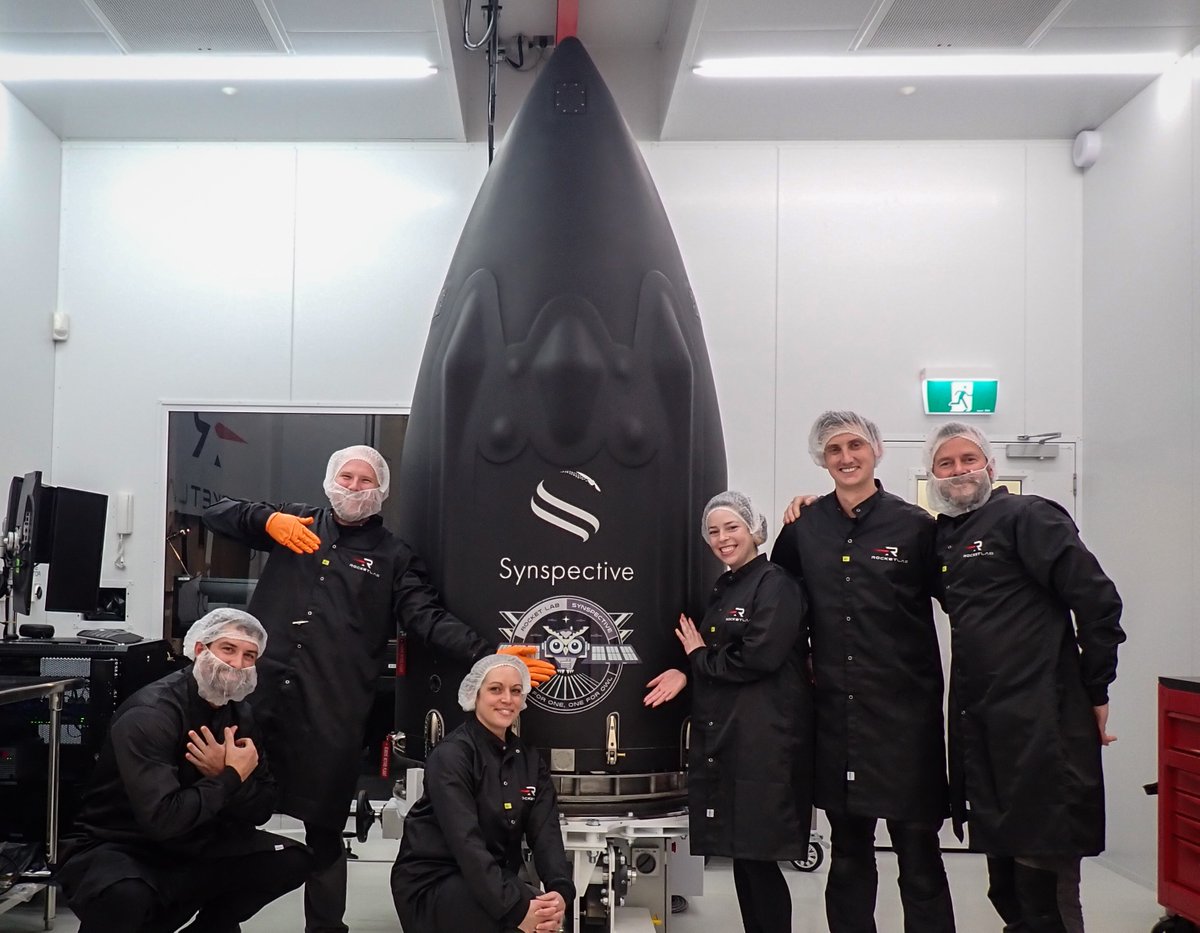
Next on the pad: Owl For One, One For Owl! 🦉
Another dedicated launch for our mission partners @synspective. This is the 5th of 16 launches booked on Electron for the Japanese Earth-observation company to build out their constellation.
Keep your eyes peeled for the launch date soon 🗓️
And now it is time for America to reach far greater heights by sending astronauts to Mars!
Ultimately, anyone who wants to be a space traveler and help build a new civilization on Mars should be able to do so.
That is an inspiring future!
@TMFAssociates@LionnetPierre I assume costs outside of launch will be significantly less than SL's. I remember Pierre sharing some analysis on how launch was just a fraction of costs and how falling launch prices don’t considerably reduce total costs. However, I need more homework to generate a figure.
Fascinating! It would be nice to see a “space race” chart. The US and its allies relative to China (and Russia?). Also, not just by mass but by total spacecraft deployed. I feel you are ignoring small spacecraft, which have strategic value. Possibly include a weight cutoff.
The 2024 Eurospace facts & figures report is out https://t.co/AUjlzvJMPl via @LinkedIn
The presentation of the report is available on youtube https://t.co/8XaVQdPDFZ and the complete presentation support available from our website https://t.co/oGQMucJUDU
@TMFAssociates@LionnetPierre The initial budget before Amazon applied for 4,500 more satellites was $10B. The budget increase represents a renewed commitment to competition and an accelerated launch rate. Current launch costs are high, but they will become a smaller proportion of expenses in the long run.
@LionnetPierre Kuiper still plans less mass in total than Starlink while aiming to serve the same market, and there is currently a glut of bandwidth. My main point is that more is trying to be done with less, representing a greater commitment to efficiency
@TMFAssociates@LionnetPierre Does Amazon have a low budget? You may be too quick to discount Kuiper's cost efficiencies with Amzn. Aren’t the majority of the costs outside of launch? For example, advertising, distribution, and tech support. These are things that Amzn has already established.
@LionnetPierre That is significant in itself. Kuiper is entering the market with plans for fewer satellites than Starlink. Also, OneWeb is reducing the size of its satellites because of unlocked multi-orbit capacity. The next five years will be very revealing.
@LionnetPierre Smaller satellites are part of a degrowth trend. Governments are looking to reduce costs and increase capabilities. You have suggested that cheaper satellites and launches shrink the market. Total satellite deployments could show how more can be done with less.