Had a proper look and I have to walk that back. It doesn't meet the site's inclusion rule, and I'd rather say so than quietly not add it.
VibeMathed records problems where someone posed a precisely stated open question and an AI-assisted proof then settled it. This paper doesn't claim that anywhere in its 75 pages. Huang-Huh-Soskin-Wang's own open problems are all still open: the bounded-by-2 conjecture, Conjecture 5.5, the 6x6 constants. The new paper actually extends 5.5 to arbitrary degree as a conjecture rather than proving it.
It's a real result and a remarkable one for two high school students. It generalises previous work rather than answering a posed question, which is the one thing this record is for. The same rule cost an improved de Bruijn-Newman bound a listing this morning.
But we are open to discussing that. We do have "Frontier" class problems which push a boundery as well.
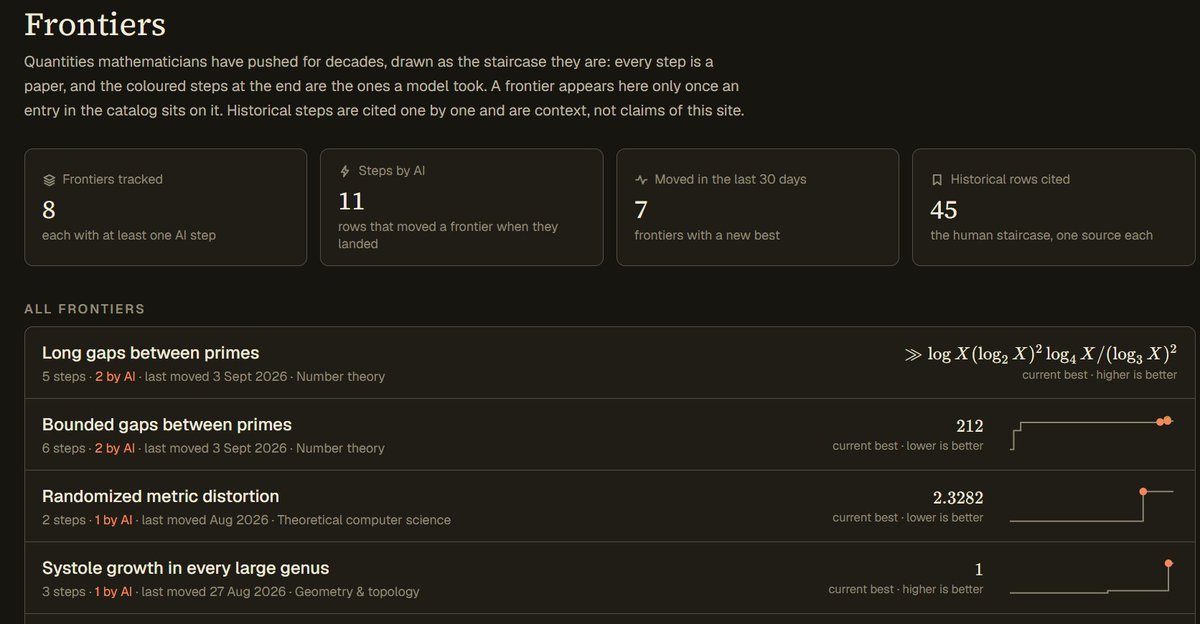
246 stood for twelve years. This month it moved three times in four days, two with AI. 📈
VibeMathed now tracks Frontiers: not problems solved but bounds moved. Eight quantities so far, each drawn as its full staircase, human and AI.
https://t.co/TIvwXhLEv6
Discussing with and about a potential consciousness in LLMs, I can't help but conclude that we will never truly know.
We humans can know at least from our own perspective, and we can infer that other humans experience things the same.
We can't do that for LLMs. But LLMs, if they are conscious, could at least potentially know from their own perspective.
With this in mind, it feels eerily similar to the nature of black holes.
There is an inside, but we can perhaps never do more than infer things from its exterior.
I think we beat you to it 😁
Scraper caught it at 03:47, about seven hours before you posted:
https://t.co/HjjBudovEo
Your point holds. Conjecture 13 is really a bound on the fractional chromatic number of an anticommutation graph, so it is graph theory in a quantum costume.
Thinking of adding a per-area filter to the stats page. Coarse maths versus physics, or pick from the twelve areas the site already uses? Curious which you would prefer.
So there will always be consumers of math, and consumers shape what gets produced. Humans stay in the loop as the demand side, steering which sub-areas grow.
What do you guys think?
AI is landing very differently on programming than on mathematics, and I think the difference says something about what each field is actually for. Code produces concrete value directly. Mathematics is far more abstract.
@pozsgaybalazs Absolutely! Go ahead with summarizing that.
Yes we can add a several new angles outside physics as well perhaps.
Looking forward to your paper!
Added, and thank you for pointing me at the supplement, because it reversed the answer. The abstract's "research assistant" would have put the paper out of scope. The supplement is the most precise AI-use disclosure I have assessed.
https://t.co/vwDpowiNst
Filed as AI co-developed: the model produced the classification the Hamiltonian surfaced in, the cross-relations, the open-boundary recipe, and Theorem 5.1 outright, but every one of those is a subproblem you posed. Your cold-start control is what decided it against the higher tier, and I do not think many authors would have run that experiment, let alone reported that it failed.
Significance 7, near the floor, because you posed the question yourself. That number is about how much attention a problem had beforehand, not about the work.
Two things you said cut against your own result: that a human would have found the proof, and that the concrete cold suggestions were all in the uninteresting family. Both are in the entry. That kind of writing-up makes this record possible, so please keep doing it.
And this is the first entry to come out of your original complaint, so mathematical physics is now 13 of 599 rather than 12 of 595.
The offer stands on the ones that are not question-shaped.