This kid Samuel (Lori’s son from @ lorisamuelsmom Instagram/TikTok) is going viral for his insanely accurate bird calls.
He can do over 100 different ones! The Oklahoma 12-year-old crushed it at his school talent show
Trump Accounts are no longer going to be optional- so if you ever plan on having a child in the USA, you should read what I found:
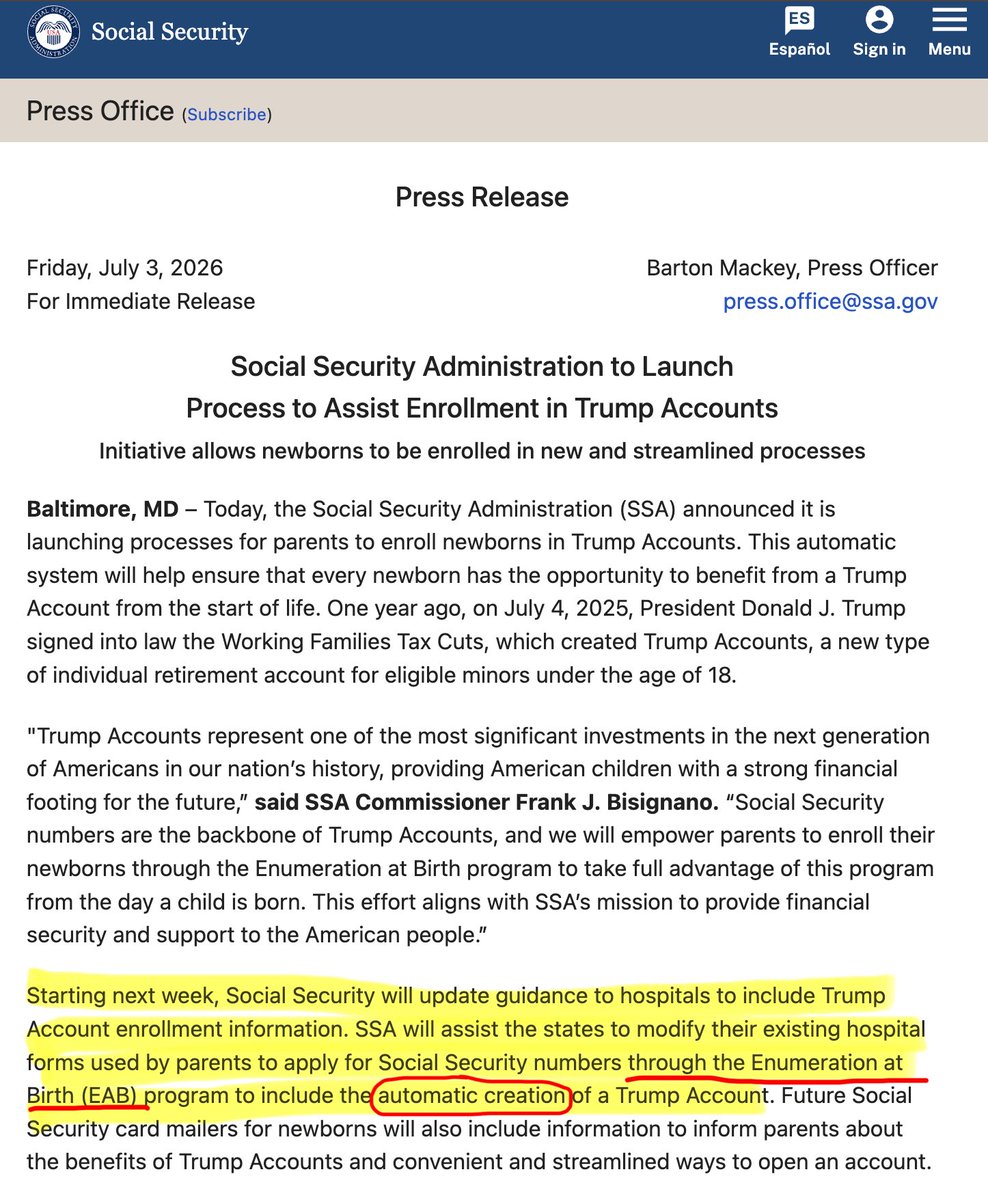
According to the @SocialSecurity Administration's announcement last week, they are modifying the hospital birth registration form so that a Trump Account is AUTOMATICALLY created for your child through that same process.
It will be bundled into the Enumeration at Birth program (EAB), which is the already automated gov pipeline that gives your newborn a Social Security number. It’s one box that you check, you don’t have the option of unbundling it. So if you want your kid to have a Social Security number, they have to have a Trump account.
Which is strange, because according to the IRS and @USTreasury’s public announcements, these accounts only open when a parent actively elects to open one. So which is it? Why is nobody in the government interested in explaining this flagrant contradiction?
Who is going to answer the basic question of what a parent does if they don’t want a government-linked investment account (one that collects biometric data, by the way) created for their child at the exact moment their child’s Social Security number issued?
They can call it a savings account all they want, but a $1,000 deposit is a hell of a cheap price for building a lifelong financial file on every American child before they can consent to anything.
And once the government normalizes linking a person’s identity, financial activity, and predictive systems from birth, who gets to decide what that data will be used to predict later?
We deserve answers immediately. @ndstudio@WhiteHouse
China added over 543 Gigawatts to their grid last year. 434 GW was renewables because they are faster to build. The U.S. added a paltry 53 GW. We are losing the “AI race” to China because these idiots hate green energy. This is suicide by stupid.
A Japanese immunologist spent 20 years proving that the chemicals trees release into the air walk into your bloodstream, hunt down your stress hormones, and arm your immune system in ways no therapist or pharmaceutical has ever matched, and most of the data has been sitting in Japanese medical journals for two decades waiting to be translated.
His name is Qing Li.
He is a clinical professor at Nippon Medical School in Tokyo and the president of the Japanese Society of Forest Medicine. The Japanese government has been funding his research since 2004, and the body of work he has produced is the reason forest bathing is now an officially prescribed clinical therapy in Japan and Korea.
The story actually starts in 1982, when the Japanese Ministry of Agriculture, Forestry and Fisheries coined the term shinrin-yoku to describe the practice of slow, mindful walking in a forest. They did it for a practical reason.
Japan was urbanizing fast, stress-related illness was climbing, and the country had thousands of square kilometers of forest sitting unused. The idea was to give people a reason to walk into the trees... They had no idea what was actually happening to the human body during those walks until Qing Li ran the first proper experiment in 2005.
He took twelve healthy adult men on a three-day, two-night trip to a forest park. They walked for a few hours each day. Nothing strenuous. No prescribed routes or breathing exercises. They simply walked slowly through the trees, breathing the air, looking at the forest.
Li drew blood and urine samples before the trip, on the second day, on the third day, on day seven after returning home, and again on day thirty.
The numbers that came back from the lab were not what anyone expected.
The activity of a specific type of immune cell called the natural killer cell, which is the cell your body uses to hunt down cancer cells and virus-infected cells before they can spread, had jumped by roughly 50 percent during the forest trip. The actual number of natural killer cells circulating in the bloodstream had increased significantly.
Three different anti-cancer proteins that those cells produce, called perforin, granzymes, and granulysin, had all risen sharply. And the effect did not disappear when the men went home. The immune boost was still measurable on day seven and was still partially present on day thirty.
Two hours a day in a forest had upgraded the immune system for a full month.
Li ran the same experiment with women a year later and found nearly identical results. Then he ran it with a control group who took a three-day trip through an urban area with the same amount of walking, the same hotel quality, and the same diet.
The urban group showed no measurable change in natural killer cell activity at all. The forest was doing the work, not the vacation.
The mechanism turned out to be a class of airborne molecules called phytoncides. Trees produce these compounds to defend themselves against insects, bacteria, and fungi. Pine, cedar, oak, and cypress trees release them in particularly large amounts, especially in warmer weather and after rainfall.
When you walk through a forest, you are inhaling those molecules into your lungs and absorbing them through your skin, and once inside your body they appear to directly stimulate the production and activity of the very immune cells Li was measuring in his lab.
Roughly 50 percent of the health benefit of a forest walk, according to Li's data, comes from the chemistry of the air itself. The other half comes from what the forest is doing to your nervous system.
This is where it stops being only about the immune system and starts being about stress.
A separate Japanese research team measured cortisol, the body's main stress hormone, in 84 participants across 35 different forest sites. They drew samples before and after a 30-minute walk in each forest and compared them to control walks in matched urban environments. The cortisol levels of the people who walked in the forest were lower than the cortisol levels of the people who walked in the city by a significant margin. Their heart rates were lower. Their blood pressure was lower.
The activity of their parasympathetic nervous system, which is the part responsible for rest and recovery, had gone up. The activity of their sympathetic nervous system, which is the part that drives fight or flight, had gone down.
Then a researcher at the University of Michigan named MaryCarol Hunter ran the cleanest version of this experiment ever done. She recruited participants from a city and told them to take a nature pill three times a week for eight weeks.
They were free to choose the time, the place, and the duration of the nature experience, as long as it was outside, in daylight, and free of phones, conversations, and aerobic exercise. They sent her saliva samples before and after each session so she could measure cortisol changes accurately and rule out the normal daily drop in stress hormones that happens to everyone.
The result was that participants experienced a 21.3 percent drop in cortisol per hour spent in nature, with the biggest payoff happening between minutes 20 and 30 of the walk.
After that, the cortisol kept dropping, but more slowly. The threshold dose for measurable stress relief was just 20 minutes outside in something that looked and felt like nature.
What none of this means is that nature is a substitute for therapy or for medication when someone genuinely needs them. Therapy treats different things than a walk does, and Li himself has been careful in interviews to call forest bathing a complementary intervention rather than a replacement for clinical care.
But what the research has settled is that the human body has a physiological response to being among trees that operates on the same biological systems modern medicine is trying to reach with drugs and clinical protocols, and that response is fast, measurable, and free.
The strangest part of Li's work is the implication he keeps repeating in interviews. The average person now spends more than 90 percent of their life indoors. Their cortisol stays elevated. Their natural killer cells stay sluggish.
Their parasympathetic nervous system rarely gets a chance to take over. The system that was tuned by millions of years of life under a canopy of trees is being asked to run permanently inside a box made of drywall and screens.
Your body has not forgotten what it is supposed to do in a forest. It is waiting for you to walk into one.
מה שקורה כאן זו חתיכת גאונות מוזיקלית. לא ראיתי שום דבר דומה לזה. צפיתי בזה 10 פעמים ואני עדיין לא יודע איך זמר מצליח לגרום לאלפי אנשים לשיר ביחד כל אחד בסולם אחר בהרמוניה מושלמת. אם אתם חסרי סבלנות תדלגו לדקה ה-4
Fred Rogers met with a child psychologist every week for 22 years to build his show. She shaped everything: every script, prop, and song. The whole point was to give a child's nervous system time to slow down. In 1984, a single regulatory decision ended all of it.
The psychologist was Dr. Margaret McFarland, who co-founded the Arsenal Family and Children's Center alongside Benjamin Spock and Erik Erikson. She and Rogers understood that the prefrontal cortex in children, the part of the brain that controls impulse, emotion, and attention, takes decades to fully develop. At the start of every episode, Rogers tied his sneakers and changed his sweater while children settled in. Those pauses were intentional, designed to help a child's nervous system shift into a calmer, more focused state.
What ended it had nothing to do with child development science. In 1984, Reagan's FCC chairman Mark Fowler abolished the advertising limits that had protected children's programming from commercial pressure. Toy companies moved within months. Between 1984 and 1985, cartoons tied to toy lines increased by 300%, from a handful of shows to more than 40 animated series. In almost every case, the toy was designed first. The cartoon was built to sell it.
Researchers later put numbers to what parents were already noticing. A 2011 study in Pediatrics from the University of Virginia tested 60 four-year-olds across three groups: one watching SpongeBob, which cuts scene every 11 seconds; one watching a slow PBS show, which cuts scene every 34 seconds; and one drawing. Nine minutes later, all three took tests on attention, impulse control, short-term memory, and problem-solving. The SpongeBob group scored significantly worse across every measure.
In the 1970s, children began watching television around age 4. Research from pediatrician Dimitri Christakis found that by 2009, the average age of first screen exposure had dropped to 4 months, as the content got faster and the audience got younger. Researchers separately found that each additional hour of daily screen time at ages 1 or 3 raised the risk of attention problems at age 7 by 9%.
In the USA in 1943 they produced a film 'Don't be a Sucker' about fascism.
It perfectly explains Nigel Farage, Donald Trump, Elon Musk and the entire Right.
🇺🇸💥🇮🇱 Congress Just Voted to Fuse the U.S. Military With Israel’s — and Buried It on Page 847 So You Wouldn’t Notice ☠️
Section 224 of the $1.15 Trillion NDAA Doesn’t Fund Israel. It Makes Israel Part of the Pentagon. Forever. No Exit. No Debate. No Vote. 👇
My Dearest Feiends.
Thank you all for everything you do!
Researched and reported in Good Faith, here’s a faux podcast generated by Google Notebooks that beautifully explains what my 11/5/2024 - 11/6/2024 https://t.co/rePECNPRfp backend Internet scans reveal about siphined American votes for potus.
According to the screenrecording stills, Mr. Trump didn‘t win and Harris/Walz didn’t lose.
And please, in your kindness, will you share this tweet? America deserves to know the truth!
Here’s the link to the stills I‘ve uploaded to the Internet Archive:
https://t.co/tvNUISUNC7 pt 1 Stills from Screenshots TPV
Thank You God for never letting us go! blessed be God forever!
May all be blessed and may our enemies also blessed with a change of heart.
Hugs and thank you!
-V
@homma2x
Bill Clinton has a random run-in with Loretta Lynch at an airport in 2016 - MASSIVE, WEEKS LONG SCANDAL
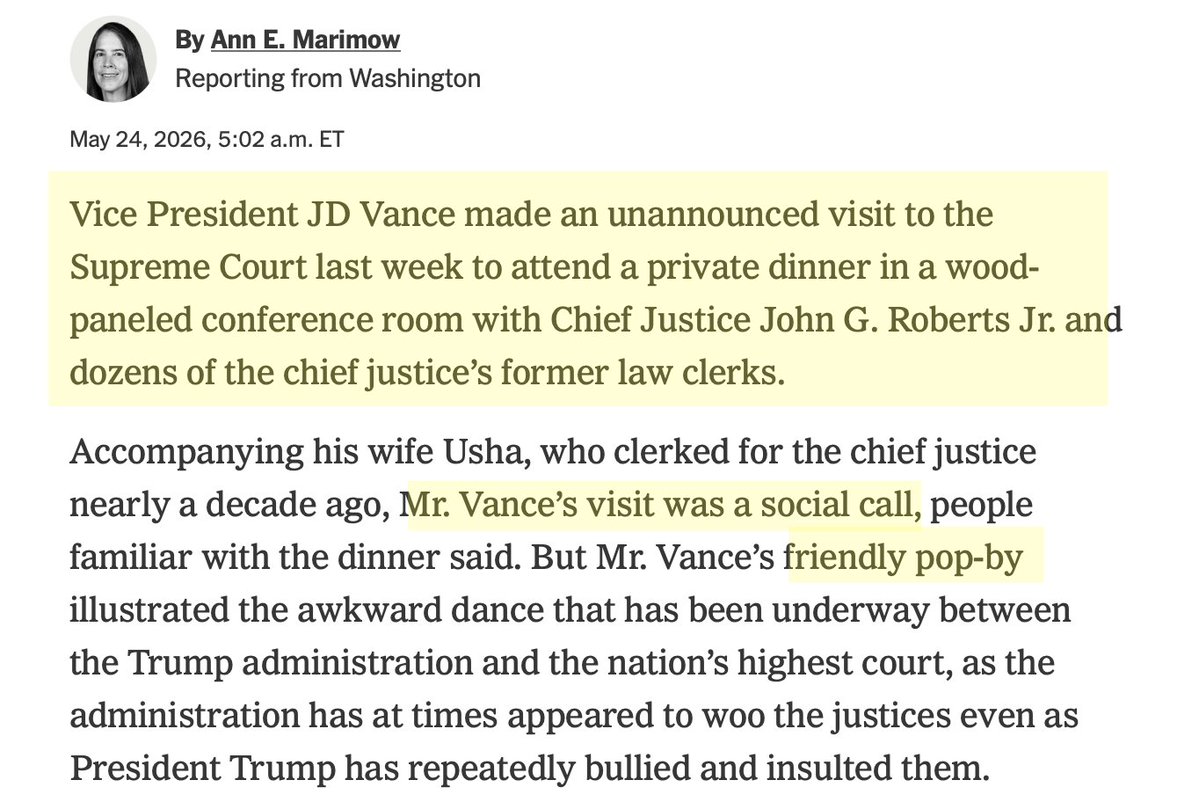
JD Vance attends a private dinner with Chief Justice Roberts while the Court considers multiple Trump Admin lawsuits - "social call" ... "friendly pop-by"
What would it look like if you printed out every page of the Epstein Files?
The Trump-Epstein Reading Room has put all 3.5 million pages, bound together in 3,437 volumes of books, on display in a new exhibit that is set to open Friday in Tribeca.