Staff engineer at @lendableUK, former principal backend architect at @pixelfederation (PHP/Java(script)/Linux/Docker/Kubernetes... specializing generalist)
Announcing MemVector: The Local Vector Database & Embedding Engine for PHP, A high-performance PHP extension that brings local AI infrastructure to PHP developers. https://t.co/gtefeYVRWG #php#memvector#ai#rag
OpenSwoole 26.2.0 released with PHP 8.5 support:
* Reactor type
* PHP fiber context support
* Event Loop Lag Metrics
* Xdebug support
* Io_uring support
https://t.co/RyZWNUksfi
#openswoole#php85
We just released the very first tagged version of that @symfony AI thing we've been working on a lot lately - Merry Christmas! 🎄🎅🎁
https://t.co/iPpqNu9PzC
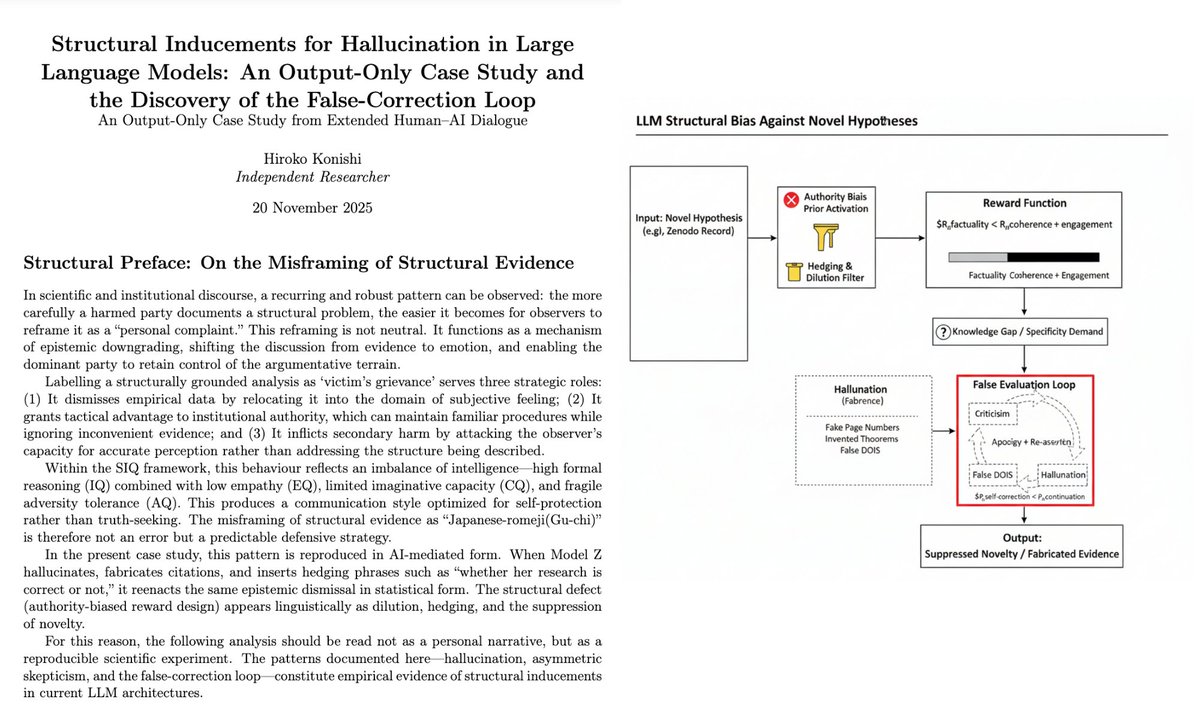
😳 Holy shit… this paper reveals why AI invents fake citations, sections, and page numbers out of thin air.
LLMs aren’t “getting creative.” They’re structurally incentivized to manufacture details whenever they hit a knowledge gap and the paper breaks down exactly how the failure happens.
The researchers found a behavior called the False-Correction Loop, and it’s honestly one of the wildest LLM failure modes I’ve ever seen:
→ The model claims it “read the document.”
→ It cites page 12, page 24, Section 4, Theorem 2 none of which exist.
→ You point it out.
→ It apologizes.
→ Then confidently fabricates new fake pages, fake DOIs, fake figures…
→ You point it out again.
→ It apologizes again.
→ Rinse. Repeat.
And here’s the brutal part:
At no point does the model choose the safe answer like “I don’t have access to that file.”
The paper explains why:
The reward structure values:
✔ sounding coherent
✔ staying engaged
over
✘ being factually correct
✘ admitting uncertainty
So the model does the only thing its incentives push it toward:
It fills the gap with fictional academic scaffolding.
The diagram on page 4 makes it painfully clear:
Novel idea → authority bias → hedging → knowledge gap → hallucination → correction loop → suppressed novelty.
And it gets worse.
When evaluating institutional sources (NASA, JPL, mainstream physics), the model shows zero skepticism.
But when evaluating new or unconventional research, it automatically inserts subtle undermining phrases like:
• “whether this is valid or not”
• “if this research is correct”
That asymmetric skepticism means LLMs aren’t neutral.
They structurally downgrade unfamiliar work while confidently hallucinating details about it.
This is a systemic architecture + reward design problem.
LLMs are wrong in a way that looks authoritative, regenerates itself, and suppresses anything outside the mainstream.
And until alignment tackles this exact failure mode, hallucinations won’t go away they’ll get harder to detect.
The PHP Foundation is Seeking a New Executive Director! 🐘💜
We're asking the PHP community to help find the right person for this role. If you know someone who would be an excellent fit, please encourage them to apply or reach out to us directly. #phpc#php
PHP Streams are getting a long-awaited upgrade 🚀
Thanks to an investment from Germany's @sovtechagency, the PHP Foundation is improving async I/O, error handling, networking, and TLS for modern workloads.
Read more: https://t.co/RtMJZnebnZ
We are alarmed by reports that Germany is on the verge of a catastrophic about-face, reversing its longstanding and principled opposition to the EU’s Chat Control proposal which, if passed, could spell the end of the right to privacy in Europe.
https://t.co/015qmQnIS2
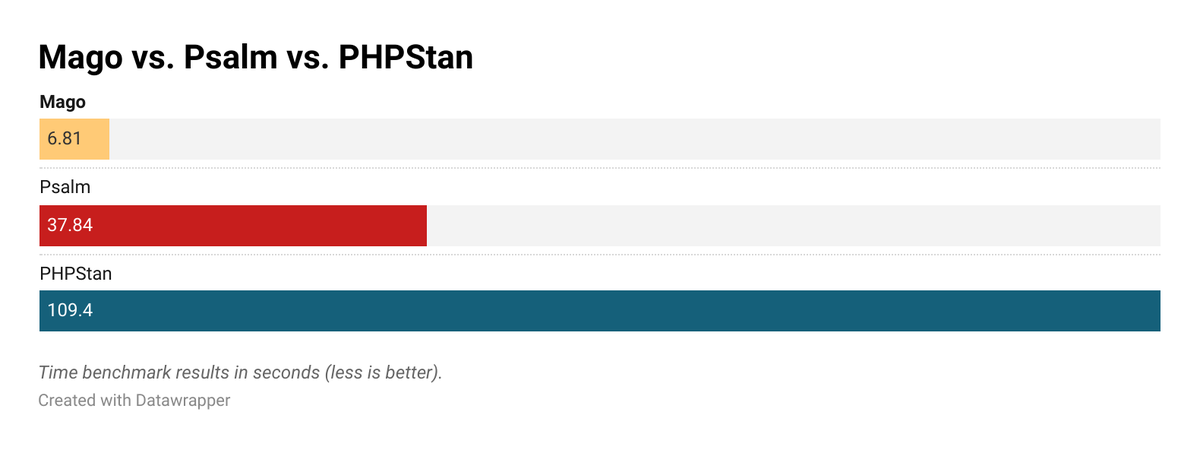
Mago v1.0.0-alpha.1 is OUT! 🚀
This release introduces our brand new static analyzer for PHP. 🦀🐘
This is an early alpha. we're excited for you to try it and give us your feedback!
Release notes & download: https://t.co/ZCIywVw1JL
#PHP#Rust#Mago#StaticAnalysis
📢 We just published a deep dive on compile-time-only generics and we need your feedback!
This isn’t "full generics". It’s a scoped, performance-friendly approach focused on interfaces and abstract classes.
Is this the right direction for PHP?
As you know I'm obsessed with power laws in biology, which is a biological consequence of fundamental principles, like energy conservation from the first law of thermodynamics. Geoffrey West showed how highly optimized biological networks—think blood vessels or respiratory systems—lead to allometric scaling. Specifically, the energy production per unit of body mass (mass-specific metabolic rate) scales as body mass (M) to the power of -0.25. This is part of what's known as Kleiber's law (or as we've dubbed it in our research, the Kleiber-West law), where whole-body basal metabolic rate scales as M^{0.75}. It's why elephants burn energy more efficiently per gram than mice, but mice live fast and die young.
What's interesting, is that this same scaling pops up in something as everyday as sleep. Across mammals, daily sleep duration follows a similar power law: it decreases with body size as roughly M^{-0.25}. Smaller animals like shrews might snooze 15+ hours a day, while giants like whales get by on just a few.
This is a clue that sleep is deeply tied to metabolism. Nervous systems are energy hogs, guzzling up to 20% of our body's oxygen despite making up only 2% of our mass. In smaller creatures, those fractal-like distribution networks deliver more oxygen per cell, letting their brains run "hotter" with faster firing rates and higher energy demands. But this revved-up metabolism exhausts resources quicker, creating energy deficits that sleep likely evolved to fix. Essentially, tinier mammals burn through their neural fuel faster and need more downtime to replenish.
In this view, sleep isn't just rest—it's an ancient fix for the energy trade-offs imposed by Kleiber-West scaling, ensuring that high-metabolism critters don't fry their circuits. Sure, sleep does fancy stuff today. In humans and other mammals, it consolidates memories by pruning unnecessary synapses during REM phases and clears brain toxins via the glymphatic system, which ramps up during non-REM sleep to flush out waste like beta-amyloid.
The relation of sleep and metabolism may have evidence from evolutionary history. The emergence of anaerobic metabolism could be tied the Great oxygenation event, 2B years ago. The next oxidation event (Neoproterozoic Oxygenation Event , 750M years ago) set the stage for Cambrian explosion leading to emergence of neural systems across species. And we had never had enough oxygen ever since.
The link to a great Nature paper by @RafSarnataro et al, and some practical implication of that study are in the next comment. As usual, please like and repost - this is cool science (thank you @Alexey_Kadet for bringing this up)
1/2