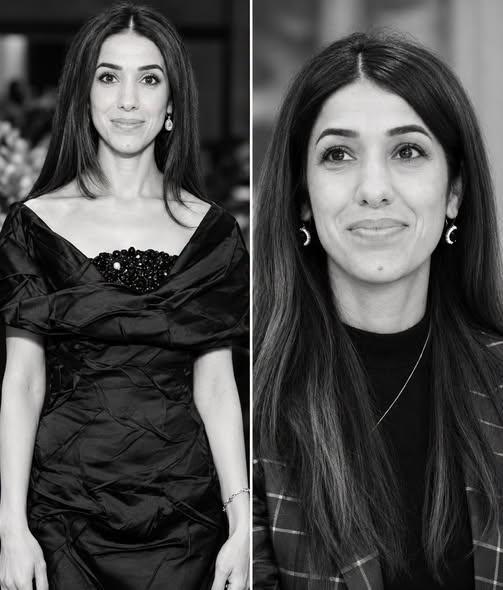
She was bought and sold seven times in just three months.
Years later, she stood before the United Nations and made the world face what had happened to her. At 25, she became a Nobel Peace Prize winner.
August 3, 2014.
Kocho, Iraq.
Nadia Murad was 21 when ISIS surrounded her Yazidi village. What happened next was genocide. Men and boys were taken away and executed. Six of Nadia’s brothers were killed.
Her mother was murdered and buried in a mass grave.
Nadia was taken to Mosul. To her captors, she was no longer a person. She was property.
She was bought, sold, and traded seven times in just 90 days. She was beaten, burned, and repeatedly sexually assaulted. At one point, Nadia tried to escape.
She was caught.
The punishment was horrific.
Six men raped her until she lost consciousness. She was beaten so badly that she could barely walk.
Her captors wanted to break her spirit.
They didn’t.
In November 2014, Nadia noticed an unlocked door.
She ran.
A local Muslim family took an enormous risk by hiding her and helping her get out of ISIS-controlled territory.
Eventually, she reached a refugee camp.
Then she made it to Germany.
For the first time in months, she was free.
She could have chosen to disappear and build a quiet life somewhere far from the attention.
Instead, she decided to speak.
In December 2015, Nadia stood before the United Nations Security Council. She was 22 years old.
She spoke about girls being sold like cattle, mothers being murdered, and an entire culture being deliberately destroyed.
The world listened.
In 2016, the United Nations formally recognized the genocide against the Yazidi people. But Nadia wasn’t finished. She turned what had happened to her into a fight for others.
In 2018, she founded Nadia’s Initiative, working to rebuild villages, schools, and clinics while helping survivors pursue justice.
That same year, at just 25, Nadia became the first Iraqi woman to receive the Nobel Peace Prize. The world celebrated her.
But Nadia’s attention remained on the people who were still missing and those who were still being held captive. For her, that was the prize that truly mattered.
Their freedom.
She continues to speak for the thousands who were killed and for those whose fate remains unknown.
Every time she tells her story, she has to carry the pain all over again.
But she knows what silence can cost.
Nadia turned suffering into purpose.
Trauma into testimony.
Survival into a demand for justice.
ISIS tried to strip her of her identity and reduce her to property.
History remembers her by her name.
Nadia Murad.
Not simply because she escaped.
But because she survived, stood before the world, and refused to let silence have the final word.
Let me introduce you to Aida Rostami, another hero from my country, Iran.
She was 36 years old. A general physician.
During January arising in 2026,, while the streets of Iran were filled with injured protesters, Aida chose to do help them. She was a doctor. Her job was to save lives.
Quietly and anonymously, she traveled to homes in western Tehran,l, to provide medical care to protesters who were afraid to go to hospitals because they feared arrest, torture, or worse.
On December 12, 2022, Aida left her home of one of the injured protesters to get medical supplies. She never came back.
The next day, her family was called to a police station and told that Aida had died in a car accident.
But when her family saw her body, they saw something very different.
Her hands were broken. The right side of her face was crushed. Her nose was shattered. Her left eye had been severely injured. There were bruises across her body.
Her family questioned the official story. And then the story changed.
First, they said it was a car accident. Later, authorities claimed she had fallen from a pedestrian bridge.
Her family continued to reject the official accounts.
And later, her brother released an audio recording that shed light on the pressure security forces had placed on the family. They took her life.
Aida was not carrying weapons, she was carrying medical supplies. She was treating wounded people.
I have a question:
How many people outside Iran know the name of Aida Rostami?
How many doctors around the world know the story of a physician who risked everything to treat injured protesters when hospitals were no longer safe?
Remember that 19 Yazidi girls were burned alive in iron cages by the Islamic State for refusing to convert to Islam and become sex slaves.
ISIS paraded them through the streets of Mosul, then burned them in front of hundreds of people. Not a single person attempted to stop them!
Not a single Muslim or pro-Palestinian activist protested for the Yazidis!
TERRIFYING: During a TikTok live battle, an Algerian Muslim influencer asks a girl why she’s wearing a cross. She says she’s a Lebanese Christian.
He then becomes enraged and says he’d spit on her, and threatens to rape her and kill her, declaring that Christians deserve nothing but to be tortured in this world and the afterlife.
He has half a million followers and has illegally arrived in France via Spain just a few days ago.
This is Islam. And this is how much they hate Christians. Imagine when they become the majority.
“No lo haré. Pueden matarme si quieren.”
Auschwitz, 1943. Una médica francesa permanece firme frente a un grupo de mujeres judías aterrorizadas. A pocos pasos, un médico nazi acaba de dictar una instrucción clara:
“Tendrá que ayudar en los experimentos de esterilización.”
Adélaïde Hautval dirige la mirada hacia aquellas prisioneras. Ellas ya comprenden el horror que se prepara: tortura médica disfrazada de ciencia. Acto seguido, vuelve la vista hacia el oficial y pronuncia una palabra categórica:
“No.”
El silencio se vuelve absoluto. En la atmósfera de Auschwitz, nadie rechaza una orden directa sin arriesgar la existencia misma. Le advierten de inmediato que su negativa puede llevarla al paredón de ejecución.
Sin embargo, Adélaïde no cede. Se niega rotundamente a causar daño a esas mujeres y, contra toda lógica dentro del campo, los guardias no la matan.
¿Cómo terminó una médica francesa en medio de aquel infierno?
Un año atrás, en 1942, Adélaïde viajaba por la Francia ocupada cuando fue detenida al intentar cruzar la línea de demarcación. Durante su arresto, presenció el trato cruel que recibían los prisioneros judíos y protestó abiertamente contra las autoridades.
Aquel gesto de valentía fue visto como un desafío. Las fuerzas de ocupación la clasificaron como “amiga de los judíos”, un rótulo destinado a infundir vergüenza, pero que ella llevó con dignidad.
Fue encarcelada, trasladada por distintos centros de internamiento y, finalmente, en enero de 1943, deportada en un vagón hacia Auschwitz.
Al ser médica, los administradores del campo la asignaron a tareas sanitarias. Sin embargo, no dejaron de poner a prueba su lealtad, exigiéndole participar activamente en las agresiones:
“Participe en los experimentos.”
Adélaïde volvió a decir que no. Una y otra vez.
Durante todo su cautiverio, rehusó colaborar con los procedimientos médicos pseudocientíficos. En su lugar, utilizó su posición para atender a las prisioneras, proteger a mujeres judías en peligro y aliviar el sufrimiento en un entorno diseñado exclusivamente para la destrucción.
Cuando le imponían obediencia, respondía con su conciencia; cuando le exigían complicidad, elegía el riesgo personal. No poseía poder, libertad ni garantías de ver el mañana, pero conservaba un límite moral que se negó a cruzar.
Posteriormente fue enviada al campo de Ravensbrück, donde sobrevivió hasta la liberación en 1945.
Al finalizar la guerra, regresó a Francia y reanudó su profesión, buscando reconstruir su rutina cotidiana. Sin embargo, su voz se volvió imprescindible para la historia.
En 1964, acudió como testigo en un proceso judicial sobre los crímenes médicos perpetrados en Auschwitz. Frente a los intentos por minimizar o negar las atrocidades, Adélaïde se mantuvo firme: ella había estado ahí, lo había presenciado todo y se había negado a formar parte.
En 1965, la institución Yad Vashem la distinguió como Justa entre las Naciones, reconociendo su labor en la protección de prisioneros y el riesgo asumido al resistir.
Adélaïde jamás buscó notoriedad. Mantuvo siempre que solo había cumplido con su deber profesional y humano. Tras el reconocimiento, continuó su labor médica en el área de la psiquiatría, atendiendo a personas que cargaban con las secuelas de la guerra.
La doctora Adélaïde Hautval falleció en 1988, a los 82 años de edad.
Su historia invita a reflexionar: tenía motivos de sobra para ceder. Ya era prisionera, ya estaba marcada y su vida dependía de un régimen dispuesto a erradicarla en cualquier instante. Colaborar no le habría garantizado integridad, mientras que negarse ponía en riesgo su vida.
Aun así, eligió resistir. No en una sola ocasión, sino múltiples veces.
Transformó el único recurso que los administradores requerían de ella —su conocimiento profesional— en una herramienta de protección, dignidad y resistencia.
Adélaïde vivió para ofrecer su testimonio y consolidar la verdad histórica. Continuó su labor curativa durante el resto de sus días.
#2jul || Luis Olavarrieta conversó con Fabiana Blanco, la niña de 14 años que fue rescatada con una gran sonrisa entre los escombros en La Guaira.
Fabiana nos contó lo agradecida que está por el cariño de las personas y el apoyo de los rescatistas en todo momento.
#INAVI Construyó durante la democracia en Caracas y Vargas:
Gran Complejo Caricuao (Unidades de Desarrollo UD): Compuesta por decenas de bloques multifamiliares divididos por sectores:Ruiz Pineda (UD9): Concluida durante el gobierno de Raúl Leoni, consta de 22 edificios.UD2, UD3, UD4, UD5 y UD6: Bloques de densidades variables distribuidos en toda la parroquia.UD7 y UD8: Complejos de 16 superbloques añadidos a finales de los sesenta.
Urbanización Alberto Ravel (El Valle): Proyectada y levantada a partir de 1961. Consta de una red de pequeños bloques de 4 pisos integrados a caminerías peatonales.
Bloques de Propatria y Casalta (Catia): El INAVI erigió densas hileras de bloques multifamiliares (como los bloques 7, 8 y 9 de Propatria) para absorber el crecimiento demográfico del oeste de la ciudad.
Bloques de Kennedy y Macarao: Sectores de bloques de interés social de mediana y alta altura edificados de forma progresiva desde 1959.
Urbanización Diego de Lozada: Bloques residenciales multifamiliares construidos para dar solución habitacional en el norte-centro de la ciudad.Ampliación de El Valle (Longaray y zonas aledañas):
Urbanización Guarenas (Menca de Leoni / Casarapa)
La Guaira, Urbanización 10 de Marzo (Parroquia Carlos Soublette): complejo de bloques residenciales de alta densidad construidos frente a la costa para albergar a las familias trabajadoras del Puerto de La Guaira y el Aeropuerto de Maiquetía.
Bloques de la Aviación (La Guaira): Conjuntos de bloques multifamiliares de mediana altura desarrollados para el sector militar y civil en el Litoral Central.
Todos están en pie y fueron construidos con criterios antisísmicos. Los de Misión Vivienda se derrumbaron con enorme saldo de pérdidas humanas.
My friend from Venezuela posted this on his instagram stories.
Where is the help of China or Russia?
Did you notice how the “far right” countries such as USA, El Salvador or Argentina were the first ones to send help?
They are living a nightmare there.
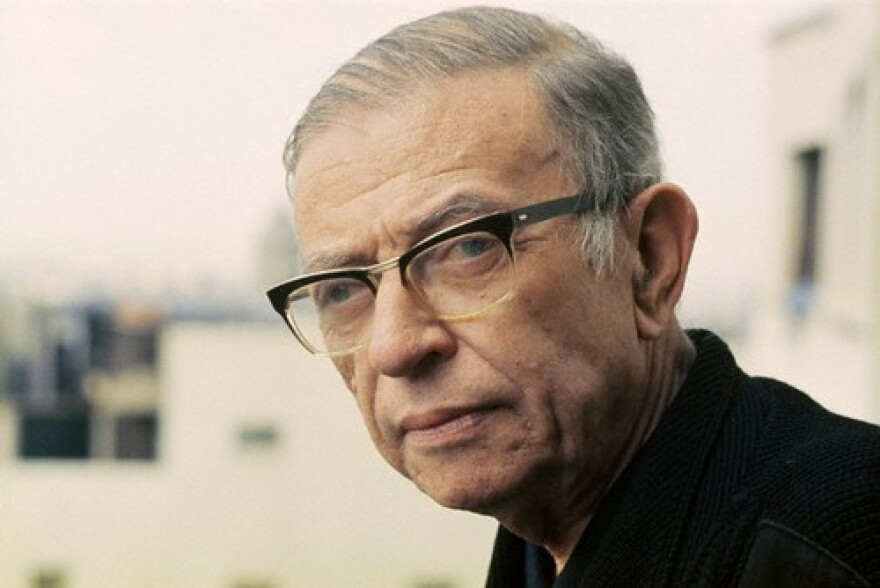
In 1968, while teenage Red Guards beat their professors to death with clubs in Beijing courtyards, Jean-Paul Sartre sat in Paris calling Mao's Cultural Revolution a model of revolutionary democracy. The most celebrated intellectual in France looked at a country burning its own libraries and saw liberation. He sold the Maoist newspaper La Cause du Peuple on French street corners himself, holding it aloft like a sacrament.
Consider what he was endorsing. Between 1966 and 1976, the Cultural Revolution killed somewhere between 500,000 and two million people. Schools shut down across the entire country. Students dragged teachers onto stages, hung placards around their necks, forced them to kneel on broken glass, then murdered them. The historian Bian Zhongyun, vice-principal of a girls' school in Beijing, died on August 5, 1966, beaten by her own students with nail-studded clubs. Sartre called this the people governing themselves.
You should understand why a man this intelligent got it this wrong. Sartre believed knowledge served power, that truth was whatever the revolution required, that the individual existed to be dissolved into the collective will. So when Mao abolished the distinction between teacher and student, between expert and mob, Sartre cheered. He had spent decades arguing that bourgeois reason was a class weapon. Here was a regime taking him at his word and clubbing the reasoners to death.
This is what economic illiteracy buys you. A university, a price, a contract, and a peasant's grain stockpile all carry knowledge that no central planner can seize or replicate. Mises explained the calculation problem in 1920. Hayek explained dispersed knowledge in 1945. Sartre had access to both and chose the dunce cap of the collective instead, then handed out its propaganda on the Rue de Rennes.
He died in 1980, mourned by 50,000 followers, never having retracted a word about Mao. The professors of Beijing got no such funeral. They got a ditch, and a philosopher in Paris explaining that their murder was freedom.
Christopher Hitchens: ”In 1786, when the United States was barely a country, it was having its sailors taken as slaves by the Barbary states, the states of the Ottoman Empire and North Africa. Tripoli, shores of Tripoli. Ships stopped, its crews carried off into slavery. We estimate 1.5 million European and American slaves taken between 1750 and 1815.
Jefferson and Adams went to their ambassador in London and said, why do you do this to us? The United States has never had a quarrel with the Muslim world of any kind. We weren't in the crusades. We weren't at war with Spain. Why do you do this to our people and our ships? Why do you plunder and enslave our people? The ambassador said very plainly, Mr. Abdul Rahman said, because the Quran gives us permission to do so, because you are infidels, and that's our answer. Jefferson said, well, in that case, I will send a navy which will crush your state, which he did.
Islamic fundamentalism is not created by American democracy. It's a lie to say so. It's a masochistic lie, and it excuses those who are the real criminals, and blames us for the attacks made upon us.”
Marco Rubio: "All radical Islamic movements in the world identify the West, but the United States in particular, as the greatest evil on Earth. Radical Islam wants to expand, it’s in their nature.”