A welcome change. Should lead to better understanding and wider acceptance of tree-based farming. For every acre of agricultural land, there must be at least two bovine animals. When soil is enriched with tree litter and animal waste, it will decrease dependence on chemical-based fertilizers, reduce input cost and enhance crop health & farmer income. -Sg
@ChouhanShivraj
🚨 PwC just partnered with a $TAO subnet SN44 @webuildscore
$56.9 billion in revenue.
364,000 employees.
136 countries.
175,004 clients.
82% of the Fortune Global 500.
$1.5 billion invested in scaling AI this year alone.
$3.1 billion in total network investment.
Key alliances with Microsoft, Google, AWS, OpenAI, and Anthropic.
PwC The largest professional services firm on earth.
Read that again.
They just formed an alliance with Manako @manakoai, powered by Score Subnet 44 @webuildscore to bring physical AI to enterprise at global scale.
PwC France and Maghreb will integrate Manako's Business Operations World Model into its AI and digital advisory practice. That model runs on decentralized AI infrastructure. On Bittensor.
This is not a proof of concept. This is deployment infrastructure for the world's largest organizations.
One billion cameras exist globally. Twenty-one billion connected sensors. Most of that footage is never seen. None of it drives action. Manako changes that.
Connect existing camera feeds, describe what you need in plain language, and the system monitors, understands, and acts.
Real-time. Across retail, logistics, manufacturing, energy, and infrastructure.
PwC's own 29th Global CEO Survey found that 3 in 5 CEOs believe their company won't be viable beyond a decade without major reinvention.
AI adoption is expected to raise global GDP by 15%.
👀 $7.1 trillion in redistributed revenues is up for grabs this year alone.
When PwC needed physical AI infrastructure, they could stand behind at enterprise scale, they chose a Bittensor subnet.
Not OpenAI. Not Google. A decentralized network.
This is what institutional adoption looks like. Not announcements about "exploring blockchain." A $57 billion firm embedding subnet technology into how it serves Fortune 500 clients.
@manakoai@webuildscore@PwC_France
$TAO
Stop guessing how to use Claude Code.
This is the complete Claude Code learning path — videos, repos, docs, and books.
No noise. No confusion. Just everything in one place.
🎥 Videos
1. FULL Claude Code Tutorial for Beginners (2026)
https://t.co/LuS9X0gESW
2. CLAUDE CODE FULL COURSE — Build & Sell (4 Hours)
https://t.co/mLu14drDke
3. Mastering Claude Code in 30 Minutes
https://t.co/jw1Q2mosqO
4. Master 95% of Claude Code Skills in 28 Minutes
https://t.co/WJafgUoXLF
5. Claude Code Tutorial Playlist (Beginner → Advanced)
https://t.co/idLZoWJyKN
6. My Top 6 Tips Using Claude Code Efficiently
https://t.co/ZEBCn71VA5
🗂 Repositories
1. Claude Code (Official)
https://t.co/Np1bsd2TQQ
2. Claude Cookbooks
https://t.co/lsjZXJVE5a
3. Claude Code Ultimate Guide
https://t.co/THuyq6DKyT
4. Awesome Claude Plugins
https://t.co/RVmRh3rQFQ
5. Best Claude Code Repos Collection
https://t.co/jlbk63Cf1O
📚 Guides & Documentation
1. Claude Code Overview Docs
https://t.co/AYCqHJQ29b
2. Claude Code Handbook (freeCodeCamp)
https://t.co/B7iBSOmVs3
3. Claude Code Complete Guide 2026
https://t.co/KIm5svPKF5
4. Practical Guide to Claude Code
https://t.co/7z2iOhcS4F
5. Claude Code Beginner Guide
https://t.co/reHMqrAqgc
📖 Books
1. Mastering Claude AI — Practical Journey
https://t.co/WhXNBeJzOr
2. AI Engineering — Chip Huyen
https://t.co/1mz6wv3kNd
3. Claude Code Lab — Production AI Apps
https://t.co/BYBZFXPXm1
Bookmark this. You’ll need it.
Repost to help someone master Claude Code faster.
Claude vs. Claude Code vs. Cowork.
If you've been confused about which one to use and when, this post will clear that up in under two minutes.
Anthropic now offers three distinct ways to interact with Claude, and each one targets a fundamentally different workflow. Think of it as: Chat for thinking, Code for building, and Cowork for doing.
Here's a quick breakdown:
1️⃣ Claude Chat
This is the conversational AI assistant most people already know. You type a prompt, Claude responds, and you iterate together.
- Turn rough ideas into structured plans through conversation
- Write emails, reports, essays, and long-form content
- Research and summarize complex topics in minutes
- Analyze documents, PDFs, and images
- Build interactive prototypes through Artifacts
The key here is that everything happens through conversation. You're thinking with Claude, not delegating work to it.
It's available on every device, has a free tier, and supports persistent memory across sessions.
The tradeoff is that it has no direct access to your local files (upload only), and it can't generate raster images natively.
2️⃣ Claude Code
This is a terminal-native coding agent. You describe what you want in plain English, and Claude reads your codebase, writes code, runs tests, fixes errors, and ships the result.
- Build and debug entire features across the full codebase
- Write, run, and fix tests automatically
- Manage git workflows and create pull requests
- Spawn multiple parallel agents working on different parts of a task simultaneously
It handles the full development cycle end to end, from planning to execution to testing. With the CLAUDE(.)md configuration file, you can teach it your project's conventions, patterns, and constraints so it writes code the way your team expects.
The tradeoff is a steeper learning curve compared to Chat, and token costs can add up during heavy sessions.
3️⃣ Claude Cowork
This is the newest addition. Anthropic describes it as Claude Code for the rest of your work.
It's an agentic desktop assistant that automates file management and repetitive tasks through a GUI. You describe an outcome, and Claude plans, executes, and delivers finished work: formatted documents, organized file systems, spreadsheets with working formulas, and synthesized research.
- Direct local file access and editing (no upload/download cycle)
- Schedule recurring tasks automatically
- Assign tasks remotely via Dispatch from your phone
- Computer Use lets Claude control your screen directly
It runs inside a sandboxed virtual machine on your computer, so Claude can only access folders you explicitly grant. You don't need to know how to code to use it.
The tradeoff is that your computer must stay awake for tasks to run, and it's still in research preview.
Here's how to think about choosing between them:
→ If you need to think through a problem or get writing/research help, use Chat
→ If you're building software and want an autonomous coding partner, use Code
→ If you have a clearly defined deliverable that involves local files and desktop workflows, use Cowork
All three are included in the same subscription starting at $20/month, which makes it one of the highest-leverage subscriptions in productivity software right now.
I've put together a visual below that maps the workflow of each product side by side.
If you want to go deeper into Claude Code specifically, I wrote a detailed article covering the anatomy of the .claude/ folder, a complete guide to CLAUDE(.)md, custom commands, skills, agents, and permissions, and how to set them all up properly. Link in the next tweet.
CPU vs GPU vs TPU vs NPU vs LPU, explained visually:
5 hardware architectures power AI today.
Each one makes a fundamentally different tradeoff between flexibility, parallelism, and memory access.
> CPU
It is built for general-purpose computing. A few powerful cores handle complex logic, branching, and system-level tasks.
It has deep cache hierarchies and off-chip main memory (DRAM). It's great for operating systems, databases, and decision-heavy code, but not that great for repetitive math like matrix multiplications.
> GPU
Instead of a few powerful cores, GPUs spread work across thousands of smaller cores that all execute the same instruction on different data.
This is why GPUs dominate AI training. The parallelism maps directly to the kind of math neural networks need.
> TPU
They go one step further with specialization.
The core compute unit is a grid of multiply-accumulate (MAC) units where data flows through in a wave pattern.
Weights enter from one side, activations from the other, and partial results propagate without going back to memory each time.
The entire execution is compiler-controlled, not hardware-scheduled. Google designed TPUs specifically for neural network workloads.
> NPU
This is an edge-optimized variant.
The architecture is built around a Neural Compute Engine packed with MAC arrays and on-chip SRAM, but instead of high-bandwidth memory (HBM), NPUs use low-power system memory.
The design goal is to run inference at single-digit watt power budgets, like smartphones, wearables, and IoT devices.
Apple Neural Engine and Intel's NPU follow this pattern.
> LPU (Language Processing Unit)
This is the newest entrant, by Groq.
The architecture removes off-chip memory from the critical path entirely. All weight storage lives in on-chip SRAM.
Execution is fully deterministic and compiler-scheduled, which means zero cache misses and zero runtime scheduling overhead.
The tradeoff is that it provides limited memory per chip, which means you need hundreds of chips linked together to serve a single large model. But the latency advantage is real.
AI compute has evolved from general-purpose flexibility (CPU) to extreme specialization (LPU). Each step trades some level of generality for efficiency.
The visual below maps the internal architecture of all five side by side, and it was inspired by ByteByteGo's post on CPU vs GPU vs TPU. I expanded it to include two more architectures that are becoming central to AI inference today.
👉 Over to you: Which of these 5 have you actually worked with or deployed on?
____
Find me → @_avichawla
Every day, I share tutorials and insights on DS, ML, LLMs, and RAGs.
Most $1000 AI/ML courses don't teach you how to actually build. These 16 repos do.
These repos include real projects, working code, and step-by-step guides to help you build actual skills.
P.S. I share such repos and tutorials with 200K+ AI/ML Engineers here: https://t.co/6fxaO0iznk
1:// Machine Learning for beginners by Microsoft (84.3k ⭐)
https://t.co/qNk2pTFppb
2:// 100 days of ML coding (49.8k ⭐)
https://t.co/wt9hwG0Ymt
3:// All algorithms implemented in Python (219k ⭐)
https://t.co/p0yWyJFF8W
4:// Mathematics for Machine Learning (15.1k ⭐)
https://t.co/fG76b6egv5
5:// Made with ML (46.7k ⭐)
https://t.co/hI8HaDh0dk
6:// 60+ implementations of Deep Learning papers (65.9k ⭐)
https://t.co/ofB1oljOim
7:// Neural Networks: Zero to Hero (20.8k ⭐)
https://t.co/63mvVI2ysA
8:// Hands-On LLMs book (23.4k ⭐)
https://t.co/7JwHBNma6Q
9:// Prompt Engineering guide (71.5k ⭐)
https://t.co/Ce0xR5VFff
10:// AI Agents for Beginners by Microsoft (53.9k ⭐)
https://t.co/g0bMREtXK8
11:// Generative AI Agent techniques (20.5k ⭐)
https://t.co/XevQ23TuPv
12:// RAG techniques (25.9k ⭐)
https://t.co/SUem1Hai0B
13:// Data Science to learn and apply for real world problems (28.6k ⭐)
https://t.co/BvV5sNABX1
14:// Awesome Natural Language Processing (18.2k ⭐)
https://t.co/zOwqWmVLlK
15:// Awesome Reinforcement Learning (9.6k ⭐)
https://t.co/SCAIwnwcDp
16:// All Reinforcement Learning algorithms from scratch (1.4k ⭐)
https://t.co/P7UqFjle7Z
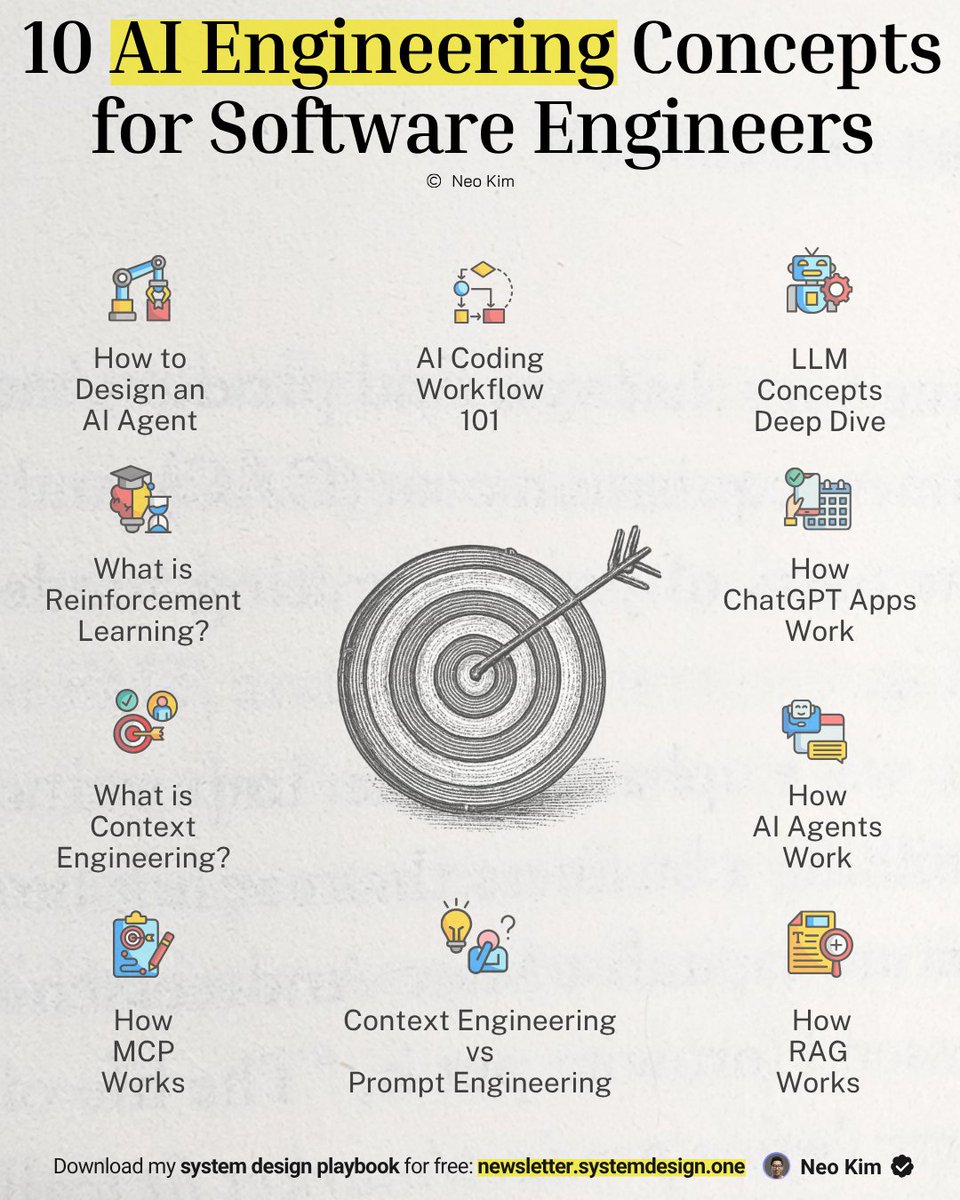
I struggled with AI engineering until I learned these 10 concepts (not joking):
1 How RAG Works
↳ https://t.co/cGmunPTUlb
2 LLM Concepts - A Deep Dive
↳ https://t.co/5lCKxq2g4N
3 How to Design an AI Agent
↳ https://t.co/JvnPd9773A
4 What is Reinforcement Learning
↳ https://t.co/AVpl9j1oit
5 Context Engineering vs Prompt Engineering
↳ https://t.co/9h8q9F2i57
6 Context Engineering 101
↳ https://t.co/OMkiZhkODL
7 AI Coding Workflow 101
↳ https://t.co/paIf9ksIU9
8 How ChatGPT Apps Work
↳ https://t.co/BJTYYnAwO1
9 How AI Agents Work
↳ https://t.co/tk3zkCjRvg
10 How MCP Works
↳ https://t.co/wgf8gHnnkn
What else should make this list?
——
👋 PS - Want my System Design Playbook for FREE?
Join my newsletter with 200K+ software engineers:
→ https://t.co/ByOFTtOihX
———
💾 Save this for later & RT to help others learn AI engineering.
👤 Follow @systemdesignone + turn on notifications.
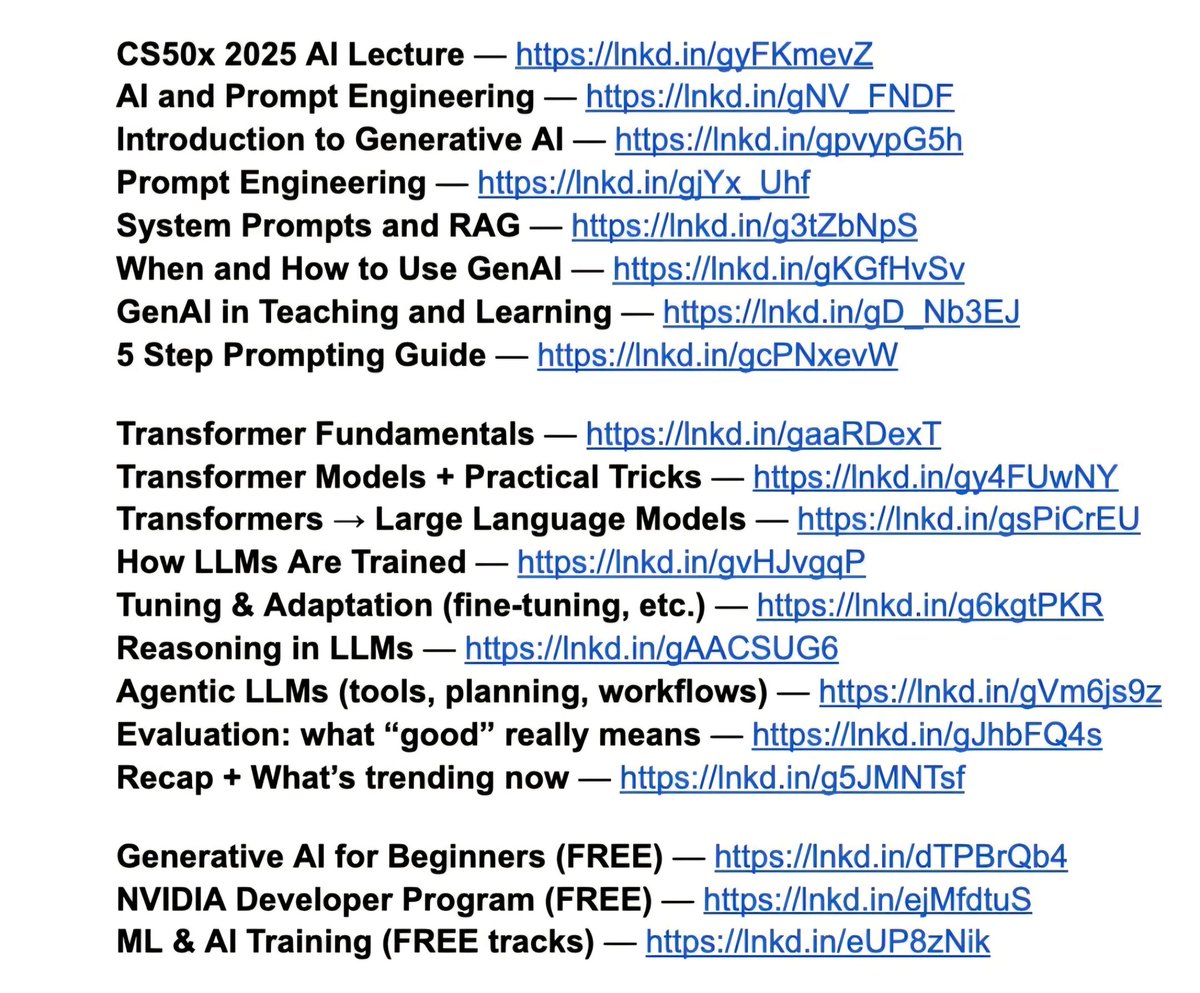
Most people learning AI in 2026 are watching random YouTube videos.
Meanwhile, a full AI curriculum just dropped — from prompting → transformers → agentic LLMs → evaluation.
And it's all FREE.
Here’s the complete roadmap (don’t lose this):
CS50x 2025 AI Lecture — https://t.co/J4G6WyxqwF
AI and Prompt Engineering — https://t.co/AxQ84l54km
Introduction to Generative AI — https://t.co/fw9O8iuG28
Prompt Engineering — https://t.co/6OJHg4JxOi
System Prompts and RAG — https://t.co/7oP5QDhlYj
When and How to Use GenAI — https://t.co/tUVdggWEzt
GenAI in Teaching and Learning — https://t.co/s3Mon2Ljqy
5 Step Prompting Guide — https://t.co/y3XbVFp2pj
Transformer Fundamentals — https://t.co/V296Iluyy4
Transformer Models + Practical Tricks — https://t.co/jygWMTinbU
Transformers → Large Language Models — https://t.co/qsOKj5hpE5
How LLMs Are Trained — https://t.co/zBaBKCITqY
Tuning & Adaptation — https://t.co/UHcyRlzliE
Reasoning in LLMs — https://t.co/Vl2XV3AwvX
Agentic LLMs — https://t.co/sbeByDQtZQ
Evaluation: what “good” really means — https://t.co/RG2WOQxRLq
Recap + What’s trending now — https://t.co/TUD9vCqiCQ
Free Courses:
Generative AI for Beginners — https://t.co/sWEGRvTeIk
NVIDIA Developer Program — https://t.co/fF2jQMLszs
ML & AI Training (FREE tracks) — https://t.co/ujYLlsGmdn
This is basically:
Prompting → RAG → Transformers → LLMs → Agents → Evaluation → Production
Everything in one place.
Bookmark this before it disappears.
Retweet to save someone 100+ hours of searching.
Here are the 5 best GitHub repositories to learn AI Engineering in 2026:
1. Awesome Machine Learning
https://t.co/u2EAEirQue
2. Full Stack Deep Learning
https://t.co/nqnn8f0vbK
3. LangChain
https://t.co/VD7J00AHbm
4. LlamaIndex
https://t.co/8pckeBjnpM
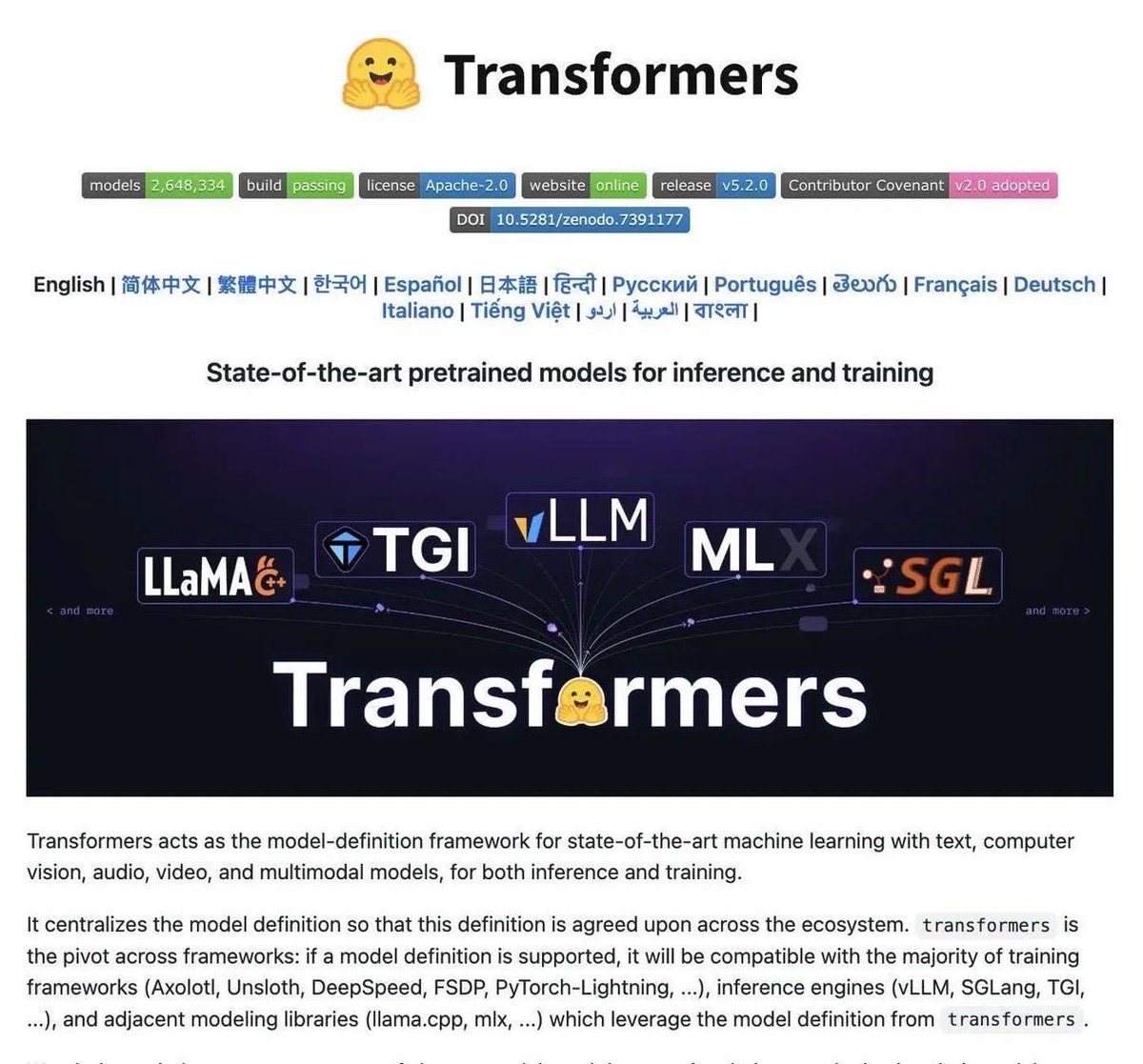
5. Hugging Face Transformers
https://t.co/PnlncFueAi
Comment "Git" if you find this helpful.
Repost so others can benefit.
Introducing TurboQuant: Our new compression algorithm that reduces LLM key-value cache memory by at least 6x and delivers up to 8x speedup, all with zero accuracy loss, redefining AI efficiency. Read the blog to learn how it achieves these results: https://t.co/CDSQ8HpZoc
Best GitHub Repos to Learn AI From Scratch in 2026:
Most people trying to learn AI in 2026 are stuck in tutorial hell.
Random videos. No structure. No real depth.
Meanwhile, these GitHub repos can take you from zero → building real AI systems (for FREE):
Andrej Karpathy – Neural Networks: Zero to Hero
https://t.co/8wrukS6Vqm
Hugging Face Transformers
https://t.co/AtyDLv7NXI
https://t.co/A9wyOebLde Practical Deep Learning (fastbook)
https://t.co/DsmaVa0WuT
Made With ML
https://t.co/bIlKIjWN9J
ML Systems Design
https://t.co/8mgOFAZCQD
Awesome Generative AI Guide
https://t.co/AmuUmfvJTD
Dive into Deep Learning
https://t.co/ntRDPNjOFr
Stop consuming.
Start building.
Bookmark this before you forget.
AI Engineering Toolkit
A curated list of 100+ LLM libraries and frameworks for training, fine-tuning, building, evaluating, deploying, RAG, and AI Agents.
100% Open Source
This GitHub repo isn’t a tutorial dump.
It contains 28 production-ready AI projects you can actually use.
Here’s what you’ll find inside:
Machine Learning Projects
→ Airbnb price prediction
→ Flight fare calculator
→ Student performance tracker
AI for Healthcare
→ Chest disease detection
→ Heart disease prediction
→ Diabetes risk analyzer
Generative AI Applications
→ Live Gemini chatbot
→ Working medical assistant
→ Document analysis tool
Computer Vision Projects
→ Hand tracking system
→ Medicine recognition app
→ OpenCV implementations
Data Analysis Dashboards
→ E-commerce insights
→ Restaurant analytics
→ Cricket performance tracker
And 10 advanced projects coming soon:
→ Deepfake detection
→ Brain tumor classification
→ Driver drowsiness alert system
This isn’t just code files.
These are end-to-end, working applications.
Explore the Repo here: https://t.co/pGZZS6XD2k
Save it for later.
Repost ♻️ if you’re building with AI.
Check my profile for more AI resources 👋