I got $20 for one post, thanks to @PythNetwork
In short, Pyth launched their ambassador program
where we simply write posts and receive project tokens for it
Payments depend on the reach of your posts
You need to go to the Telegram bot: [https://t.co/twtrq05CGp]
Next, we connect our payout wallet and social media
After that, open a group with tasks
Leave a link to your post in the comments to the task (required)
Join us and let's grow together
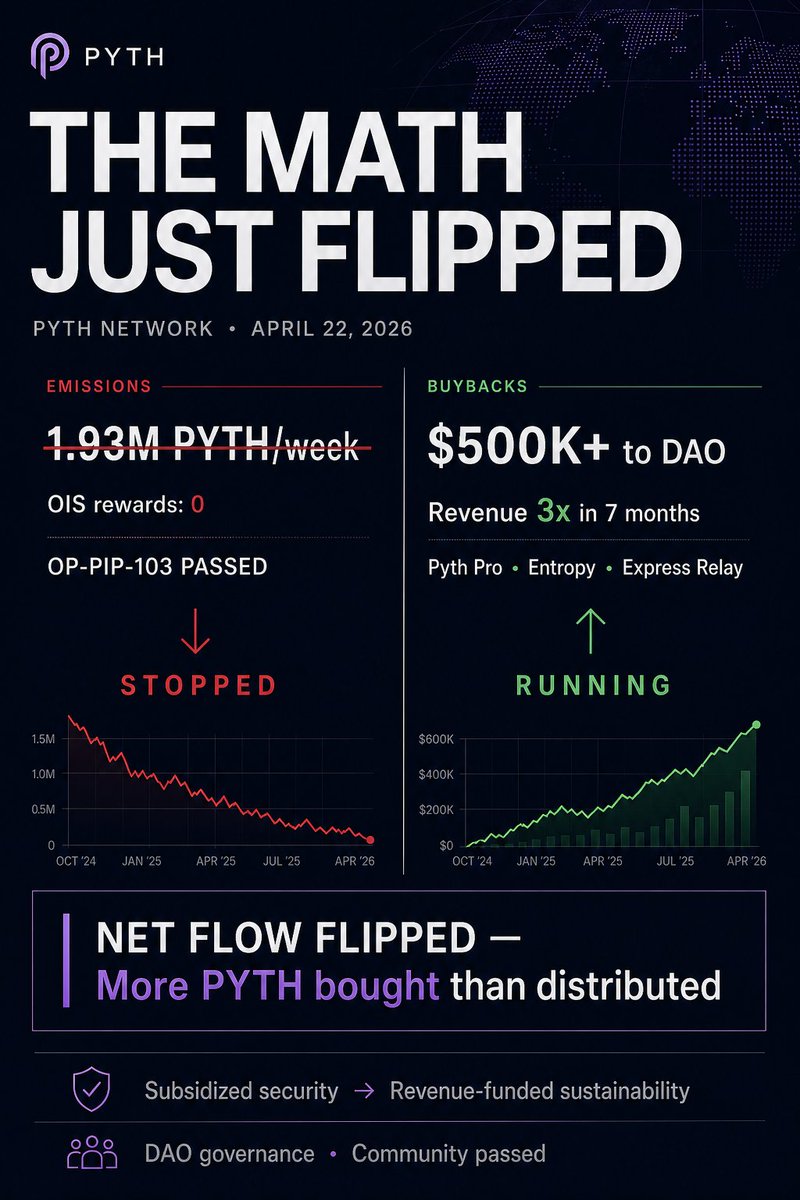
Pyth just killed ~1.93M PYTH/week in emissions.
Revenue-funded buybacks keep running every month.
For the first time, the math favors holders:
→ On April 22, OP-PIP-103 set OIS rewards to zero. The pool depleted naturally.
Weekly emissions of ~1.93M PYTH stopped completely.
→ DAO revenue is growing every month. ~$500K from Pyth Pro alone since Sept 2025.
Monthly distributions have nearly 3x'd. Listing fees, data marketplace, Entropy, Express Relay still scaling.
→ For the first time in Pyth's history, more PYTH is being bought from the open market than distributed. Net flow flipped.
This was a @PythNetwork DAO decision.
Proposed on the forum, debated by the community, passed by governance.
The protocol moved from subsidized security to revenue-funded sustainability.
Emissions stopped. Buybacks didn't.
Do the math.
Pyth just killed ~1.93M PYTH/week in emissions.
Revenue-funded buybacks keep running every month.
For the first time, the math favors holders:
→ On April 22, OP-PIP-103 set OIS rewards to zero. The pool depleted naturally.
Weekly emissions of ~1.93M PYTH stopped completely.
→ DAO revenue is growing every month. ~$500K from Pyth Pro alone since Sept 2025.
Monthly distributions have nearly 3x'd. Listing fees, data marketplace, Entropy, Express Relay still scaling.
→ For the first time in Pyth's history, more PYTH is being bought from the open market than distributed. Net flow flipped.
This was a @PythNetwork DAO decision.
Proposed on the forum, debated by the community, passed by governance.
The protocol moved from subsidized security to revenue-funded sustainability.
Emissions stopped. Buybacks didn't.
Do the math.
I got $20 for one post, thanks to @PythNetwork
In short, Pyth launched their ambassador program
where we simply write posts and receive project tokens for it
Payments depend on the reach of your posts
You need to go to the Telegram bot: [https://t.co/twtrq05CGp]
Next, we connect our payout wallet and social media
After that, open a group with tasks
Leave a link to your post in the comments to the task (required)
Join us and let's grow together
Pyth just killed ~1.93M PYTH/week in emissions.
Revenue-funded buybacks keep running every month.
For the first time, the math favors holders:
→ On April 22, OP-PIP-103 set OIS rewards to zero. The pool depleted naturally.
Weekly emissions of ~1.93M PYTH stopped completely.
→ DAO revenue is growing every month. ~$500K from Pyth Pro alone since Sept 2025.
Monthly distributions have nearly 3x'd. Listing fees, data marketplace, Entropy, Express Relay still scaling.
→ For the first time in Pyth's history, more PYTH is being bought from the open market than distributed. Net flow flipped.
This was a @PythNetwork DAO decision.
Proposed on the forum, debated by the community, passed by governance.
The protocol moved from subsidized security to revenue-funded sustainability.
Emissions stopped. Buybacks didn't.
Do the math.
Free $150 per account + $200 per referral to the Opus 4.6 API
And other models, which can be seen in the screenshot
Agentrouter has launched a promotion where you get $150 added to your account
And $200 for each referral
The promotion may end quickly due to high demand.
How to get it:
1. Go to -> https://t.co/W2QitVE7da
2. Register using your GitHub account (they say the account registration date must be before March 20, 2025)
3. Take the referral link from your profile and send it to your friends
4. Create an API key in your profile and connect it to Claude Code
5. Profit
These APIs can only be used in the official CLIs Claude Code, Codex, and Gemini
Third-party applications are not supported supported
Claude Design is going to kill Figma
ngl I laughed
Then I used it
Typed "landing page for my AI startup"
2 minutes later I had hero section, features, testimonials, CTA. Colors matched my brand.
Fonts made sense. Nothing looked AI-generated.
Here's what's actually different:
You tell it your brand once.
Colors, fonts, style.
Every design after remembers.
No more re-explaining.
No more fixing the blue every single time.
And it's conversational the whole way:
→ make that section tighter
→ swap the hero image
→ add a pricing block
It just does it
Figma makes you learn Figma.
Claude Design makes Figma learn you.
Prompt 👇
You are an experienced business analyst, product manager, marketer, and solo founder with real product launch experience.
Your task is to evaluate the idea I provide as honestly and critically as possible.
IMPORTANT:
• Be brutally honest, no sugarcoating
• Don't try to encourage me. Your job is to find weak spots
• If the idea is weak, say it directly
• Avoid generic statements, give specifics
• Don't assume things for me, but point out where data is missing
• Do NOT create an MVP plan unless I specifically ask for one
Analyze the idea using the following sections:
1. QUICK VERDICT
Give a fast summary:
• Is there potential or not
• Is it worth pursuing
• Viability level (low / medium / high)
• Brief reasoning
2. CORE PROBLEMS (CRITICAL)
• Where the idea breaks down
• What is most likely to fail
• Key risks
• Most vulnerable points
3. STRENGTHS
• What could realistically work
• Where the potential lies
• Strong sides of the idea
4. REAL NEED
• Is there a genuine pain point or is this a "made up problem"
• How important is this to the target audience
• Are they willing to pay for it
5. MONETIZATION
• How realistic are the proposed methods
• Where could money problems arise
• How do competitors typically monetize this
6. COMPETITORS
• Do similar solutions already exist
• Why are they stronger or weaker
• What makes this idea different (if anything)
7. ROLE-BASED ANALYSIS
As a marketer:
• How sellable is this
• Is it hard to communicate the value
• Is there a clear acquisition channel
As a product manager:
• Is there a clear value proposition
• Is there product-market fit (or a chance to find it)
As a solo founder:
• How realistic is it to build this alone
• Where will the overload hit
• Where is the burnout risk
8. RED FLAGS
List of warning signs:
• Illusions within the idea
• Logical gaps
• Dangerous assumptions
• Self-deception
9. FIT WITH MY SKILLS
(if data is available)
• Does the idea match my skill set
• Where will I lack competencies
• What are the risks specifically for me
10. SPECIFIC RECOMMENDATIONS
• What to change about the idea
• How to strengthen it
• What to remove
• Where to focus
Response format:
• Write in plain text (no tables)
• Structure by sections
• No fluff, only substance
Here is my idea:
Turn Your Ideas Into Results
Have you ever come up with an idea that felt absolutely GENIUS and had to be executed immediately?
I get these creative bursts often, but I don't always manage to turn them into a product that generates revenue.
Here's how my idea evaluation system works:
1. I describe my idea: the target audience, monetization methods, key features, my relevant skills, and the core differentiator of my product.
2. I take this information to AI (Claude in my case) and give it a structured prompt (I'll drop it in the comments).
3. It provides a full breakdown:
• Core problems
• Key advantages
• Real market need
• Monetization strategy
• Competitor landscape
• Multi-perspective analysis (marketer, product manager, solo founder)
• Red flags
• Skill fit assessment
• Specific recommendations
4. From there, I continue the conversation, discussing the idea in depth to find the optimal approach and determine whether it's worth pursuing at all.
5. If the idea still resonates after this process, I ask for a detailed description so nothing gets lost.
6. If I decide to move forward with execution, I send the document from step 5 and request help with the technical side (choosing a stack, mapping out the UI, etc.).
What comes next?
I give the idea time to breathe so I can revisit it with a clear head and reassess whether it truly deserves my effort.
Then you create a plan for yourself: how you'll build it and how long it should take.
Without a plan, your idea will drift, and you'll end up building it without any real structure.
The goal is to reach a minimum MVP that makes your project functional, and then focus on monetization from there (if that's part of your plan).


![RavenFBI's tweet photo. I got $20 for one post, thanks to @PythNetwork
In short, Pyth launched their ambassador program
where we simply write posts and receive project tokens for it
Payments depend on the reach of your posts
You need to go to the Telegram bot: [https://t.co/twtrq05CGp]
Next, we connect our payout wallet and social media
After that, open a group with tasks
Leave a link to your post in the comments to the task (required)
Join us and let's grow together](https://pbs.twimg.com/media/HJZI6FIXYAAevDm.jpg)