Always a pleasure to work with Jim. We analyze the decision of surge price vs high reserve price by firms with market power under demand uncertainty. I think of Swiggy vs Zomato & strategies of delivery charges. Many thanks to my brilliant PhD student Shivam Baurai for his help.
Anyone familiar with ROC curve knows that if you don't want cheaters getting away as false negatives, you will end up falsely accusing genuine writers as false positives.
Combine this with more and more of data that trains AI being poisoned by ... AI generated slop itself.
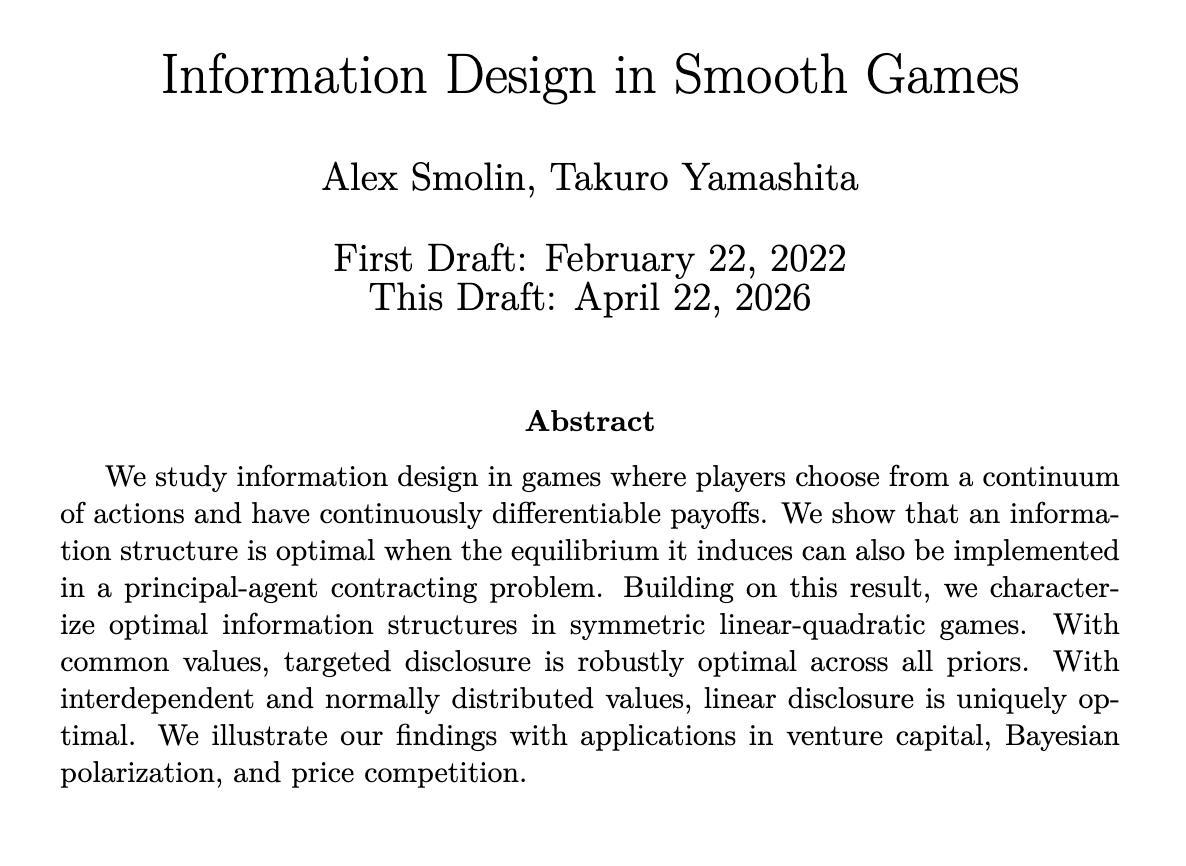
How should information be disclosed to strategic players? The paper develops a tractable framework and shows that optimal policies are often simple: targeted or linear disclosure. Applications include VC, belief polarization, and price competition https://t.co/DbuWFq8FBP
How does the amount of information required to monitor many players scale with their number? In repeated games, we show cooperation turns on the ratio of the discount rate and the per-capita channel capacity of the stage game monitoring structure https://t.co/Sywzkh9nd8
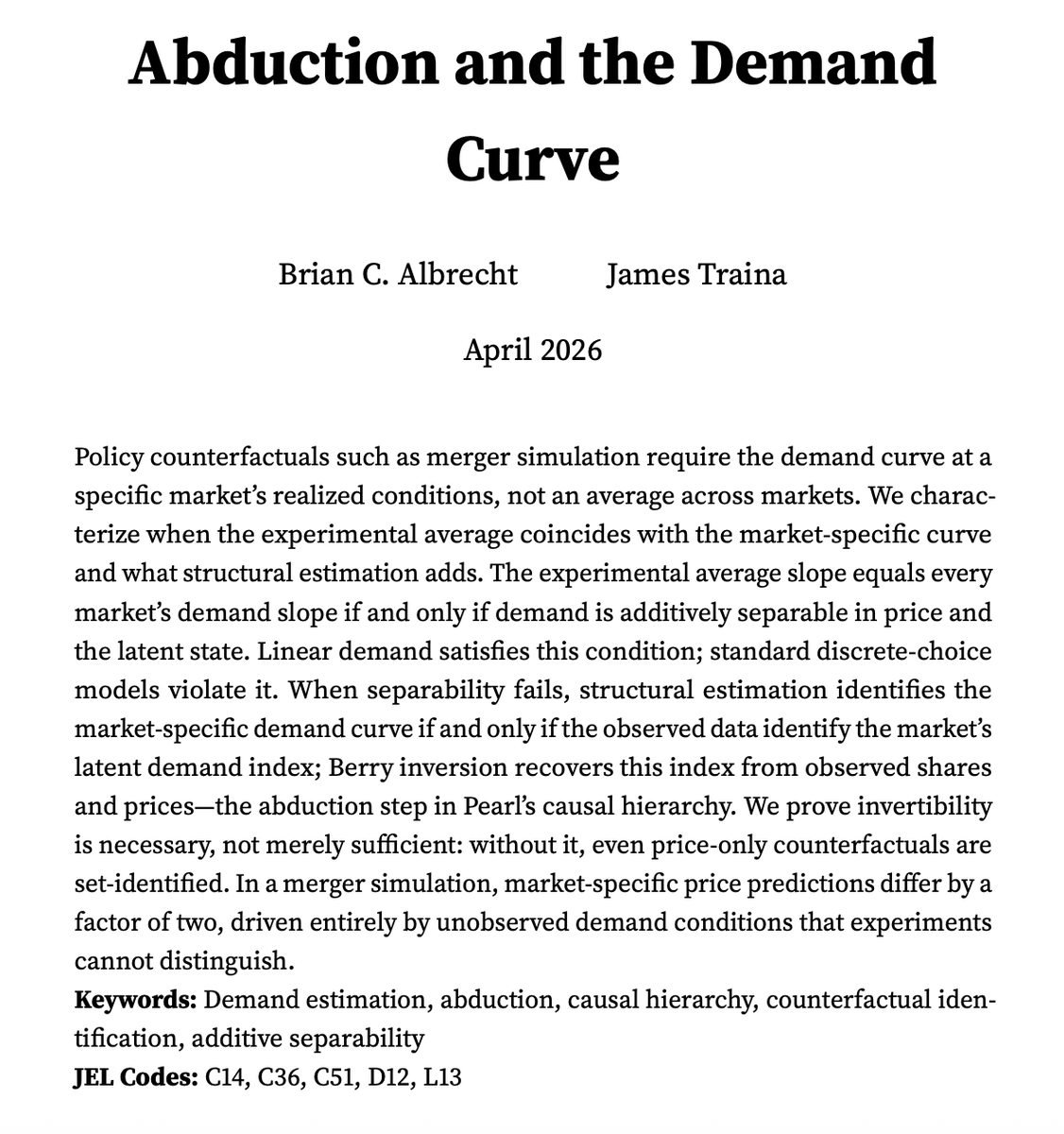
"Abduction and the Demand Curve"
A new paper with @EconTraina
The demand curve is the most basic object in economics. Hold everything else fixed, change the price, see what happens. Ceteris paribus. Day one stuff. Okay, maybe day 3.
But what does "everything else" include? Unobserved quality, local tastes, recent advertising. Things the econometrician doesn't see. A market's demand curve holds those fixed.
Now suppose you run a randomized experiment. Set a price, observe quantity, repeat. You've eliminated confounding. You have a causal effect. We love experiments. Perfect. Right? Right?
Are these the same things? This maybe isn't well-known outside of IO, but the answer is no.
When they aren't, what are you supposed to do? This paper connects the experimental literature with the structural IO demand estimation literature to make clear the interplay .
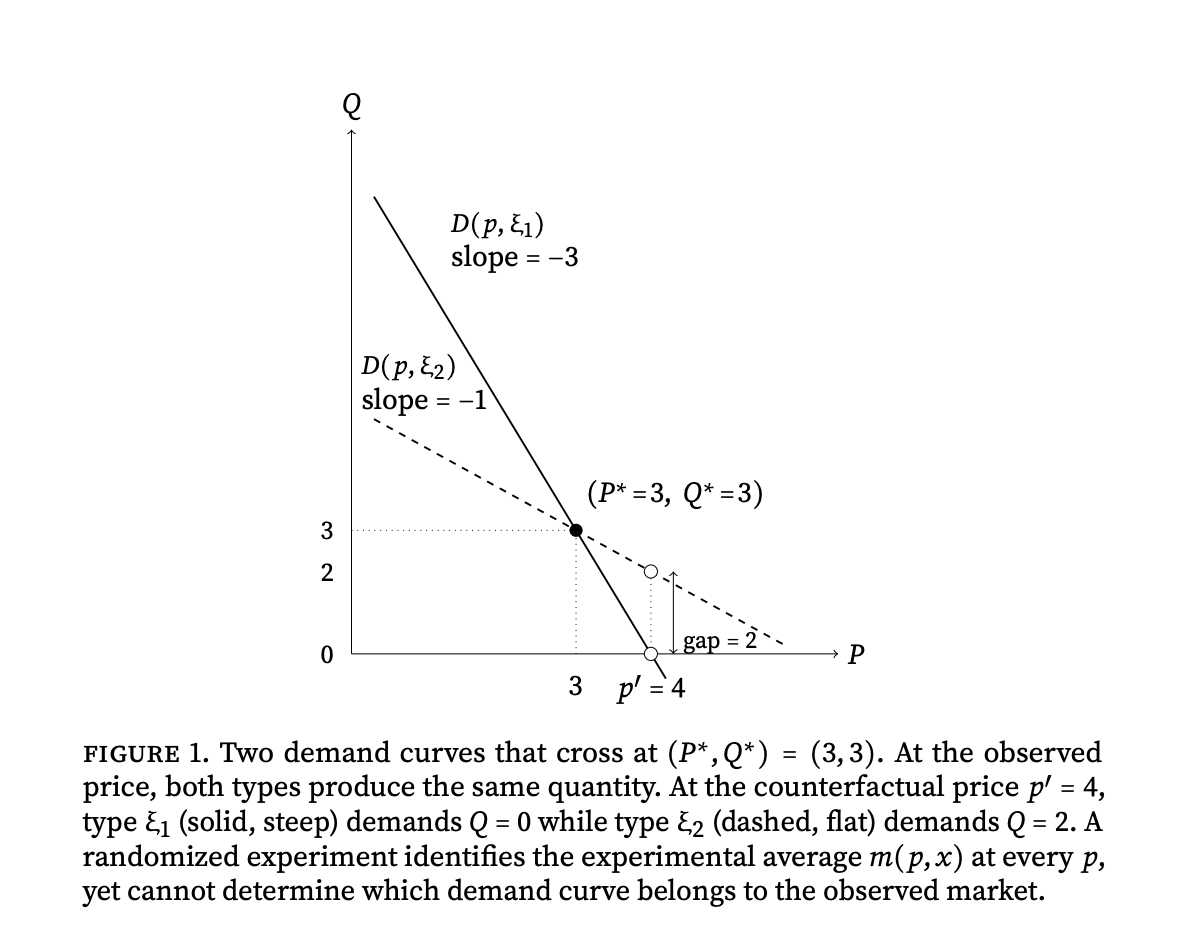
In the experiment, you've averaged over all those unobserved conditions. You know what happens on average across markets when you set a price.
You don't know what happens in THIS market, with THIS unobserved quality, at that price. The experiment gives the average demand response. Policy happens in a specific market.
Two markets produce the same quantity at the same price. An experiment can't tell them apart. But at any other price, they diverge. The demand curve is a market-specific object. So what bridges the gap? Good ole' Berry (1994_ inversion.
You observe a market's shares, prices, and characteristics. Inversion recovers the unobserved demand index, the δ*, that rationalizes what you see. It pins down WHERE on the demand function this particular market sits.
Prior work treats this as a computational convenience. Berry (1994, p. 249) compares it to "taking logarithms of observed data." Berry and Haile (2021, p. 40) call it a "trick." They leave as an open question what happens when invertibility fails, "perhaps involving partial identification."
We answer. Without inversion, even price-only counterfactuals are set-identified. The trick is not optional. Inversion is not just sufficient but necessary for recovering market-specific counterfactuals.
But when exactly do you need it? Berry and Haile (2021) say experiments "generally" don't identify demand. Angrist, Graddy, and Imbens (2000) showed that when demand differs across markets beyond an additive shift, IVs identify a weighted average of derivatives, not any single market's response. Imbens even reiterates the point in his Nobel lecture.
We first make "generally" exact beyond the linear case of AGI (2000). We characterize precisely when the experimental average price response equals every market's demand slope (if and only if additive separability holds, a knife-edge that every standard discrete-choice model violates).
So outside of that case, what are we to do? That hasn't stopped IO economists. Are they just making stuff up? No! Berry inversion baby!
Along the way, we can make a few more connections. @yudapearl asked whether ceteris paribus demand can even be formally defined in counterfactual language. We do that.
The demand curve is the unit-level counterfactual Q_p(u) for a market with realized conditions held fixed.
We also show the connection to Pearl's causal hierarchy. Experiments give Rung 2 (causal). The demand curve is a Rung 3 object (counterfactual). There's generically a gap between them. Berry inversion is what is called abduction in SCM to move between those rungs.
The econometrics and CS frameworks are saying the same thing, and the demand curve is the natural, well-developed setting to see it.
New Working Paper Alert 📔
Do accents shape social and economic opportunity? With @miweintraub83 and @NGarbirasDiaz, we tested this in Colombia through an online experiment with 6,000 adults.
🧵
We are pleased to share the release of a major open data resource on Harvard Dataverse:
Indian Census Data Collection, 1901–2026: Digitised Subnational Population and Administrative Datasets
DOI: https://t.co/zsSOTCGyuD
#OpenData#India#Census#SocialScience
What’s included?
• Population time series (1901–2011)- Census A02 (cleaned and strcutured)
• first time digitization of Primary Census Abstract tables (state & district level)-1961, 1971, and 1981
• 2026 subdistrict-level administrative directory linked to census data (2011)
#DataInfrastructure #ResearchData
📢New Working Paper Alert📢
Very excited to share the latest version of our paper with @HLarreguy, David Martinez, and @mstalanquer on how authoritarian regimes vary their strategies across territory to maintain political control.
🔗https://t.co/Gaqw1JltPI
Quick 🧵 summarizing the question & main results 👇
I'm delighted that my paper "Bad Networks" with Robby Akerlof and @djthornton97 is coming out at @JPubEcon. Here's a thread about what we do. And here's a link to the paper. https://t.co/dwmnW37FUO 1/18
What leads to choice overload, i.e., people opting out when there are too many choices?
One plausible mechanism is the desire to avoid ex post regret.
Sarah Auster and Yeon-Koo Che formalize this idea in a very cool paper:
https://t.co/ciU8JoiRax
📢 We are pleased to share the release of a new paper by Ernesto Rivera Mora and Philipp Strack in the Cowles Foundation Discussion Paper Series:
Information without Rents: Mechanism Design without Expected Utility
https://t.co/qMkd7iEqdk
We show that the existence of an equilibrium in the classic private value first price auction model hinges on a single statistic of the joint distribution of the players’ values, namely the lowest value in the support of the high-value distribution. https://t.co/29t9dEDM1U
In honor of John Leahy, who sadly passed away too soon this week. Remembering this paper with his longtime coauthor, Andrew Caplin: Economic Theory and the World of Practice: A Celebration of the (S, s) Model.
John made several contributions to our understanding of the implications of decisions under fixed costs. This paper presents the problem in a non-technical way (there is an open link below). As the paper emphasizes, we frequently face this kind of constraint and the theory has many practical applications.
John was an exceptional thinker and had a great sense of humor. He will be missed