Australia’s Health Revolution - a 3-part series I co-hosted with Dr Michael Mosley. It outlines the research around remission of type 2 diabetes and you can watch as 8 Australians attempt to turn T2D around in just 8 weeks!
Available to watch on demand:
https://t.co/cPAlJFzpFb
This last workshop is on August 12 in western Sydney. The cost of the workshop is free, however you must be employed in Aboriginal and/or Torres Strait Islander health.
Sign up in the link below:
https://t.co/0xW65jWWOf
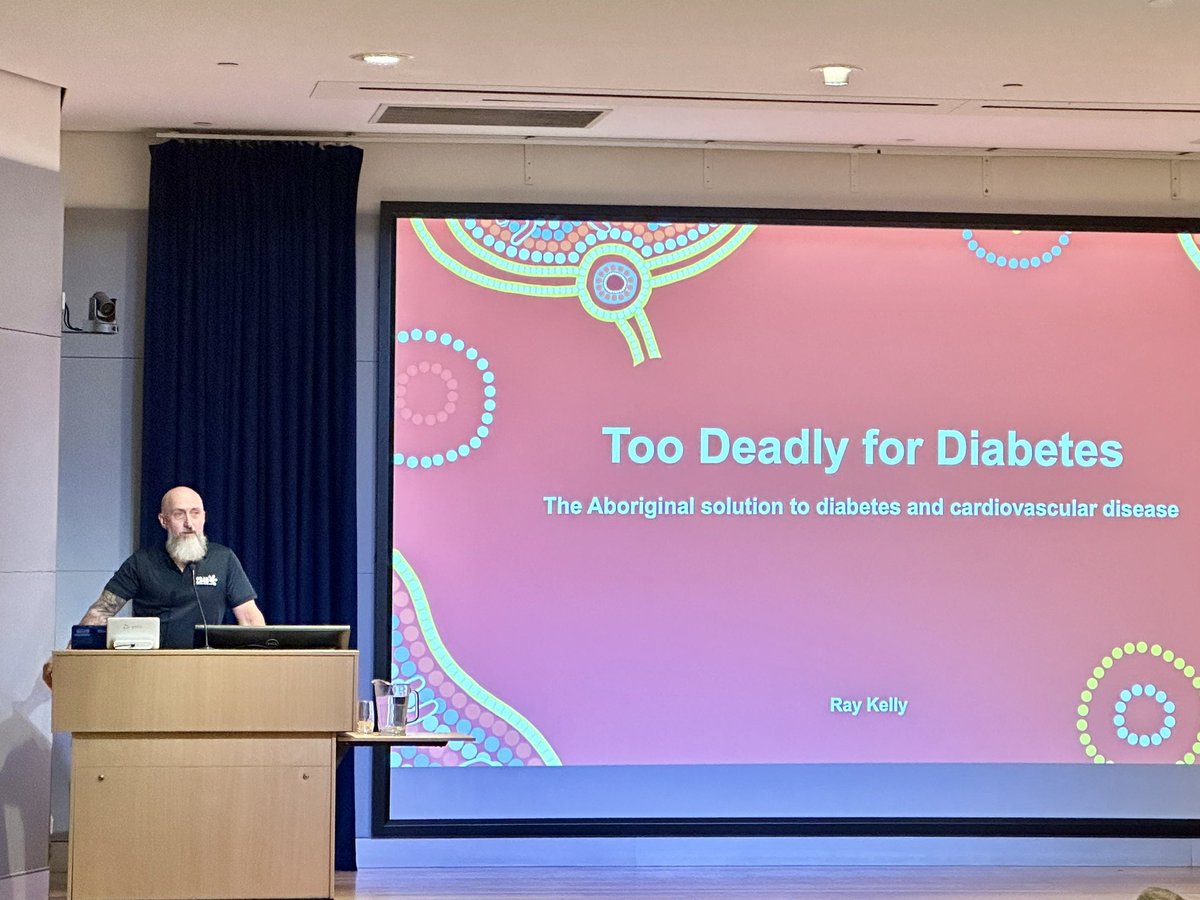
Close the Gap on Diabetes: Ray Kelly runs the Too Deadly for Diabetes program qqtargets Indigenous people with diabetes in NSW, recently other remote regions, and is typically facilitated through a local medical centre.
"When people first come to us there's a bit of fatalism around their diabetes or their health in general," Mr Kelly said.
"We show them that they've got a lot of control."q
Read full story
Kelly Anderson's life fell apart when she suddenly lost her daughter in 2017.
She stopped leaving the house, started eating unhealthy food and rapidly gained weight.
"I was in a really dark place," she said.
"I was suicidal. I felt worthless. I didn't think that I was good enough to be a parent. I thought I'd failed my family."
The Dhungatti and Gumbaynggirr woman sought advice from a doctor after finding a lump in her breast, which was ultimately deemed benign, but the GP delivered a searing reality checkq
https://t.co/Voip9U456H
Northern Rivers people!
We have our Leadership in Diabetes Care workshop in Lismore next week. If you've like to learn how we improve health outcomes for community, despite seemingly overwhelming barriers, you need to attend this.
https://t.co/HOZkme8xBQ
Learn how to design an effective program for type 2 diabetes and cardiovascular disease in our next Leadership in Diabetes Care workshop.
Based on the learnings from our Too Deadly for Diabetes program.
Find out more in the link below!
https://t.co/Dhv1WEcddb
Our next Leadership in Diabetes Care workshop will be held at Olympic Park, Sydney at the head office of the GWS Giants on April 10-11.
We limited places so book early so you don't miss out!
Sign up in the link below.
https://t.co/Dhv1WEcddb
Imagine if we got this much support for racism against Aboriginal and Torres Strait Islander peoples, which is much more entrenched in Australian society than anti-semitism
Here’s the list of demands from the ‘ Antisemitism Summit’
a bunch of people Sky News got together came up with, and unless Australians wake up, they are likely to be adopted. Then we will be just like Germany. Parliament are largely sleep walking into this
No one. No one has the guts to call this out.
@mattjcan@Barnaby_Joyce@BarnsGreg@johnmenadue@ggreenwald@yanisvaroufakis #auspol
BTW No 1 should have been: Call on the Police Commissioner for an update on these ‘antisemitic incidents’, by paid criminals, none of whom are motivated by antisemitism. Who is paying them??
We have criminal laws to deal with criminal behaviour. We live in a society made up of people who have come here from around the world. No one group should be privileged. The Muslim community’s places of worship have been attacked, Muslim worshipers attacked. No media attention. No political reaction. Before the genocide, ‘antisemitism’ was no bigger a problem than any other form of discrimination. This push is being used to prevent criticism of Israel, an apartheid state that has been ethnic cleansing the Palestinians for decades.
Here we go folks
1Declaration of a National Emergency on antisemitism and establishment of a Joint Counter-Terrorism Taskforce
2Uniform policing guidelines, including training for law enforcement officials on understanding antisemitism and how hate crimes should be prosecuted
3Antisemitism education to be included in the national curriculum
4More public awareness and advertising campaigns, particularly for younger Australians, aimed at debunking the ideology of antisemitism
5National ban on encampments on Australian university campuses, as well as prohibiting the disruption of lectures by protesters
6Creation of a judicial inquiry into antisemitism at universities, which should investigate possible foreign funding of student protests
7Universities to disclose all sources of funding from foreign governments and foundations
8Tougher legislation to overcome restrictions on disciplinary action against academics
9Repeal of charity status and funding from religious and charitable institutions if they promote racism or display terrorist symbols
10Greater scrutiny of the use of funds administered by charities to ensure, for example, that funds are not used to support terrorism
11Immigration officers must be trained to recognise antisemitism, with applicants to be assessed under the character test on whether they have promoted antisemitism
12The Migration Act should be enforced or amended to ensure antisemitic conduct is grounds to reject a new visa, or cancel an existing one
13New social media legislation such as Algorithms Regulation laws should be introduced to counter foreign interference
14For cultural institutions, a condition should be placed on government grants issued to festivals and individuals that recipients do not spread racism, or they risk grant cancellation
15Balance of representation on literary and cultural festival boards, as well as among senior staff tasked with programming decisions
Closing the Gap on Diabetes: Dr Ray Kelly The Australian newspaper nomination for Australian on the Year
Exercise physiologist and Gomeroi man Ray Kelly has routinely achieved seemingly impossible results for those at the frontline of Australia’s type 2 diabetes epidemic, yet he is the first to discount the “Ray Kelly factor”.
In 2000, Dr Kelly began treating diabetes in the community. Putting aside a career in sports physiology to pursue it, he had no inkling it would develop into a world-leading methodology. His novel approach often garnered little applause.
“It wasn’t a matter of the success, people would pass that off as the Ray Kelly factor. That would be the term,” he said.
“They would give all these terms, like I was just a motivational interviewer. And it wasn’t that, it was that I listened to people and I would help them come up with strategies (to lose weight) that would work in their life. It was as simple as that.”
Though hesitant to be the face of his success, Dr Kelly has advanced one of the most innovative models for obesity and diabetes treatment, garnering himself a nomination for The Australian’s Australian of the Year.
His view on diabetes changed fundamentally in 2006 when he discovered the work of nutritionist Kerin O’Dea, whose study of diets in Indigenous communities through the 1980s indicated results markedly more effective than treatments of the time.
Realising that patients could not only manage diabetes through diet and exercise, but actively push it into remission and come off insulin, was a revelation.
Dr Kelly’s exposure to Professor O’Dea’s work would cause a fork in his career that prompted him to leave his bulk-billing clinic behind and travel between Indigenous communities to put theory into practice.
“I knew that it would have to work in challenging environments, which is one of the reasons I decided to work in regional and remote communities,” Dr Kelly said. “These communities get things last, that was a strong motivator, and in the back of my mind I knew that if I showed it there then there’d be no excuses.
“If you can do it in Bourke, why can’t you do it in Bondi?
“I’m just really proud of the communities that have been able to do this, because it’s these Aboriginal communities that have helped change the way non-Aboriginal people are seeing type 2 diabetes.”
Among Dr Kelly’s patients, 85 per cent of those who could drop 15 per cent of their weight entered full remission.
In Central Australia, four in 10 Indigenous Australians have diabetes. A dearth of non-processed food, poor social support, and high turnover among medical staff complicate outcomes.
Before Dr Kelly was trying to dispel the mythical “Ray Kelly factor”, he had to bring sceptics onside. “I started looking into rapid weight loss, and for my whole career, I’d been told that losing weight fast was bad, that you were better off to lose it slowly. But the research never said that.
“I was seeing these kinds of improvements, but I was pretty quiet about it, because I thought it was unusual, and I thought people would think that it was dangerous and reckless.
“Since 2006 I felt like quitting probably about two times a year, especially in the early years.”
Dr Kelly’s research has become the benchmark for diabetes treatment in Australia. In 2024, he presented his work twice at the parliamentary inquiry into diabetes, and drafted the National Aboriginal Community Controlled Health Organisation’s preventive health guidelines on healthy eating, physical activity and obesity.
Ophthalmologist James Muecke, a contemporary in diabetes treatment for his work on curbing macular oedema through diet, praised the “unparalleled benefit” of Dr Kelly’s work.
“Ray is a pioneering exercise physiologist supporting people living with type 2 diabetes,” Professor Muecke said.
If you are at the NACCHO conference check out Jason’s session at 9:50 this morning. It’s a great move forward for the health of Aboriginal and Torres Strait Islander people!
Prof. @MMorrisUNSWSyd and I have an article in The Conversation, which discusses the first study from my PhD. This study is now published in the Medical Journal of Australia (MJA).
https://t.co/fNPx3RJpNL