NHIA REVIEW OF RADIOTHERAPY TARIFF
The NHIA has reviewed its radiotherapy coverage and tariff for cancer patients.
Key changes:
• ₦400,000 radiotherapy cap removed
• 50:50 cost-sharing abolished
• Full radiotherapy coverage introduced
• Site-specific tariffs adopted.
UPDATE TO ALL MEMBERS ON LOCUM ENGAGEMENT & CASUALIZATION
Good evening Distinguished NARDITES!
The leadership of NARD, ably led by the Strategic P-MUS (Garkuwan Matasan Arewa), is pleased to update members on the outcome of the FMoHSW Committee on Regulation and Casualization of Doctors.
Following extensive consultations, the Committee has developed a National Policy on the Engagement of Locum, aimed at ensuring fair, transparent and non-exploitative engagement of temporary healthcare personnel.
KEY RECOMMENDATIONS
1. Recruitment & Approval:
Locum engagement must be based on a clearly identified staffing gap and approved by the appropriate hospital authorities.
2. Contract Duration:
Initial locum contracts shall not exceed 6 months, with only one additional 6-month renewal permitted. Continuous engagement for 12 months makes the position eligible for permanent appointment.
3. Maximum Work Hours:
Healthcare personnel shall work a maximum of 48 hours per week, including weekends. Excess hours must be appropriately compensated.
4. Maximum Duty Period:
No healthcare personnel shall work beyond 24 continuous hours, including call duty.
5. Mandatory Rest:
- Minimum 12 hours between shifts.
- Mandatory 24-hour post-call rest after weekday and weekend calls.
- A 1-hour break after 6 hours of continuous work.
6. Call Duty:
- Maximum 2 calls per week.
- Maximum 1 weekend call per month.
- Calls must be equitably distributed.
7. Remuneration & Welfare:
Pay rates are standardized in alignment with the government's
Scheme of Service. Remuneration must be paid monthly without delay, accompanied by monthly
payslips.
Locum staff are entitled to all government-approved leaves, public holidays, and occupational insurance coverage.
8. Excess Work Hours:
Excess hours must be properly documented, monitored and adequately compensated, or appropriately balanced with structured time-off.
9. Protection Against Abuse:
Locum engagement must not be used as a permanent substitute for substantive recruitment or as a means of exploiting healthcare workers.
10. Integration & Safety: All locum workers must undergo mandatory orientation and integration into their respective clinical or administrative teams. Institutions are required to provide safe
working environment, adequate call rooms, refreshments during prolonged calls/shifts, and burnout prevention programs.
11. Discipline & Grievance Process: Professional misconduct shall be governed by the regulatory
council guidelines. Contracts can be terminated by either party with a one-month notice or payment in lieu, and all accrued entitlements must be settled within 14 days of termination. Disputes escalate through institutional mechanisms up to the Federal Ministry of Health and Social Welfare, and the Federal Ministry of Labour and Employment.
12. Monitoring: The Ministry would ensure Institutions do not engage in exploitative staffing practices and violations of this guideline in line with the Nigerian Labour Law.
13. Policy Review and Effective Date:
This policy becomes legally binding on the exact date of approval by the Federal Ministry of
Health and Social Welfare (FMoH&SW). To ensure its continuous operational relevance, the
policy mandates a comprehensive evaluation and review within two (2) years of its
implementation.
The policy is expected to provide a more structured and equitable framework for locum engagement across Nigerian health institutions.
UPDATE TO ALL MEMBERS ON WORK HOUR REGULATION (AND EXCESS WORKLOAD)
Good evening Distinguished NARDITES!
The leadership of NARD ably led by the Strategic P-MUS (Garkuwan Matasan Arewa), is pleased to update all members on a significant development arising from the deliberations of the FMoHSW Ministerial Committee on Work Hour Regulation and Casualization of Doctors.
Following extensive engagements and a comprehensive nationwide situational assessment involving 6,350 healthcare personnel across the six geopolitical zones, the Committee has developed a National Policy on Work Hour Regulation for Health Institutions in Nigeria.
The findings clearly demonstrated the urgent need to address excessive work hours, burnout, fatigue, inadequate rest, and the associated risks to healthcare workers and patient safety.
NEWLY RECOMMENDED WORK HOUR GUIDELINES
The following key provisions have been recommended under the new framework:
1. Maximum Weekly Work Hours:
Healthcare personnel shall work a maximum of 48 hours per week, including weekends. Any authorized excess hours shall be appropriately compensated.
2. Maximum Shift Duration:
- Day shift: 8 hours maximum
- Afternoon shift: 6 hours maximum
- Extended shifts exceeding 12 hours shall be limited to emergency situations only.
- All authorized excess hours must be adequately compensated.
3. Maximum Call Duty:
- A maximum of two call duties per week, including weekend calls.
- Calls must be equitably distributed among eligible personnel.
- A maximum of one weekend call per month.
4. Maximum Consecutive Duty Period:
There shall be an absolute maximum of 24 continuous hours of duty, inclusive of call duty.
5. Mandatory Rest Periods:
- A minimum of 12 hours between regular shifts.
- Mandatory 24-hour post-call rest following weekday calls, Saturday calls, Sunday calls, and public holiday calls.
6. Mandatory Break During Duty:
A minimum one-hour break after six hours of continuous work, including shift and call duties, shall be provided. Breaks should be appropriately staggered to ensure uninterrupted patient care.
7. Equitable On-Call Distribution:
Call duties shall not exceed two per week and one weekend call per month, with equitable distribution among eligible healthcare personnel.
8. Compensation for Excess Work Hours:
Authorized excess work hours must be properly documented and adequately compensated above the normal hourly rate, or appropriately balanced through structured time-off. This provision must not be abused by institutions.
9. Protected Research and Development Time:
Healthcare personnel in all institutions should have protected time for research and professional development, subject to approval by the appropriate National or Institutional Health Research and Ethics Committee.
IMPORTANT NOTE:
These recommendations are without prejudice to the stipulated maximum shift, call and rest durations, particularly in genuine emergency situations where patient safety and continuity of care may require exceptional arrangements.
We are pleased to inform all members that these recommended guidelines have been forwarded to all MDs/CMDs for implementation across all health institutions.
Hospital Managements and Heads of Departments are expected to take appropriate steps towards full compliance of these guidelines.
We strongly encourage all Centre Leaderships to engage their respective Managements and follow up on the implementation of these guidelines.
Members are encouraged to remain vigilant, document cases of non-compliance and channel legitimate concerns through their center leadership for necessary action by NARD.
We await the release of the second document addressing casualization and abusive locum appointments soon.
🚨 FINAL REWARD CLAIM NOTICE 🚨
This is your last reminder to claim your rewards before the deadlines.
⏰ Important Dates:
🔹 VPOT Claims (all other sections): July 1, 00:00 UTC
🔹 Beta Mainnet Participants: July 6, 00:00 UTC
⚠️ No extensions will be granted. Unclaimed rewards after the deadlines will be permanently forfeited.
Don't wait until the last minute—claim your rewards now!
Thank you to everyone who participated and supported the community. 💙
#BetPot #VPOT #Crypto #Web3 #Mainnet #Airdrop #CryptoRewards #CryptoBetting #Predictions #Solana
🚨AMD's Second Act: From GPU Challenger to AI Infrastructure Duopoly
AMD reported Q1 2026 results with revenue of $10.25B (+38% YoY), ahead of the $9.84B consensus; Non-GAAP EPS of $1.37 (+43% YoY), also beating expectations. GAAP net income came in at $1.38B (+95% YoY); Non-GAAP net income reached $2.27B (+45% YoY), with Non-GAAP gross margin at 55%. Free cash flow hit a record $2.6B for the quarter, more than tripling year-over-year.
On the surface, the financials were a modest beat across the board — but AMD stock surged more than 18% in after-hours trading, briefly topping $410. The numbers alone don't explain the move. What does: CEO Lisa Su's forward guidance. Su stated that the server CPU TAM will double to $120B by 2030, that annual data center AI revenue is on track to reach "tens of billions of dollars," and reaffirmed a long-term Non-GAAP EPS target of over $20.
⚡️Core Theme: Data Center Takes the Wheel
Data Center revenue reached $5.78B, up 57% YoY, crossing the halfway mark of total company revenue and becoming the primary driver of both top-line and earnings growth — powered by the dual engine of EPYC server CPUs and Instinct GPUs.
The market's historical read on AMD's AI thesis was straightforward: can MI300/MI350/MI450 take share from NVIDIA? What this quarter's management commentary reframes is that agentic AI and inference workloads are driving a significant uplift in CPU demand as well. AI clusters don't just need GPUs for training and inference — they require substantial CPU capacity for orchestration, data preprocessing, head node management, and parallel task scheduling. AMD's advantage is now expanding from a single-point GPU play into a compound architecture: EPYC + Instinct + Helios, together.
Critically, CEO Lisa Su raised AMD's server CPU TAM outlook significantly: the addressable market is now expected to grow at over 35% annually, reaching more than $120B by 2030 — effectively doubling the prior forecast of ~18% CAGR and a ~$60B TAM.
🌞Product Pipeline: MI450 / Helios Enter the Visible Order Cycle
On the AI accelerator front, AMD confirmed that MI450 series GPUs have begun sampling with lead customers, and Helios rack-scale AI systems remain on track for production shipments in H2 2026. Su noted that customer demand forecasts for MI450 and Helios have already exceeded AMD's original 2027 plans, with new customers now in discussions for large-scale deployments — including additional multi-gigawatt opportunities.
More significantly, AMD raised its confidence in 2027 data center AI revenue: management expressed conviction in achieving tens of billions of dollars in annual data center AI revenue in 2027, ahead of the prior long-term target of greater than 80% CAGR.
On the hyperscaler side, the order book is becoming concrete: OpenAI and Meta have each committed to deploying 6GW of Instinct compute; Oracle plans to launch the world's first publicly available AI supercluster powered by 50,000 MI450 GPUs in Q3. Taken together, these three commitments are moving AMD's status as "AI compute's second source" from narrative to reality.
Q2 Outlook: Above Expectations, Data Center Continues to Accelerate
AMD guided Q2 revenue to approximately $11.2B (±$300M), meaningfully above the $10.5B consensus, representing roughly 46% growth YoY and 9% sequentially. Non-GAAP gross margin is guided at approximately 56%. Server CPU is expected to grow more than 70% for the full year, with both data center AI and server businesses projected to deliver double-digit sequential growth.
📈Bottom Line
This quarter isn't just another beat. The on-track delivery of MI450 and Helios has moved AMD from "potential NVIDIA alternative" to "confirmed co-anchor of AI infrastructure."
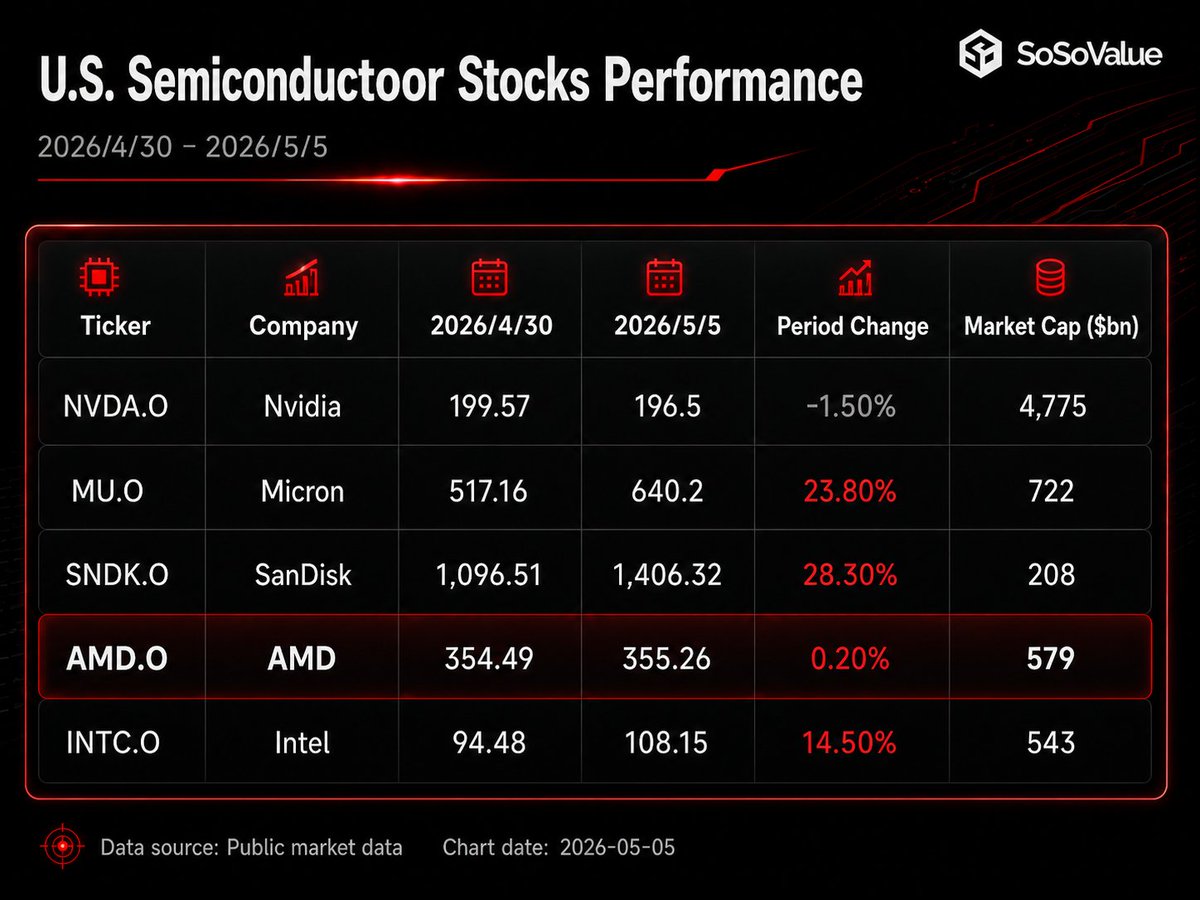
The after-hours surge to above $410 implies roughly 30x that $20 long-term EPS target — the market is pricing it in today. Notably, AMD had gone virtually nowhere over the prior three sessions, with tonight's after-hours move catching it up to Intel's recent gains. The capital rotation story isn't complicated: last Friday, Western Digital's blowout earnings ignited a fresh AI hardware rally, with funds rotating out of NVIDIA into memory and CPU names — Western Digital and Micron gained 28% and 24% respectively over three sessions, Intel added 15%, and AMD's earnings tonight became the final piece of that rotation trade.
Looking further out, the key variables are whether MI450 and Helios ship on schedule, whether the Meta and OpenAI deployments convert into durable multi-year order flow, and whether EPYC can continue capturing share as AI-driven CPU demand structurally expands.
🔐 Update on the Upcoming Verification Process
We know many of you are looking forward to verification - and we’re stepping closer to that moment.
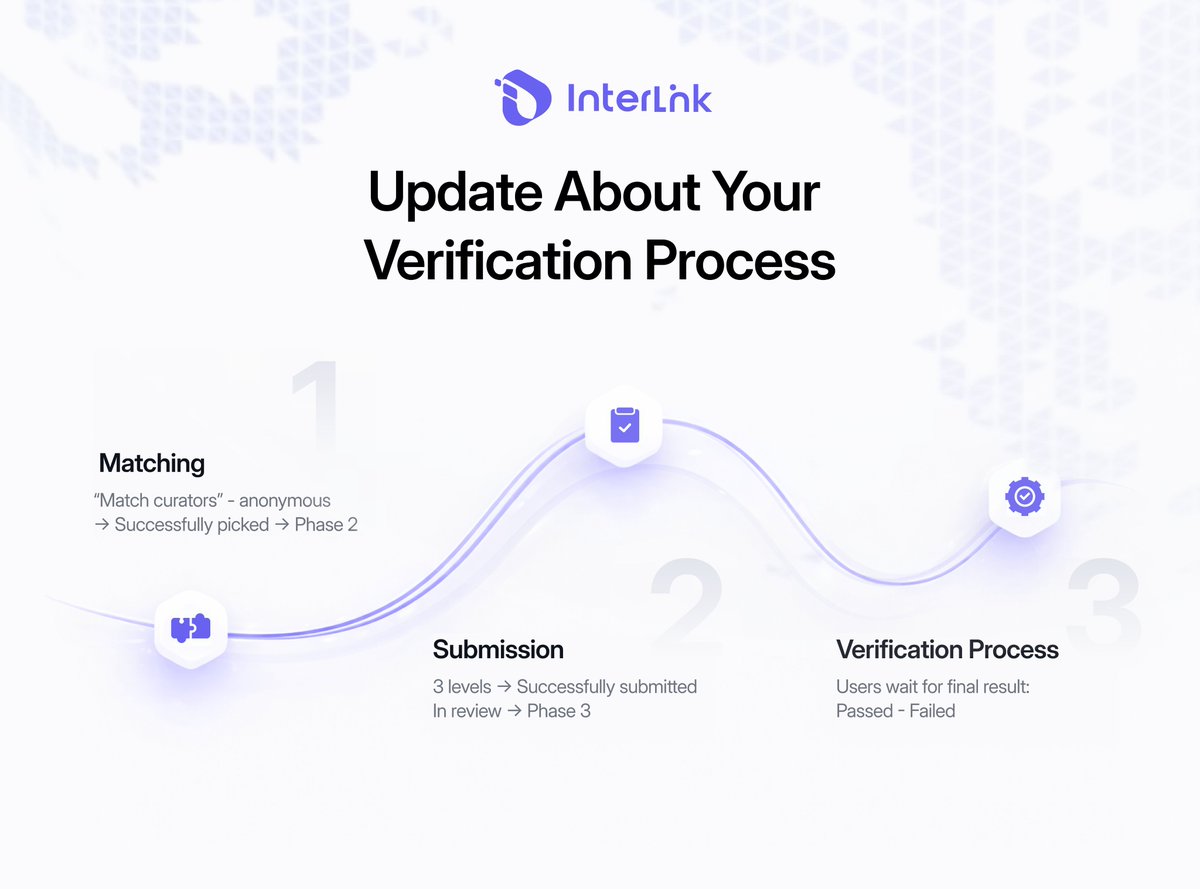
This process is designed to be structured, transparent, and fair, ensuring every qualified Human Node moves forward with clarity. Here’s how the flow will work:
Phase 1: Matching
You begin by tapping “Match Curator.”
An anonymous list will appear, and you can choose a curator to match with.
After selecting, you enter the matching state and wait to be successfully picked. Once picked, your application advances to the submission stage.
Phase 2: Submission
When it’s your turn, a strict 24-hour countdown will start.
You must complete and submit your documents within this time. Missing the deadline may move you to a later pool, delaying your progress.
There are 3 submission levels. After completing all required steps, you press Submit, and your status changes to In Review.
Phase 3: Verification Process
This is the last stage - your application will be reviewed carefully.
This process is more than a technical update - it’s a defining milestone before full verification rollout.
Prepare early. Understand each phase.
Be ready when your turn comes!
#InterLink #ITLG #ITL
🔐 Update on the Upcoming Verification Process
We know many of you are looking forward to verification - and we’re stepping closer to that moment.
This process is designed to be structured, transparent, and fair, ensuring every qualified Human Node moves forward with clarity. Here’s how the flow will work:
Phase 1: Matching
You begin by tapping “Match Curator.”
An anonymous list will appear, and you can choose a curator to match with.
After selecting, you enter the matching state and wait to be successfully picked. Once picked, your application advances to the submission stage.
Phase 2: Submission
When it’s your turn, a strict 24-hour countdown will start.
You must complete and submit your documents within this time. Missing the deadline may move you to a later pool, delaying your progress.
There are 3 submission levels. After completing all required steps, you press Submit, and your status changes to In Review.
Phase 3: Verification Process
This is the last stage - your application will be reviewed carefully.
This process is more than a technical update - it’s a defining milestone before full verification rollout.
Prepare early. Understand each phase.
Be ready when your turn comes!
#InterLink #ITLG #ITL