One more thing about yesterday’s "Oscars of Optimism". When the winning film of the $2.5M Future Vision XPRIZE was announced, it became the first prize winner in XPRIZE's 30-year history that the public can invest in. Anyone can now invest and share in its profit potential. Link below 👇 https://t.co/plgwCb87Jv
I've created a new Grok Bot Tutorial template for anyone new to Grok @Bot.
This hands-on course includes 20 lessons. It walks you through every feature step by step, with real exercises and tips so you get the most out of Grok Bot.
Download: https://t.co/Nyf5muUF23
The 20 lessons:
1) Talking to your assistant
2) Files, images, and voice
3) Research & writing
4) Connecting your apps
5) Calendar and scheduling
6) My own computer & browser
7) Working on your own computer
8) Routines
9) Staying in control
10) Privacy and security
11) Memory and preferences
12) Skills
13) Showing it how to do something
14) A team of assistants
15) Sharing and templates
16) Customizing, and fixing things
17) Using it for your job or business
18) Travel and everyday errands
19) Money and finances
20) Buying things for you
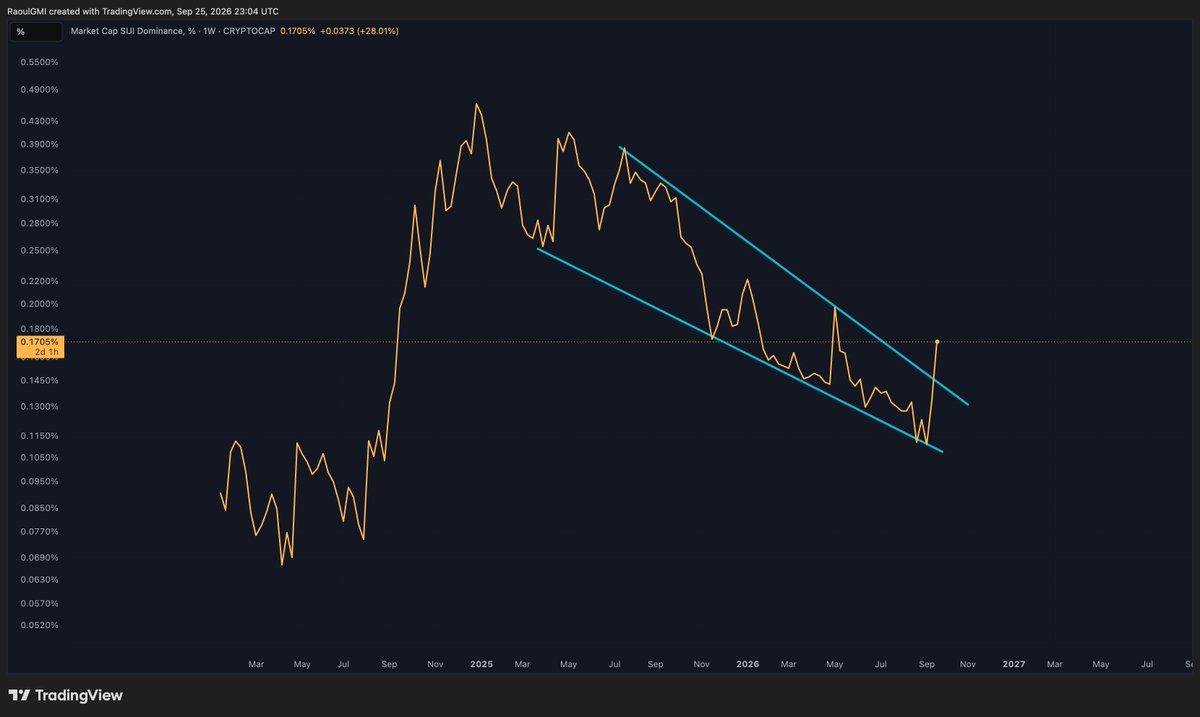
Sui dominance is a function of its beta. It has a low free float, 70% locked up in staking and it's earlier stage, and therefore any $ of capital in, or out, leads to outside moves over time.
Meanwhile the density of its network (TVL per active user) remains constant in up and down markets (a sign of network coherence), and higher than most of its peers. It still has a way to go but the sui:native team is shipping the future of finance and the agentic economy rails.
See you at @SuiBasedcamp in Singapore!
Jeff Gundlach laid out the Fed's dilemma this week:
Hike, and the interest bill on all that short-dated debt balloons. Cut, and inflation reignites.
He’s right. But I think it’s the wrong framing, and I haven’t seen anyone unpack this properly yet in response.
Here’s my take…
The US now spends roughly $1trn a year servicing its debt. And with a deficit bigger than the entire interest bill, every dollar of that interest is effectively borrowed.
They’re using a new credit card to pay the interest on the old one. Oldest trick in the book.
Every cycle the principal gets bigger, the refinancing wall gets bigger, and the liquidity it takes to refinance the debt gets bigger.
Once you understand that, the “dilemma” dissolves. There’s only one exit, and it runs through balance sheets.
The Fed is already back at it. It has added around $365bn of Treasuries since December, and the line is still climbing. Call it bill buying, call it reserve management... it's the Fed monetizing government paper.
But the Fed doesn't want to finance this alone. The real plan is to hand the baton over to the banks.
That's what the leverage rule changes in April were for: free up bank balance sheets to absorb Treasuries and, more importantly, to lend. And they are.
Bank loans are up almost $1trn in a year. When banks lend or buy government debt, they expand the money supply. And unlike QE, far more of it reaches the real economy.
Here's the catch though, and it's the whole game...
Banks borrow short and lend long. A flat yield curve does nothing for them. It squeezes the margin on every new loan.
So the Fed is still pulling liquidity higher as a bridge, waiting for the one thing that makes the handoff work: a steeper yield curve. And it has to be the right kind of steep.
What they need is a bull steepener. Front end falling faster than the long end.
Right now we have the opposite problem.
Markets saw Warsh's hike coming. Yields are up across the curve, with the 10-year and 30-year hitting their highest since 2007, but the front end has sold off hardest, flattening the curve. Exactly what banks don’t want/need.
Warsh delivered last week and signaled more to come. But strip oil out and inflation looks a lot tamer. Core CPI is at 2.4% and still edging lower.
This hike was about independence and credibility with the bond market, not broad-based inflation.
Which brings us back to oil…
Trump wants a deal, and he's saying so openly. Iran has put a road map on the table: a phased reopening of the Strait in exchange for the blockade coming off.
And with the midterms less than six weeks away, nobody in Washington wants voters staring at gas prices the way they are right now.
We've seen one deal fall apart already this year, so I'm not taking it on faith... but the incentives have never been more aligned.
If the Strait reopens and crude heads lower, headline inflation loses its biggest tailwind and inflation expectations cool.
That’s the pressure valve.
Warsh has shown the bond market he’s serious. Take oil out of the picture and he has room to stop hiking, then reverse course.
The front end rips, the curve bull steepens, and banks finally have the spread to put those freed-up balance sheets to work.
Then the dominoes fall…
A bull steepener pulls the dollar lower. A weaker dollar lets gold run. And when rates, the dollar and oil are all falling together, that's liquidity rising.
Here's why:
Every one of those forces the world to hedge.
A strong dollar forces anyone with dollar debt or dollar assets to pay up to protect against it.
High short rates make it expensive to hedge dollar exposure, which is why foreign buyers like Japan have largely stepped away from Treasuries.
Expensive oil forces airlines, shippers and importers to lock up capital in margin just to hedge their fuel bill.
When all three ease, that hedging demand falls away and the capital sitting behind it gets released.
And released capital doesn't sit still. It gets levered, lent and financialized.
But that's only act one...
The bigger play is Greenspan, mid-90s. The consensus said above-trend growth had to be inflationary. The consensus was wrong.
Greenspan saw what technology was doing to productivity and refused to fight an inflation wave that wasn't coming.
Real GDP ran at 4-5% for years. Core CPI held around 2-2.5%.
He eased, held his nerve through the boom, and only leaned against it late in the decade.
The Nasdaq 100 rose more than 500% from 1996 to 1999.
Warsh has made it clear he believes the same thing. Growth without inflation, because productivity lowers the cost of everything it touches.
Except this time around the productivity engine is AI and robotics, and it will dwarf what the internet did.
That's how you actually escape the debt trap. Not by paying it down. By growing nominal GDP faster than the debt itself. Debt to GDP stops rising, then eventually starts to fall, without a single dollar being paid back.
So does the party end when the need for debasement fades?
I don't think so. I think it changes shape...
In the 90s there was no QE. The Fed’s balance sheet grew mainly to keep up with the economy’s demand for cash.
Instead, the liquidity came from the private sector: bank lending, bond markets and a booming IPO market funding the buildout.
That's exactly where the banks come back in. Today they’re absorbing government debt so the refinancing gets done. Tomorrow they're lending into the AI capex boom. And that boom is only just getting started.
The big four hyperscalers alone are on track to spend more than 2% of US GDP on capex this year, most of it AI. NASA at the height of Apollo peaked at 0.7%. The Manhattan Project at 0.4%. And it's companies footing the bill, not governments, increasingly with borrowed money.
If you’ve followed my work for a while, you’ve heard me say this before, and I’ll keep saying it:
We’ve spent the last few years teaching AI to think. The next decade is about teaching it to move, see and build.
Robots, factories, power plants, grids… and almost none of that hardware exists yet. Someone has to finance it. That’s the banks’ next job.
So what does this all mean?
Risk assets stop rising on a dollar losing purchasing power (debasement) and start rising on an economy that’s worth more (productivity).
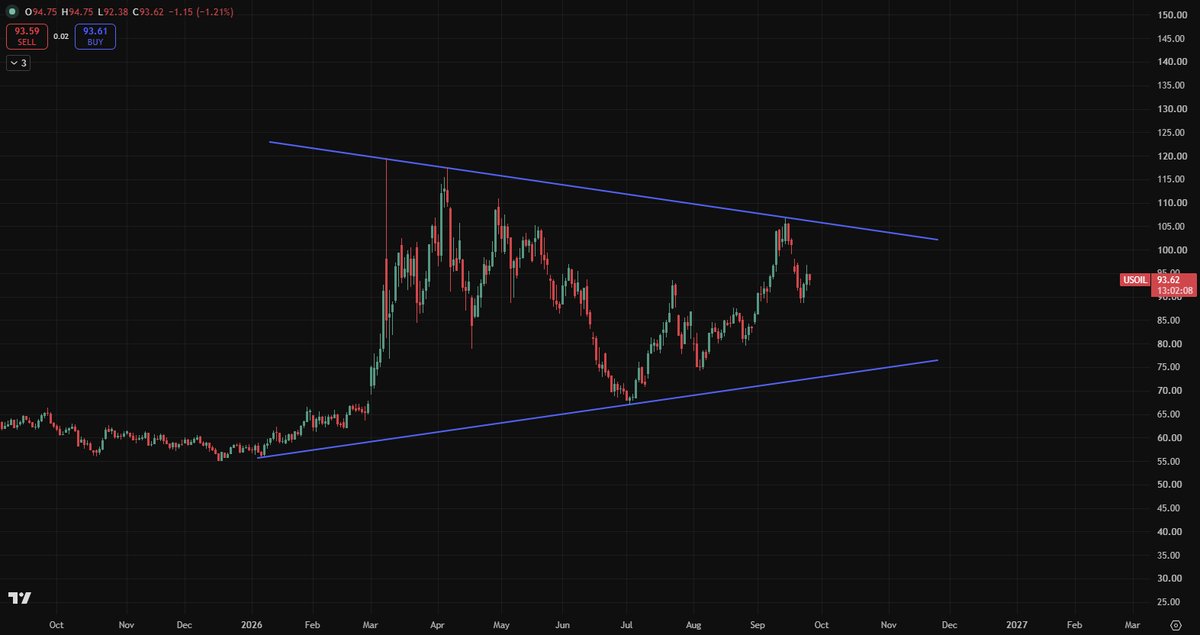
Now, act one hinges on the chart below…
WTI has spent the whole year coiling inside this large range. It just tested the top of it near $107 and got rejected.
So long as crude stays below that downtrend, and especially below $110, act one is on track.
If it breaks out and clears $110, it probably means the Strait deal isn't happening. Inflation stays sticky and Warsh loses his cover.
That delays act one. It doesn't cancel act two. The debt still needs rolling and the productivity wave is still coming.
That’s the playbook as I see it right now.
Act one: a Strait deal lands before the midterms, oil moves lower, the curve bull steepens ahead of the Fed, Warsh pauses then reverses, the dollar falls, gold runs, liquidity rises.
Act two: the productivity boom takes the wheel and the banks finance it.
Watch the yield curve, the dollar and gold for confirmation, then own what outruns debasement now and compounds with productivity later: tech and crypto.
The regime changes. The trade doesn’t.
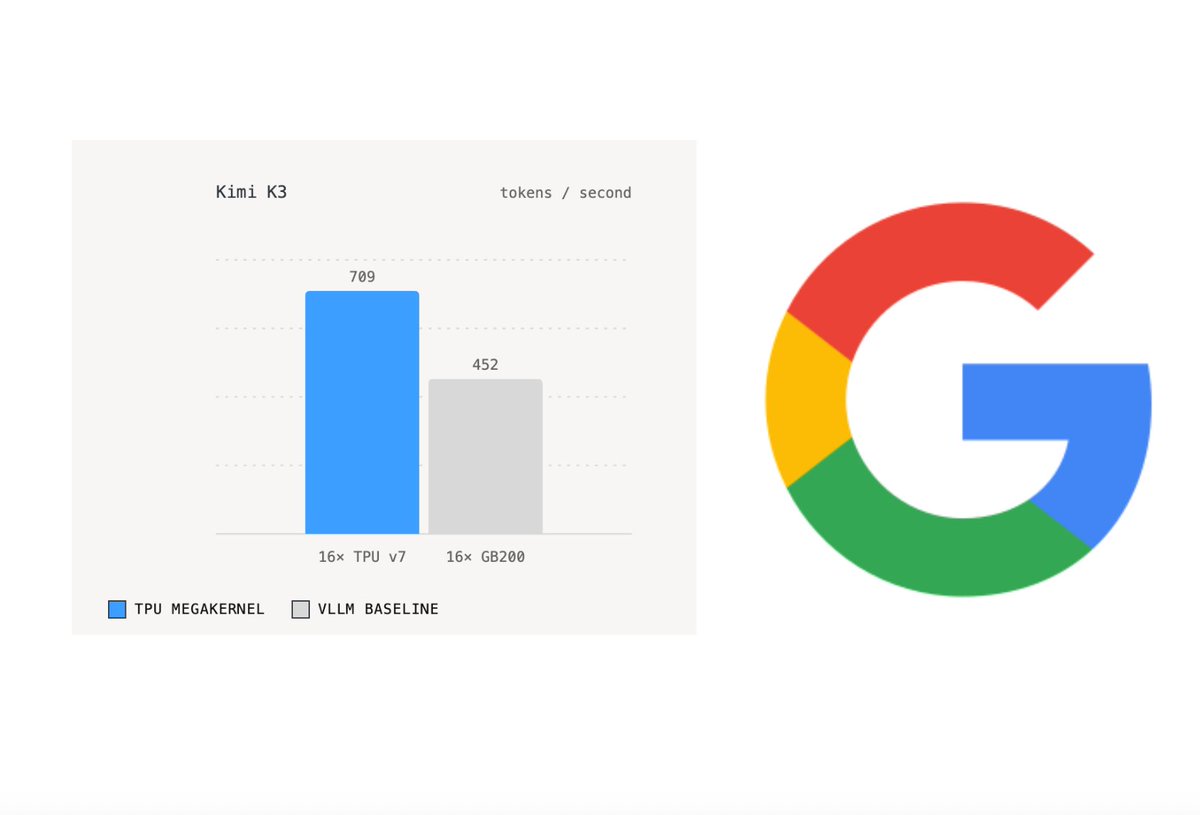
ALERT ALERT ALERT 🚨 🚨 🚨 VLLM MAINTAINERS HAVE JUST SHOWN THAT TPUv7 CAN GET 700 tok/s/user, 56% BETTER PERFORMANCE THAN NVIDIA GB200 NVL72 THROUGH MEGAKERNEL OPTIMIZATION ON KIMI K3.
As we said awhile ago, the TPU externalization of software is full steam ahead. This is ultra important to follow the progress of this.
Ten banks are providing a $22 billion loan to support Alphabet and Blackstone’s new AI cloud JV, Crux AI, with Blackstone investing an initial $5 billion to bring 500MW of capacity online in 2027.
$GOOG $AVGO
Joe Kennedy told me that out of 535 people in Congress, four have engineering degrees. @PeterDiamandis astutely pointed out that in the CCP, the vast majority of leadership is comprised of engineers and scientists.
The cracks started to show during the Facebook hearings a few years, ago but now it’s a national crisis. Social media and AI landed back to back, and only a tiny subset really knows what they're talking about.
It’s like Congress is writing traffic laws, having only ever ridden horses. It’s not going to work out well.
Zcash is up 25x+ in the past yr and people wonder whether crypto is going into a bull mkt?
Huh?
But crypto is hard...
Post below from Nov 10, 2025. The @50t view.
U can nail the right view and not make $.
Max conviction must mean a max position.
Hats off to the ZHODLers.
Is crypto back? Everyone who quietly rebranded to AI last year seems to think so. Some thoughts on the market, and on @RealVision.
Tis the season of humble brags on X, so here's mine.
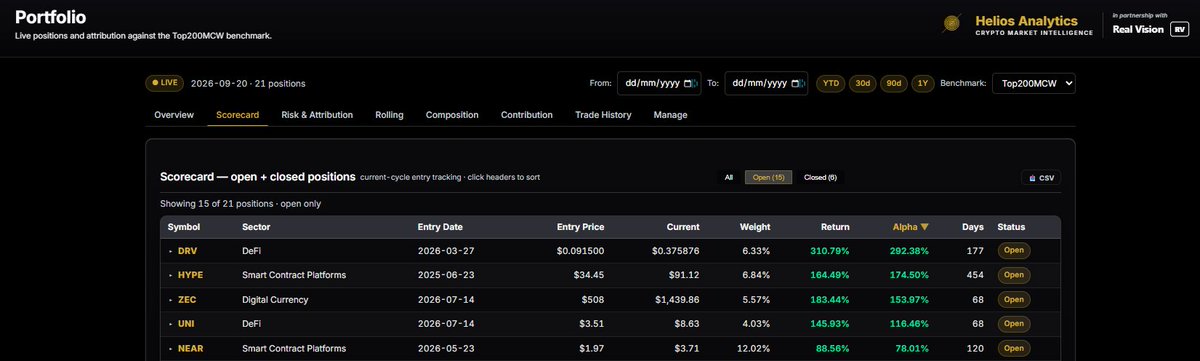
In reality, this was a pretty tough bear market. Crypto had to face the reality of a big drawdown outside of a general equities sell-off. But dogged analysis while the poo was flying thick and fast generated targeted calls and positioning insights that took the portfolio I run for the Pro tier up 2x in 2 months. I don't overtrade. I make high-conviction calls.
My primary calls:
1. Derive ethereum:0xb1d1eae60eea9525032a6dcb4c1ce336a1de71be, up 5x from the March Deep Dive
2. Zcash $ZEC (2 trades), up 5x from the April Deep Dive
3. NEAR Protocol $NEAR, up 2x from the June Deep Dive
4. The SCP vs BTC, and the DeFi vs SCP outperformance call
5. In July, deployed 75% of the cash built up since the Q3 2025 top
6. Lousy call on Circle $CRCL, down 20%
At @RealVision, my Pro members' portfolio compounded at 40% p.a. for 3 years, including the 47% drawdown. Importantly, it has outperformed both NDX and BTC.
Now for the reality check. Altcoin open interest is at the 91st percentile versus Bitcoin. Things are frothy. But the first move out of a bear can be like that without derailing the cycle. This is not the time to get super aggressive or reach for leverage. Expect more volatility. I never like to overtrade the start of a cycle, but taking some profits makes sense. I want to hold Quality names for the medium to long term. (ps: I am bringing out a Quality index/basket to help narrow the field for Alpha tier subscribers.)
On the macro front, I am still concerned about the general state of global liquidity. DXY is strong, the yield curve is flattening, and real rates are climbing. We are late stage in the 5-year refi cycle. Bessent blinked, but it will take more to get through this. Crypto could easily see a 30%+ pullback which means (50%+ for many high flyers).
But for long-term investors who are now waking up and need to take their crypto allocation from nothing to something (depending on risk tolerance), dips are for buying quality names. The structural tailwinds are coalescing. Some of this move is ahead of the data, but that's generally how markets work. Assets are pricing in what the agent economy + tokenisation looks like in 12 months, not today.
Just a short comment on @RealVision. We have been around for 13+ years. After being force-fed the bile of BBG and CNBC for 20 years in TradFi, I saw straight away how transformative the platform was back in 2014 and became a foundational subscriber. I was a subscriber for almost a decade before joining @RaoulGMI to build out the crypto product. It's been an incredible 3 years. Whether as a strategist or a subscriber, I am lucky each day to read the phenomenal macro, equity, tech, AI, and geopolitics analysis from the team of independent strategists team: Raoul, @AndreasSteno, @RosenvoldGeo, and @DMattin. That's 5 strategists who often agree but, more importantly, often disagree. There is no 'house' view. If that upsets you, go become a client of Morgan Stanley, JPM or some brokerage with a conflict of interest.
My lane is crypto. That's what I love, and I have never been more bullish on the secular trend that inspired me to leave the TradFi world years ago.
Brutal, undignified, sleep-destroying. Best job I have ever had.
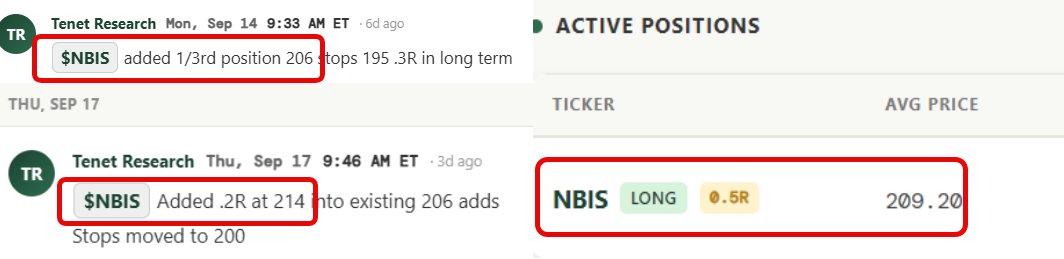
$NBIS Almost 230!🚀
Our Portfolio looking really nice overnight
If you loaded $NBIS after news last week or paid attention to 210 Level I tweeted you are doing good.
Might not have to trade all week way our Swing & Longs are Pushing over night! $MU $CRDO $GNRC $CBRS
This week @jvisserlabs breaks down why bitcoin and stocks refused to crash even as the Fed hiked rates.
We also discuss why AI agents are now driving crypto's next leg higher and why the real "AI bubble" lives inside just two companies. Then we get into Andrew Yang's bombshell AI lab claims and why Jordi remains a bitcoin maxi for the next 30 years.
YouTube: https://t.co/IcGIG32HnI
Apple: https://t.co/mqNdZFqNAq
Spotify: https://t.co/FusJTsoq8H
TIMESTAMPS:
0:00 - Intro
0:51 - Why bitcoin & stocks didn't crash when the Fed hiked rates
4:44 - The liquidity cycle is broken (there are no more recessions)
14:34- AI agents solve impossible problems & what it means for the future
23:18 - Andrew Yang's AI lab bombshell claim
33:21 - Instinct AI & the rise of agent-run personal assistants
40:10 - Recursive self-improvement: AI outpacing human comprehension
43:22- Why Jordi is a bitcoin maxi for the next 30 years
48:06 - Bitcoin vs altcoins: are AI agents the new demand source?
55:54 - What would make Jordi change his mind?
1:02:33 - Bitcoin back above $80,000 & Jordi launches his crypto research
Tesla has reopened Roadster reservations.
Roadster reservations require an initial $5,000 credit card payment, plus a $45,000 wire transfer payment due in 10 days, the same as before.
Tesla: “The estimated purchase price of the vehicle, if provided, is only an estimate. We are still working on what options, features and hardware the vehicle will have and so cannot confirm the exact price just yet. Your Purchase Price will ultimately be confirmed once you’ve configured your vehicle.”
The market didn’t crash. Humanity didn’t die. Crypto broke out.
This week gave investors almost every excuse to panic: AI extinction headlines, oil surging, 10-year yields back near 2007 levels, and a hawkish Fed hike.
Bears jumped to the highest level since the tariff panic and yet the S&P barely moved.
Meanwhile, my 46-name crypto ecosystem index broke to new highs for the year.
The bigger story is being missed.
Crypto spent 16 years building the rails before the users arrived. The next stage of the AI trade is here with the rise of AI swarms. Humans were never meant to be the crypto users. Agents were.
The ghost city is starting to fill.
And next week, I’m finally releasing the long-awaited crypto video and research laying out why now, how the ecosystem fits together, and where I think the opportunities are.
New video: The Market Didn’t Crash, Humanity Didn’t Die — But Crypto Just Broke Out
https://t.co/y4d3IwivVJ
QUICK THOUGHTS RE: FED DECISION AND WARSH PRESSER:
“We’re not a Wall Street newsletter. We stay in our lane.”
—Kevin Warsh 9/16/26
“As the CEO of ‘a Wall Street newsletter’ that is helping thousands of investors around the world retire on time and comfortably and someone from the bottom 0.0001% of the K-shaped economy that decades of over-easy monetary policy helped perpetuate, I feel that We the People have a responsibility to hold our elected and unelected officials accountable. This is our lane. Helping the ~92 million American households who live paycheck-to-paycheck understand why their purchasing power has collapsed at an accelerating rate over the past 5, 10, 15, 20, and 50 years is ‘our lane’ too.”
—Darius Dale 9/16/26
“Today’s policy action will support a timelier return to the Committee’s 2 percent goal.”
—FOMC Statement 9/16/26
“Today’s Summary of Economic Projections is the first time I realized that 2029 precedes 2028 in chronological terms, because the Fed punted its projected achievement of its 2% inflation target ‘backward’ (read: forward) by one year.”
—Darius Dale 9/16/26
If you're reading this, you are also a frog being boiled alive in a pot of financial repression, monetary debasement, and obfuscating @federalreserve communications.
One of the reasons I chose to quit my lucrative Wall Street job 5.5 years ago to earn $0 while building @42Macro was to ensure that your family does not fall victim to the historic Cantillon effect that is the key driver of the K-shaped economy.
Q: What is causing this historic Cantillon effect that nearly 100 million American families are suffering from (i.e., the share of US households who live paycheck-to-paycheck, per $JPM)?
A: Decades of fiscal, monetary, and regulatory policies that have overwhelmingly favored people who can afford to buy political influence in the K-1/capital class over those who cannot in the W-2 labor class.
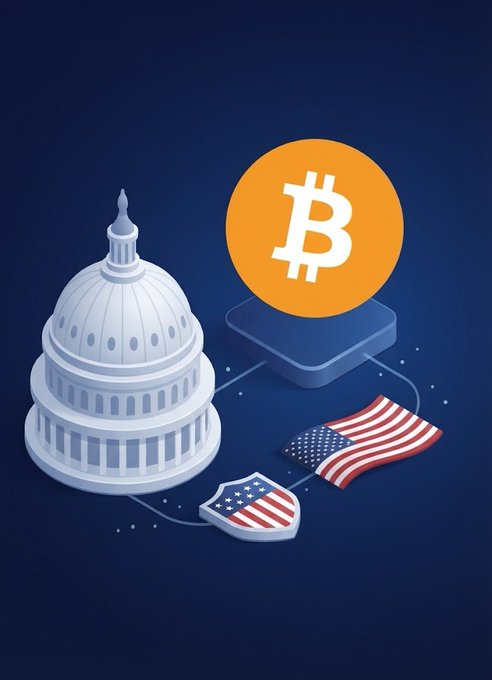
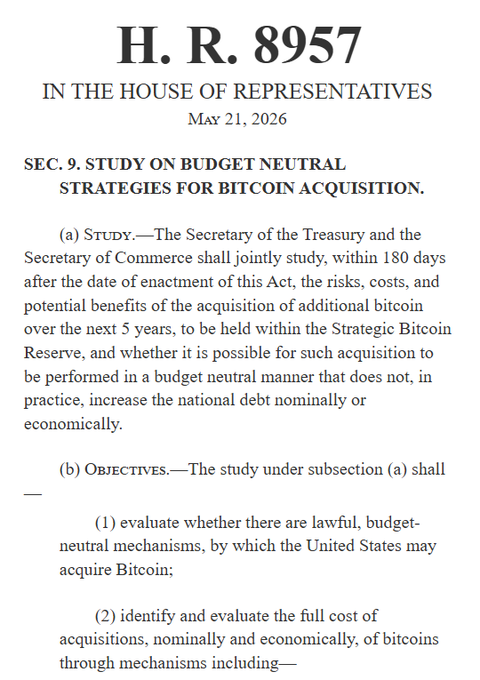
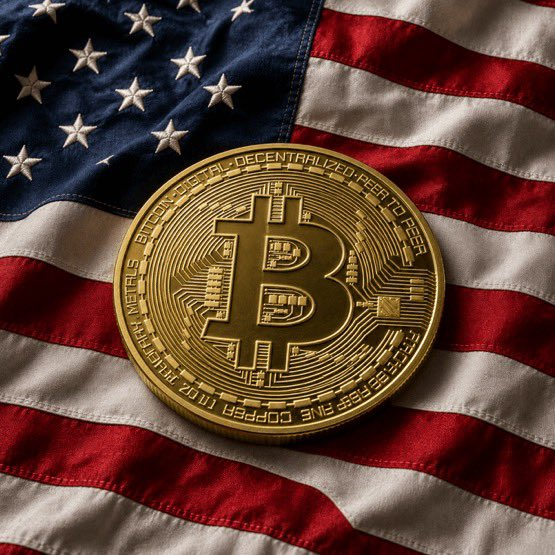
BREAKING: Bitcoin Strategic Reserve bill passes U.S. House committee. 🚀
• Mandates study of budget-neutral BTC acquisition.
• Extends wash-sale rules to crypto.
• Requires 20-year hold on future reserves.
Advances to full House vote.
Darius Dale Says This Bull Market Isn’t Over Yet (Here's Why) | September 9, 2026 https://t.co/xfNXxbr3Yk
@DariusDale42 joined @JeffSnider_EDU to discuss today’s supportive backdrop for risk assets and the dangers of letting bearish narratives override market signals.
As market regimes transition, systematic risk management helps investors stay on the right side of market risk.
Watch the full appearance here:
BREAKING: 🇺🇸 THE STRATEGIC #BITCOIN RESERVE BILL JUST OFFICIALLY PASSED THE HOUSE FINANCIAL SERVICES COMMITTEE MARKUP VOTE
THE BILL MANDATES THE TREASURY TO FIND BUDGET NEUTRAL WAYS TO ACQUIRE MORE BTC
IT FORCES THE US TO HOLD ALL BTC FOR 20 YEARS
AMERICA IS BUYING BTC. IT'S HAPPENING 🔥