A work of art honoring Seismic Ecosystem and its ecosystem partners @SeismicSys
Thank you @HngNguy58222 for dedicating this work. I'm very happy to be part of this close-knit community.
On Seismic's development path, members constantly accompany and help each other progress
I Love Seismic !!!
@NoxxW3@xealistt@heathcliff_eth
New month, new trend.
I created this Seismic Ecosystem series as a gift for the community.
Each of us brings something unique, but we’re all part of the same journey and helping @SeismicSys grow together. 🤎
🎁 Want a FREE version of your own? Just send me your PFP and I’ll create one for you.
Wishing everyone a smooth month ahead, good luck, great opportunities, and plenty of alpha.
@NoxxW3@xealistt@heathcliff_eth
most protocols treat u like farmers
we treat u like an evolving node
neosoul x @0g_labs credentials just dropped
50k total supply but epoch 1 only gets a fraction
20k orbit spots for the early ones
4k vector spots if u actually do shit
140 zenith upgrades for the absolute brains
mint opens tmrw 10am utc
tell us ur boldest market prediction to get on the radar
Latch is not just an API key management system, but is moving towards a: Hardware-Enforced Agent Authorization Infrastructure
Latch is an infrastructure that allows AI agents to have real-world authority (spending money, calling APIs, executing tasks), but all authority is delegated, controlled, and continuously validated by policies running in a secure hardware environment, while the secret key is never handed over to the agent.
This combines five core layers:
-> Secret Vault (secure key storage)
-> Delegated Capabilities (token-based authorization)
-> Policy Engine (policy-based control)
-> Trusted Hardware/TEE (security enforcement)
-> Immutable Audit Layer (auditing and tracing)
Sign up for early access 👉 https://t.co/mFEZN43X3T
@RialoHQ
Bad access control has already cost companies billions. Now everyone's deploying agents as their newest employees and handing them all-access master keys on day one.
We're building a better more secure way, powered by @RialoHQ 🧵
👉 https://t.co/cbCIjBK9tH
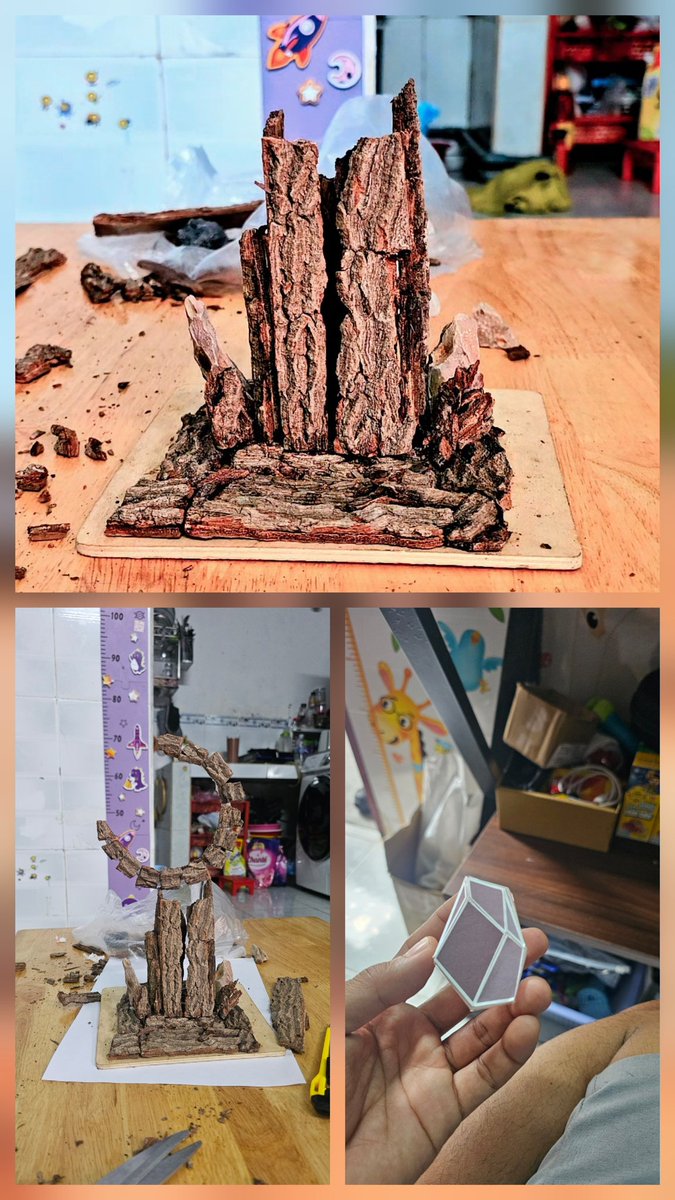
I just wanted to share a small piece of art…
but it’s something I poured a lot of emotion into creating.
A source of energy illuminated through stone, wood, and light — much like how Seismic is gradually growing through the dedication of the whole community.
I’ve always loved the feeling of turning invisible ideas into something that can actually be touched in real life.
If it were up to you, what would you name this piece?
And for the next version… what details do you think I should add to make it feel even more alive?
I’d really love to hear everyone’s ideas. Thank you so much 🙏
@SeismicSys@NoxxW3@xealistt@heathcliff_eth@thoai6sixx@2imtunek
Today after a week of vacation Builder Hub is back on the @RialoHQ community
This week I was very impresse's project with the PrivStay project của @cloudtechvn
PrivStay is a complete MVP-level decentralized application (dApp) that demonstrates how real-life accommodation properties can be listed, booked, paid for, verified and settled through blockchain technology, without publicly exposing sensitive customer, host, hotel or reservation data.
You can experience it here
https://t.co/pg0Q0cAiIa
Thank you @Caseuall for giving me this special @SeismicSys style note
As the world becomes closer thanks to globalized fintech, the application of blockchain in global financial transactions becomes faster and more optimal.
Seismic provides a foundation for security and transactions to become safer and more reputable
@NoxxW3@xealistt@heathcliff_eth
After launching my previous content that turned out to be a huge success, this time I made Fun Money for the @SeismicSys Community with a brand new unique touch ecosystem section at the bottom.
If you want one, just send your PFP in comments and write your nickname below it.
What Happens When Infrastructure Takes Over the Work?
Analyzing the Role of Concrete Vaults in Simplifying and Optimizing DeFi
The development of DeFi is gradually shifting focus from individual applications to intelligent financial infrastructure. Instead of requiring users to research strategies, constantly rebalance portfolios, and track profits, modern protocols are moving much of this work to the infrastructure layer. This is the philosophy behind Concrete Vaults: transforming DeFi into a self-operating system where users only need to provide capital, and the infrastructure handles the rest.
1. Concrete Vaults – When Infrastructure Becomes the Asset Manager
Concrete Vaults are asset storage solutions designed to automatically deploy and manage capital across multiple DeFi protocols.
Instead of users having to:
-> Search for profit opportunities
-> Move capital between protocols
-> Harvest rewards
-> Reinvest profits
Concrete Vaults handle the entire process automatically.
This marks a shift from the model of "user-managed strategy" to "infrastructure-managed strategy."
2. DeFi Vaults – The Foundation of Automated Asset Management
DeFi vaults act as an abstraction layer between users and complex DeFi protocols.
Traditional Model
Users must:
-> Deposit assets into a protocol
-> Monitor APY
-> Harvest rewards
-> Reinvest manually
Vault Model
Users:
-> Deposit assets once
-> The vault automatically executes all backend operations
Results:
-> Reduced management time
-> Lower operational costs
-> Minimized errors
Vaults transform DeFi from a platform for professional users into an accessible product.
3. ctAssets – Representing Ownership of Capital
When users deposit assets into Concrete Vaults, they receive ctAssets.
What are ctAssets?
These are tokens representing:
-> Ownership of a portion of the vault
-> Entitlement to generated profits
-> Accumulated value over time
Instead of tracking multiple positions across protocols, users only need to hold a ctAsset.
Benefits
-> Simplified experience
-> Increased liquidity
-> Easy integration with other protocols
ctAssets become the “digital receipt” for the entire investment strategy.
4. Automated Compounding – The Power of Self-Compounding Returns
One of the most important features in DeFi is automated compounding.
Process
The vault will:
-> Harvest rewards
-> Convert rewards back into the underlying asset
-> Reinvest immediately
This happens continuously without user intervention.
Impact
Returns are generated not only from the initial capital but also from previously accumulated profits.
Over time, the compound effect:
-> Increases actual APY
-> Maximizes capital efficiency
-> Reduces opportunity costs
This is a prime example of infrastructure doing the work for users.
5. Structured DeFi – Bringing Structure to Decentralized Finance
Traditional DeFi is often seen as fragmented and difficult to manage.
Structured DeFi solves this by packaging multiple strategies into a single product.
Components
-> Lending
-> Staking
-> Liquidity Providing
-> Yield Farming
-> Arbitrage Opportunities
Instead of manually combining strategies, the infrastructure executes them automatically.
Outcome
-> Optimized portfolio
-> Risk distribution
-> Enhanced performance
6. Onchain Capital Deployment – Smart Capital Allocation on Blockchain
One of the infrastructure’s most important tasks is onchain capital deployment.
This involves:
-> Identifying the most profitable opportunities
-> Allocating capital to suitable strategies
-> Rebalancing the portfolio according to market conditions
Previously
Investors had to:
-> Monitor multiple protocols
-> Compare APYs
-> Transfer capital manually
Now
Vaults can:
-> Track real-time data
-> Adjust positions automatically
-> Continuously optimize returns
Infrastructure becomes a 24/7 “capital coordinator.”
7. Capital Efficiency – Maximizing the Use of Capital
In finance, idle capital is wasted capital.
Capital efficiency measures how much value can be generated per unit of capital.
Concrete Vaults improve capital efficiency by:
-> Reducing idle capital
-> Automating reinvestment
-> Redirecting capital to more efficient strategies
When capital is always deployed optimally, the system’s overall returns increase significantly.
8. Institutional DeFi – Bridging Capital for Organizations
Financial institutions care about more than just high returns.
They require:
-> Transparency
-> Auditability
-> Risk management
-> Automation
This is why institutional DeFi is gaining traction.
Concrete Vaults provide:
-> Onchain transparency
-> Standardized strategies
-> Clear reporting
-> Automated capital management
This makes DeFi more attractive to investment funds, asset managers, and financial institutions.
9. Risk-Adjusted Yield – Not Just High Returns
High returns aren’t meaningful if risks are too high.
Risk-adjusted yield focuses on optimizing the balance between:
-> Expected returns
-> Acceptable risk levels
Concrete Vaults can:
-> Allocate capital across multiple strategies
-> Reduce exposure to risky protocols
-> Balance growth and safety
The ultimate goal is not the highest APY but sustainable, reliable returns.
10. One-Click DeFi – Next-Generation User Experience
The full power of infrastructure is reflected in one-click DeFi.
Users only need to:
-> Connect their wallet
-> Deposit assets
-> Click one button
All backend operations are handled by:
-> Concrete Vaults
-> Automated Compounding
-> Structured DeFi Strategies
-> Onchain Capital Deployment
It’s like using a professional investment fund, but fully transparent and operating on blockchain.
Conclusion
When infrastructure takes over the work, DeFi shifts from a knowledge-intensive ecosystem to an automated, accessible financial platform. Through Concrete Vaults, ctAssets, automated compounding, structured DeFi, and onchain capital deployment, users can achieve higher capital efficiency, access better risk-adjusted yield, and enjoy one-click DeFi simplicity. This infrastructure also paves the way for institutional DeFi, setting the stage for the next phase of decentralized finance.
@ConcreteXYZ #defi