+$750K committed through Rayls Mainnet Liquidity Seeding.
The momentum now carries into the $USDr Liquidity Campaign.
Participants from the seeding phase can roll their $USDr into the live campaign and access the highest Week 1 reward rate.
16K $RLS per 1K $USDr
Week 1 lock deadline: Monday, 25 May, 12:00 UTC
Join the campaign:
https://t.co/UXc4hVsrnO
Most AMMs weren’t designed for tokenized treasuries, yield-bearing assets & institutional flows. And Algebra is perfect for it.
With modular plugins, compliant pool logic & upgradeable architecture, Algebra gives RWA chains a DEX layer they can actually build around.
Institutional assets need institutional-grade exchange infrastructure.
And RWA chains know that: @RaylsLabs has deployed their native DEX, Rayls Swap on Algebra 🌐
What does liquidity look like for institutional assets on a public chain?
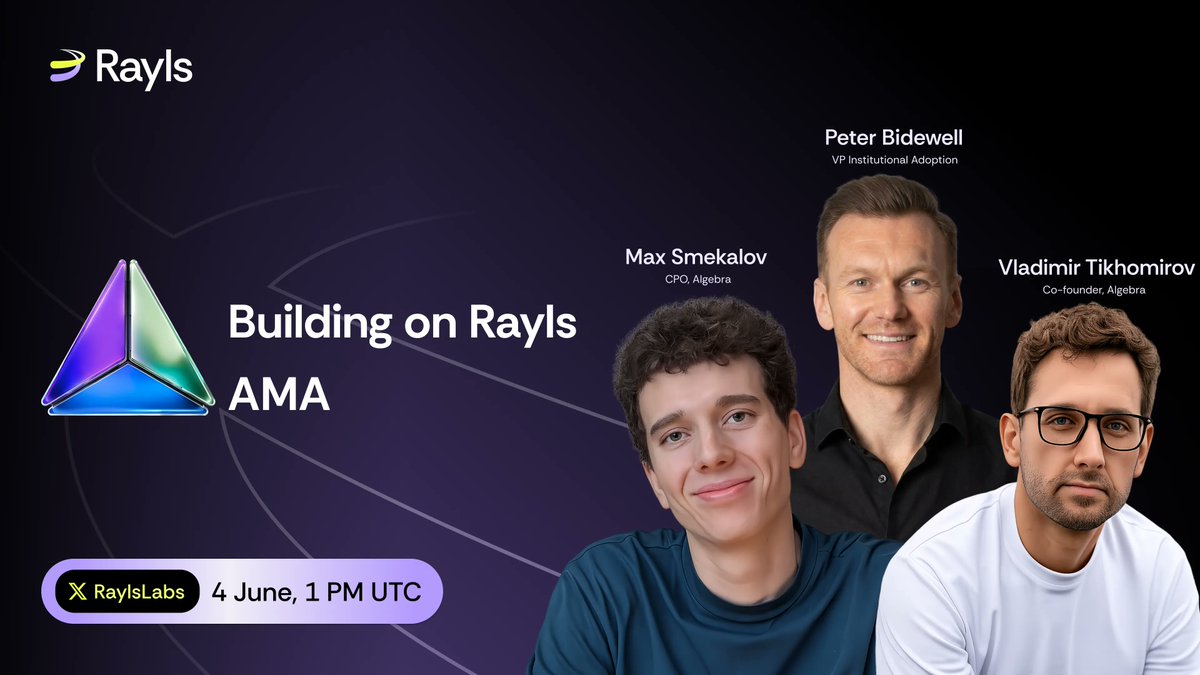
Today on Building on Rayls, @petebidewell is joined by Vladimir Tikhomirov and Max Smekalov @CryptoAlgebra to discuss Rayls Swap, the official DEX on the Rayls Public Chain.
Built with Algebra Integral, Rayls Swap supports swaps, routing, and capital-efficient liquidity across the Rayls ecosystem.
4 June, 1 PM UTC
🔔Set a reminder and join us live.
$RLS is now live on Revolut.
Available to users across the UK and EEA through Europe’s largest fintech.
@revolut serves over 70 million customers globally and more than 15 million crypto users, bringing $RLS to a wider European retail audience.
Find $RLS on Revolut.
Liquidity is where institutional assets become usable.
Rayls Swap is the official DEX on the Rayls Public Chain, built with Algebra Integral to support swaps, routing, and capital-efficient liquidity across the ecosystem.
Tokenised assets from Privacy Nodes, yield-bearing vault tokens, $USDr, $RLS, and wider onchain capital can all interact through one unified trading venue.
That is the two-way flow Rayls is built for: institutional assets moving into public liquidity, and onchain markets gaining access to those assets.
Read the full blog ↓
https://t.co/v64p78Inmz
Community safety is a shared effort.
@ChainPatrol helps monitor and protect the Rayls ecosystem from scams, phishing attempts, fake accounts, and other online threats.
If you see something suspicious, report it here:
https://t.co/2iC3bzecxg
🛡 We are proud to protect the @RaylsLabs ecosystem🛡
24/7 Real-time monitoring and precision targeting of scams and other online threats.
You can also help protect the Rayls community if you see a scam, phishing attempt, fake account or suspicious link report it here: https://t.co/Y34yjAomWN
What does tokenizing real-world assets actually look like?
From our AMA with @nimofastglobal, we broke down how commodity finance can move onchain: starting with receivables, then inventory, facilities, and eventually the products themselves.
NimoFast is building with Rayls to bring real commodity flows into tokenized markets, beginning with biofuel and agriculture-linked assets in Brazil.
This is RWA adoption beyond the abstract: real businesses, real cash flows, and real assets moving into programmable financial infrastructure.
Great day yesterday at the B3 - Brazillian Stock Exchange for the Tokenization day.
I shared a panel with Tatiana Guazzelli from Pinheiro Neto Advogados, Antonio Carlos Berwanger VP of Regulation from Securities Commison and Humberto Costa - Head of Products and Digital Assets from B3.
Key points of discussion around stable coin, tokenization of securities, new services for On chain tokenizatized Depositary and clearing together with all relevant aspects of regulation.
Since B3 invested on Parfin 4 years ago through their corporate venture L4, we have been working together to transform financial markets and more important, seen one of the largest exchanges in the World adopting blockchain technology at their core business is very exciting.
Today at 1 PM UTC 🎙️
Join @x10xalex for this week’s Rayls AMA as we discuss the latest around Rayls, the road ahead, and answer questions from the community live.
Tune in and join the conversation 🔔
DeFi isn’t just a threat to banks. It can become a new B2B revenue channel.
Banks can create new revenue opportunities by giving institutional capital and users compliant access to onchain markets.
Our latest blog breaks down how the Rayls Privacy Node and Public Chain architecture enables three bank-side revenue opportunities:
> Distribution
> Liquidity provision
> Privacy Node fee conversion to Public Chain
XP’s USDXP launch on Rayls shows how privately issued assets can move from controlled institutional environments to broader onchain markets.
Why is AmFi building on Rayls?
In our AMA, João Pirola, Founder & CPO at AmFi, shared why scalability is a key reason behind AmFi’s adoption of Rayls.
Through Nuclea Chain infrastructure powered by Rayls, AmFi is tokenizing commercial receivables and bringing real-world credit markets onchain.
This is institutional RWA adoption in practice: regulated participants, scalable infrastructure, and assets already moving in production.
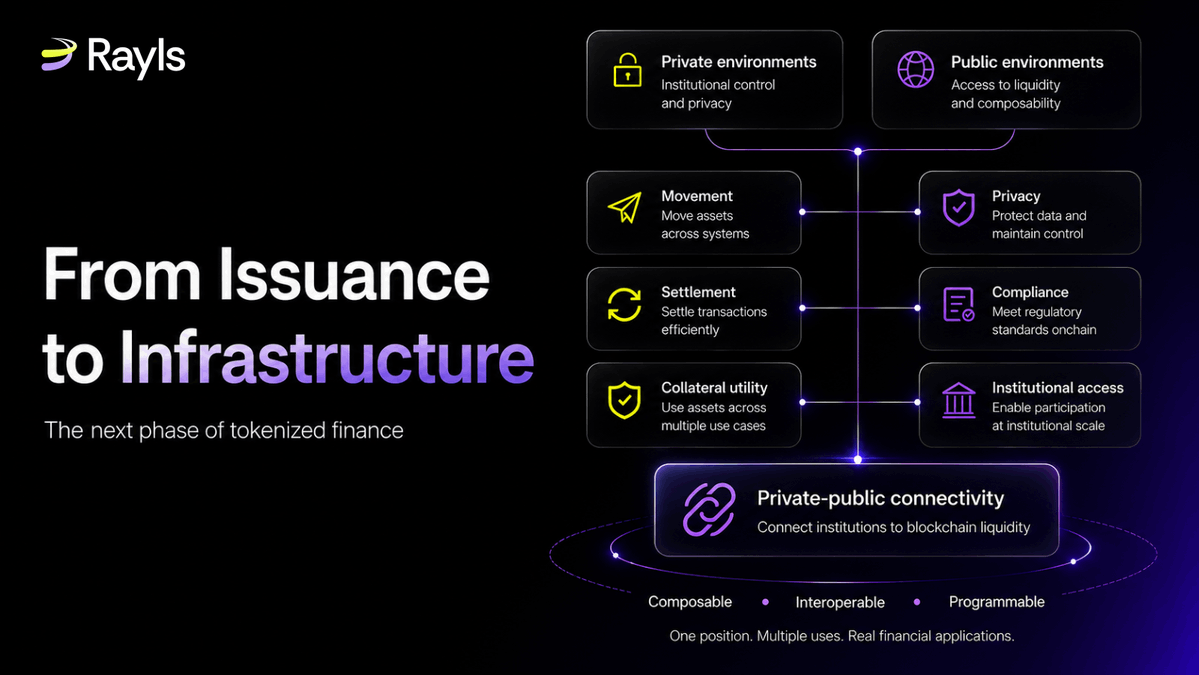
Tokenized assets are moving into a new phase.
The first phase was about proving that real-world assets, stablecoins, and other financial instruments could exist onchain.
The next phase is about making them usable at scale.
@StanChart is now forecasting $4T in tokenized assets onchain by 2028, split roughly between stablecoins and real-world assets.
A market of that size needs more than issuance.
It needs rails for:
> movement
> settlement
> collateral
> privacy
> compliance
> institutional access
> connectivity between private and public environments
Composability is part of the reason this matters.
Onchain assets are not limited to sitting passively after issuance.
A single position can earn yield, serve as collateral, remain tradable, and interact with other financial applications.
Traditional finance usually separates those functions across intermediaries, contracts, and closed systems.
Tokenized finance can bring them into shared financial infrastructure.
As more assets move onchain, the pressure shifts to the infrastructure underneath.
Can institutions participate without giving up privacy or control?
Can assets move between private and public environments?
Can regulated financial activity happen onchain without compromising the standards it depends on?
Rayls is focused on the infrastructure behind institutional tokenized finance.
Private networks.
Public chain access.
Privacy and compliance rails.
Onchain financial services.
Tokenized asset flows.
Connectivity between institutions and blockchain liquidity.
Issuance brings assets onchain.
Infrastructure determines whether those assets can move, settle, connect, and be used in real financial activity.
Institutional tokenised assets need infrastructure that can support distribution beyond the point of issuance.
Our latest blog explores how @lagoon_finance’s asset-manager-led vault infrastructure fits into the Rayls Public Chain.
It supports controlled deposits and redemptions, NAV accounting, configurable permissions, and yield distribution.
Stay tuned for the Building on Rayls AMA with Lagoon, taking place next week.
Read the blog ↓
https://t.co/DOmAenCIi3
Tokenised assets need more than issuance.
They need vault infrastructure built for distribution, yield, and institutional controls.
Today on Building on Rayls, Nadia Sergejuk Co-foudner of @lagoon_finance joins @petebidewell to discuss institutional-grade vaults on the Rayls Public Chain.
22 May, 1:30 PM UTC
🔔 Set a reminder and join us live.
Banks and AI agents may become two key interfaces between users and blockchain.
On Searching for Mana, @x10xalex joined @LloydWahed to discuss what that means for financial infrastructure.
High throughput. Fast finality. Short block times. Predictable gas fees.
Alex also breaks down why Rayls was built as a Layer 1, with stablecoin gas, instant finality, and hybrid private/public architecture designed for financial institutions.
A conversation on bringing TradFi liquidity onchain, connecting it with DeFi, and building for the next phase of financial markets.
Listen here ↓
https://t.co/MchWQqK50g