On a trip to Johannesburg In may 1978 the plane was commandeered by the Belgian government and diverted to Kinshasa.
After all these years I have decided to write about my experience at the time.
Among many of the events recalled during the time was the distress of the other passengers.
I tried to help the young mother we sat on a concrete barrier outside the terminal building the twins were restless and couldn’t sleep the mother entrusted me with their care and I recall walking holding their little hands and directed their attention away from the medical teams tending the wounded as they boarded the evacuation planes she tended the baby girl as best she could. I ventured away from the relative safety of the other passengers and tried to find her some milk it turned out to be the most expensive milk on earth several men in the store gathered around me and and took every bit of money I had on me . But I did at least get the milk. I would like to know where the family is now
I have only been able to confirm that they were on the flight and they were going to join the husband in Johannesburg who worked in the mining industry
The family was mentioned during an interview with one of the air hostesses
The children will be in their 40s now. I remember the details vividly and yet even though this small group of people seemed emotional very close I have never been able to recall their names or faces.
Just a chance someone out there may have details
@chatswithem Bravo 👏 well stated I am 80 now and have lived through loads of weather extremes . I don’t remember hearing anyone moaning about it. We all helped each other . Shovelling snow or filling sandbags.
We were better off without relying on the nanny state .
Safeguards and Considerations
1. Exemptions for Vulnerable Groups: Low-income individuals and small deposits will be exempted or subject to lower rates to prevent undue hardship.
2. Data Privacy: Robust data protection measures will be implemented to safeguard personal and financial information.
3. Fraud Prevention: Advanced security protocols will be used to prevent misuse or manipulation of the system.
4. Public Consultation: Stakeholders, including citizens, businesses, and financial institutions, will be consulted during the design and implementation phases.
5. Pilot Program: A pilot program will be conducted to test the system and address any issues before full-scale implementation.
Conclusion
The Automated Micro-Taxation System (AMTS) represents a forward-thinking approach to tax collection, leveraging modern technology to create a more efficient, equitable, and sustainable system. By automating the deduction of a tiny percentage from all bank deposits, the AMTS will streamline revenue collection, reduce administrative costs, and enhance public trust. With proper safeguards and stakeholder engagement, this system has the potential to transform taxation and contribute to long-term economic stability and growth.
Next Steps:
1. Conduct a feasibility study and cost-benefit analysis.
2. Draft legislation and consult with stakeholders.
3. Develop and test the technology infrastructure.
4. Launch a pilot program and evaluate results.
5. Implement the AMTS nationwide, with ongoing monitoring and optimisation.
Prepared by
Raymond Barry Smith
Private individual
This proposal is submitted for review and consideration. Feedback and suggestions are welcome to refine the system and ensure its successful implementation.
No need
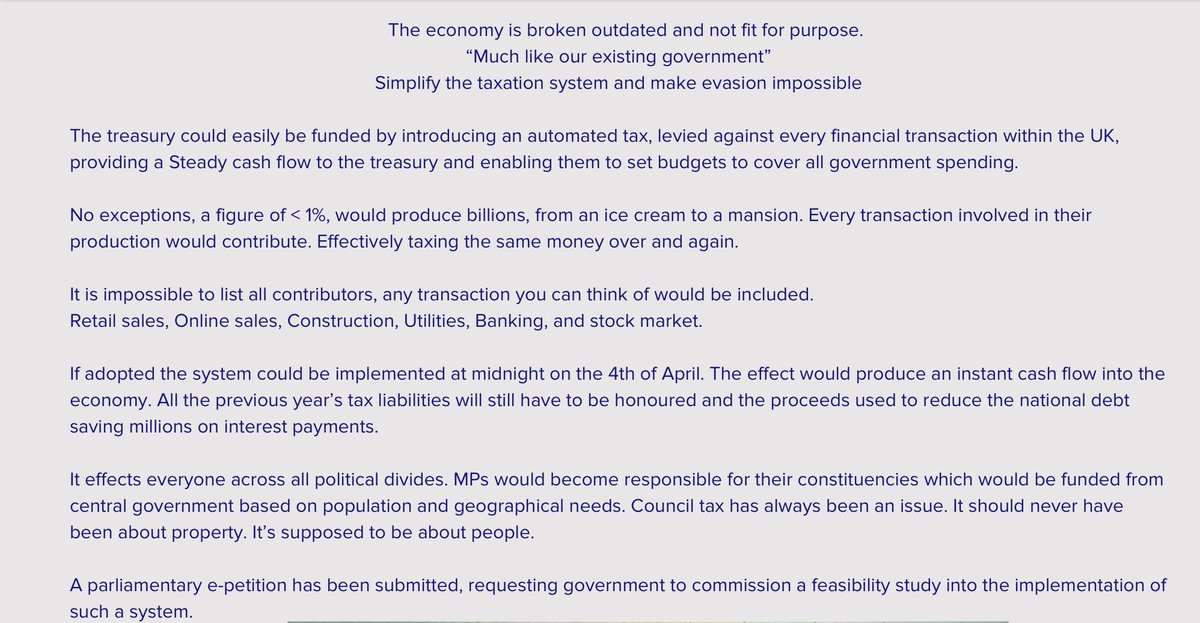
Proposal for the Introduction of an Automated Micro-Taxation System on Bank Deposits
Date: February 21, 2025
Prepared by: Barry Smith
Subject: Proposal for a Sustainable and Efficient Taxation System Based on Automated Deduction from Bank Deposits
Aims
This proposal outlines the introduction of a new taxation system that leverages modern banking infrastructure to automatically deduct a tiny percentage (e.g., 0.1% to 0.5%) from all bank deposits. This system, referred to as the Automated Micro-Taxation System (AMTS) , aims to streamline tax collection, reduce administrative costs, and create a sustainable revenue stream for public services and infrastructure development. The proposal highlights the benefits, implementation framework, and safeguards to ensure fairness, transparency, and public trust.
Background
Traditional taxation systems often face challenges such as inefficiency, high administrative costs, tax evasion, and delayed revenue collection. These issues can hinder economic growth and limit the government's ability to fund essential services. With the increasing digitisation of financial systems, there is an opportunity to modernise tax collection by integrating it seamlessly into banking operations.
The proposed AMTS would deduct a small, fixed percentage from all bank deposits, ensuring a broad-based and consistent revenue stream. This approach aligns with global trends toward digital financial systems and automated processes, offering a more efficient and equitable solution.
Objectives
1. Efficiency: Reduce the administrative burden and costs associated with traditional tax collection methods.
2. Sustainability: Create a steady and predictable revenue stream to fund public services and infrastructure.
3. Equity: Ensure a fair contribution from all individuals and entities with bank deposits, regardless of income level.
4. Transparency: Enhance public trust through clear reporting and accountability mechanisms.
5. Compliance: Minimise tax evasion by automating the deduction process.
Key Features
1. Micro-Tax Rate: A small percentage (e.g., 0.1% to 0.5%) deducted automatically from all bank deposits.
2. Universal Application: Applies to all individuals and entities with bank accounts, ensuring broad participation.
3. Real-Time Deduction: Taxes are deducted at the time of deposit, ensuring immediate revenue collection.
4. Exemptions and Thresholds: Low-income individuals and small deposits could be exempted or subject to lower rates to ensure fairness.
5. Transparency: Detailed reports on tax deductions and revenue allocation will be made publicly available.
Implementation Framework
1. Legislation: Enact laws to authorise the AMTS and define its scope, rates, and exemptions.
2. Banking Integration: Collaborate with financial institutions to integrate the AMTS into their systems.
3. Technology Infrastructure: Develop secure and scalable software to facilitate real-time tax deductions and reporting.
4. Public Awareness: Launch campaigns to educate the public about the benefits and mechanics of the AMTS.
5. Monitoring and Evaluation: Establish oversight bodies to ensure compliance, address concerns, and optimise the system.
Benefits
1. Increased Revenue: The AMTS will generate a steady and predictable revenue stream, reducing reliance on volatile tax sources.
2. Reduced Administrative Costs: Automation eliminates the need for extensive paperwork and manual processing.
3. Enhanced Compliance: Automated deductions minimise opportunities for tax evasion.
4. Economic Stability: A consistent revenue stream will enable better planning and funding of public services.
5. Public Trust: Transparent reporting and equitable application will build confidence in the system.